Advertisement
)

At a Glance
Concept: A global network of underwater fiber-optic cables transmitting data as pulses of light.
Why it matters: They process trillions of dollars in daily financial trades and sustain the global cloud.
Who uses it: Cloud providers, financial institutions, militaries, and telecom networks.
Biggest takeaway: The global economy relies on garden-hose-sized cables that are highly vulnerable to espionage and physical sabotage.
In Simple Words
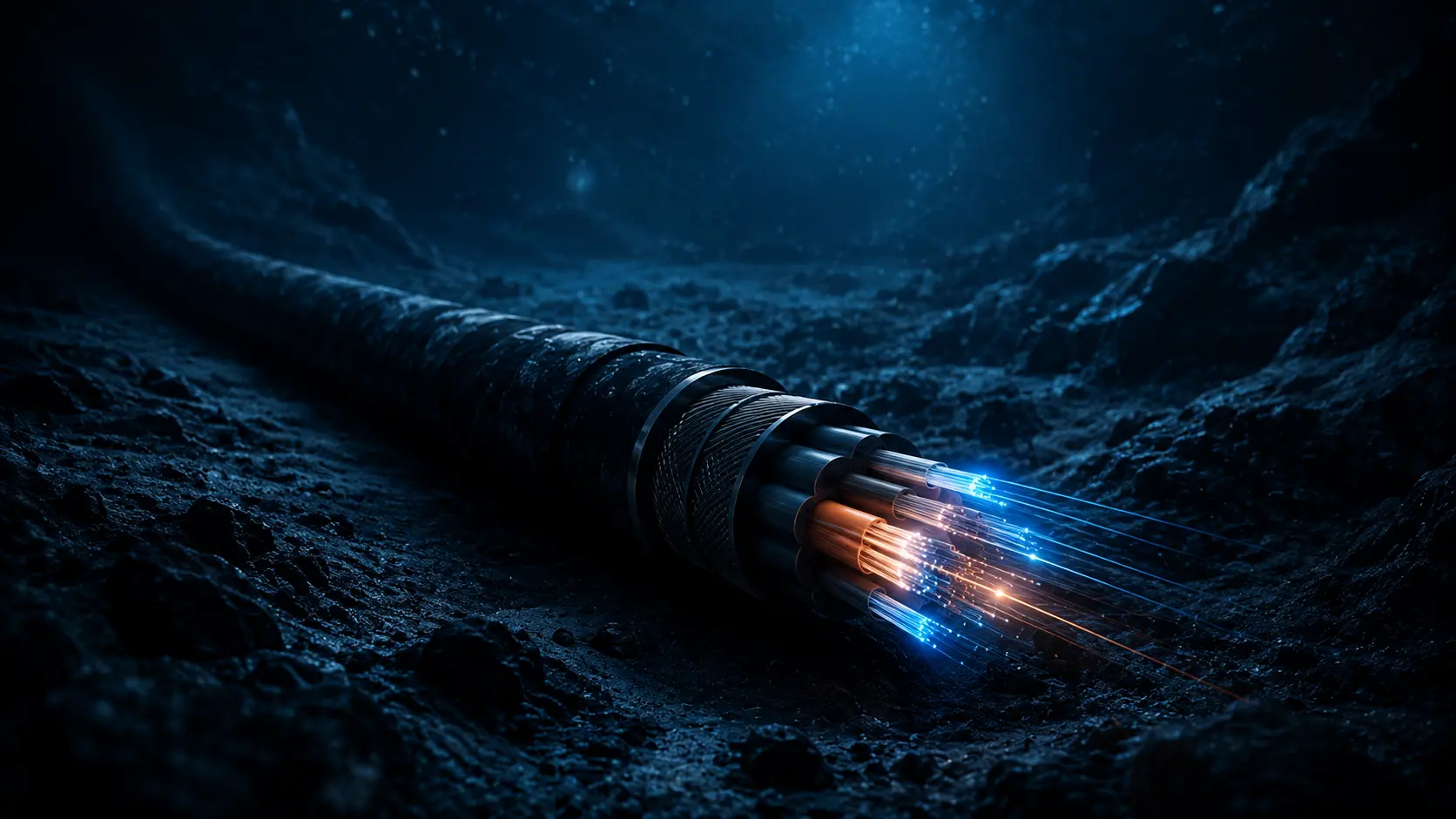
When you upload a file to the cloud, send an international email, or stream a video, the data does not go into the sky. It goes into the ocean.
Most people assume satellites power global communications. In reality, satellites carry less than 1% of international data. The other 99% travels through a sprawling network of physical cables laid across the seabed. These cables connect continents, running from the beaches of New York to the shores of London, and from Tokyo to California.
Despite their massive importance, these cables are shockingly thin—often no wider than a standard garden hose. They rest unprotected on the ocean floor in international waters. Because the entire modern world relies on these fragile wires to function, they have quietly become one of the most critical and vulnerable pieces of infrastructure on the planet.
Why This Matters
If the global subsea cable network were completely severed tomorrow, modern civilization would grind to a halt within hours.
The financial system would be the first to freeze. The Society for Worldwide Interbank Financial Telecommunication (SWIFT) network relies on subsea cables to clear trillions of dollars in global transactions every day. Without them, international banking stops. Supply chains would instantly lose the ability to track shipments, process payments, or coordinate manufacturing.
Despite this total dependence, the network is fundamentally insecure.
Most cables lie in international waters governed by the United Nations Convention on the Law of the Sea (UNCLOS). Under this legal framework, the ocean floor is largely a no-man’s-land. There are no police, no military checkpoints, and no physical barriers protecting the cables. Any fishing trawler dragging an anchor—or any state-sponsored submarine executing a sabotage mission—can sever a cable and severely degrade a nation’s communication infrastructure.
As geopolitical tensions rise, global powers are realizing that controlling, tapping, or threatening to cut these cables provides massive strategic leverage. The internet is not an invisible cloud; it is a physical asset that can be attacked.
HOW SUBSEA INTERNET CABLES WORK
Moving terabytes of data across the Pacific Ocean requires overcoming immense physical and optical challenges.
Here is exactly how data travels under the sea.
1. The Core Concept: At the center of a subsea cable are strands of highly purified glass, known as optical fibers. These strands are roughly the thickness of a human hair. Lasers shoot pulses of light through this glass to transmit digital data—ones and zeros—at nearly the speed of light.
2. Cable Anatomy and Protection: Because the ocean floor is a hostile environment, those fragile glass strands require protection.
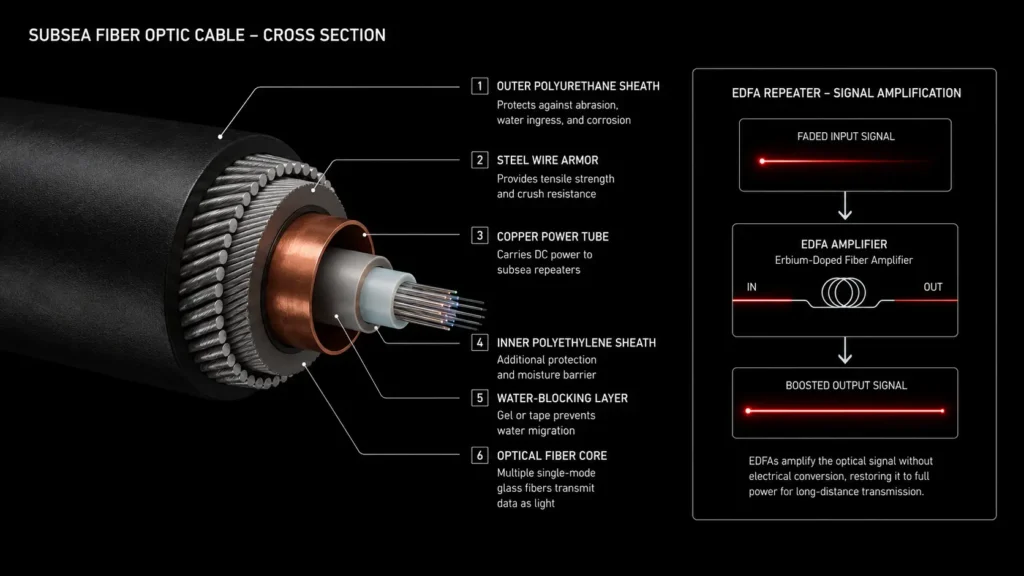
The fibers are encased in a copper tube, which carries high-voltage electricity. This is surrounded by layers of steel wire armor to protect against shark bites and water pressure, all wrapped in a final layer of polyurethane plastic. Near the shore, where ship anchors and fishing nets pose a high risk, the cables are heavily armored and buried in trenches. In the deep ocean, they are unarmored and simply laid flat on the seabed.
3. Dense Wavelength-Division Multiplexing (DWDM): To maximize data capacity, engineers use a technique called Dense Wavelength-Division Multiplexing (DWDM).
Instead of sending one beam of white light, DWDM splits the light into dozens of different colors (wavelengths). Each color carries its own independent data stream simultaneously through the exact same strand of glass. This allows a single cable to carry hundreds of terabits of data per second.
4. Optical Amplification (EDFA): Light naturally fades as it travels through glass. If you shine a laser from New York, it will go dark long before it reaches London.
To solve this, the cables are equipped with repeaters spaced every 50 to 100 kilometers. Inside these repeaters are Erbium-Doped Fiber Amplifiers (EDFAs). The copper tube running through the cable supplies electricity to these repeaters. When the fading light signal enters the repeater, the erbium atoms are excited by a secondary laser, which physically boosts the incoming light signal back to full strength without ever converting it into electrical data.
5. System Limitations: The primary limitation is physical repair. When a cable is cut in the middle of the Atlantic Ocean, a specialized repair ship must sail to the exact GPS coordinates.
The ship drops a grappling hook, drags it across the seabed to catch the severed ends, hauls them thousands of feet up to the surface, and splices the glass back together in a sterile onboard lab. This process takes weeks, during which global data must be routed through backup cables, causing internet congestion worldwide.
Real-World Applications
Subsea cables serve as the invisible plumbing for nearly every major digital system.
High-Frequency Trading: Financial firms spend hundreds of millions of dollars to build dedicated subsea cables that shave milliseconds off the data transit time between London and New York. In automated algorithmic trading, the fastest data feed dictates who profits.
Global Cloud Synchronization: Amazon Web Services (AWS), Google Cloud, and Microsoft Azure operate data centers on every continent. To ensure that an application hosted in Europe instantly syncs with a database in Asia, these tech giants rely exclusively on high-capacity subsea routes.
Military Communications: Modern militaries require massive bandwidth to operate global drone fleets, coordinate naval groups, and process satellite imagery. While tactical data uses military satellites, heavy strategic data routing relies heavily on encrypted commercial subsea cables.
Economic & Strategic Impact
The strategic map of the internet is defined by physical chokepoints.
Because cables must connect landmasses efficiently, they cluster in narrow geographic corridors. The most critical chokepoint on Earth is the Red Sea and the Suez Canal, where cables linking Europe to Asia are bundled tightly together in shallow water. If those specific cables are severed, digital communication between Europe and India is severely bottlenecked.
Consequently, governments view these cables as a matter of national security. Nations that serve as major landing hubs—like Singapore, Egypt, and the United Kingdom—gain significant geopolitical leverage. Conversely, island nations like Taiwan recognize that their entire digital connection to the outside world could be severed by a few coordinated submarine attacks.
This has triggered a quiet arms race in seabed warfare. Navies are deploying specialized submarines, such as Russia’s Losharik, designed to operate at extreme depths. These vessels are built not to fire torpedoes, but to locate, tap, or sever the communication lines of adversarial nations.
Advantages
Unmatched Capacity: A single modern subsea cable can carry more data in one second than a fleet of satellites could transmit in an entire day.
Minimal Latency: Light traveling through glass provides the fastest possible physical connection between two points on the globe, critical for financial markets and real-time computing.
Cost Efficiency: Once laid, subsea cables are exponentially cheaper to operate and maintain per terabyte of data than launching and managing low-Earth orbit satellites.
Limitations
Extreme Fragility: The deep-sea sections of cables are completely unarmored and can be severed by shifting tectonic plates, undersea avalanches, or dragged ship anchors.
Geographic Chokepoints: The concentration of cables in narrow straits creates single points of failure for entire continents.
Jurisdictional Ambiguity: Under UNCLOS, it is incredibly difficult to police or defend infrastructure located in international waters, leaving cables open to espionage and sabotage.
Slow Repair Times: Repairing a cut requires highly specialized ships, calm weather, and weeks of time, leaving networks vulnerable during the outage.
Common Misconceptions
Misconception: Satellites carry most international internet traffic.
Reality: Satellites handle less than 1% of global data. Satellites are too slow, too expensive, and lack the bandwidth required for mass internet traffic. Cables carry the other 99%.
Misconception: Shark bites are a major threat to the internet.
Reality: A viral 2014 video of a shark biting a cable led to this myth. Today, deep-sea cables are shielded against animal life. The real threats are commercial fishing nets and dropped ship anchors.
Misconception: Subsea cables are massive, thick pipelines.
Reality: While they are heavily armored near the shore, the deep-ocean sections are only about the thickness of a garden hose.
What Most People Miss
The ownership of the ocean floor has quietly changed hands.
Historically, subsea cables were built and owned by consortiums of national telecommunications companies like AT&T, British Telecom, and Orange.
Today, the global subsea network is being taken over by Big Tech. Google, Meta, Microsoft, and Amazon now own or lease the vast majority of the world’s subsea bandwidth. Because their cloud platforms and social networks require so much data, it became cheaper to lay their own private oceans cables rather than rent space from telecoms. This marks a profound shift: private technology corporations now physically own the infrastructure of global communication.
Comparison Table
| Feature | Subsea Internet Cables | Low-Earth Orbit Satellites (Starlink) |
| Purpose | Heavy, high-capacity international data transport. | Connecting remote or rural areas to the internet. |
| Advantages | Massive bandwidth, lowest latency, cheapest per terabyte. | Rapid deployment, immune to ocean seabed damage. |
| Limitations | Vulnerable to physical cuts, slow to repair. | Low bandwidth limits, affected by weather, high cost. |
| Typical Use Cases | Cloud synchronization, high-frequency trading. | Maritime vessels, remote military bases, rural homes. |
| Cost | Extremely High (Upfront) | High (Ongoing launches and maintenance) |
| Best Fit | Connecting entire continents and massive data centers. | Providing access where physical cables cannot reach. |
Case Study
Situation: In early 2024, amidst rising geopolitical tension, Houthi militants in Yemen targeted commercial shipping in the Red Sea.
Challenge: The Red Sea is the world’s most critical internet chokepoint, containing roughly 15 subsea cables that carry almost all data between Europe and Asia.
Solution (The Incident): During the conflict, the cargo ship Rubymar was struck by a missile. As the abandoned ship drifted and sank, its massive anchor dragged along the seabed.
Outcome: The dragged anchor severed three major subsea internet cables simultaneously. While internet traffic did not stop entirely, it severely degraded communication speeds across India and East Africa as data was forced to reroute around the globe.
Lessons Learned: The incident proved that highly sophisticated cyberattacks are not required to cripple global communications. A drifting ship with a heavy anchor in a geographic chokepoint is enough to disrupt the internet for millions of people.
Future Outlook
Next 12–24 Months: Telecoms and tech giants will aggressively fund alternative cable routes to bypass traditional chokepoints like the Red Sea. Projects connecting Europe to Asia via the Arctic Ocean or overland through the Middle East will see accelerated funding to ensure redundancy.
Next 3–5 Years: The implementation of SMART (Science Monitoring And Reliable Telecommunications) cables will begin. Future cables will feature environmental sensors built into their repeaters, turning the global internet backbone into a massive deep-sea network capable of detecting tsunamis, earthquakes, and unauthorized submarine activity.
Next 10 Years: Subsea cables will become heavily militarized zones. As autonomous underwater vehicles (AUVs) become cheaper and more capable, nations will deploy underwater drones to patrol critical cable junctions, while adversaries will use similar drones to quietly install optical taps to intercept unencrypted data.
Most Likely Scenario: Subsea cables will remain the undisputed backbone of the global internet, as physics dictates that fiber optics will always beat wireless transmission in bandwidth. However, the illusion of their safety will disappear, forcing governments to treat the seabed with the same strategic defensive posture as sovereign airspace.
Key Takeaways
99% of all international digital communication travels through physical cables on the ocean floor.
Subsea cables are highly vulnerable to commercial fishing, ship anchors, and geopolitical sabotage.
Data travels as light pulses through glass fibers, boosted by EDFA repeaters every 100 kilometers.
DWDM technology allows a single cable to carry multiple data streams simultaneously using different colors of light.
Big Tech companies like Google and Meta now dominate the construction and ownership of subsea infrastructure.
Geographic chokepoints, like the Red Sea, create single points of failure for global data traffic.
International maritime law offers little physical protection for these critical assets in deep waters.
Glossary
Chokepoint: A narrow geographic corridor where multiple subsea cables converge, creating a vulnerability.
Dense Wavelength-Division Multiplexing (DWDM): An optical technology that splits light into different colors to send multiple streams of data through one glass fiber simultaneously.
Dark Fiber: Physical fiber-optic cables that have been laid but are currently unused, held in reserve for future capacity.
Erbium-Doped Fiber Amplifier (EDFA): A device inside a cable repeater that uses a laser and excited erbium atoms to boost a fading light signal without converting it to electricity.
Landing Station: A highly secure coastal facility where a subsea cable emerges from the ocean and connects to the terrestrial internet grid.
Optical Fiber: A strand of highly purified glass, as thin as a human hair, used to transmit data via light pulses.
Seabed Warfare: Military operations conducted on the ocean floor, primarily aimed at tapping or severing communication and energy cables.
UNCLOS: The United Nations Convention on the Law of the Sea; the international agreement governing the use and protection of international waters.
Frequently Asked Questions
How deep are subsea internet cables? They can be laid as deep as 8,000 meters (about 26,000 feet), which is roughly the height of Mount Everest inverted. At these extreme depths, the cables rest directly on the flat seabed.
Who actually owns the internet cables? Historically, they were owned by telecom consortiums. Today, technology giants like Google, Meta, Amazon, and Microsoft own or heavily invest in the majority of new cable systems to support their cloud infrastructure.
What happens if a cable is cut? Data automatically reroutes to other available cables. However, if multiple cables in a chokepoint are cut simultaneously, it causes severe internet slowdowns and localized outages for entire countries.
How do they fix a broken subsea cable? A specialized repair ship is deployed to the GPS coordinates of the fault. The ship drags a grappling hook to catch the cable, pulls both broken ends to the surface, splices the glass fibers in a cleanroom, and drops the repaired cable back into the ocean.
Can satellites like Starlink replace subsea cables? No. Satellites are excellent for connecting remote areas, but they lack the massive bandwidth required to handle global cloud computing, financial markets, and mainstream internet traffic. Cables carry exponentially more data.
How big is a subsea internet cable? In the deep ocean, the cable is only about the diameter of a garden hose. Near the shore, it is wrapped in heavy steel wire armor and becomes roughly the thickness of a soda can to protect against anchors.
Can someone tap an underwater cable to steal data? Yes, but it is incredibly difficult. It requires highly specialized submarines to splice an optical tap into the glass fiber at the bottom of the ocean without breaking the light signal and triggering an alarm at the landing station.
Do sharks really eat internet cables? No. While there was a famous incident of a shark biting an old cable in 2014, modern cables emit electromagnetic shielding that deters marine life. Most damage is caused by human activity, specifically fishing nets and ship anchors.
How long does a subsea cable last? A typical subsea cable has an engineered lifespan of about 25 years. After this time, it is usually retired because the optical technology becomes obsolete, not necessarily because the physical cable degrades.
How are the cables laid across the ocean? Massive, specialized cable-laying ships spool thousands of miles of cable from giant onboard carousels, slowly dropping it into the ocean as they cross the sea at very low speeds.
Sources
TeleGeography: Submarine Cable Map and Global Bandwidth Research
Center for Strategic and International Studies (CSIS): Undersea Cables and Geopolitical Vulnerability
United Nations Convention on the Law of the Sea (UNCLOS) Documentation
International Telecommunication Union (ITU): Resilient Submarine Cable Infrastructure