Advertisement
)

At a Glance
Concept: An unbroken network of refrigerated trucks, ships, and automated warehouses.
Why it matters: It prevents mass starvation in urban centers and enables global healthcare distribution.
Who uses it: Agricultural exporters, supermarket conglomerates, and pharmaceutical manufacturers.
Biggest takeaway: Maintaining an unbroken temperature line is highly energy-intensive, making thermal logistics one of the most critical infrastructures for human survival.
In Simple Words
Imagine a strawberry growing on a farm in Peru. To reach a supermarket shelf in Tokyo while still looking fresh, it must travel over 9,000 miles.
If that strawberry is simply placed in a regular shipping container, it will rot within a few days. Instead, immediately after harvest, it is rapidly cooled to exactly 34°F (1°C). From that moment on, it never experiences room temperature again.
It moves into a refrigerated truck, is transferred onto a refrigerated cargo ship, waits in an automated chilled warehouse, and finally rides in another specialized delivery van. This unbroken sequence of climate-controlled environments is called the cold chain.
Without it, modern cities could not exist. Millions of people live in urban areas that produce no food. The cold chain acts as the global refrigerator that makes modern civilization possible.
Why This Matters
The global population relies on a logistics network that is entirely invisible to the average consumer.
Before the invention of mechanized refrigeration, humanity was bound by geography and seasons. You could only eat what grew nearby, and medical treatments were limited by their chemical stability at room temperature. Today, the modern economy takes global availability for granted. You can buy fresh avocados in New York during a blizzard, and doctors in rural Africa can administer vaccines manufactured in Switzerland.
However, this system is incredibly fragile. A temperature deviation of just three degrees for a few hours can completely ruin a shipment of high-grade sushi tuna or destroy a million doses of an mRNA vaccine.
When the cold chain breaks, the economic losses are catastrophic. According to the United Nations, roughly one-third of all food produced globally for human consumption is lost or wasted, largely due to inadequate refrigeration in developing nations. Bridging this gap is not just a business opportunity; it is a fundamental requirement for global food security as the human population expands.
HOW COLD CHAIN LOGISTICS WORKS
Moving temperature-sensitive cargo across an ocean requires more than just a big freezer. It requires precise thermodynamic engineering and constant digital monitoring.
Here is how the modern cold chain functions.
1. Rapid Pre-Cooling: The cold chain begins the exact moment a product is harvested or manufactured. For agriculture, crops hold “field heat” from the sun. If they are packed into boxes while warm, they act like tiny heaters and rot from the inside out. Facilities use blast chillers or hydro-cooling (submerging crops in near-freezing water) to rapidly drop the internal temperature of the product to its optimal storage level before transport even begins.
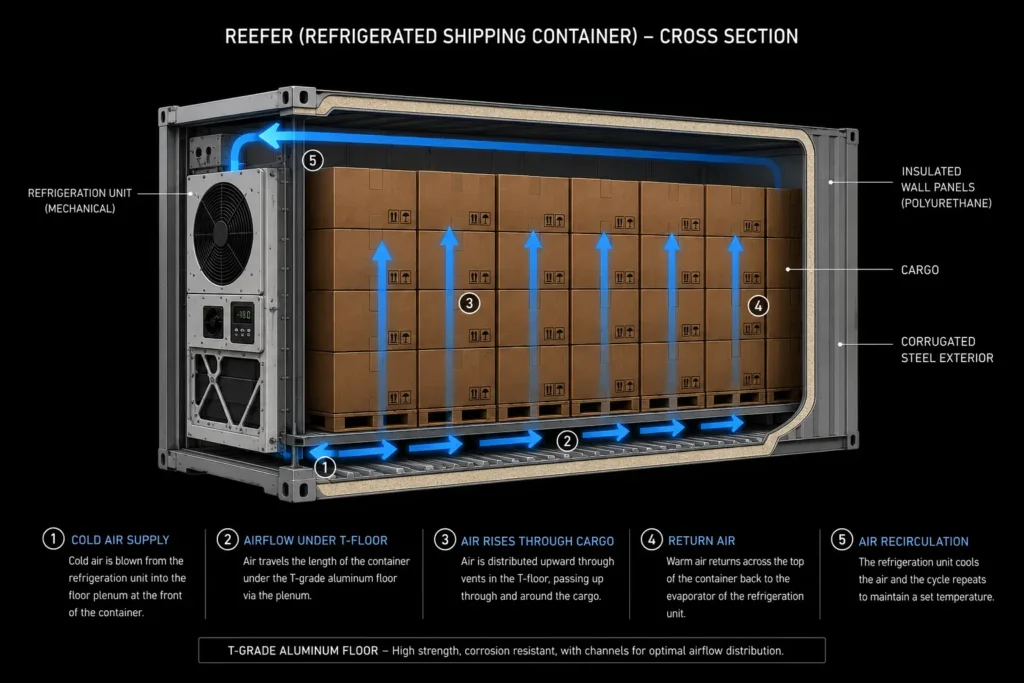
2. The Reefer Container: The workhorse of global trade is the “reefer”—a specialized refrigerated shipping container. Unlike a standard steel box, a reefer is lined with high-density polyurethane insulation. Crucially, a reefer does not just blast cold air. It circulates air continuously from the floor upward through the cargo. The container is plugged directly into the electrical grid of the cargo ship. If the ship’s power fails, the reefer relies on a backup diesel generator to ensure the internal temperature remains perfectly flat for the entire multi-week voyage.
3. Industrial Refrigeration and Ammonia Physics: When reefers arrive at a port, the goods are moved into massive cold storage warehouses. Traditional residential air conditioners use chemical refrigerants like hydrofluorocarbons (HFCs). Massive industrial warehouses use anhydrous ammonia. Ammonia is highly toxic, but it is a thermodynamic masterpiece. It absorbs massive amounts of heat when it transitions from a liquid to a gas. Compressors squeeze ammonia gas into a hot, high-pressure state. It flows into condenser coils outside the building, releasing its heat into the atmosphere and turning back into a liquid. The liquid then flows inside, expands, absorbs the heat from the warehouse, and vaporizes back into a gas to repeat the cycle.
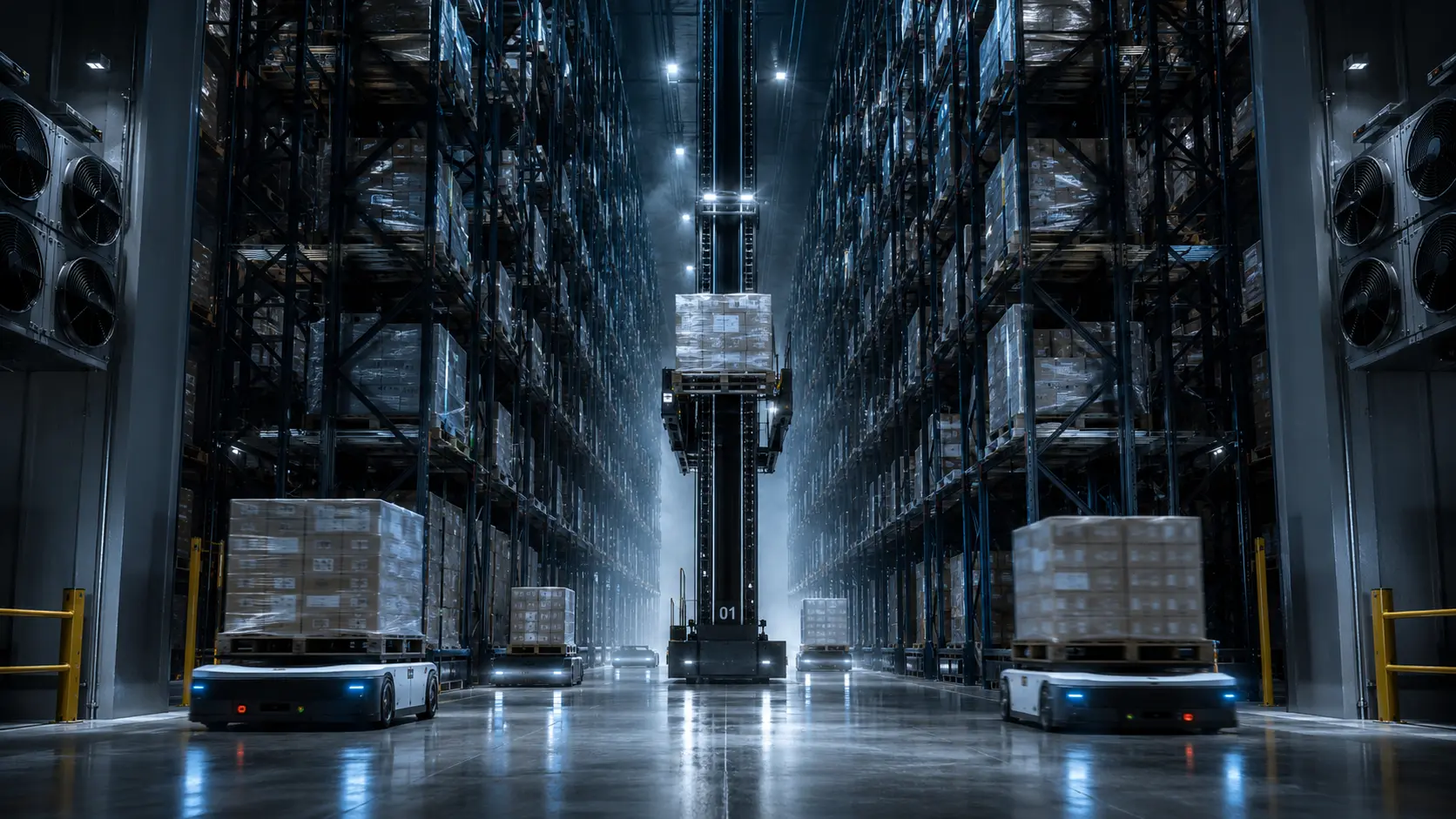
4. Automated Storage and Retrieval Systems (AS/RS): Humans introduce heat. Every time a worker breathes or a forklift engine runs inside a freezer, the refrigeration system must burn electricity to remove that heat. To solve this, modern cold storage facilities use Automated Storage and Retrieval Systems (AS/RS). These are dark, massive freezers operated entirely by robots. Because robots do not need oxygen, operators can reduce the oxygen levels in the warehouse to prevent fires. The robots slide along rails, moving pallets of frozen goods at high speeds in complete darkness at -20°F (-29°C).
5. IoT Thermal Tracking: The entire chain is monitored by the Internet of Things (IoT). Small digital data loggers are placed inside individual pallets. These sensors track temperature, humidity, and even physical shock in real-time.
6. System Limitations: The cold chain is bound by the laws of thermodynamics. Heat always seeks to enter a cold space. Fighting this natural physics requires massive amounts of electrical power. In many developing nations, the electrical grid is simply not stable enough to run continuous compressors. When the power goes out, the cold chain breaks, and the product is lost.
Real-World Applications
The cold chain is highly segmented based on the specific temperature requirements of the cargo.
Pharmaceuticals and Vaccines: The distribution of biological medicines requires extreme precision. mRNA vaccines must be kept in ultra-cold cryogenic states, often reaching -94°F (-70°C). This requires passive cold chains, using specialized vacuum-sealed containers packed with dry ice (solid carbon dioxide) rather than mechanical refrigerators.
The Global Floral Industry: Cut flowers are living, breathing organisms that degrade rapidly. When a rose is cut in Colombia, it is immediately cooled, flown on a refrigerated cargo plane to Miami, and trucked to florists across North America. The temperature must remain at exactly 34°F to put the flower into a dormant state, preventing it from blooming until it reaches a vase.
High-Grade Seafood: Bluefin tuna caught in the Atlantic is often flash-frozen to -76°F (-60°C) immediately on the fishing vessel. At this extreme temperature, cellular degradation stops completely. Months later, when it is thawed in a high-end restaurant in Tokyo, the cellular structure remains indistinguishable from the day it was caught.
Economic & Strategic Impact
The cold chain defines global trade deficits and agricultural economies.
For exporting nations like Chile or New Zealand, a robust cold chain is the difference between poverty and economic power. It allows them to monetize their agricultural output by selling fresh fruit to the Northern Hemisphere during the winter. Without temperature-controlled logistics, their export market would be limited to their immediate geographic neighbors.
For logistics companies, cold storage is one of the most profitable real estate sectors in the world. Companies like Lineage Logistics and Americold operate as specialized real estate investment trusts (REITs). They do not just own warehouses; they own the critical chokepoints of the global food supply.
Strategically, governments view cold storage capacity as a matter of national security. During global supply chain shocks, nations with massive refrigerated warehousing can stockpile perishable food for months, insulating their populations from immediate shortages and price spikes.
Advantages
Extended Shelf Life: Products that would naturally rot in days can safely last for months, stabilizing global food prices.
Geographic Independence: Populations can consume diverse, nutrient-rich diets regardless of their local climate or agricultural capacity.
Waste Reduction: Proper temperature control prevents billions of tons of food from rotting in transit, reducing the overall carbon footprint of agriculture.
Medical Safety: It ensures that temperature-sensitive biologics, blood plasma, and vaccines remain potent and safe for patients.
Limitations
Massive Energy Consumption: Industrial refrigeration accounts for a significant percentage of global electricity usage, placing heavy strain on power grids.
Environmental Hazards: Older refrigerants (HFCs) are potent greenhouse gases. If a system leaks, it contributes heavily to climate change.
The Last-Mile Bottleneck: Maintaining temperature control from a massive warehouse to a final consumer’s doorstep in a delivery van is the most difficult and expensive segment of the chain.
High Capital Costs: Building an automated AS/RS cold storage facility costs tens of millions of dollars, creating a high barrier to entry for developing nations.
Common Misconceptions
Misconception: Freezing food destroys its nutritional value.
Reality: Modern commercial blast freezing occurs so quickly that it locks in vitamins and minerals. Flash-frozen vegetables often contain more nutrients than “fresh” vegetables that have degraded in a truck for a week.
Misconception: The cold chain just relies on packing things in ice.
Reality: Ice is heavy, melts quickly, and alters humidity, which ruins many products. The modern cold chain relies almost entirely on active mechanical refrigeration and precise digital climate control.
Misconception: All refrigerated trucks are kept below freezing.
Reality: The vast majority of the cold chain is “chilled,” not frozen. Bananas, for example, must be kept at exactly 56°F (13°C). If they get colder, the skin turns black; if they get warmer, they ripen too fast.
What Most People Miss
The physics of freezing dictates the quality of the food you eat.
When water freezes slowly, it forms large, jagged ice crystals. If you put a piece of meat in a standard home freezer, it takes hours to freeze. During that time, large ice crystals grow and act like microscopic knives, puncturing the cell walls of the meat. When you thaw it, those ruptured cells leak moisture, resulting in dry, tough food.
Industrial cold chains use blast freezers. They drop the temperature of a product so violently fast that the water molecules do not have time to form large crystals. Instead, they form microscopic, smooth ice structures. The cell walls remain perfectly intact. This is why a commercially frozen piece of salmon tastes vastly superior to a fish you froze yourself at home.
Comparison Table
| Feature | Active Cold Chain | Passive Cold Chain |
| Purpose | Continuous mechanical temperature control. | Short-term thermal protection without power. |
| Cooling Method | Compressors, electric generators, ammonia. | Vacuum insulation, phase-change materials, dry ice. |
| Infrastructure | Reefer containers, chilled warehouses. | Specialized insulated shipping boxes. |
| Duration | Indefinite (as long as power is supplied). | 48 to 120 hours. |
| Typical Cargo | Bulk produce, frozen meats, mass commodities. | Urgent pharmaceuticals, human organs, vaccines. |
| Complexity | High maintenance, requires a stable power grid. | Simple logistics, highly dependent on precise timing. |
| Best Fit | Long-haul ocean and rail transport. | Last-mile air freight and medical delivery. |
Case Study
Situation: A major global supermarket chain struggled with excessive energy costs and food spoilage in its primary distribution centers. Every time human workers drove forklifts into the massive freezers to retrieve pallets, warm air rushed in, and the workers’ body heat forced the refrigeration compressors to work harder.
Challenge: The company needed to increase storage density, reduce electricity usage, and eliminate temperature fluctuations in a warehouse holding millions of pounds of perishable food.
Solution: The company tore down its traditional warehouse and built a towering, 120-foot-tall Automated Storage and Retrieval System (AS/RS) facility. The building operates in total darkness. Specialized robotic cranes navigate narrow aisles to store and retrieve pallets automatically.
Outcome: Because robots can operate in much colder environments without complaining, the facility runs at maximum thermal efficiency. The building footprint was reduced by 50%, energy consumption dropped by 40%, and human-error-related food spoilage was virtually eliminated.
Lessons Learned: In modern logistics, human presence is a thermal liability. The future of cold storage is fully automated, allowing facilities to act as perfectly sealed thermodynamic vaults.
Future Outlook
Next 12–24 Months: The logistics industry will aggressively upgrade reefer containers with continuous 5G IoT tracking. Shippers will demand real-time visibility, receiving automated alerts the exact second a shipping container deviates from its required temperature range, allowing them to reroute cargo before it spoils.
Next 3–5 Years: Diesel generators on refrigerated trucks and shipping containers will be phased out. The cold chain will rapidly electrify, drawing power from massive battery packs built directly into the chassis of transport vehicles to comply with strict new urban emissions regulations.
Next 10 Years: Developing nations in Southeast Asia and Sub-Saharan Africa will see massive investments in solar-powered micro-cold storage. Because national power grids remain unreliable, decentralized, off-grid refrigeration powered directly by local solar panels will drastically reduce agricultural waste in these regions.
Most Likely Scenario: The cold chain will become entirely autonomous and vertically integrated. Algorithms will predict consumer demand, automatically dispatching robotic reefers to automated warehouses. The system will operate seamlessly from the farm to the supermarket shelf with zero human intervention, maximizing thermodynamic efficiency and eliminating global food waste.
Key Takeaways
The cold chain is an unbroken, temperature-controlled logistics network essential for modern global survival.
Products are rapidly pre-cooled immediately after harvest to remove “field heat” and halt cellular degradation.
Refrigerated shipping containers (reefers) use active mechanical cooling to maintain precise temperatures across oceans.
Massive industrial cold storage relies on highly efficient, though toxic, ammonia refrigeration physics.
Automated Storage and Retrieval Systems (AS/RS) use robots to manage frozen inventory in dark, oxygen-depleted warehouses.
Blast freezing preserves food quality by forming microscopic ice crystals that do not rupture cell walls.
The expansion of the cold chain in developing nations is the most effective way to solve global food shortages.
Glossary
Active Cold Chain: A logistics system that relies on powered mechanical refrigeration (compressors) to maintain temperature.
Ammonia Refrigeration: An industrial cooling method that uses anhydrous ammonia (NH3) for its highly efficient thermodynamic properties.
AS/RS (Automated Storage and Retrieval System): Robotic infrastructure used in warehouses to automatically place and retrieve pallets of goods without human labor.
Blast Freezing: The process of dropping a product’s temperature violently fast to prevent large ice crystals from forming, preserving cellular integrity.
Dry Ice: Solid carbon dioxide, used heavily in passive cold chains for ultra-low temperature transport (e.g., mRNA vaccines).
Internet of Things (IoT) Datalogger: A small digital sensor placed with cargo that continuously records and transmits temperature data.
Passive Cold Chain: A system that uses advanced insulation and phase-change materials (like ice packs) to maintain temperature without electrical power.
Reefer: Industry shorthand for a refrigerated shipping container equipped with a built-in active cooling unit.
Frequently Asked Questions
Why not just use regular air conditioning for warehouses? Regular chemical refrigerants (like freon) are too inefficient for massive industrial spaces. Facilities use ammonia because it transfers heat much faster, requiring less electricity to keep massive volumes of space frozen.
How do they keep things cold on a cargo ship? Refrigerated containers (reefers) are plugged directly into the ship’s massive electrical grid. They act as independent, actively cooled vaults for the duration of the voyage.
What happens if a refrigerated truck breaks down? The cargo relies on the insulation of the truck walls. Depending on the outside weather, the internal temperature may stay safe for a few hours. If the breakdown lasts longer, the entire shipment must be discarded for safety reasons.
Why is frozen food sometimes mushy when thawed? If food is frozen slowly (like in a home freezer), large ice crystals puncture the cell walls. When it thaws, the structure collapses. Industrial blast freezing prevents this, keeping the food firm.
Are cold chain refrigerants bad for the environment? Historically, yes. Hydrofluorocarbons (HFCs) are powerful greenhouse gases. However, the commercial industry is rapidly transitioning back to natural refrigerants like ammonia and carbon dioxide, which have zero ozone depletion potential.
How are ultra-cold vaccines transported? They use a passive cold chain. Vials are placed in specialized vacuum-insulated boxes and packed tightly with dry ice. As long as the dry ice sublimates (turns to gas), the box remains at -94°F (-70°C).
How much food is wasted because of poor refrigeration? Globally, nearly 30% of all food produced is lost or wasted. In developing countries, the vast majority of this waste occurs between the farm and the market due to a lack of cold chain infrastructure.
Who owns the cold chain? It is heavily consolidated. Massive maritime shipping companies (like Maersk) own the reefers, while specialized real estate investment trusts (like Lineage Logistics and Americold) own the majority of global cold storage warehouses.
Sources
- Global Cold Chain Alliance (GCCA): Annual Global Cold Storage Capacity Report
- Food and Agriculture Organization of the United Nations (FAO): The State of Food and Agriculture
- International Institute of Refrigeration (IIR): The Role of Refrigeration in the Global Economy
- American Society of Heating, Refrigerating and Air-Conditioning Engineers (ASHRAE): Industrial Refrigeration Guidelines