Advertisement
)


At a Glance
Concept: A global messaging system for financial institutions to securely transmit transaction data.
Why it matters: Without it, international trade, corporate payrolls, and cross-border banking would instantly freeze.
Who uses it: Over 11,000 global financial institutions across more than 200 countries and territories.
Biggest takeaway: SWIFT does not actually move money; it only moves the secure information that tells banks how to move the money.
In Simple Words
If you want to send an email to a friend in another country, you use an internet service provider. To send money across borders, banks use SWIFT.
Most people assume that when they wire money internationally, the actual cash physically or digitally flies from one country to another. This is not true. Banks cannot simply “email” cash across international borders because every country operates on a different legal and financial system.
Instead, banks use SWIFT (the Society for Worldwide Interbank Financial Telecommunication). SWIFT is essentially a highly secure, private messaging app exclusively for banks.
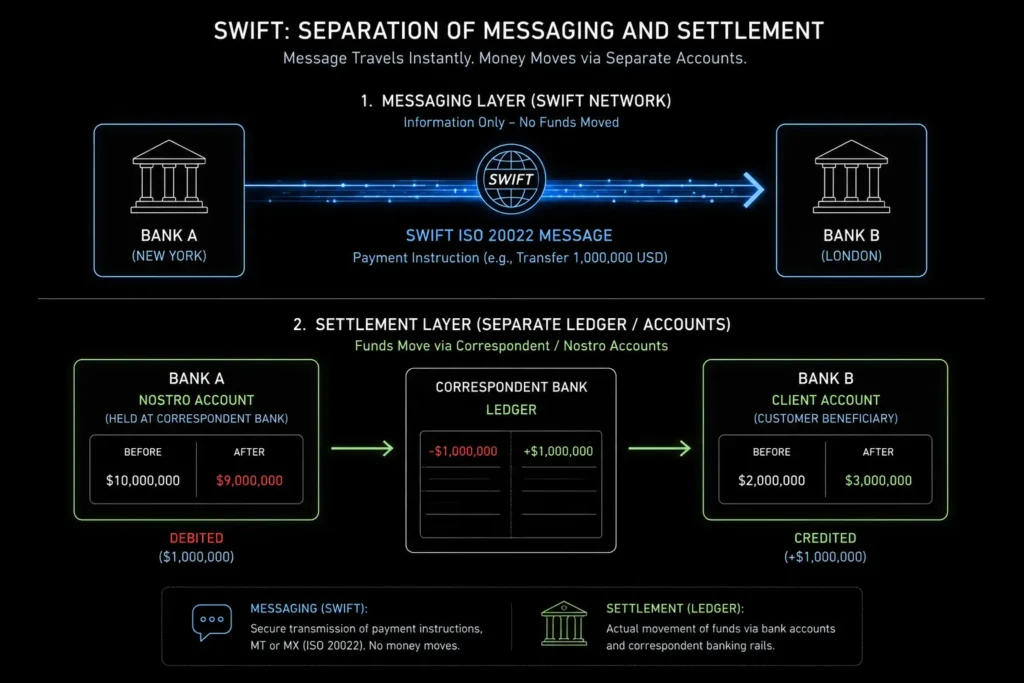
When you send money from New York to London, your New York bank sends a secure SWIFT message to the London bank. The message says, “Deduct this amount from our shared account, and deposit it into your customer’s account.” The money never actually crosses the ocean. The banks simply update their respective ledgers based on the trusted instructions contained in the SWIFT message.
Why This Matters
SWIFT is the foundation of modern globalization.
Every day, the network processes over 45 million messages, facilitating trillions of dollars in daily transactions. When a Japanese automaker buys steel from Australia, the payment clears through SWIFT. When a European energy company buys natural gas from the Middle East, the transaction is orchestrated through SWIFT messages.
Because the entire global economy relies on this single communication protocol, it has become a profound instrument of geopolitical power.
If a nation is disconnected from the SWIFT network, its banks can no longer communicate with the outside world. It cannot easily receive payment for its exports or pay for its imports. Its economy is effectively exiled from the international financial system. This reality makes SWIFT not just a neutral piece of technological plumbing, but one of the most powerful geopolitical weapons in the modern world.
HOW THE SWIFT NETWORK WORKS
Understanding the mechanics of international banking requires separating the flow of communication from the settlement of physical capital.
Here is exactly how global financial telemetry operates.
1. The Illusion of Moving Money
SWIFT is purely a messaging network, not a clearinghouse. It holds no cash reserves, manages no bank accounts, and executes no physical financial settlements. The system provides the secure telecommunications infrastructure and standardized cryptographic language that institutions use to transmit payment instructions across borders.
2. Nostro and Vostro Accounts
Correspondent banking relationships form the core settlement mechanism because money cannot easily cross sovereign borders. This architecture relies on paired bilateral accounts. A Nostro account represents “our money held at your bank,” while a Vostro account represents “your money held at our bank.” When funds move internationally, no cash travels; the receiving bank simply adjusts its internal account balances based on the trusted instruction inside the message.
3. The Message Architecture (ISO 20022)
Global migration to ISO 20022 is replacing legacy text formats like the MT103 message. ISO 20022 is a structured XML messaging standard capable of carrying rich metadata. By embedding explicit details about the source of funds, purpose of transaction, and ultimate beneficiary, the standard allows automated anti-money laundering (AML) compliance screening, drastically reducing manual processing delays.
4. Cryptographic Security and PKI
Public Key Infrastructure (PKI) protects the network from fraudulent instructions that could trigger massive capital theft. Each member institution operates isolated hardware security modules inside their data centers to store private cryptographic keys. Every outgoing message is mathematically signed, allowing the receiving bank’s server to instantly verify authenticity and confirm the data was not tampered with in transit.
5. Settlement via RTGS
Real-Time Gross Settlement (RTGS) systems complete the final step of the transaction. If two banks lack a direct correspondent account relationship, they route settlement through a central bank. The verified message instructs systems like the U.S. Federal Reserve’s Fedwire to execute the final, irrevocable transfer of central bank reserves between the two institutions.
Real-World Applications
The network handles nearly every major corporate and institutional capital movement on Earth.
Global Trade Finance: When a cargo ship full of electronics leaves Asia for Europe, the exporting factory requires a Letter of Credit from the buyer’s bank guaranteeing payment. This legally binding financial contract is transmitted exclusively via highly specific SWIFT message categories, allowing the shipment to proceed.
Foreign Exchange (FX) Markets: The global currency market trades over $7 trillion a day. When major banks swap Yen for Dollars, the actual delivery of those currencies is coordinated through SWIFT messages communicating with the Continuous Linked Settlement (CLS) system.
Sanctions Enforcement: Global regulators use SWIFT data to monitor illicit financial flows. Because SWIFT messages contain the identity of the sender and receiver, compliance software automatically flags and blocks transactions that attempt to route money to sanctioned individuals, terrorist organizations, or embargoed nations.
Economic & Strategic Impact
The structure of the SWIFT network inherently supports the dominance of the United States Dollar.
Because the U.S. dollar is the world’s primary reserve currency, roughly half of all SWIFT messages involve dollar-denominated transactions. Even if a bank in South America is paying a bank in Southeast Asia, the transaction often routes through a correspondent bank in New York to clear the dollar exchange. This forces global transactions to pass through U.S. legal jurisdiction.
This reality gives Western governments immense strategic leverage. Based in Belgium, SWIFT must comply with European Union law. When the EU, often in coordination with the United States, mandates sanctions against a nation, SWIFT complies by disconnecting that nation’s banks.
This occurred with Iran in 2012 and Russia in 2022. The economic impact of disconnection is profound. Imports immediately stall as foreign suppliers cannot be paid, and exports pile up at ports because international buyers cannot send funds. The weaponization of SWIFT is the modern equivalent of a naval blockade.
Advantages
Universal Standardization: It provides a single, trusted language that a bank in rural India and a bank in downtown Manhattan both perfectly understand.
Impeccable Security: The network’s core messaging infrastructure has never been compromised in its history, establishing absolute institutional trust.
Legal Finality: SWIFT messages are recognized globally as legally binding financial instructions, reducing disputes in international courts.
Operational Efficiency: The transition to the ISO 20022 standard allows banks to automate compliance checks, drastically reducing the cost of manual processing.
Limitations
Geopolitical Centralization: Its location in Europe makes it subject to Western foreign policy, alienating non-Western nations.
Endpoint Vulnerabilities: While the central network is secure, hackers frequently target the local, less-secure servers of individual banks to send fraudulent SWIFT messages (as seen in the 2016 Bangladesh Bank heist).
Correspondent Banking Delays: A payment might have to hop through three or four intermediary banks before reaching its destination, adding fees and days of delay.
Lack of Instant Settlement: Because it is only a messaging system, it relies on legacy banking hours to clear funds, making weekend or holiday transactions impossible.
Common Misconceptions
Misconception: The United States government owns and controls SWIFT.
Reality: SWIFT is a neutral, member-owned cooperative headquartered in La Hulpe, Belgium. It is governed by the National Bank of Belgium in partnership with major central banks. The U.S. holds immense influence, but it does not own the network.
Misconception: SWIFT actually transfers money.
Reality: SWIFT only transfers data. The actual money moves when banks update their internal ledgers (Nostro/Vostro accounts) based on the data in the SWIFT message.
Misconception: Cryptocurrency has already made SWIFT obsolete.
Reality: While blockchain offers faster settlement, SWIFT handles over $150 trillion annually. The global legal, compliance, and regulatory frameworks are deeply embedded in SWIFT, making it highly resistant to immediate technological disruption.
What Most People Miss
The true value of SWIFT is not just the secure transfer of instructions; it is the data itself.
Because SWIFT processes the majority of international trade, its data centers contain a perfect, real-time map of global economic activity. By analyzing the volume and direction of SWIFT messages, economists can accurately predict global GDP growth, identify early signs of a recession, and track shifts in global supply chains months before official government data is published.
This makes financial telemetry the most valuable economic intelligence asset on the planet.
Comparison Table
| Feature | SWIFT | Fedwire (US) | CIPS (China) |
| Primary Function | Secure financial messaging. | Real-Time Gross Settlement. | Cross-border Yuan settlement. |
| Moves Actual Money? | No (only moves data). | Yes (moves central bank reserves). | Yes (combines messaging and settlement). |
| Geographic Scope | Global (200+ countries). | Domestic (United States). | Expanding globally (Focus on Asia/BRICS). |
| Operating Hours | 24/7 (Messaging only). | Business hours. | Business hours. |
| Primary Currency | Multi-currency (Heavily USD/EUR). | US Dollar only. | Chinese Yuan (RMB) only. |
| Strategic Purpose | Global banking standardization. | Backbone of the US financial system. | Alternative to Western financial control. |
| Best Fit | International correspondent banking. | Domestic institutional transfers. | Bypassing US Dollar jurisdiction. |
Case Study
Situation: Following the invasion of Ukraine in 2022, the European Union, the United States, and allied nations agreed to enact severe economic sanctions against the Russian Federation.
Challenge: The coalition needed to cripple the Russian economy and its ability to fund the military without resorting to physical conflict.
Solution: The European Union issued a legal directive requiring SWIFT to disconnect key Russian banks from its secure financial messaging network.
Outcome: The targeted Russian banks immediately lost the ability to communicate with international financial institutions. They could not easily process payments for oil and gas exports or purchase advanced technology imports. To survive, Russia was forced to rely on slower, more expensive workarounds, such as routing payments through friendly nations or using physical gold.
Lessons Learned: Access to SWIFT is a privilege, not a global right. However, weaponizing the network accelerated efforts by the BRICS nations (Brazil, Russia, India, China, South Africa) to develop alternative, non-Western financial messaging systems to protect their own future sovereignty.
Future Outlook
Next 12–24 Months: The global banking sector will finalize its complete migration to the ISO 20022 messaging standard. This rich-data format will allow artificial intelligence compliance systems to instantly scan international payments for money laundering, drastically reducing the number of legitimate transactions delayed by false flags.
Next 3–5 Years: SWIFT will actively integrate with Central Bank Digital Currencies (CBDCs) and tokenized asset networks. Rather than competing with blockchain technology, SWIFT is building interoperability protocols that will allow traditional banks to send secure messages instructing the settlement of digital tokens across multiple different blockchain ledgers simultaneously.
Next 10 Years: The absolute monopoly of SWIFT will fracture. Driven by geopolitical fears of Western sanctions, China’s Cross-Border Interbank Payment System (CIPS) and other regional networks will capture a significant percentage of Eurasian trade. The global financial system will split into a multipolar architecture, requiring complex bridges between competing regional messaging networks.
Most Likely Scenario: SWIFT will not be replaced by a decentralized cryptocurrency. Instead, it will upgrade its infrastructure to become the secure routing layer for regulated digital assets. However, its role as the undisputed, singular global utility will erode as rival geopolitical blocs build parallel networks to insulate their economies from Western foreign policy.
Key Takeaways
SWIFT is a highly secure messaging network, not a bank or a clearinghouse.
It transmits financial instructions; the actual money moves via correspondent bank ledgers.
Nostro and Vostro accounts are the physical mechanisms that banks use to settle SWIFT instructions.
The network uses strict public key cryptography (PKI) to ensure messages cannot be altered.
The global transition to ISO 20022 provides rich data to automate compliance and reduce payment delays.
Disconnecting a nation from SWIFT is the geopolitical equivalent of a naval blockade.
Weaponizing the network has driven rival nations to build their own alternative financial systems.
Glossary
Correspondent Banking: An arrangement where one financial institution provides services on behalf of another in a different country, allowing them to conduct local business.
ISO 20022: The modern, data-rich global standard for electronic data interchange between financial institutions.
Letter of Credit: A document from a bank guaranteeing that a buyer’s payment to a seller will be received on time and for the correct amount, often transmitted via SWIFT.
Nostro Account: A bank account held by one bank in another bank, usually in a foreign country and in the currency of that country (“our money at your bank”).
Public Key Infrastructure (PKI): A system of cryptographic keys and digital certificates that securely authenticates the identity of the banks sending SWIFT messages.
Real-Time Gross Settlement (RTGS): A funds transfer system where the transfer of money takes place from one bank to another on a real-time and gross basis, usually operated by a central bank.
SWIFT: Society for Worldwide Interbank Financial Telecommunication, a Belgian cooperative providing secure financial messaging services.
Vostro Account: A term used by a correspondent bank to describe an account held on behalf of a foreign bank (“your money at our bank”).
Frequently Asked Questions
Does SWIFT hold my money during a transfer? No. SWIFT never touches your money. It only securely transmits the text message containing the instructions for the banks to move the money.
How fast is a SWIFT transfer? The message itself is transmitted in seconds. However, the actual transfer of funds can take 1 to 5 days depending on the time zones, the number of intermediary banks, and anti-money laundering checks.
Why do international bank transfers cost so much? SWIFT itself charges pennies per message. The high fees are charged by the correspondent banks that have to manually process the payment, perform compliance checks, and manage currency exchange risk.
Who governs the SWIFT network? It is governed by the National Bank of Belgium, overseen in partnership by the central banks of the G10 countries, including the U.S. Federal Reserve and the European Central Bank.
Can hackers steal money through SWIFT? Hackers cannot compromise the core SWIFT network. However, they have successfully hacked into the local computers of poorly secured banks, generated legitimate-looking SWIFT messages, and tricked other banks into sending them money.
What is the CIPS system? The Cross-Border Interbank Payment System (CIPS) is China’s alternative to SWIFT, designed to facilitate international trade directly in Chinese Yuan and bypass U.S. financial jurisdiction.
How does ISO 20022 change SWIFT? Older SWIFT messages were short, limited text codes. ISO 20022 is an advanced XML format that includes deep data about the sender, receiver, and purpose of the payment, which drastically speeds up legal compliance checks.
Can a cryptocurrency like Bitcoin replace SWIFT? Bitcoin cannot replace SWIFT for institutional banking because it lacks the regulatory compliance, transaction privacy, and rich data messaging required by global banking laws. However, blockchain networks for regulated stablecoins are attempting to compete with traditional correspondent banking.
Sources
Society for Worldwide Interbank Financial Telecommunication (SWIFT): Annual Review and ISO 20022 Documentation
Bank for International Settlements (BIS): Cross-Border Payments and Correspondent Banking Reports
European Central Bank (ECB): Oversight Framework for Systemically Important Payment Systems
International Monetary Fund (IMF): The Geopolitics of Global Financial Infrastructure