Advertisement
)

At a Glance
- Concept: The physical and mechanical engineering required to move 24,000 shipping containers across the ocean with the least amount of fuel possible.
- Why it matters: Ocean freight is the backbone of global trade, but it burns millions of tons of fossil fuels. Microscopic changes in ship design yield billions of dollars in fuel savings and prevent massive environmental damage.
- Who uses it: Global shipping conglomerates like OOCL, Maersk, and MSC, along with naval architects and maritime regulators.
- Biggest takeaway: A ship’s bulbous bow only saves fuel if the ship travels at the exact speed it was designed for; driving slower actually makes the bulb cause more drag, forcing the industry to constantly retrofit older vessels.
In Simple Words
Imagine trying to run through waist-deep water. It is exhausting because you have to physically push a massive wall of heavy water out of your way. This is the exact problem a cargo ship faces. As the ship pushes forward, it creates a massive bow wave. Creating that wave wastes a colossal amount of the engine’s energy.
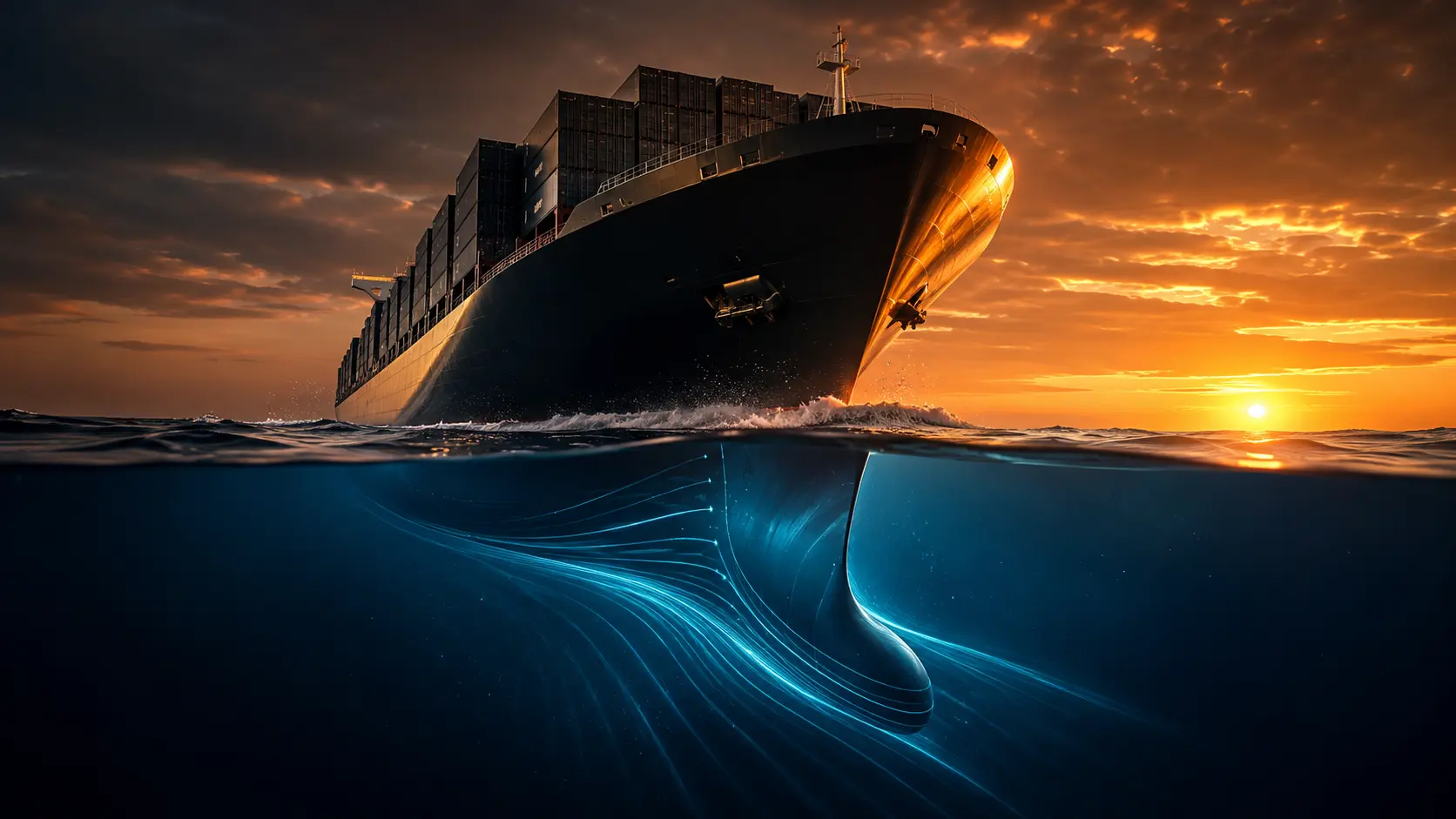
To fix this, engineers attach a large, torpedo-shaped spike—a bulbous bow—to the front of the ship underwater. This spike creates its own wave before the main ship does. By carefully shaping the spike, engineers force the two waves to crash into each other and cancel each other out. The water flattens, and the ship glides forward smoothly, saving up to 20% on fuel.
At the same time, the engines pushing these ships are evolving. Instead of burning thick, dirty oil, the newest megaships use “dual-fuel” engines. They can switch seamlessly between standard fuel and “green methanol,” a clean-burning liquid that almost entirely eliminates toxic sulfur and drastically reduces carbon emissions. By combining these hyper-efficient shapes with clean engines and scaling the ships up to hold 24,000 containers at once, the global supply chain is simultaneously becoming cheaper and greener.
Why This Matters
The global economy is entirely dependent on the mathematical efficiency of the maritime supply chain. Around 80% of all international trade by volume travels by sea.
Historically, this efficiency came at a heavy environmental cost. The maritime industry contributes roughly 3% of all global greenhouse gas emissions. As international regulators—specifically the International Maritime Organization (IMO) and the European Union via its Emissions Trading System (ETS)—clamp down on carbon, shipping companies face an existential financial threat.
The industry cannot simply replace a 100,000-horsepower marine engine with a battery; the physics do not work. To survive, naval architects must extract every single fraction of a percent of physical efficiency from the hull, while mechanical engineers transition the powerplants to burn synthetic, low-carbon fuels.
When a modern 24,000 TEU (Twenty-foot Equivalent Unit) vessel utilizes a methanol dual-fuel engine, it can eliminate approximately 150,000 metric tons of CO₂ emissions annually compared to a legacy vessel. Scaling this technology across the global fleet of 5,000+ container ships represents the single largest industrial decarbonization lever on Earth.
The Big Picture
Moving a steel box from Shanghai to Rotterdam is a battle against fluid dynamics.
A ship experiences two main types of drag. The first is frictional resistance (skin friction)—the physical rubbing of water against the vast surface area of the steel hull. The second is wave-making resistance—the energy lost to the ocean by pushing water out of the way to form a bow wave and a stern wake.
As a ship accelerates, wave-making resistance becomes the dominant force attempting to stop the vessel. Defeating this invisible wall of water requires manipulating the exact phase and amplitude of the ocean’s surface, leveraging the physics of destructive interference to trick the ocean into letting the massive steel hull slip past.
HOW DUAL-FUEL MEGASHIPS WORK
Achieving maximum efficiency in a modern Ultra Large Container Vessel (ULCV) requires a three-pronged engineering approach: fluid dynamics, chemical propulsion, and geometric scaling.
1. The Fundamental Problem: Wave Resistance
When a ship displaces water at the bow, the water rises, creating a wave crest. The energy required to lift this millions of gallons of water comes directly from the ship’s engine. The relationship between the ship’s speed and its wave-making resistance is dictated by the Froude number (Fr):
Fr = v / √(gL)
Where v is velocity, g is gravity, and L is the waterline length. At high speeds (typically Fr between 0.2 and 0.3 for container ships), the energy wasted generating the Kelvin wave pattern becomes staggering.
2. The Hydrodynamic Solution: The Bulbous Bow
To eliminate this wasted energy, naval architects introduced the bulbous bow. The bulb acts as a localized pressure disturbance extending ahead of the ship. It generates its own secondary transverse wave system.
The engineering goal is destructive interference. The bulb is sized and positioned so that the trough (the lowest point) of the wave it generates aligns perfectly with the crest (the highest point) of the ship’s natural bow wave. When the trough meets the crest, they cancel each other out. The water profile remains relatively flat, eliminating up to 20% of the wave-making drag at the design speed.
3. The Propulsion Solution: Dual-Fuel Two-Stroke Engines
A flat hull is useless without efficient power. Modern ULCVs rely on massive, low-speed, two-stroke diesel cycle engines. However, to meet decarbonization goals, the newest vessels utilize dual-fuel architecture.
These engines have highly complex fuel injection systems. They can burn traditional Heavy Fuel Oil (HFO) or switch instantly to burn green methanol or Liquefied Natural Gas (LNG). Because methanol has different combustion properties (lower flashpoint, different energy density), the engine requires separate fuel lines, specialized double-walled piping to prevent toxic leaks, and high-pressure injection nozzles to ensure the methanol atomizes perfectly inside the massive cylinder.
4. The Scale Solution: 24,000 TEU Scaling
The final piece of the efficiency puzzle is raw size. The jump to 24,000 TEU megaships leverages the “square-cube law.”
As a ship gets larger, its internal cargo volume (which scales cubed) grows vastly faster than its underwater surface area (which scales squared). This means a 24,000 TEU ship carrying twice as much cargo as a 12,000 TEU ship does not experience twice the water resistance. It requires far less horsepower—and burns far less fuel—per shipping container, making the largest ships mathematically the most efficient vehicles on Earth.
Real-World Applications
The integration of these three engineering feats defines the modern 2026 fleet.
The OOCL Wisdom: In May 2026, the OOCL Wisdom began its sea trials. Built by Nantong COSCO KHI Ship Engineering (NACKS) in China, it is the world’s first 24,000-TEU class methanol dual-fuel container ship. Measuring 399.99 meters long, it houses the world’s largest methanol dual-fuel main engine. By burning green methanol instead of bunker fuel, it practically eliminates sulfur oxide (SOx) emissions and severely curtails nitrogen oxides (NOx).
Slow Steaming Retrofits: Following the 2008 financial crisis, shipping lines adopted “slow steaming”—running ships at 15 knots instead of 24 knots to save fuel. However, a bulbous bow is highly tuned to a specific Froude number. At slower speeds, wave-making resistance drops naturally, but the massive bulb just acts as dead weight, actively increasing frictional skin drag. Consequently, shipping lines spend millions dry-docking older ships to physically cut off the original bulbs and weld on smaller, blunter bulbs optimized for slower speeds.
Economic & Strategic Impact
The hydrodynamics and propulsion of the global fleet dictate international inflation and commodity pricing.
Fuel (bunkering) accounts for roughly 50% to 60% of a container ship’s total operating expenses. When a perfectly designed bulbous bow reduces fuel consumption by 15%, it saves millions of dollars per vessel annually. Across a fleet of hundreds of ships, this allows ocean carriers to offer lower freight rates, reducing the final shelf price of consumer goods globally.
Strategically, the shift to green methanol fundamentally alters port logistics. Ports like Singapore, Rotterdam, and Shanghai are spending billions to construct specialized methanol and LNG bunkering barges. A 24,000 TEU dual-fuel ship is useless if it cannot refuel along its route. The nations that secure the supply chains for green methanol (synthesized using renewable energy and captured CO₂) will control the strategic chokepoints of 21st-century maritime trade.
Advantages
- Massive CO₂ Reductions: Dual-fuel engines burning green methanol can cut carbon emissions by over 150,000 tons per ship per year compared to traditional fossil fuels.
- Fuel Efficiency: Destructive wave interference from a properly tuned bulbous bow cuts wave-making drag by 10% to 20%, generating massive OPEX savings.
- Pitch Dampening: The added buoyancy of the bulb at the very front of the ship helps dampen violent pitching (see-sawing) motions in heavy seas, protecting cargo and crew.
- Economies of Scale: 24,000 TEU ships offer the lowest cost-per-container transport metric in human history due to the favorable physics of surface area versus volume.
Limitations
- Speed Dependency: A bulbous bow is a rigid, physical structure. If the ship sails below its design speed, the bulb generates no wave cancellation and only adds wasteful frictional drag.
- Draft Sensitivity: If a ship is partially empty (in ballast), it rides higher in the water. If the bulbous bow breaches the surface, it causes severe splashing and slamming, destroying its hydrodynamic efficiency.
- Fuel Scarcity: Green methanol is currently highly scarce and expensive to synthesize. While the engines exist, the global supply of truly zero-carbon methanol cannot yet support the entire fleet.
- Port Limitations: Only the largest, deepest deep-water ports in the world possess the massive STS (Ship-to-Shore) gantry cranes and deep dredging required to handle 400-meter-long, 24,000 TEU vessels.
Common Misconceptions
Misconception: The bulbous bow is designed to ram ice or protect the ship from collisions.
Reality: The bulb is entirely hydrodynamic. Its sole purpose is to create a localized pressure disturbance to cancel out the primary bow wave. It is structurally hollow and highly vulnerable to physical impacts.
Misconception: Green methanol ships are completely electric.
Reality: They are internal combustion engines. They burn liquid fuel inside a cylinder, driving a massive piston, exactly like a traditional diesel engine. The difference is the chemistry of the fuel, which emits harmless water vapor and recaptured CO₂ rather than fossil-derived carbon.
Misconception: Bigger ships are always slower.
Reality: Due to the Froude number mathematics, a longer waterline actually increases a ship’s theoretical “hull speed” before wave-making resistance becomes insurmountable. A 400-meter ULCV can sail at 22 knots far more efficiently than a 100-meter feeder vessel.
What Most People Miss
Naval architects are now utilizing “Air Lubrication Systems” (ALS) alongside advanced hydrodynamics.
While the bulbous bow defeats wave-making resistance at the front of the ship, it does nothing for the frictional skin resistance along the massive flat bottom of the hull. Modern ULCVs use massive compressors to pump a continuous carpet of micro-bubbles under the ship. The vessel literally glides on a cushion of air, reducing the friction between the steel and the water, shaving an additional 5% to 8% off the fuel bill.
Comparison Table
| Feature | Legacy Panamax Ship (2005) | Modern ULCV (2026) |
| Cargo Capacity | ~5,000 TEU. | ~24,000 TEU. |
| Primary Fuel | Heavy Fuel Oil (HFO). | Dual-Fuel (Green Methanol / LNG). |
| Hydrodynamic Design | Large bulb tuned for 24+ knots. | Blunt, optimized bulb tuned for 15-18 knots. |
| Wave Cancellation | Effective only at high speed. | Highly effective at slow-steaming speeds. |
| Emissions Profile | High Sulfur (SOx) and High Carbon. | Near-zero SOx, vastly reduced Carbon. |
| Cost per Container | High. | Extremely Low (Square-cube scaling). |
Case Study
Situation: The tightening of global environmental regulations mandated that ocean carriers drastically lower their Energy Efficiency Design Index (EEDI) scores.
Challenge: Orient Overseas Container Line (OOCL) needed to transport high volumes of goods from Asia to Europe while drastically curtailing emissions. They could not simply slow their ships down further without destroying their delivery schedules.
Solution: OOCL partnered with NACKS in China to design the OOCL Wisdom. They scaled the hull to the absolute physical maximum limit—399.99 meters long, capable of carrying 24,168 standard containers. Crucially, they integrated the world’s largest methanol dual-fuel engine systems, completely redesigning the engine room and bunker tanks to safely handle the new volatile fuel.
Outcome: Launched in May 2026, the OOCL Wisdom became a benchmark for green logistics. By combining a highly optimized, slow-steaming bulbous bow with methanol combustion, the vessel achieves massive economies of scale while reducing its annual CO₂ output by 150,000 tons when running on green methanol.
Lessons Learned: Decarbonizing heavy transport cannot rely on a single technology. It requires a holistic synthesis: optimizing the physical hull shape to slip through the water effortlessly, while completely swapping the underlying chemistry of the engine.
Future Outlook
Next 12–24 Months
The shipping industry will experience a massive spike in dual-fuel engine orders as the EU Emissions Trading System (ETS) financial penalties bite. Shipyards in China and South Korea will be booked at full capacity exclusively building methanol and LNG-ready ULCVs, permanently retiring the era of pure Heavy Fuel Oil engines.
Next 3–5 Years
Computational Fluid Dynamics (CFD) guided by artificial intelligence will yield radical new bow shapes. Instead of a single static bulb, we will see early tests of “active” hydrodynamics—hulls that physically alter their shape or deploy variable fins to adjust their wave-cancellation properties dynamically based on the exact cargo weight and sailing speed of the day.
Next 10 Years
The physical limits of the 24,000 TEU ship will rarely be surpassed. The constraint is no longer hydrodynamic engineering; it is terrestrial infrastructure. Ships longer than 400 meters simply cannot fit through the Straits of Malacca, the Suez Canal, or easily dock at automated cranes. The focus will shift entirely from increasing size to achieving absolute net-zero emissions via synthetic ammonia fuels and advanced wind-assist rotor sails.
Most Likely Scenario
The 24,000 TEU dual-fuel ULCV represents the apex predator of global logistics. These vessels will dominate the main East-West trade arteries for the next three decades. As the global supply of green methanol and ammonia scales up to meet their demands, these massive, hyper-efficient steel leviathans will quietly and successfully decarbonize the invisible supply chains that sustain the modern world.
Key Takeaways
- A bulbous bow reduces fuel consumption by up to 20% by generating a secondary wave that destructively interferes with the ship’s primary bow wave.
- The wave-cancellation effect is highly dependent on the Froude number; if a ship sails too slow or rides too high, the bulb creates drag instead of removing it.
- Ultra Large Container Vessels (ULCVs) maximize efficiency through the square-cube law, holding 24,000 TEU with far less hydrodynamic drag per container than smaller ships.
- Modern ULCVs utilize massive two-stroke, dual-fuel engines capable of switching seamlessly between traditional oils and green methanol.
- Running a 24,000 TEU ship on green methanol can eliminate up to 150,000 tons of CO₂ emissions annually.
- Naval architects are retrofitting older ships by physically cutting off their high-speed bulbous bows and replacing them with shapes optimized for modern “slow steaming.”
Glossary
Air Lubrication System (ALS): A technology that pumps micro-bubbles under a ship’s hull to reduce frictional skin drag against the water.
Bulbous Bow: A protruding, torpedo-shaped structure at the front of a ship underwater designed to alter the water flow and reduce wave-making resistance.
Destructive Interference: A physics phenomenon where the crest of one wave aligns with the trough of another, canceling out the overall wave energy.
Dual-Fuel Engine: A marine engine engineered with complex injection systems capable of burning both traditional fuel oils and alternative low-carbon fuels like LNG or methanol.
Froude Number ($Fr$): A dimensionless mathematical metric used in fluid dynamics to determine the resistance of an object moving through water, heavily dictating hull design.
Green Methanol: Methanol produced using green hydrogen (from renewable energy) and captured carbon dioxide, resulting in a fuel with a net-zero carbon footprint.
Twenty-foot Equivalent Unit (TEU): The standard unit of measurement in the maritime industry, representing the cargo capacity of a standard 20-foot long shipping container.
Ultra Large Container Vessel (ULCV): The largest class of container ships in the world, generally holding 14,000 to 24,000+ TEU.
Frequently Asked Questions
Why don’t all boats have a bulbous bow?
They are only effective on large, displacement hulls operating at a steady, continuous speed. Small boats, speedboats, or ships that constantly change speeds suffer increased frictional drag from the extra surface area of the bulb.
How does a ship engine switch between oil and methanol?
Dual-fuel engines have highly advanced, electronically controlled fuel injection systems. Operators can press a button on the bridge, and the engine’s software smoothly phases out the heavy fuel oil while simultaneously ramping up the high-pressure methanol injection, keeping the engine running seamlessly.
Can you make a 50,000 TEU container ship?
Theoretically, yes. Practically, no. A ship that size would be too deep to enter any major port, too wide for the Suez or Panama canals, and no existing port cranes could reach across it to unload the containers.
Does a bulbous bow help in rough storms?
Yes. The added volume of the bulb at the very front of the ship increases buoyancy. As the bow plunges into a trough, the bulb resists the downward motion, dampening the violent pitching (see-sawing) of the ship and protecting the cargo.
Why is methanol better than Heavy Fuel Oil?
Heavy Fuel Oil is incredibly dirty, thick, and packed with toxic sulfur. Methanol burns cleanly, virtually eliminating sulfur oxides (SOx) and particulate matter (soot). If it is “green” methanol, it also eliminates net carbon emissions.
What is slow steaming?
The practice of intentionally running a cargo ship below its maximum speed (e.g., 15 knots instead of 24 knots). Because water resistance increases exponentially with speed, slowing down slightly saves a massive amount of fuel.
Are container ships electric?
No. While they generate their own electricity onboard for lights and navigation, the physical propulsion of pushing a 200,000-ton ship across the Pacific Ocean relies entirely on massive internal combustion engines. Batteries are far too heavy and hold too little energy for transoceanic travel.
Sources
- Global Times: Chinese-built world’s largest methanol dual-fuel container ship begins sea trials (May 2026)
- iMarine News: World’s First 24,000 TEU Methanol Dual-Fuel Boxship Embarks on Sea Trials (May 2026)
- Marine Public: Bulbous Bow: Why How & When Explained For Modern Ship Design
- Seatrade Maritime News: OOCL names world’s largest methanol dual-fuel container ship (May 2026)