Advertisement
)

At a Glance
- Concept: The two primary liquid-cooling architectures required to prevent next-generation artificial intelligence chips from physically melting under extreme computational loads.
- Why it matters: Standard air cooling completely fails above 30 kilowatts (kW) per rack. As AI racks routinely exceed 120 kW in 2026, data centers must choose between retrofitting localized plumbing (Direct-to-Chip) or building entirely new sealed-tank infrastructure (Immersion).
- Who uses it: Hyperscalers (Google, Meta, Microsoft), AI colocation providers, and high-performance computing (HPC) research laboratories.
- Biggest takeaway: Direct-to-Chip (D2C) is currently dominating the market because it easily retrofits into existing data centers, but Two-Phase Immersion provides a vastly superior Total Cost of Ownership (TCO) for large-scale, greenfield AI campuses.
In Simple Words
Cooling a computer is simply moving heat from the silicon chip to the outside atmosphere.
For the last forty years, we used air. Fans blew cold air over metal fins attached to the chip. Today, AI chips generate so much heat that air cannot absorb it fast enough. We have to use liquid.
There are two ways to do this.
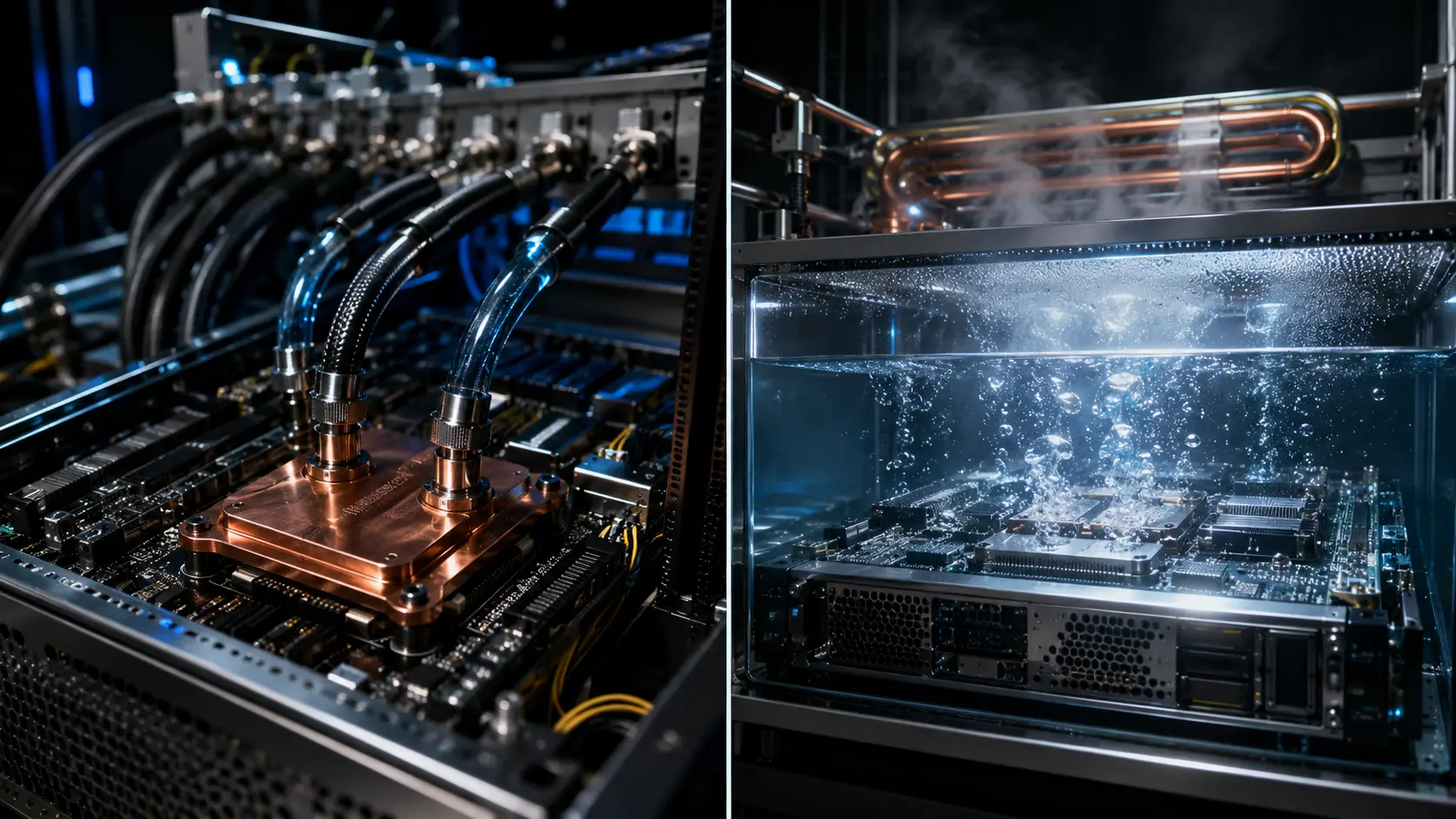
Direct-to-Chip (D2C): Imagine strapping a tiny metal radiator directly onto the AI chip and pumping a mixture of water and antifreeze through it. The water absorbs the heat and flows out to a larger cooling tower outside the building. It is highly effective, but it only cools the main chip. The rest of the server—like the memory and power supplies—still needs traditional air fans to survive.
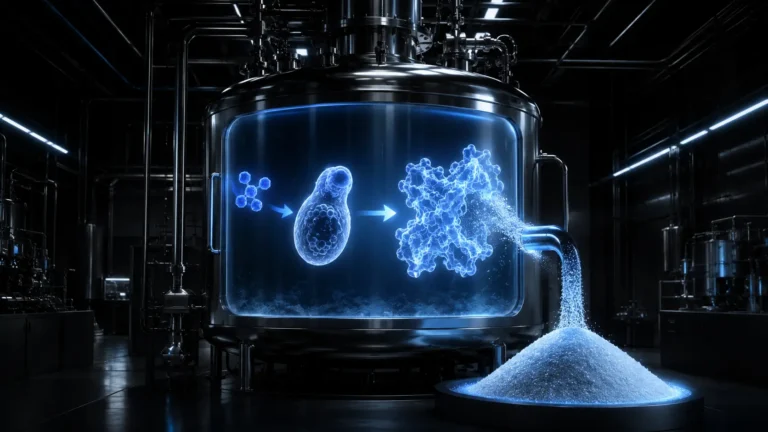
Two-Phase Immersion: Imagine taking the entire server, unplugging its fans, and dropping it into a sealed bathtub filled with a synthetic, non-conductive liquid. When the AI chips get hot, the liquid directly touching them actually boils. The heat turns the liquid into a gas, which floats to the top of the tank, hits a cold pipe, turns back into a liquid, and rains back down. It cools every single component simultaneously and requires zero fans, making the data center completely silent.
Why This Matters
The global rollout of artificial intelligence relies entirely on the thermodynamics of data center real estate.
Nvidia’s Blackwell-era GPUs exceed 1,000 watts of Thermal Design Power (TDP) per chip. When you pack 72 of these GPUs into a single server rack (such as the GB200 NVL72 architecture), the rack generates over 120 kW of concentrated heat. If the cooling system fails, the silicon physically degrades in milliseconds.
This thermal wall forces infrastructure funds and colocation providers into a multibillion-dollar capital expenditure (CapEx) decision. Do they deploy Direct-to-Chip systems, which require complex plumbing but fit into standard 19-inch racks? Or do they transition to Immersion Cooling, which drastically lowers power consumption by eliminating server fans, but requires heavy, horizontally oriented tanks and highly regulated synthetic fluids?
By 2026, thermal management dictates the geographic placement, physical design, and total capacity of global AI mega-clusters.
The Big Picture
At the macroeconomic level, liquid cooling alters the Power Usage Effectiveness (PUE) metric. PUE measures how much total power a data center draws compared to the power actually used by the computing hardware.
A traditional air-cooled facility operates at a PUE of around 1.4—meaning for every 100 megawatts (MW) of servers, it requires 40 MW of air conditioning and massive fans. A facility utilizing Two-Phase Immersion operates at a PUE approaching 1.02. In a 100MW AI data center, eliminating the 38 MW of cooling overhead saves operators hundreds of millions of dollars in electricity over a ten-year lifespan.
However, achieving this absolute efficiency requires abandoning decades of standardized data center architecture.
HOW AI DATA CENTER LIQUID COOLING WORKS
Managing the extreme thermal density of modern GPUs requires bypassing the limits of traditional air convection.
1. The Fundamental Problem
A semiconductor calculates by flipping microscopic transistors, a process that inherently generates heat due to electrical resistance. If this heat is not removed instantly, the silicon hits its thermal threshold (usually around 85°C) and “thermal throttles”—slowing down its calculations to prevent physical melting.
2. The Insufficiency of Air Cooling
Air is a thermal insulator. Its specific heat capacity is incredibly low. To cool an AI server with air, data centers must install massive fans spinning at 30,000 RPM. In dense AI racks, the fans themselves consume up to 20% of the entire server’s electricity. Beyond 30 kW per rack, the air required must move so fast that the acoustic vibration can actually physically damage hard drives, and the energy required to run the fans exceeds the cooling benefit.
3. Direct-to-Chip (D2C) Liquid Cooling: Micro-Convection
D2C abandons air for the primary heat source. Engineers bolt a highly engineered copper “cold plate” directly onto the bare silicon of the GPU. Inside the cold plate are microscopic channels. A Coolant Distribution Unit (CDU) pumps a water-glycol mixture through these channels. Because water conducts heat roughly 4,000 times better than air, it absorbs the extreme thermal spike instantly. The hot water flows out of the rack through specialized dripless quick-disconnect (QD) fittings, heading to a heat exchanger facility to be cooled.
4. Two-Phase Immersion Cooling: Latent Heat of Vaporization
Two-phase immersion abandons plumbing entirely. The entire server motherboard (with its fans physically removed) is submerged in a horizontal tank filled with a specialized dielectric (non-electrically conductive) fluorochemical fluid. This fluid is engineered to have a very low boiling point—usually around 50°C.
When the GPU hits 50°C, the fluid touching the silicon boils instantly. This utilizes the “latent heat of vaporization”—the physics principle that turning a liquid into a gas absorbs a massive amount of thermal energy. The vapor bubbles rise to the sealed top of the tank, where they hit a condenser coil filled with facility water. The vapor condenses, sheds its heat to the coil, and rains back down as liquid.
5. Technical Depth: Fluid Chemistry and PFAS Friction
Immersion systems require highly specialized chemicals. Historically, the market relied on 3M’s Novec engineered fluids. However, 3M ceased manufacturing these fluoropolymers by the end of 2025 due to global regulatory crackdowns on PFAS (per- and polyfluoroalkyl substances)—often called “forever chemicals.” The transition to 2026 required the immersion industry to urgently adopt next-generation, low-Global Warming Potential (GWP), PFAS-free dielectric fluids, briefly driving up the operational costs (OpEx) of immersion tanks and stalling immediate hyperscale adoption.
Real-World Applications
These two technologies solve distinct infrastructural problems depending on the scale and age of the facility.
Retrofitting Existing Data Centers (D2C): Enterprise data centers originally built for 10 kW racks are upgrading localized sections for AI inference. D2C allows operators to install a Coolant Distribution Unit (CDU) at the end of the aisle. The CDU pumps water into standard, vertically standing 19-inch racks. Because the D2C cold plates only cover the main processors (leaving ~20% of the heat to be handled by the room’s existing air conditioning), D2C allows companies to deploy liquid cooling without redesigning their entire building.
High-Density Greenfield AI Campuses (Immersion): New 100MW+ data centers purpose-built for massive AI training clusters (LLM foundation model training) deploy Two-Phase Immersion. By dropping servers into horizontal vats, they eliminate the need for raised floors, massive air handlers (CRAHs), and complex cold-aisle containment corridors. The facility resembles an industrial warehouse of sealed tanks, maximizing spatial density to push rack-equivalent cooling limits beyond 200 kW.
Cryptocurrency Mining (Single-Phase Immersion Fallback): While enterprise AI leans toward two-phase or D2C, massive bitcoin mining farms often utilize single-phase immersion. Single-phase uses cheap mineral oil instead of expensive boiling fluorochemicals. It pumps the warm oil through an external radiator. It is cheaper and avoids PFAS regulations, but lacks the extreme heat-transfer capability of a two-phase boiling system.
Economic & Strategic Impact
The cooling architecture dictates the Total Cost of Ownership (TCO) over a data center’s 10-to-15-year lifecycle.
At a 100MW scale, Direct-to-Chip infrastructure typically incurs higher operational costs. D2C still relies on thousands of mechanical server fans and facility air handlers to cool secondary components (memory, network interface cards, power supplies).
Two-Phase Immersion provides a stark CapEx to OpEx arbitrage. The initial installation requires specialized tanks and expensive dielectric fluid. However, removing server fans and computer room air conditioners (CRACs) reduces total facility power consumption by up to 20%. In large-scale AI campuses, industry models calculate that immersion cooling generates 30% to 35% savings in TCO over a decade, heavily rewarding long-term greenfield investments over short-term retrofits.
Strategically, D2C dominates current supply chains. Because Nvidia and major OEMs (Dell, Supermicro, HPE) explicitly designed their GB200 architectures natively for D2C liquid manifolds, D2C is the path of least resistance for immediate 2026 deployment. Immersion remains the ultimate engineering end-state, but requires specialized server modifications that void standard OEM warranties unless negotiated at the enterprise level.
Advantages
Direct-to-Chip (D2C)
- Form Factor Compatibility: Fits seamlessly into traditional, vertical 19-inch server racks.
- Targeted Efficiency: Pipes directly target the hottest components (CPUs/GPUs), extracting heat before it enters the server chassis.
- OEM Support: Natively supported by major chipmakers and server manufacturers out of the box, with standardized quick-disconnect fittings.
Two-Phase Immersion
- Absolute PUE Efficiency: Achieves PUE metrics near 1.02 by eliminating all server fans and facility air handlers.
- 100% Component Coverage: The fluid touches every millimeter of the motherboard, effortlessly cooling secondary components like memory and optical transceivers.
- Spatial Density: Capable of dissipating heat loads exceeding 200 kW per tank, drastically reducing the physical square footage required for a 100MW data center.
Limitations
Direct-to-Chip (D2C)
- Leakage Risk: Introduces water directly over highly sensitive electronics. A manifold failure can destroy a $3 million server rack instantly.
- Partial Cooling: Cold plates only capture 75% to 80% of the total server heat. The facility must still maintain a robust air-cooling infrastructure.
- Plumbing Complexity: Requires miles of complex, dense hoses, manifolds, and drip sensors, severely complicating routine hardware maintenance.
Two-Phase Immersion
- Regulatory Friction: The phase-out of traditional fluorochemicals (due to PFAS restrictions) creates uncertainty in fluid pricing and availability.
- Horizontal Footprint: Tanks sit horizontally, requiring facilities to abandon vertical rack aisles and establish heavy-duty floor load ratings to support the massive fluid weight.
- Maintenance Friction: To swap a failed GPU, a technician must physically lift a dripping, heavy server blade out of a tank of synthetic fluid, requiring specialized hoists and vapor-capture ventilation.
Common Misconceptions
Misconception: Direct-to-Chip liquid cooling means the data center is fanless.
Reality: D2C only cools the main silicon. Memory modules, switches, and power supplies still generate massive heat and require server fans and facility air conditioning to survive.
Misconception: Immersion cooling puts water inside the server.
Reality: Immersion uses highly engineered, non-conductive dielectric fluids. You can drop a live, uninsulated television or smartphone into the fluid and it will continue to operate flawlessly without short-circuiting.
Misconception: Two-phase immersion is dangerous because the liquid boils.
Reality: The boiling point of the engineered fluid is extremely low (often around 50°C / 122°F). It boils at a temperature that will not even burn human skin. It is entirely safe for the silicon.
What Most People Miss
The hidden bottleneck of Direct-to-Chip cooling is connection degradation.
A standard D2C rack contains dozens of Quick Disconnect (QD) valves connecting the cold plates to the rack manifold. Cooling a 1,000W chip requires pushing roughly 1.5 liters of water-glycol per minute through microscopic copper channels. The extreme fluid velocity and pressure inherently cause erosion and corrosion inside the fittings over years of operation. Routine maintenance of a D2C infrastructure requires stringent water-quality chemistry management; if the coolant chemistry drifts, the microscopic channels clog, and the GPU melts.
Immersion eliminates this entire mechanical failure point. There are no hoses, no high-pressure valves, and no microscopic clogs inside the tank.
Comparison Table
| Feature | Direct-to-Chip (D2C) Liquid Cooling | Two-Phase Immersion Cooling |
| Cooling Medium | Water-Glycol mixture (PG25). | Dielectric synthetic fluids. |
| Heat Transfer Mechanism | Conduction / Micro-Convection. | Latent Heat of Vaporization (Boiling). |
| Component Coverage | 75% – 80% (Requires secondary air). | 100% (Zero air required). |
| Server Fans | Still required. | Completely eliminated. |
| Practical Rack Density | ~60 kW to 130 kW. | 100 kW to 250+ kW. |
| Best Fit Use Case | Retrofitting existing data centers; standard OEM hardware. | Massive greenfield AI campuses; custom ultra-dense hardware. |
| Typical PUE | 1.08 – 1.15. | 1.02 – 1.05. |
Case Study
Situation: A leading hyperscaler needed to deploy a 100MW artificial intelligence training cluster utilizing Nvidia’s next-generation Blackwell architecture.
Challenge: The facility designers modeled the deployment using traditional Direct-to-Chip cooling. While D2C successfully managed the GPU heat, the remaining 20% of residual heat from the 100MW load still required the construction of a massive, 20MW traditional air conditioning infrastructure (CRAHs, raised floors, and chiller plants) to prevent the secondary components from failing.
Solution: The architects pivoted the design to a total Two-Phase Immersion architecture. They partnered with specialized hardware vendors to strip the OEM servers of their fans and cold plates, placing the stripped boards directly into massive, sealed horizontal tanks utilizing new PFAS-free dielectric fluids.
Outcome: By eliminating the computer room air handlers and removing thousands of server fans, the facility’s total power requirement dropped by 18MW. This reclaimed electricity was rerouted entirely into adding more GPUs. The total capital expenditure (CapEx) for the cooling infrastructure dropped by approximately 35% because they entirely eliminated the complex water piping and air ducting required for a D2C hybrid layout.
Lessons Learned: At the extreme edge of compute scale, hybridized environments (D2C + Air) generate compounding inefficiencies. Committing fully to a specialized architecture (Immersion) allows operators to extract vastly more compute power from the exact same utility grid connection.
Future Outlook
Next 12–24 Months
Direct-to-Chip will dominate global AI rollouts. Because the Nvidia GB200 NVL72 rack natively integrates liquid manifolds and cold plates out of the factory, data centers will focus purely on deploying Coolant Distribution Units (CDUs) to rapidly absorb this hardware. Simultaneously, the immersion sector will finalize its transition to compliant, PFAS-free boiling fluids, stabilizing OpEx models for future greenfield designs.
Next 3–5 Years
The physical limits of copper micro-channels will begin to bottleneck D2C systems as individual GPU TDPs breach 1,500W to 2,000W. To prevent massive pressure spikes and erosion in the hoses, the D2C industry will experiment with “Two-Phase Cold Plates”—combining the plumbing of D2C with the boiling mechanics of immersion inside a sealed copper block on the chip.
Next 10 Years
Data centers will fracture into two distinct architectural ecosystems. General enterprise compute and light inference will remain in standardized, vertical D2C and air-cooled racks. Massive foundation-model AI training centers will operate entirely as silent, fanless, immersion-cooled warehouses placed next to dedicated nuclear small modular reactors (SMRs) or massive offshore wind farms.
Most Likely Scenario
D2C wins the present; Two-Phase Immersion wins the future. The sheer mechanical complexity and leakage risk of plumbing millions of high-pressure water hoses into 100MW data centers is ultimately unsustainable. As hardware OEMs begin natively designing and warrantying “immersion-ready” blade servers without fans or heat sinks, the industry will inevitably gravitate toward the absolute thermodynamic superiority of phase-change physics.
Key Takeaways
- Direct-to-Chip (D2C) cooling uses high-pressure water-glycol pumped through copper plates to extract heat specifically from CPUs and GPUs.
- Two-Phase Immersion drops the entire server into a sealed tank of dielectric fluid, utilizing the boiling process (vaporization) to cool all components instantly.
- D2C is currently the dominant architecture because it fits into standard vertical racks and handles current GPU generation densities (up to 130 kW).
- Immersion completely eliminates server fans and air conditioning overhead, achieving near-perfect PUE and massive long-term operational savings.
- D2C carries the risk of catastrophic water leaks over sensitive electronics and still requires robust air cooling for secondary server components.
- Two-Phase Immersion faced heavy regulatory friction in 2025 due to global bans on PFAS “forever chemicals” used in legacy dielectric fluids, forcing a rapid shift in chemistry.
Glossary
Coolant Distribution Unit (CDU): The critical piece of infrastructure in a D2C system that isolates the localized, high-purity server water loop from the massive, lower-purity facility water loop.
Dielectric Fluid: An engineered, synthetic liquid that conducts heat but does not conduct electricity, allowing sensitive electronics to be submerged safely.
Greenfield Data Center: A facility built entirely from scratch, allowing architects to design the structural load, plumbing, and power distribution perfectly for a specific technology (like immersion tanks).
Latent Heat of Vaporization: The enormous amount of thermal energy absorbed by a liquid at the exact moment it transitions from a liquid state into a gas.
PFAS: Per- and polyfluoroalkyl substances. Highly durable synthetic chemicals previously used in cooling fluids, heavily restricted in the mid-2020s due to their inability to break down in the environment.
Power Usage Effectiveness (PUE): A ratio measuring data center efficiency. A PUE of 1.0 is mathematically perfect; a PUE of 1.5 means 50% extra power is wasted on cooling and lighting.
Thermal Design Power (TDP): The maximum amount of heat generated by a computer chip that the cooling system is required to dissipate.
Frequently Asked Questions
Is the water in Direct-to-Chip cooling the same as tap water?
No. It is a highly purified, chemically treated mixture of water and glycol (antifreeze) designed to prevent corrosion, biological growth, and freezing inside the microscopic copper channels.
How do you repair a broken server in an immersion tank?
The technician opens the sealed lid, uses a mechanical hoist to pull the server blade out of the liquid, and lets the volatile fluid evaporate off the hardware in a matter of seconds. The server is completely dry and safe to handle almost instantly.
What happens if a D2C hose leaks?
D2C systems use dripless quick-disconnects and operate under negative pressure (meaning a leak sucks air in rather than spraying water out). However, if a catastrophic manifold failure occurs, the liquid will short-circuit the server, which is why leak detection sensors line the bottom of modern racks.
Why don’t we use Single-Phase Immersion for AI?
Single-phase uses fluids (like mineral oils) that do not boil. While vastly cheaper and easier to maintain, it relies on circulating the oil via pumps to cool the chips. It simply cannot move heat fast enough to cool ultra-dense 1,000W+ AI GPUs effectively compared to boiling (two-phase) systems.
Does liquid cooling reduce carbon emissions?
Directly, no; the servers still draw massive electricity. Indirectly, yes. By dropping the PUE from 1.4 down to 1.05, the data center requires significantly less electricity to run its cooling infrastructure, heavily reducing the facility’s overall carbon footprint.
Can I run an immersion tank in my office?
No. Two-phase immersion tanks are incredibly heavy industrial equipment. They require dedicated facility water loops connected to external condenser units to cool the vapor, and specialized ventilation systems to capture any fugitive gas emissions when the tank is opened.
Sources
- IDTechEx: Two-Phase Liquid Cooling – The Future of High-End GPUs (Oct 2025)
- gbc engineers: Direct-to-Chip vs Immersion Cooling (June 2026)
- Dataintelo: Two-Phase Immersion Cooling Market Research Report 2034
- IT Availability: 100MW Cost Comparison DLC vs Liquid Immersion (Aug 2025)