Advertisement
)
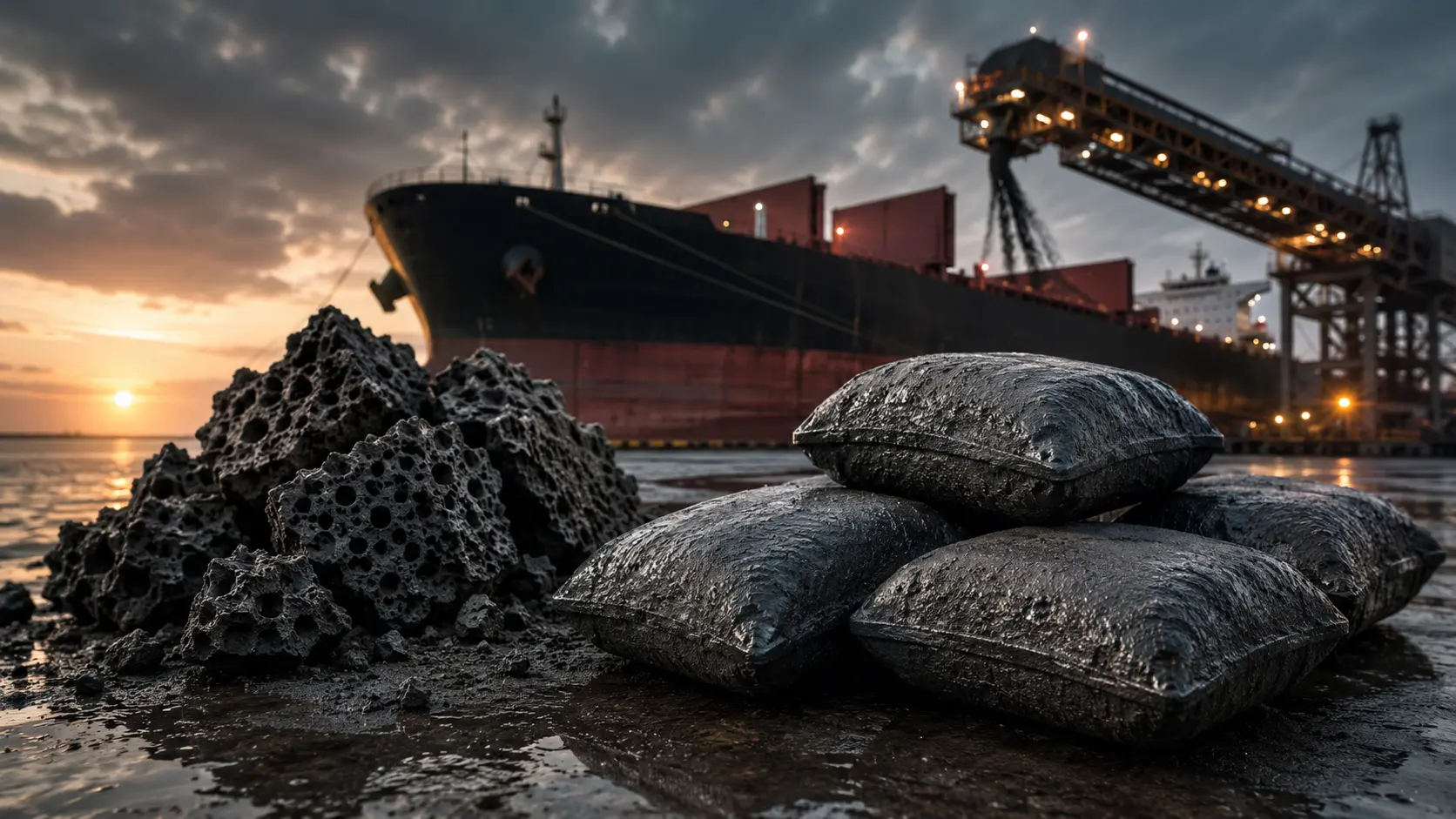

At a Glance
- Concept: The metallurgical and logistical difference between raw, highly reactive sponge iron (DRI) and its compacted, transport-safe variant (HBI).
- Why it matters: Making zero-carbon “green steel” requires shipping iron from renewable energy hubs (like the Middle East) to industrial centers (like Europe). Shipping raw DRI causes catastrophic maritime fires, making HBI the mandatory physical format of the green transition.
- Who uses it: Global steel manufacturers operating Electric Arc Furnaces (EAFs), bulk carrier shipping lines, and maritime insurance underwriters.
- Biggest takeaway: A piece of DRI is essentially a metallic sponge. When exposed to sea air, its massive internal surface area rusts instantly, generating extreme heat and explosive hydrogen gas. Compacting it into HBI squeezes the holes out, preventing the explosion.
In Simple Words
To make “green steel,” you use hydrogen instead of coal to pull the oxygen out of raw iron ore. This process never melts the rock. Because the rock stays solid while the oxygen is chemically ripped out of it, the resulting piece of iron is left completely full of microscopic holes. It looks and acts exactly like a sponge. This is called Direct Reduced Iron (DRI), or “sponge iron.”
If you dump 50,000 tons of this metallic sponge into the cargo hold of a ship, you have a massive problem. The sponges absorb moisture from the ocean air. The iron inside those microscopic holes begins to rust. Rusting generates heat. Because the iron is so porous, it rusts so incredibly fast that the heat builds up until the iron literally catches fire, reaching temperatures over 900°C. Worse, the reaction releases highly flammable hydrogen gas.
To prevent cargo ships from exploding, factories take the hot, freshly made DRI and run it through massive hydraulic presses. They squish the sponge iron at extreme pressures until all the microscopic holes are crushed closed. This turns the sponge into dense, solid bricks called Hot Briquetted Iron (HBI). Because the holes are gone, the ocean air cannot get inside, making the iron safe to put on a ship.
Why This Matters
The geography of green steel is physically fractured.
To produce DRI without carbon emissions, you need gigawatts of cheap, renewable electricity to power green hydrogen electrolyzers. The places with the cheapest solar and wind energy—such as Australia, Saudi Arabia, and Chile—are rarely the same places that actually manufacture finished steel, such as Germany, Japan, or South Korea.
Therefore, the global supply chain must decouple the reduction of iron (pulling the oxygen out) from the melting of iron (making the steel). Decarbonized iron must be traded across oceans as an intermediate global commodity.
However, the maritime insurance industry dictates global trade. Following several catastrophic ship explosions in the early 2000s caused by raw DRI, the International Maritime Organization (IMO) heavily restricted its transport. For green steel to scale, commodity traders and supply chain directors must rely entirely on HBI to bypass the staggering logistical costs and insurance premiums associated with shipping reactive sponge iron.
The Big Picture
The regulatory framework governing this trade is the International Maritime Solid Bulk Cargoes (IMSBC) Code.
Under maritime law, not all iron is created equal. The IMO classifies raw sponge iron as DRI (B)—a highly hazardous material that requires extreme, expensive precautions to move. Hot Briquetted Iron is classified as DRI (A)—a significantly safer, low-risk cargo.
Understanding the thermodynamic transition from DRI to HBI is not just a matter of metallurgy; it is the fundamental economic bridge that allows a multi-trillion-dollar heavy industry to achieve global decarbonization without violating international maritime safety laws.
HOW HOT BRIQUETTED IRON WORKS
Transporting reduced iron requires defeating the natural, violent thermodynamics of oxidation.
1. The Fundamental Problem: Porosity and Pyrophoricity
When iron ore (iron oxide, Fe₂O₃.) is reduced by a gas like hydrogen or carbon monoxide, the oxygen atoms are stripped away, but the volume of the pellet remains the same. This leaves a highly porous structure with an immense internal surface area. Because the iron is no longer bound to oxygen, it is chemically desperate to re-oxidize. When exposed to ambient air, this porous iron acts as a pyrophoric material—it oxidizes (rusts) so rapidly that the exothermic heat of the reaction causes spontaneous combustion.
2. The Hydrogen Evolution Threat
If DRI comes into contact with fresh water or seawater (moisture in a ship’s hold), a secondary, more dangerous reaction occurs. The iron reacts with the water to form iron oxide and free hydrogen gas:
Fe + H₂O → FeO + H₂
Hydrogen gas is highly explosive and can detonate if it reaches a concentration of just 4% by volume in the air.
3. The Insufficiency of Inerting (DRI Transport)
To legally ship raw DRI (B) under the IMSBC Code, the shipping company must purge all oxygen from the cargo hold and replace it with a 100% pure Nitrogen blanket. The moisture content of the cargo must be strictly verified below 0.3%. The ship must be equipped with complex gas monitoring sensors, and the hold must remain perfectly sealed. If a hatch leaks and seawater gets in, the ship is in immediate danger of a localized meltdown. This “inerting” process is logistically complex and prohibitively expensive for routine global trade.
4. The Core Mechanism: Hot Briquetting
To eliminate these hazards, engineers developed Hot Briquetted Iron (HBI). Immediately after the DRI exits the reduction furnace at temperatures exceeding 650°C, it is fed directly into massive roller presses. The extreme heat makes the iron malleable. The presses exert massive mechanical force, crushing the porous pellets into dense, pillow-shaped briquettes.
5. Density and Passivation
The briquetting process achieves two critical physical changes. First, it increases the density of the material to over 5,000 kg/m³. Second, by crushing the pores closed, the internal surface area is virtually eliminated. When HBI is exposed to air, only the smooth outer surface oxidizes. This creates a microscopic, natural layer of rust that seals the briquette—a process called “passivation.” The inner core remains pure, unreacted iron, completely shielded from the ocean air.
Real-World Applications
The distinction between DRI and HBI dictates the layout of multi-billion dollar industrial megaprojects.
Integrated Mill Operations (Hot DRI): If a steel company builds a hydrogen reduction tower directly next to an Electric Arc Furnace (EAF) on the exact same property, they do not bother making HBI. They use pneumatic transport tubes to shoot the raw, 600°C DRI directly into the melting furnace. This “Hot DRI” (HDRI) method saves massive amounts of electricity because the EAF does not have to spend energy re-heating cold iron.
Export Hubs (HBI Facilities): If a mining company in Western Australia builds a green hydrogen facility to process iron ore for export, they must install a hot briquetting plant at the base of the reduction tower. The resulting HBI is piled into open-air stockpiles at the port, exposed to the rain, and loaded onto standard bulk carrier ships bound for Japan or Europe, completely bypassing the need for nitrogen blankets.
Economic & Strategic Impact
The transition to HBI effectively commoditizes green iron.
Historically, steel was manufactured end-to-end in centralized locations (like the Ruhr Valley in Germany or the Rust Belt in the United States) because coal and iron ore were cheap to ship. With the green transition, shipping raw hydrogen gas to Germany to make steel is economically disastrous; hydrogen is notoriously difficult and expensive to transport via ship.
Instead, it is vastly cheaper to use the hydrogen where it is made, turn the local iron ore into HBI, and ship the solid iron bricks to Germany.
This flips the geopolitical leverage of heavy industry. Nations with extreme solar irradiance and massive open land (Saudi Arabia, Mauritania, Australia) are positioning themselves as the new “HBI superpowers.” They will capture the high-value middle step of the steel supply chain, exporting premium HBI to European and Asian EAF operators who are legally restricted from burning coal by regulations like the EU’s Carbon Border Adjustment Mechanism (CBAM).
Advantages
HBI (Hot Briquetted Iron)
- Maritime Safety: Eliminates the risk of spontaneous combustion and massive hydrogen gas evolution during transoceanic voyages.
- Logistical Simplicity: Can be stored in open-air yards, exposed to rain, and shipped in standard bulk carriers with normal surface ventilation.
- High Yield: Retains 90% to 94% total iron content, making it a highly premium, clean feedstock that dilutes the impurities found in scrap steel.
DRI (Direct Reduced Iron)
- Energy Efficiency (If kept localized): Bypassing the mechanical briquetting process saves capital expenditure.
- Hot Charging: Feeding 600°C raw DRI directly into an adjacent EAF drastically lowers the electricity required to melt the steel, optimizing the localized plant’s overall energy footprint.
Limitations
HBI (Hot Briquetted Iron)
- Capital Expenditure: Adding a hot briquetting machine to a direct reduction plant adds tens of millions of dollars to the facility’s construction cost.
- Energy Penalty: The briquettes must be cooled for transport, meaning the receiving steel mill must expend massive amounts of electricity to re-heat and melt the cold bricks upon arrival.
DRI (Direct Reduced Iron)
- Untransportable: Requires prohibitively expensive pure nitrogen atmospheres and continuous temperature monitoring to move on the open ocean.
- Degradation: If stored in open air, raw DRI will rapidly oxidize, essentially turning back into useless rust and destroying its economic value before it ever reaches the furnace.
Common Misconceptions
Misconception: HBI is a type of melted iron.
Reality: HBI is never melted. The iron ore remains in a solid state throughout the entire reduction and briquetting process. It is simply heated enough to become soft, like hot plastic, so it can be squished.
Misconception: Raw DRI cannot be shipped at all.
Reality: DRI (B) can legally be shipped, but only under the strictest IMSBC Code regulations. Because the risk of losing the ship to a fire is so high, many ship captains and P&I (Protection and Indemnity) insurance clubs simply refuse to carry it.
Misconception: Wetting HBI ruins it.
Reality: While wetting HBI will cause slight surface rusting and very minor hydrogen generation, it is structurally safe. The IMSBC Code allows HBI to be shipped with up to 1.0% moisture, whereas raw DRI is heavily restricted.
What Most People Miss
The dust is deadlier than the briquette.
Even when a facility produces safe HBI, the mechanical handling of the briquettes—dropping them onto conveyor belts and into cargo holds—chips off tiny pieces of iron. These fragments are classified as DRI (C) Fines.
Because these fines are tiny, their surface-area-to-mass ratio is extreme. They exhibit the exact same highly reactive, pyrophoric, and explosive properties as raw sponge iron. A ship carrying perfectly safe HBI can still suffer a catastrophic explosion if the loading crew fails to properly clean the cargo hold and allows a concentrated pile of broken fines and dust to accumulate in the corner of the ship where moisture can reach it.
Comparison Table
| Feature | DRI (Sponge Iron) | HBI (Hot Briquetted Iron) |
| IMSBC Code Classification | DRI (B) – Highly Reactive | DRI (A) – Less Reactive |
| Density | Low (Highly Porous) | > 5,000 kg/m³ |
| Shipping Atmosphere | Mandatory 100% Nitrogen Blanket | Normal Atmosphere (Surface Ventilation) |
| Moisture Limit | Strictly < 0.3% | Up to 1.0% |
| Self-Heating Risk | Extreme (Can exceed 900°C) | Low (Passivated surface) |
| Maritime Insurance Cost | Astronomically High | Standard Bulk Rates |
Case Study
Situation: In the early 2000s, the global trade of direct reduced iron was growing, but maritime safety protocols were poorly enforced and deeply misunderstood by bulk carrier crews.
Challenge: On February 28, 2004, the bulk carrier Ythan was sailing off the coast of Colombia carrying a cargo of highly reactive DRI fines.
Solution (The Failure): The cargo was loaded with a higher moisture content than permitted. Deep inside the cargo hold, the moisture reacted with the porous iron fines, rapidly evolving explosive hydrogen gas. Because the crew was unaware of the acute danger, the hold was not properly inerted with nitrogen, and the ventilation systems were inadequate to clear the gas buildup.
Outcome: The hydrogen gas ignited, triggering a massive series of explosions that ripped through the Ythan, killing six crew members and sinking the vessel.
Lessons Learned: The Ythan tragedy forced a reckoning in global maritime law. The International Maritime Organization (IMO) fundamentally rewrote the IMSBC Code for solid bulk cargoes. They split reduced iron into strict categories (DRI A, B, and C) and mandated that any highly reactive DRI must be shipped under an absolute nitrogen blanket. This regulatory clampdown made HBI the only economically viable option for the mass oceanic transport of decarbonized iron.
Future Outlook
Next 12–24 Months
European steel giants (such as Thyssenkrupp and ArcelorMittal) will aggressively accelerate off-take agreements with Middle Eastern and North African (MENA) energy firms. Because Europe lacks the cheap renewable energy to generate the massive amounts of green hydrogen required for domestic DRI production, they will lock in long-term import contracts to secure millions of tons of foreign-produced green HBI.
Next 3–5 Years
Traditional iron ore mining giants like Vale, Rio Tinto, and BHP will pivot their business models. Instead of merely digging up raw hematite and shipping it to China, they will vertically integrate. They will build massive green hydrogen electrolyzers and hot briquetting plants directly at the Australian and Brazilian mine sites, upgrading their dirt into premium HBI before it ever goes on a ship.
Next 10 Years
We will witness the absolute geographical decoupling of the global steel industry. The “heavy” and highly energetic phase of steelmaking (reducing the iron) will permanently migrate to the Earth’s “sunbelts.” The localized, high-tech phase (melting HBI into specialized steel alloys via Electric Arc Furnaces) will remain near the automotive and industrial hubs of the West and Asia.
Most Likely Scenario
Hot Briquetted Iron will become one of the most heavily traded strategic commodities of the 21st century. As carbon taxes make traditional blast furnaces financially obsolete, the maritime routes carrying dense, passivated green iron bricks will replace the routes that historically carried metallurgical coal, fundamentally rewriting the logistics of global heavy infrastructure.
Key Takeaways
- Direct Reduced Iron (DRI) is a highly porous “sponge iron” that spontaneously combusts and evolves explosive hydrogen gas when exposed to sea air and moisture.
- To ship reduced iron safely across the ocean, it must be compacted at extreme temperatures (>650°C) into dense bricks called Hot Briquetted Iron (HBI).
- Compacting the iron eliminates the internal surface area, allowing the outside of the briquette to “passivate” (rust slightly) and seal the pure iron inside.
- The International Maritime Organization (IMO) heavily restricts the shipping of raw DRI (B) requiring expensive nitrogen blankets, while HBI (DRI A) can be shipped normally.
- Because green hydrogen is difficult to transport, the green steel supply chain relies on producing HBI at renewable energy hubs and shipping the solid iron bricks to global steel mills.
- Iron dust and broken briquette pieces (DRI Fines) remain highly explosive and require strict cargo hold cleanliness to prevent maritime disasters.
Glossary
Direct Reduced Iron (DRI): Iron ore that has had its oxygen removed by a reducing gas at temperatures below the melting point of iron, resulting in a highly porous, reactive sponge iron.
Electric Arc Furnace (EAF): A modern steelmaking furnace that uses massive electrical currents to melt scrap steel and HBI without burning coal.
Exothermic Reaction: A chemical reaction that releases energy in the form of heat, such as the rapid oxidation of porous iron.
Hot Briquetted Iron (HBI): DRI that has been mechanically compacted at temperatures above 650°C to achieve a density greater than 5,000 kg/m³, making it safe for bulk maritime transport.
IMSBC Code: The International Maritime Solid Bulk Cargoes Code, the legally binding UN framework dictating the safe stowage and shipment of dangerous bulk materials.
Passivation: A natural or artificial process where a material develops a microscopic outer layer of corrosion that acts as a shield, protecting the inner material from further reactive degradation.
Pyrophoricity: The property of a substance to ignite spontaneously when exposed to air.
Frequently Asked Questions
Why not just melt the iron before shipping it?
Melting iron turns it into “Pig Iron.” However, melting requires a massive amount of extra energy, which defeats the purpose of making an efficient, low-energy green product. Squishing it into HBI requires significantly less energy than melting it.
Can HBI be used in a traditional Blast Furnace?
Yes. While HBI is primarily designed for Electric Arc Furnaces, traditional coal-fired blast furnaces can add HBI to their mix to significantly increase the furnace’s efficiency and lower its overall carbon emissions.
How is green hydrogen used to make DRI?
Inside the reduction tower, pure hydrogen gas (H₂) flows over the iron oxide rock (Fe₂O₃,). The hydrogen chemically binds with the oxygen in the rock, turning into water vapor (H₂O,) and leaving pure iron (Fe) behind.
Is it dangerous if HBI gets rained on before loading?
It is generally safe. Open-air storage of HBI is permitted because the briquette is so dense that water cannot penetrate the core. However, the IMSBC code still mandates that the cargo be kept as dry as practicable during loading to prevent excess moisture from accumulating in the ship’s hold.
Why did the IMO classify DRI into A, B, and C categories?
To give ship captains and insurance underwriters clear safety rules. Type A is safe HBI. Type B is highly dangerous raw sponge iron. Type C is the highly dangerous broken dust and fines generated by moving A or B.
What gas is used to blanket raw DRI on a ship?
Pure nitrogen. The nitrogen displaces all the oxygen in the cargo hold, making it chemically impossible for the porous iron to oxidize and catch fire during the voyage.
Sources
- International Maritime Organization (IMO): International Maritime Solid Bulk Cargoes (IMSBC) Code
- International Iron Metallics Association (IIMA): Guide for Shipping, Handling & Storage of DRI and HBI
- West of England P&I Club: The Hot Briquetted Iron (HBI) Guide to Shipping
- NorthStandard Marine Insurance: Carriage of Direct Reduced Iron (DRI) by Sea and IMO Code Changes