Advertisement
)

At a Glance
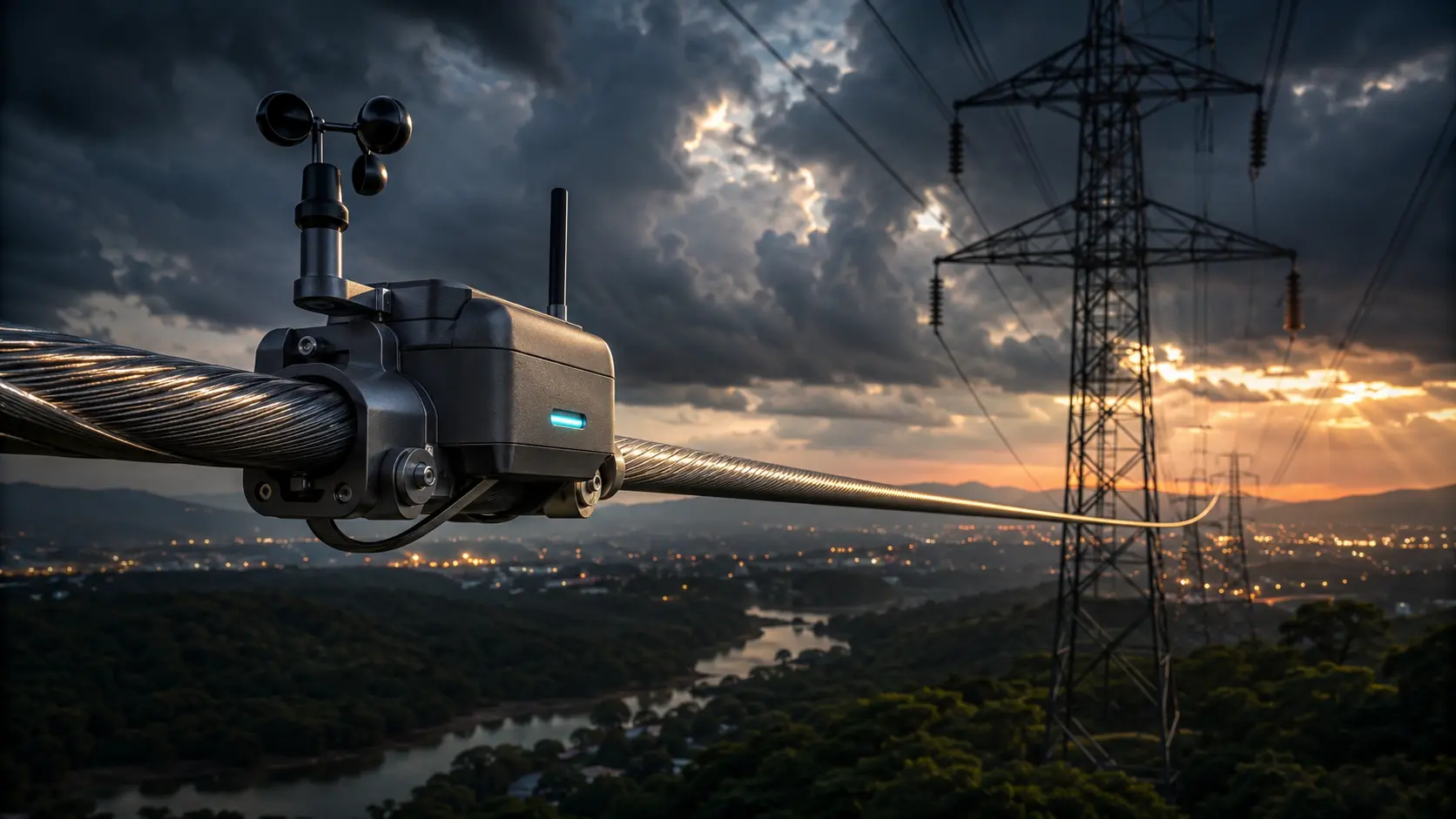
- Concept: Hanging advanced smart sensors on overhead power lines to measure actual wind cooling, ambient temperature, and line sag, instantly calculating the true thermal capacity of the wire.
- Why it matters: Permitting and building new high-voltage transmission lines takes 10 to 15 years, but the surging power demands of AI data centers and electric vehicles are happening right now. DLR unlocks massive hidden capacity overnight without pouring an ounce of new concrete.
- Who uses it: Electric utilities, Regional Transmission Organizations (RTOs/ISOs), and Grid Enhancing Technology (GET) providers like LineVision, Heimdall Power, and Ampacimon.
- Biggest takeaway: Wind is the ultimate cooler of power lines. Traditional grid math assumes zero wind. By factoring in a simple 3 mph perpendicular breeze, a power line can instantly carry significantly more current without dangerously sagging into the trees.
In Simple Words
Imagine a major highway where the speed limit changes based on the weather. For the past century, the electrical grid has essentially operated under a “Static Line Rating” (SLR). Grid operators assumed it was always a 100-degree, windless summer day. Because heat causes metal power lines to physically expand and sag dangerously close to trees, grid operators severely limit how much electricity can flow through the lines to prevent them from melting or causing wildfires.
This conservative assumption keeps the grid safe, but it means our power lines are vastly underutilized for 95% of the year.
Dynamic Line Rating (DLR) updates the grid’s speed limit in real time. Utilities deploy drones to snap small IoT (Internet of Things) sensors directly onto the high-voltage wires. These sensors measure the exact temperature, tension, and wind speed hitting the cable. If it is a cool, windy Tuesday, the wind physically cools the metal. The sensors detect this cooling effect and alert the central control room that the line can safely handle 30% more power. By continuously reading the actual weather, DLR allows the grid to instantly act like it has thicker, newer wires.
Why This Matters
The global electrical grid is currently suffering from a massive traffic jam.
In the United States alone, the interconnection queue—the waiting list for new wind, solar, and battery projects to connect to the grid—exceeds thousands of gigawatts. These clean energy projects are fully funded and ready to build, but utilities cannot let them connect because the existing transmission lines are supposedly “full.” To fix this, utilities traditionally build new transmission towers, a process crippled by right-of-way lawsuits, environmental reviews, and supply chain delays that routinely stretch a single project past a decade.
Meanwhile, the hyper-scaling of Artificial Intelligence requires gigawatt-scale data centers immediately. We cannot wait 10 years to build new wires.
DLR is the ultimate stopgap. By deploying Grid Enhancing Technologies (GETs), utilities can optimize their existing infrastructure and alleviate transmission bottlenecks overnight. This prevents “curtailment”—the painful practice of forcing cheap, clean wind farms to shut down simply because the local wires are artificially rated as congested. Unlocking this latent capacity saves ratepayers billions of dollars in congestion fees and accelerates the integration of zero-carbon energy.
The Big Picture
The regulatory landscape governing transmission capacity is undergoing a forced modernization.
Historically, U.S. utilities relied on static, seasonal ratings. In December 2021, the Federal Energy Regulatory Commission (FERC) intervened, issuing FERC Order 881. This landmark ruling required all U.S. transmission providers to transition to Ambient-Adjusted Ratings (AAR) by July 12, 2025. AAR forces utilities to adjust their line capacities based on regional weather forecasts, updating at least hourly.
However, AAR is only a transitional step. While AAR relies on generalized weather forecasts, DLR relies on hyper-local, physical sensor data. Recognizing the massive economic value of GETs, FERC went further with FERC Order 1920, finalized in May 2024. This order mandates that transmission providers must explicitly consider grid-enhancing technologies—specifically dynamic line ratings and advanced power flow controls—in their long-term regional transmission planning, signaling that sensor-driven capacity is no longer an optional science experiment, but a regulatory expectation.
HOW DYNAMIC LINE RATING WORKS
Extracting hidden capacity from a copper or aluminum wire requires mastering the thermodynamics of the conductor.
1. The Fundamental Problem: I2R Heating and Thermal Sag
When electrical current (I) flows through a wire with resistance (R), it generates heat, a physical property known as I2R heating. Overhead transmission lines are generally made of Aluminum Conductor Steel Reinforced (ACSR) cables. As the cable heats up, the metal physically expands and the line “sags” toward the ground. If it sags too low, the electricity can arc into trees, causing catastrophic wildfires or triggering safety relays that shut off the power.
2. The Insufficiency of AAR (Ambient Adjusted Ratings)
While FERC Order 881 forces the use of AAR, AAR only looks at ambient air temperature forecasts. It completely ignores wind. Air temperature matters, but convective cooling (wind blowing across the wire) is mathematically the most powerful factor in keeping a power line cool. Because AAR relies on regional weather stations, it cannot accurately predict the hyper-local micro-gusts of wind hitting a specific span of wire in a remote valley.
3. The Core Mechanism: Contact and Non-Contact Sensors
DLR solves this by putting eyes on the wire. Companies use two primary methods. Contact sensors (like those from Heimdall Power or Ampacimon) are clamped directly onto the energized wire by drones, physically measuring the vibration, tension, and temperature of the metal. Non-contact sensors (like LineVision) are mounted on the steel transmission tower itself, using LiDAR and optical sensors to safely measure the physical sag of the line without touching the high-voltage conductor.
4. Technical Depth: Computational Fluid Dynamics (CFD)
Raw sensor data is meaningless without advanced math. Providers like LineVision stream the sensor telemetry into cloud platforms equipped with Computational Fluid Dynamics (CFD) algorithms. These models map how the local terrain, vegetation, and structures alter the wind flow around the transmission line. The algorithm calculates the real-time thermal state of the conductor and outputs a dynamic rating—often providing a 48-hour forecast of the line’s maximum safe current-carrying capacity.
5. Real-World Consequences: SCADA Integration
The final, most critical step is feeding this new capacity data directly into the utility’s Supervisory Control and Data Acquisition (SCADA) system. The Energy Management System (EMS) instantly receives the DLR telemetry, allowing the human grid dispatchers to safely route excess power from a suddenly active wind farm through the newly unlocked capacity of the transmission line, mitigating congestion in real-time.
Real-World Applications
DLR is actively deployed to solve the most expensive bottlenecks in modern power systems.
Unlocking Curtailed Wind Power: The greatest synergy in energy infrastructure is the relationship between wind farms and DLR. Wind turbines generate maximum power during high wind events. Coincidentally, high winds simultaneously cool the local transmission lines, instantly increasing their physical capacity. DLR perfectly matches the generation spike with the transmission capacity spike, ensuring that utilities never have to curtail (turn off) clean wind power due to artificial grid congestion.
Data Center Load Management: When a massive 100 MW hyperscale data center connects to the grid, it can overload local transmission corridors. Utilities are using DLR on the critical lines feeding these tech campuses. By continuously monitoring the exact thermal limits of the wires, operators can safely squeeze the necessary electricity through the existing infrastructure while the utility spends the next 5 years navigating the permitting process to string new, higher-voltage cables.
Construction and Outage Mitigation: When a utility needs to upgrade or repair a major transmission line, they must turn it off, which forces the electricity to detour onto smaller, underlying lines. DLR is deployed on these secondary lines before the outage occurs. By maximizing the real-time capacity of the detour routes, the utility avoids triggering rolling blackouts while the primary line is under construction.
Economic & Strategic Impact
The financial arbitrage of Grid Enhancing Technologies is staggering.
Congestion costs—the penalty ratepayers pay when grid operators are forced to turn off cheap renewable energy and turn on expensive, localized fossil-fuel peaker plants because the wires are “full”—cost the U.S. economy billions of dollars annually. By implementing AAR and DLR, utilities can identify between 15% and 40% of additional, safe capacity on existing transmission lines.
The return on investment (ROI) for DLR is historically unprecedented for utility hardware. Installing a network of DLR sensors costs millions of dollars, whereas building a new high-voltage transmission line costs hundreds of millions or billions of dollars. Industry data shows that DLR systems typically deliver a full return on investment in less than a year strictly through the reduction of congestion costs.
Strategically, the rapid rollout of DLR exposes a legacy flaw in the utility business model. In many jurisdictions, utilities are guaranteed a set rate of return on their capital expenditures (building massive steel towers). Software and sensors are traditionally treated as operational expenses, which do not generate guaranteed profits for shareholders. FERC Order 1920’s mandate to evaluate GETs is a deliberate regulatory push to force utilities to prioritize cheap, fast software optimization over slow, expensive concrete.
Advantages
- Extreme Speed to Deployment: DLR sensors are drone-compatible and can be installed on active, live power lines in a matter of minutes without requiring a service outage.
- Massive Capacity Increases: Accurate measurement of convective wind cooling reliably unlocks 15% to 40% more capacity than static summer ratings.
- Asset Health Monitoring: In addition to capacity, the sensors continuously monitor the physical line for anomalous vibrations, galloping (wind-induced swinging), and ice buildup, alerting operators to potential physical failures before they cause an outage.
Limitations
- Cybersecurity Vulnerabilities: Feeding live, hyper-local sensor telemetry directly into an Energy Management System (EMS) opens a new attack vector. The data streams must be heavily encrypted to prevent adversaries from spoofing false ratings and triggering an artificial blackout.
- Maintenance in Harsh Environments: Physical sensors clamped to high-voltage wires are exposed to extreme UV radiation, lightning strikes, and freezing rain, requiring ruggedized IP-66/67 hardware to maintain the 99.5% uptime required by grid operators.
- Not a Permanent Panacea: DLR optimizes the margins. It cannot magically turn a 69kV rural distribution line into a 500kV interstate transmission backbone. It buys grid operators 5 to 10 years of breathing room, but physical wire expansion remains ultimately necessary for deep decarbonization.
Common Misconceptions
Misconception: DLR physically changes the power lines to make them carry more power.
Reality: DLR is purely an information technology. It does not alter the physical metallurgy of the wire; it simply provides accurate mathematical data that proves the wire can safely handle more current than the outdated rulebook previously allowed.
Misconception: AAR and DLR are the same thing.
Reality: Ambient Adjusted Ratings (AAR) rely entirely on regional weather forecasts (specifically temperature). Dynamic Line Ratings (DLR) rely on physical hardware sensors installed on the actual tower to measure hyper-local wind speed, solar radiation, and the physical sag of the metal.
Misconception: DLR makes power lines more dangerous by pushing them to their absolute limit.
Reality: DLR makes the grid safer. Static ratings guess the line’s temperature; DLR knows it. If the wind suddenly dies and the temperature spikes unexpectedly, a DLR system will actually lower the rating below the static baseline, preventing the line from overheating during anomalous weather.
What Most People Miss
The hidden genius of DLR is its ability to bypass solar heating effects.
While the industry fixates heavily on wind cooling, solar radiation acts as a massive, invisible heater on transmission lines. FERC Order 881 specifically mandates that utilities must account for the difference between daytime and nighttime solar heating, updating sunrise and sunset times continuously. A physical DLR sensor directly measures the solar radiation hitting the wire. Because there is zero solar heating at 2:00 AM, DLR systems automatically unlock a massive surge of capacity every night, perfectly aligning with the ideal charging windows for millions of residential Electric Vehicles.
Comparison Table
| Feature | Static Line Rating (SLR) | Ambient Adjusted Rating (AAR) | Dynamic Line Rating (DLR) |
| Data Source | Worst-case historical assumptions. | Regional weather forecasts. | Real-time hardware sensors on the wire. |
| Update Frequency | Seasonal (e.g., Summer vs. Winter). | Hourly / Periodic. | Real-time, continuous. |
| Key Variables | Fixed temperature, zero wind. | Forecasted ambient temperature. | Wind speed, sag, tension, solar radiation. |
| Capacity Increase | Baseline. | Low to Moderate (5% – 15%). | Maximum (15% – 40%). |
| Cost & Complexity | Zero. | Low (Software/Data integration). | Moderate (Hardware installation + AI Analytics). |
| FERC Compliance | Phased out by Order 881. | Mandatory by July 2025. | Advanced grid optimization standard. |
Case Study
Situation: The United Kingdom’s transmission network was facing severe congestion due to a massive influx of offshore wind generation in the North. National Grid UK was heavily relying on static and seasonal ratings, forcing them to curtail clean energy and pay millions in congestion constraints while waiting for new lines to be built.
Challenge: Upgrading the physical wires would take years and cost billions. National Grid needed an immediate, non-intrusive way to safely increase the capacity of the existing critical corridors without shutting off the power to install the technology.
Solution: National Grid UK partnered with LineVision, deploying non-contact, tower-mounted DLR sensors across the congested network. Because the sensors used LiDAR to monitor the sag of the lines from the tower, they were installed rapidly without requiring any power outages.
Outcome: The integration of real-time wind and temperature telemetry directly into National Grid’s control room was a massive success. The DLR system delivered an average capacity increase of 31% across the monitored lines. This instantly unlocked 1 GW of additional clean energy capacity and saved the utility approximately USD 40 million annually in constraint and redispatch costs.
Lessons Learned: The deployment definitively proved that DLR is not an experimental technology. By utilizing physical sensors and Computational Fluid Dynamics (CFD), utilities can safely operate their grids closer to the physical edge, achieving sub-12-month returns on investment and solving gigawatt-scale bottlenecks with software rather than steel.
Future Outlook
Next 12–24 Months
The immediate horizon is dominated by the July 2025 deadline for FERC Order 881 compliance. While utilities will achieve minimum compliance using forecast-based AAR, progressive grid operators will heavily deploy physical DLR sensors on their most congested corridors, using the mandatory AAR software upgrades as a Trojan horse to seamlessly integrate true real-time IoT hardware data into their dispatch centers.
Next 3–5 Years
FERC Order 1920 will force a massive shift in long-term transmission planning. State regulators and RTOs will routinely reject utility proposals for multi-billion dollar new transmission lines if the utility has not mathematically proven that deploying Grid Enhancing Technologies (like DLR and advanced topology control) is insufficient to solve the bottleneck. DLR will transition from a niche optimization tool into a mandatory first step before any new concrete is poured.
Next 10 Years
The grid will transition into full autonomous dispatch. DLR telemetry will be ingested by advanced artificial intelligence platforms operating the Energy Management System (EMS). The AI will continuously monitor the thermal capacity of the wires and autonomously ramp battery storage and AI data center loads up or down, matching consumption perfectly to the real-time wind cooling of the local high-voltage cables without any human intervention.
Most Likely Scenario
DLR is the defining grid technology of the late 2020s. While it cannot permanently solve the need for new transmission lines required by deep electrification, it provides the critical 10-year runway the global economy needs. By digitally squeezing every last megawatt out of the legacy copper and aluminum web, DLR ensures that the AI revolution and the clean energy transition do not stall in the interconnection queue.
Key Takeaways
- Dynamic Line Rating (DLR) uses IoT sensors to measure real-time weather and line sag, maximizing the safe carrying capacity of transmission lines.
- Wind is the dominant variable; accurate measurement of convective cooling allows grid operators to push up to 40% more power through existing wires.
- FERC Order 881 mandates the U.S. transition to Ambient-Adjusted Ratings (AAR) by July 2025, paving the way for advanced DLR adoption.
- Unlike AAR which relies on regional weather forecasts, DLR relies on hyper-local, physical hardware clamped to the wire or mounted on the tower.
- DLR offers an incredibly fast ROI (often under a year) by drastically reducing the congestion costs associated with turning off cheap wind power.
- FERC Order 1920 mandates that utilities must evaluate Grid Enhancing Technologies (GETs) in long-term planning, fundamentally shifting the utility business model toward software optimization.
Glossary
Ambient-Adjusted Rating (AAR): A method of rating power lines that adjusts capacity based on forecasted ambient air temperatures, rather than static seasonal assumptions.
Computational Fluid Dynamics (CFD): Advanced mathematical modeling used by DLR providers to accurately simulate how wind flows around complex terrain and transmission towers.
Curtailment: The practice of forcing wind or solar farms to stop generating electricity because the local transmission lines are congested and cannot carry the power.
Dynamic Line Rating (DLR): The calculation of transmission line thermal capacity based on continuous, real-time sensor data measuring wind speed, ambient temperature, solar radiation, and physical line tension.
Grid Enhancing Technologies (GETs): A suite of technologies, including DLR, advanced power flow controls, and topology optimization, designed to maximize the capacity and efficiency of the existing power grid.
I2R Heating: The fundamental physics principle where electrical current flowing through a resistant wire generates thermal heat, causing the metal to expand.
Thermal Sag: The physical drooping of an overhead power line caused by the metal expanding due to extreme heat from electrical current and ambient weather.
Frequently Asked Questions
How are DLR sensors installed on live power lines?
Modern contact sensors are designed to be installed by specialized drones. The drone flies up to the energized, high-voltage wire and clamps the sensor directly onto the cable in a matter of minutes, completely avoiding the need to shut off the power to the local neighborhood.
Why didn’t utilities do this 20 years ago?
Two reasons: Technology and incentives. Twenty years ago, rugged IoT sensors, cellular telemetry, and CFD cloud computing were not cheap or reliable enough. Furthermore, regulated utilities make guaranteed profits by building expensive new infrastructure, not by installing cheap optimization software. It required federal intervention (FERC Orders) to force adoption.
What happens if the sensor breaks?
DLR systems are designed with high redundancy and strict fail-safes. If a sensor breaks or loses cellular connection, the utility’s Energy Management System (EMS) automatically drops the line’s capacity rating back down to the conservative AAR or static baseline until the hardware is repaired.
Does DLR work for underground power lines?
Underground cables rely on a different type of rating system called Dynamic Cable Rating (DCR). Underground cables are cooled by soil and thermal conduction, not by wind. While sensors can monitor soil temperature, the physics and constraints are entirely different from overhead lines.
Who owns the data generated by the sensors?
The data is typically processed and validated by the DLR provider’s cloud analytics platform, but the final capacity rating model belongs to the utility and is housed securely within their high-security IT environment to ensure grid safety.
Can DLR prevent wildfires?
Yes. By continuously monitoring the exact temperature and physical sag of the line, DLR guarantees that grid operators never accidentally push too much power through a wire on a hot, windless day, preventing the line from sagging into vegetation and sparking a fire.
Sources
- P&R Tech: FERC Order 881: How to Understand New 2025 Requirements
- Enline Energy: FERC, Dynamic Line Rating, and Grid Enhancing Technologies in 2026
- Ampacimon: FERC Order 881: Comprehensive Handbook for Dynamic Line Rating Implementation
- LineVision: What is DLR? Understanding Dynamic Line Ratings for Modern Grid Optimization