Advertisement
)

At a Glance
- Concept: Digitizing the most important document in global trade—the Bill of Lading—using secure, un-copyable digital ledgers.
- Why it matters: Ocean freight moves over USD 14 trillion in goods annually, yet relies on physical paper flown globally via FedEx or DHL. Paper processing costs the industry roughly USD 4 billion a year and constantly delays cargo at ports.
- Who uses it: Global shipping carriers (Maersk, MSC), corporate supply chain directors, trade finance banks, and customs authorities.
- Biggest takeaway: A PDF cannot serve as a Bill of Lading because a PDF can be copied. An eBL utilizes cryptographic technology to solve the “double-spend” problem, ensuring that only one true digital original exists at any given moment, thus acting as a legally binding document of title.
In Simple Words
Imagine going to a high-end coat check. The attendant takes your coat and hands you a physical paper ticket. That ticket is the sole proof of ownership. If you want your friend to pick up the coat, you have to physically hand them that piece of paper. You cannot just take a photo of the ticket and text it to them, because the attendant knows a photo can be printed ten times by ten different people, all trying to claim the same coat.
In global trade, the Bill of Lading (BoL) is the coat check ticket for a multi-million-dollar shipping container.
For hundreds of years, this paper ticket had to physically travel faster than the cargo ship. If a ship carrying iPhones arrived in Los Angeles from Shenzhen before the paper ticket arrived via international courier, the iPhones sat frozen at the dock.
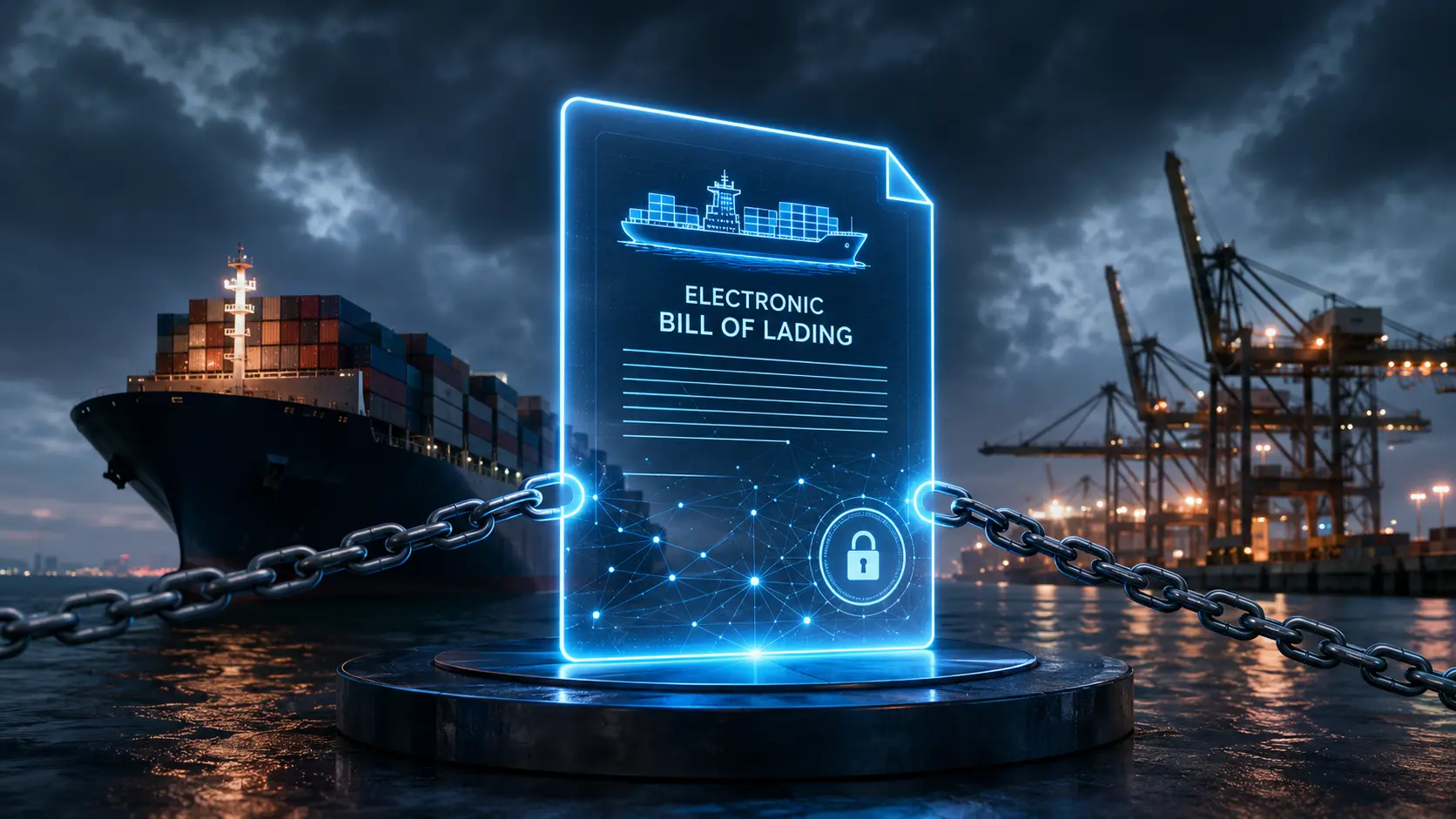
An Electronic Bill of Lading (eBL) is a digital coat check ticket that cannot be copied or screenshotted. Using secure ledger technology, it creates a digital asset that moves from the seller’s digital wallet to the buyer’s digital wallet instantly. Because it is mathematically impossible to duplicate, port authorities and banks accept it as absolute proof of ownership, eliminating the need for physical paper entirely.
Why This Matters
The reliance on physical paper is the most expensive, archaic bottleneck in the modern global supply chain.
Processing paper Bills of Lading accounts for 10% to 30% of total trade documentation costs. According to verified data from the Digital Container Shipping Association (DCSA), achieving 100% eBL adoption globally will save the industry USD 4 billion annually in direct administrative costs, while unlocking up to USD 18 billion in broader economic growth by increasing supply chain velocity.
Beyond administrative costs, paper creates severe working capital constraints. In commodity trading (like crude oil or iron ore), the cargo is often sold and resold dozens of times while the ship is in transit. Every time the cargo is sold, the physical paper BoL must be endorsed with a pen and couriered to the new owner’s bank. This takes weeks. In the interim, millions of dollars of capital are trapped in escrow (Letters of Credit). By digitizing the BoL, trade finance banks can execute ownership transfers and release funds in minutes, freeing up massive liquidity for global corporations.
The Big Picture
The primary barrier to eBL adoption was never technological; it was entirely legal.
The technology to create secure, un-copyable digital assets has existed for a decade. However, under international maritime law, a digital token did not legally constitute a “Document of Title.” If a legal dispute arose, courts historically demanded to see the physical, wet-ink piece of paper.
This legal roadblock was obliterated in September 2023 when the United Kingdom enacted the Electronic Trade Documents Act (ETDA). Because roughly 80% of all global maritime trade contracts are governed by English common law, the ETDA was the watershed moment. The Act legally granted qualifying digital documents the exact same legal status as physical paper. Paired with the UNCITRAL Model Law on Electronic Transferable Records (MLETR), the geopolitical legal architecture is now officially in place to eradicate paper from international shipping.
HOW AN ELECTRONIC BILL OF LADING WORKS
Replacing physical paper with a digital asset requires solving the fundamental laws of digital replication. Here is the first-principles breakdown of the eBL mechanism.
1. The Fundamental Problem: The Functions of a BoL
A Bill of Lading serves three mandatory legal functions:
- Receipt of Goods: Proof the carrier received the cargo.
- Contract of Carriage: The terms of the shipping agreement.
- Document of Title: The physical key that proves ownership and grants the right to claim the goods.While functions 1 and 2 are easily digitized via emails and PDFs, function 3 is historically impossible to achieve with a standard computer file because files can be infinitely duplicated.
2. The Insufficiency of PDFs
If a supplier emails a PDF Bill of Lading to a buyer, the supplier still retains a copy of that PDF in their “Sent” folder. The buyer has a copy. The bank has a copy. If the cargo is worth USD 5 million, who actually owns it? Because the digital file is not singular, it cannot serve as a legally binding Document of Title. This “double-spend” vulnerability is why traditional digitization failed.
3. The Core Mechanism: Cryptographic Registries and DLT
eBL platform providers (such as WAVE BL, Secro, and edoxOnline) solve this by utilizing Distributed Ledger Technology (DLT) or secure, central cryptographic registries. They mint the Bill of Lading as a unique digital token. When the supplier transfers the eBL to the bank, the cryptographic token leaves the supplier’s platform and enters the bank’s platform. It physically ceases to exist in the supplier’s possession. The registry mathematically guarantees singularity, perfectly mimicking the handover of a physical piece of paper.
4. Technical Depth: DCSA API Interoperability
In the early days of eBLs, the industry faced a “walled garden” problem. If Carrier A used Platform X, and Carrier B used Platform Y, the digital documents could not easily be transferred between them, forcing banks to log into dozens of different systems. To solve this, the Digital Container Shipping Association (DCSA) engineered open-source API standards. These standards force different eBL platforms to communicate flawlessly, allowing a digital title to be transferred across competing blockchain registries seamlessly, much like sending an email from a Gmail account to an Outlook account.
5. Real-World Consequences: Zero Demurrage
By solving the legal and technical bottlenecks, the real-world consequence is the elimination of “demurrage.” Demurrage is the penalty fee a shipper pays when their cargo sits at the port terminal too long. Historically, cargo sat idle because the ship arrived, but the physical paper BoL was still stuck in a FedEx sorting facility in another country. With an eBL, the ownership transfers at the speed of light, ensuring customs and port authorities can clear the cargo the minute the ship drops anchor.
Real-World Applications
The eBL is rapidly transforming the most document-heavy sectors of global trade.
Commodities and Bulk Freight: Iron ore, grain, and crude oil shipments are the most aggressive early adopters. Bulk cargoes are often traded in transit. Using eBLs, commodity traders like Trafigura or Glencore can buy and sell a floating cargo of crude oil five times in a single day, instantly transferring the digital title and settling the financial transaction via smart contracts without waiting for couriers to fly physical documents between Geneva, Singapore, and Houston.
Trade Finance (Letters of Credit): Banks use Bills of Lading as collateral. When a bank issues a Letter of Credit, they hold the BoL so the buyer cannot steal the goods without paying. eBL platforms integrate directly into the SWIFT banking network. When the buyer’s funds clear, the bank’s automated system instantly releases the eBL token to the buyer’s digital wallet, accelerating trade financing from weeks to milliseconds.
Fraud Prevention: Physical Bills of Lading are frequently forged. Criminals print fake BoLs on high-quality paper, present them to the port, and steal containers. eBLs utilize asymmetric public-key cryptography. It is mathematically impossible to forge or alter an eBL without instantly invalidating its cryptographic signature, effectively ending Bill of Lading theft.
Economic & Strategic Impact
The momentum behind eBL adoption is no longer a localized tech experiment; it is a globally coordinated industrial mandate.
In 2023, the FIT Alliance (which includes the DCSA, BIMCO, FIATA, the International Chamber of Commerce, and SWIFT) launched a binding initiative. The nine largest container shipping lines in the world—including MSC, Maersk, CMA CGM, and Hapag-Lloyd—signed a declaration committing to issue 50% of all Bills of Lading electronically within five years, and 100% by 2030.
This mandate forces a massive strategic shift for legacy banks and freight forwarders. Financial institutions that fail to integrate DCSA-compliant eBL APIs into their trade finance backend will be unable to process transactions for the world’s largest carriers. Strategically, the digitization of the BoL paves the way for fully automated, AI-driven supply chains, where smart contracts automatically trigger customs declarations, tariff payments, and insurance payouts based on GPS data, entirely devoid of human administrative intervention.
Advantages
- Speed: Transfers a Document of Title globally in seconds, eliminating the 10-to-15 day transit times of physical courier services.
- Cost Reduction: Eradicates DHL/FedEx courier fees, manual data entry labor, and port demurrage fees caused by delayed paperwork.
- Absolute Security: Cryptographic hashing makes the eBL impossible to forge, lose in a fire, or drop in the ocean, eliminating document fraud.
- ESG Compliance: Removing billions of pages of paper and the aviation fuel required to courier them globally contributes directly to corporate Scope 3 emission reduction targets.
Limitations
- Legal Fragmentation: While the UK, Singapore, and the US (via UCC Article 3) have modernized their laws, many developing nations and critical import markets do not yet legally recognize digital Documents of Title, forcing carriers to revert to paper for certain trade lanes.
- Change Management: Global trade relies on a highly fragmented network of small freight forwarders, local customs agents, and regional banks. Forcing thousands of small, low-tech entities to adopt digital wallets and API integrations is a massive logistical hurdle.
- Interoperability Friction: Despite DCSA standards, the eBL ecosystem still relies on a handful of private platform providers (like WAVE BL and Secro). If a platform experiences downtime or a cybersecurity breach, billions of dollars of trade could theoretically freeze in transit.
Common Misconceptions
Misconception: An eBL is just a highly secure PDF.
Reality: A PDF is simply data. An eBL is a cryptographic asset representing legal title. If you copy a PDF, you have two PDFs. If you attempt to copy an eBL, the underlying ledger recognizes the duplication attempt and invalidates the copy.
Misconception: eBLs require Bitcoin or public cryptocurrency blockchains.
Reality: Commercial eBL platforms operate on private, permissioned distributed ledgers (DLTs) or highly secure centralized databases. They do not use volatile public cryptocurrencies; they use enterprise-grade cryptographic architecture approved by the International Group of P&I Clubs (maritime insurers).
Misconception: Customs authorities will not accept them.
Reality: Customs authorities are actually pushing for eBLs faster than the private sector. Digital documents allow customs algorithms to scan for anomalies and illicit cargo instantly before the ship even arrives, whereas paper documents must be processed manually.
What Most People Miss
The eBL is merely the Trojan Horse for Programmable Trade Finance.
Once the Document of Title is a digital asset, it can be embedded into a blockchain Smart Contract. In the future, a buyer’s payment will be locked in a digital escrow. The moment the cargo ship’s GPS verifies it has entered the destination port, the smart contract will automatically ping the eBL registry. The registry will instantly transfer the eBL to the buyer and simultaneously release the funds to the supplier. This completely removes the bank as a manual middleman, eradicating trade finance friction and creating a self-executing, zero-trust global supply chain.
Comparison Table
| Feature | Physical Paper Bill of Lading | PDF / Scanned Copy | Electronic Bill of Lading (eBL) |
| Document of Title | Yes (Legally recognized globally). | No (Cannot prevent duplication). | Yes (Legally recognized under UK ETDA/MLETR). |
| Transfer Speed | Days to Weeks (Aviation Couriers). | Instant. | Instant. |
| Fraud Risk | High (Forged signatures, stolen paper). | Extreme (Easily manipulated via software). | Zero (Cryptographically secured). |
| Data Extraction | Manual data entry (Prone to typos). | OCR scanning (Moderate accuracy). | Native API integration (100% accurate). |
| Demurrage Risk | High (Paper arrives after the ship). | Low. | Zero (Title arrives before the ship). |
Case Study
Situation: In September 2023, the UK Electronic Trade Documents Act (ETDA) officially went into effect, removing the legal requirement for commercial trade documents to be physical paper under English law.
Challenge: The maritime industry needed to prove that a massive, high-value commodity trade could be executed entirely digitally, coordinating the buyer, seller, ocean carrier, and trade finance banks across multiple continents without a single piece of physical paper.
Solution (The Execution): A landmark transaction was executed shortly after the law passed involving a massive shipment of iron ore from Australia to China. The transaction utilized the WAVE BL platform to issue the eBL. The Letter of Credit was digitized, and the eBL was seamlessly transferred from the Australian mining company, through the international trade finance banks, to the Chinese buyer.
Outcome: The entire transfer of title, which traditionally took up to 15 days of physical courier routing through London and Singapore, was executed in a matter of minutes. The digital transfer eliminated thousands of dollars in courier fees and ensured the buyer possessed the legal right to claim the cargo weeks before the bulk carrier physically arrived at the Chinese port.
Lessons Learned: The technology had been ready for years, but the UK ETDA was the missing catalyst. By legally validating the digital token, the transaction proved that the eBL is no longer a proof-of-concept; it is a legally bulletproof, hyper-efficient standard ready for immediate, global scaling.
Future Outlook
Next 12–24 Months
The industry is currently in the “API Integration” phase. Following the DCSA’s mandate, major global banks and carriers are aggressively upgrading their legacy backend systems to interface with approved eBL platforms. We will see the share of eBLs rise from roughly 3% in 2023 to near 20% by the end of 2026, driven primarily by massive multinational corporations forcing their freight forwarders to adapt.
Next 3–5 Years
Geopolitical harmonization will be the primary focus. The G7 nations will finalize their adoption of the UNCITRAL Model Law on Electronic Transferable Records (MLETR), creating a unified legal net across the most powerful economies. During this period, the physical paper Bill of Lading will transition from the default standard to an expensive, highly penalized exception, with ocean carriers actively charging “paper processing fees” to disincentivize non-digital cargo.
Next 10 Years
The eBL will become entirely invisible. As the digital title becomes seamlessly embedded into global IoT (Internet of Things) and AI-driven ERP systems, humans will no longer manually “transfer” bills of lading. The digital tokens will move autonomously between machine wallets triggered by autonomous physical events (e.g., a robotic crane lifting a container off a ship), effectively turning the global supply chain into a massive, self-settling computer network.
Most Likely Scenario
The DCSA’s target of 100% eBL adoption by 2030 is highly realistic for top-tier global trade lanes. While niche, developing-nation ports may lag, the financial gravity of the top 9 ocean carriers will force the global ecosystem to conform. The eradication of the paper Bill of Lading will be remembered as the most significant acceleration of global trade velocity since the invention of the standardized shipping container in 1956.
Key Takeaways
- An Electronic Bill of Lading (eBL) uses cryptographic ledger technology to create a mathematically un-copyable digital asset, replacing physical paper.
- PDFs and emails cannot act as Documents of Title because they suffer from the “double-spend” problem (they can be infinitely duplicated).
- The UK Electronic Trade Documents Act (2023) was the defining legal breakthrough, granting digital tokens the exact same legal weight as physical paper under English common law.
- The Digital Container Shipping Association (DCSA), representing the 9 largest ocean carriers, has mandated a goal of 100% eBL adoption by 2030.
- Widespread eBL adoption eliminates port demurrage, saves the industry USD 4 billion annually, and radically accelerates Trade Finance and Letters of Credit.
- Open-source API standards ensure that digital titles can be seamlessly transferred across competing, interoperable eBL platforms.
Glossary
Bill of Lading (BoL): A legally binding document issued by a carrier to a shipper that details the type, quantity, and destination of the goods being carried. It serves as a receipt, a contract, and a document of title.
Demurrage: Financial penalties charged to a shipper when their cargo containers sit at a port terminal beyond the allotted free time, often caused by missing paperwork.
Distributed Ledger Technology (DLT): A digital system for recording the transaction of assets in which the details are recorded in multiple places at the same time, preventing forgery or duplication (the underlying tech of most eBLs).
Document of Title: A legal document that proves ownership of goods and grants the holder the exclusive right to claim those goods.
Double-Spend Problem: The fundamental flaw in digital files where an asset (like a digital coin or a PDF document) can be copied and spent or claimed multiple times.
Letter of Credit (LC): A letter from a bank guaranteeing that a buyer’s payment to a seller will be received on time and for the correct amount, heavily reliant on the transfer of the Bill of Lading.
MLETR (Model Law on Electronic Transferable Records): A legal framework created by the UN to enable the legal recognition of electronic transferable records (like eBLs) globally.
Frequently Asked Questions
Is an eBL the same thing as a cryptocurrency?
No. While they share underlying cryptographic principles (preventing the double-spend problem), an eBL is a digital representation of physical cargo on a ship. It is managed on private, highly regulated enterprise ledgers, not volatile public crypto networks like Bitcoin.
What happens if the eBL platform gets hacked?
Approved eBL platforms are subject to extreme cybersecurity audits and are verified by the International Group of P&I Clubs (the organizations that insure 90% of global ocean freight). The platforms use advanced encryption, meaning even if a server is breached, the cryptographic titles cannot be altered or stolen without the users’ private keys.
Does a PDF Bill of Lading count as an eBL?
Absolutely not. A PDF can be copied and emailed to 100 different people. An eBL is a unique digital asset designed to ensure that only one singular “original” exists in the world at any given time.
If the eBL is so great, why isn’t everyone using it today?
The technology is ready, but the law and human habits are slow. Until late 2023, many countries legally required wet-ink signatures on paper to prove ownership in court. Furthermore, trade finance banks have decades of legacy software that must be expensively updated to integrate with modern eBL APIs.
Do customs authorities accept eBLs?
Increasingly, yes. Major ports and customs authorities strongly prefer digital data because it allows them to run AI risk assessments on cargo before the ship arrives.
Who controls the standards for eBLs?
The Digital Container Shipping Association (DCSA) is the primary body driving technical standards, ensuring that an eBL generated by Maersk’s system can be seamlessly read and transferred by MSC’s system using universal API languages.
Sources
- Digital Container Shipping Association (DCSA): 100% eBL Adoption Initiative and Financial Impact Reports (2024/2026)
- United Nations Commission on International Trade Law (UNCITRAL): Status of the Model Law on Electronic Transferable Records (MLETR)
- UK Government: Electronic Trade Documents Act 2023 (ETDA)
- Global Shipping Business Network (GSBN) and FIT Alliance Publications
- International Group of P&I Clubs: Approved Electronic Bill of Lading Systems