Advertisement
)

At a Glance
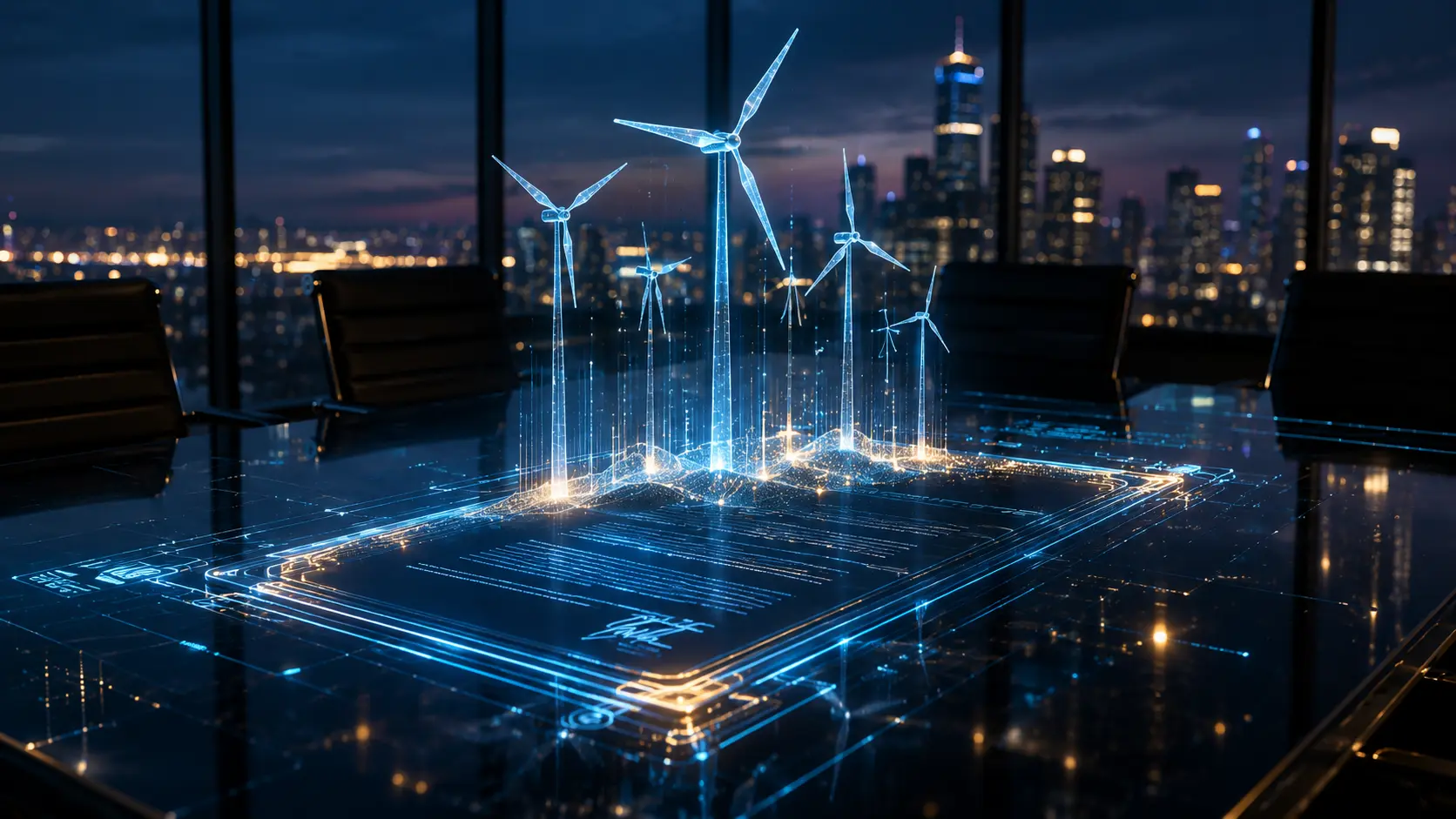
- Concept: A financial “swap” agreement separating the physical delivery of electricity from its financial and environmental value.
- Why it matters: When Amazon or Google claim to be “100% renewable,” their data centers are actually running on the standard, often coal-heavy local grid. VPPAs are the financial mechanisms that allow them to legally make that claim by funding an equivalent amount of new wind and solar power elsewhere in the country.
- Who uses it: Tech hyperscalers, Fortune 500 corporations, ESG-focused investment funds, and utility-scale renewable energy developers.
- Biggest takeaway: A VPPA is not an energy contract; it is a financial hedge. It provides the developer with the bankable revenue certainty needed to secure construction loans, while providing the corporate buyer with a hedge against volatile energy markets and the highly coveted Renewable Energy Certificates (RECs).
In Simple Words
Imagine you want to buy organic, locally grown apples to support sustainable farming, but you live in a city where the only grocery store sells mass-produced, imported apples.
You cannot physically get the organic apples delivered to your apartment.
Instead, you make a financial deal with an organic farmer across the country. You promise the farmer, “For the next 10 years, I guarantee you will make $2.00 per apple you grow. Sell your apples to your local town at whatever the daily market price is. If the market price drops to $1.50, I will pay you the 50-cent difference. But if the market price spikes to $3.00, you have to pay me the $1.00 extra.”
Because the farmer now has a guaranteed income of $2.00 per apple, a bank gives them the loan to buy the tractor they need to plant the orchard. The farmer grows the apples and sells them locally. In return for your financial guarantee, the farmer sends you a legal certificate proving you financed the creation of those organic apples. You keep buying your normal apples from your city grocery store, but you can legally claim your money added organic apples to the world.
This is a Virtual Power Purchase Agreement (VPPA). The apples are megawatt-hours of electricity, the certificate is a Renewable Energy Certificate (REC), and the financial deal is a Contract for Differences (CfD).
Why This Matters
The scale of the artificial intelligence boom has triggered an unprecedented electrical crisis.
Training and running Large Language Models (LLMs) requires gigawatt-scale data centers. Tech giants like Microsoft, Meta, and Google are deploying hundreds of billions of dollars into infrastructure, but they have legally binding “Net Zero” and “100% Renewable” climate pledges.
They cannot simply plug a 500-megawatt data center into the Ohio or Virginia power grids (which are heavily reliant on natural gas and coal) without destroying their ESG (Environmental, Social, and Governance) commitments. Furthermore, you cannot easily permit or build a 500-megawatt wind farm in Virginia due to land and wind constraints.
VPPAs solve this geographic mismatch. By signing VPPAs for massive wind farms in Texas or solar farms in Arizona, tech giants inject the necessary capital to build gigawatts of clean energy where the weather and land are optimal. Without VPPAs, the modern corporate funding pipeline for renewable energy would completely collapse, and the AI revolution would be permanently chained to fossil fuels.
The Big Picture
To understand VPPAs, you must understand the physics of the electrical grid.
The grid is essentially a giant, interconnected bathtub. When a coal plant or a wind farm generates electricity, it pours water into the bathtub. When your house or a data center turns on the lights, it drains water out of the bathtub.
Once the electrons enter the grid, they mix instantly. It is physically impossible to route a specific “green electron” from a wind turbine in Texas directly to a specific server rack in Virginia. Electrons always travel the path of least resistance.
Because we cannot track the physical electron, the energy industry created Renewable Energy Certificates (RECs). One REC is created for every one megawatt-hour (MWh) of clean energy generated. The REC represents the “greenness” of the power. VPPAs decouple the physical power (which stays in the bathtub) from the REC (which is transferred to the corporate buyer’s balance sheet).
HOW A VIRTUAL POWER PURCHASE AGREEMENT WORKS
Executing a multi-hundred-million-dollar VPPA requires mastering complex financial derivatives and wholesale market mechanics. Here is the first-principles breakdown.
1. The Fundamental Problem: Revenue Uncertainty
To build a USD 200 million solar farm, a developer needs a bank loan. Banks hate risk. If the developer plans to sell power into the wholesale electricity market, the price of power fluctuates wildly every five minutes. A bank will not lend USD 200 million based on unpredictable, floating market prices. The developer needs a guaranteed, long-term buyer to make the project “bankable.”
2. The Insufficiency of Physical PPAs
Historically, developers used Physical Power Purchase Agreements (Physical PPAs). A utility company would sign a 20-year contract to physically take delivery of the power. But a tech company like Google is not a utility. Google does not want the legal and logistical nightmare of managing physical power scheduling, transmission congestion, and daily grid delivery protocols. Furthermore, a Physical PPA requires the buyer and seller to be physically located on the same regional grid.
3. The Core Mechanism: The Financial Swap
The VPPA solves this by abandoning physical delivery entirely. The developer builds the wind farm in Texas (ERCOT) and sells its physical electricity directly into the Texas wholesale market at the floating, daily price. The tech company builds its data center in Virginia (PJM) and buys its physical electricity from its local Virginia utility at the standard retail price. The VPPA is simply a financial “swap” executed between the two parties, disconnected from the physical power flow.
4. Technical Depth: Contract for Differences (CfD)
The mathematical heart of the VPPA is the Contract for Differences (CfD). The developer and the corporation agree on a “Strike Price” (e.g., USD 30 per MWh).
Every month, they look at the actual wholesale market price the developer received in Texas.
- If the market price is USD 20/MWh: The corporation pays the developer USD 10 to make up the difference.
- If the market price is USD 50/MWh: The developer pays the corporation USD 20.The developer is now guaranteed exactly USD 30/MWh no matter what the market does. The bank approves the loan, and the project is built.
5. Real-World Consequences: Additionality and Scope 2 Emissions
In exchange for providing this financial hedge, the corporate buyer receives all the RECs generated by the project. Because the project could not have been financed and built without the corporation’s financial guarantee, the corporation achieves Additionality—proving their money caused new clean energy to be added to the grid. The corporation retires these RECs to legally offset the Scope 2 carbon emissions generated by its Virginia data center, perfectly satisfying its ESG requirements.
Real-World Applications
VPPAs have transitioned from a niche tech-sector experiment to the dominant engine of global renewable finance.
Hyperscale Data Centers (Amazon, Google, Meta): Amazon is the largest corporate buyer of renewable energy in the world, largely driven by VPPAs. To power the AWS cloud, Amazon signs dozens of VPPAs annually across the globe. When energy prices spiked in Europe during the 2022 energy crisis, many of these tech companies actually made massive profits on their VPPAs (because the market price soared far above their fixed strike prices), effectively hedging their global energy operational costs.
Heavy Industry and Manufacturing: Traditional industrial giants (like General Motors, Dow, and Nucor) consume massive amounts of energy and face intense pressure to decarbonize. Because they often operate in regions with poor renewable resources, they use VPPAs to fund wind and solar projects in the U.S. Midwest or Texas, capturing the RECs required to hit their corporate sustainability mandates without having to relocate their physical manufacturing plants.
Aggregated VPPAs for Smaller Buyers: Historically, executing a VPPA required a massive balance sheet to guarantee a 100-megawatt project. Today, advisory firms organize “Aggregated VPPAs.” They pool five to ten mid-sized companies together (like retail chains or universities) to collectively sign a single VPPA. This allows smaller buyers to achieve additionality and secure institutional-grade RECs that were previously restricted to the Fortune 50.
Economic & Strategic Impact
The VPPA market has fundamentally decoupled the production of clean energy from local demand, enabling massive geographic arbitrage.
Developers no longer need to find a local buyer to build a solar farm; they only need to find cheap land, strong sunshine, and a grid interconnection point. The financial buyer can sit in a boardroom in New York. This geographic flexibility accelerated the explosive growth of wind in the U.S. Midwest and solar in Texas.
However, this financialization introduces complex accounting risks. Because a VPPA is technically a derivative contract under Generally Accepted Accounting Principles (GAAP) and IFRS, it subjects the corporate buyer to mark-to-market accounting. If future energy prices are forecasted to drop significantly below the agreed strike price, the corporation may have to recognize a massive derivative liability on its quarterly earnings report, introducing financial volatility that terrifies conservative CFOs.
Advantages
- Additionality: The gold standard of ESG. VPPAs prove that a corporation’s capital directly caused a new renewable project to be built, unlike buying cheap, unbundled RECs from an existing 20-year-old hydro dam.
- Geographic Independence: Buyers can offset their carbon footprint by financing the most economically efficient projects in the country, regardless of where their physical operations are located.
- Financial Hedging: If global energy prices spike, the corporate buyer’s physical utility bill will go up, but their VPPA will generate positive cash flow (as the market price exceeds the strike price), perfectly offsetting the operational cost increase.
Limitations
- Basis Risk: This is the most dangerous element of a VPPA. The contract often settles at a “Hub” (a regional pricing point), but the wind farm sells its power at a specific “Node” (the physical spot it connects to the grid). If the transmission lines between the node and the hub get congested, the node price crashes. The developer makes no money from the grid, but the hub price remains high, forcing a massive, unexpected financial loss on the project economics.
- Negative Pricing Exposure: On very sunny or windy days, grids like Texas (ERCOT) produce too much power, and wholesale prices drop below zero. If the market price is -$10/MWh and the strike price is $30/MWh, the corporate buyer is forced to pay the developer $40/MWh for energy the grid literally does not want.
- No Physical Reliability: A VPPA does not keep your data center running if the local grid goes down. It is purely a financial and environmental offset; it provides zero physical energy resilience.
Common Misconceptions
Misconception: When Google signs a VPPA, its data centers run on green energy.
Reality: The data center runs on whatever mixture of coal, gas, nuclear, and renewables the local grid provides. The VPPA simply ensures that for every megawatt-hour of “dirty” grid power Google consumes, they have paid a developer somewhere else to inject one megawatt-hour of clean power into a different part of the grid.
Misconception: VPPAs are the same as buying carbon offsets.
Reality: Carbon offsets (like paying someone not to cut down a forest) are highly controversial, poorly regulated, and often fail to prove additionality. A VPPA deals strictly in RECs (Scope 2 emissions) and directly finances verifiable, metered electrical infrastructure.
Misconception: The corporate buyer pays the entire cost of the wind farm upfront.
Reality: The corporate buyer puts $0 down. The developer gets a loan from a bank to build the farm. The VPPA is simply the long-term price guarantee that convinces the bank the loan is safe to issue.
What Most People Miss
The era of the standard annual VPPA is ending, giving way to 24/7 Carbon-Free Energy (CFE) Matching.
Currently, VPPAs operate on an annual volumetric basis. If a data center uses 100,000 MWh of power over a year, and their contracted solar farm produces 100,000 MWh of power over a year, the company claims to be “100% renewable.”
But the solar farm only produces power during the day. The data center runs 24/7. At 2:00 AM, the data center is running entirely on fossil fuels. Tech leaders (led by Google and Microsoft) have realized that annual matching does not actually decarbonize the grid. The new paradigm is “hourly matching” or “24/7 CFE.” This requires incredibly complex VPPAs that combine wind, solar, and battery storage to guarantee that the clean energy is injected into the grid at the exact same hour the data center consumes it, a monumental leap in financial and engineering complexity.
Comparison Table
| Feature | Unbundled RECs | Physical PPA | Virtual PPA (VPPA) |
| What is exchanged? | Just the certificate. | Physical electricity + RECs. | Financial swap (Cash) + RECs. |
| Grid Location Requirement | None. | Buyer & Seller must be on the same grid. | None (Can be on different grids). |
| Additionality (Impact) | Very Low (often buys existing supply). | High (Finances new projects). | High (Finances new projects). |
| Regulatory Complexity | Simple purchase. | Requires managing physical utility load. | Requires derivative accounting (GAAP). |
| Price Hedge | No hedge. | Locks in physical energy price. | Financial hedge against market volatility. |
Case Study
Situation: In the early 2020s, a major hyperscale cloud provider committed to achieving 100% renewable energy for its global data center operations by 2025. However, their largest data center clusters were located in PJM (Virginia/Ohio), a grid heavily reliant on natural gas and coal with limited large-scale renewable development opportunities due to land costs and interconnection queues.
Challenge: The company could not physically purchase enough renewable energy locally to offset its massive gigawatt-scale footprint without halting data center expansion.
Solution (The VPPA Scaling): The hyperscaler aggressively deployed a VPPA strategy. They executed a series of massive Contract for Differences (CfD) agreements with developers building gigawatt-scale wind farms in ERCOT (Texas) and SPP (Midwest). They locked in a strike price, guaranteeing the developers revenue while securing millions of MWh of RECs.
Outcome: When the 2022 global energy crisis hit, wholesale power prices across the U.S. skyrocketed. Because the hyperscaler had locked in low strike prices on their VPPAs years earlier, the wind farms were suddenly selling power into the market for drastically more than the strike price. The developers paid the massive upside difference back to the hyperscaler. These financial windfalls effectively subsidized the hyperscaler’s surging physical utility bills in Virginia, proving the VPPA’s value not just as an ESG tool, but as a masterful corporate financial hedge.
Lessons Learned: A well-structured VPPA solves two enterprise problems simultaneously: it legally satisfies Scope 2 decarbonization mandates through proven additionality, and it acts as an effective financial derivative to insulate the corporate balance sheet from macroeconomic energy shocks.
Future Outlook
Next 12–24 Months
The VPPA market will face intense pressure from the “Interconnection Queue” crisis. Developers have the corporate buyers lined up, but they cannot get the permits to plug their new solar and wind farms into the grid. Consequently, corporate buyers will face a shortage of viable projects. Expect to see “Buyer’s Market” dynamics flip into a “Seller’s Market,” with developers demanding higher strike prices and shifting more of the “Negative Pricing” and “Basis Risk” onto the corporate buyers.
Next 3–5 Years
The transition to 24/7 Hourly Matching will redefine the contract structure. VPPAs will no longer be simple solar or wind deals. We will see the rise of “Firm clean energy VPPAs,” where developers must integrate massive lithium-ion battery banks to shape their power output. A developer will guarantee to settle the financial swap evenly across 24 hours, rather than dumping all the generation during peak daylight. This will significantly increase the cost of VPPAs but will drive the essential deployment of grid-scale storage.
Next 10 Years
VPPAs will expand beyond wind and solar into next-generation baseload clean energy. As advanced geothermal, Long-Duration Energy Storage (LDES), and Small Modular Reactors (SMRs) mature, tech giants will use VPPAs to bankroll these highly capital-intensive projects. The financial structure of the VPPA—providing guaranteed revenue to unlock project finance—will be the exact mechanism that funds the commercialization of the nuclear renaissance.
Most Likely Scenario
The traditional, annual volume-matching VPPA will increasingly be viewed as a basic, entry-level ESG tactic. The most advanced global corporations will move toward geographically matched, hourly carbon-free energy portfolios. However, the foundational financial architecture of the VPPA—the Contract for Differences—will remain the undisputed primary engine of global renewable energy finance, continuing to channel trillions of dollars of private corporate capital into the modernization of the electrical grid.
Key Takeaways
- A Virtual Power Purchase Agreement (VPPA) is a financial derivative (a Contract for Differences) used by corporations to fund renewable energy projects without physically taking delivery of the electricity.
- The contract agrees on a “Strike Price.” If wholesale market prices fall below the strike price, the corporation pays the developer; if prices rise above it, the developer pays the corporation.
- This guaranteed revenue allows the developer to secure a bank loan to build the project, achieving “Additionality”—proving the corporate buyer directly caused new clean energy to exist.
- In exchange, the corporate buyer receives Renewable Energy Certificates (RECs) to legally offset their Scope 2 carbon emissions (the electricity used by their data centers or factories).
- VPPAs expose corporations to complex financial risks, including “Basis Risk” (grid congestion pricing disparities) and periods of negative wholesale power prices.
- The industry is shifting from annual volume matching to “24/7 Hourly Matching,” which requires far more complex VPPAs integrated with grid-scale battery storage.
Glossary
Additionality: The critical principle in carbon and energy accounting proving that a renewable project would not have been built without the specific financial intervention of the buyer.
Basis Risk: The financial risk arising from the difference in the wholesale price of electricity at the specific point the generator connects to the grid (the Node) versus the regional pricing center where the contract is financially settled (the Hub).
Contract for Differences (CfD): A financial derivative where two parties agree to exchange the difference between a fixed “strike price” and the floating market price of an underlying asset over a set period.
Locational Marginal Pricing (LMP): The exact wholesale price of electricity at a specific physical location on the grid, heavily influenced by localized transmission congestion.
Renewable Energy Certificate (REC): A tradable, non-tangible energy commodity that represents proof that one megawatt-hour (MWh) of electricity was generated from an eligible renewable energy resource.
Scope 2 Emissions: Indirect greenhouse gas emissions associated with the purchase of electricity, steam, heat, or cooling. These are the primary emissions offset by VPPAs.
Frequently Asked Questions
Does a VPPA reduce the corporate buyer’s local utility bill?
No. The corporate buyer continues to pay their local utility for physical electricity at normal retail rates. The VPPA is a completely separate financial transaction that settles in cash, generating either a profit or a loss depending on the wholesale market.
Why don’t companies just build their own solar farms?
Core competency and capital allocation. Google is a software and search company; it does not want to become a power plant operator. Managing land acquisition, grid interconnection, physical maintenance, and energy trading requires specialized expertise. VPPAs allow tech companies to fund renewables without the operational liability.
What happens if the wind doesn’t blow?
The developer only generates RECs and settles the financial swap when the turbines are actually turning. VPPAs are typically structured as “pay-as-produced.” If there is no wind, no power is sold, no money changes hands, and no RECs are generated.
Is a VPPA legal in all countries?
The mechanism relies heavily on deregulated, transparent wholesale electricity markets (like ERCOT, PJM, or SPP in the United States, and Nord Pool in Europe). In countries with fully monopolized, state-run utilities where there is no open wholesale market, executing a traditional VPPA is structurally impossible.
Why would a company sign a VPPA if they might lose money on the swap?
The primary goal is acquiring the RECs to meet mandatory corporate climate pledges. The financial swap is the cost of doing business to get those RECs. Furthermore, if energy prices rise globally, the losses on their physical utility bill are often offset by the gains on the VPPA, making it a valuable long-term hedge.
Sources
- BloombergNEF (BNEF): Corporate Energy Market Outlook 2025/2026
- Clean Energy Buyers Association (CEBA): State of the Market: Corporate Renewable Procurement
- LevelTen Energy: PPA Price Index and Market Trends (Q1 2026)
- S&P Global Market Intelligence: The Shift to 24/7 Carbon-Free Energy Matching