Advertisement
)
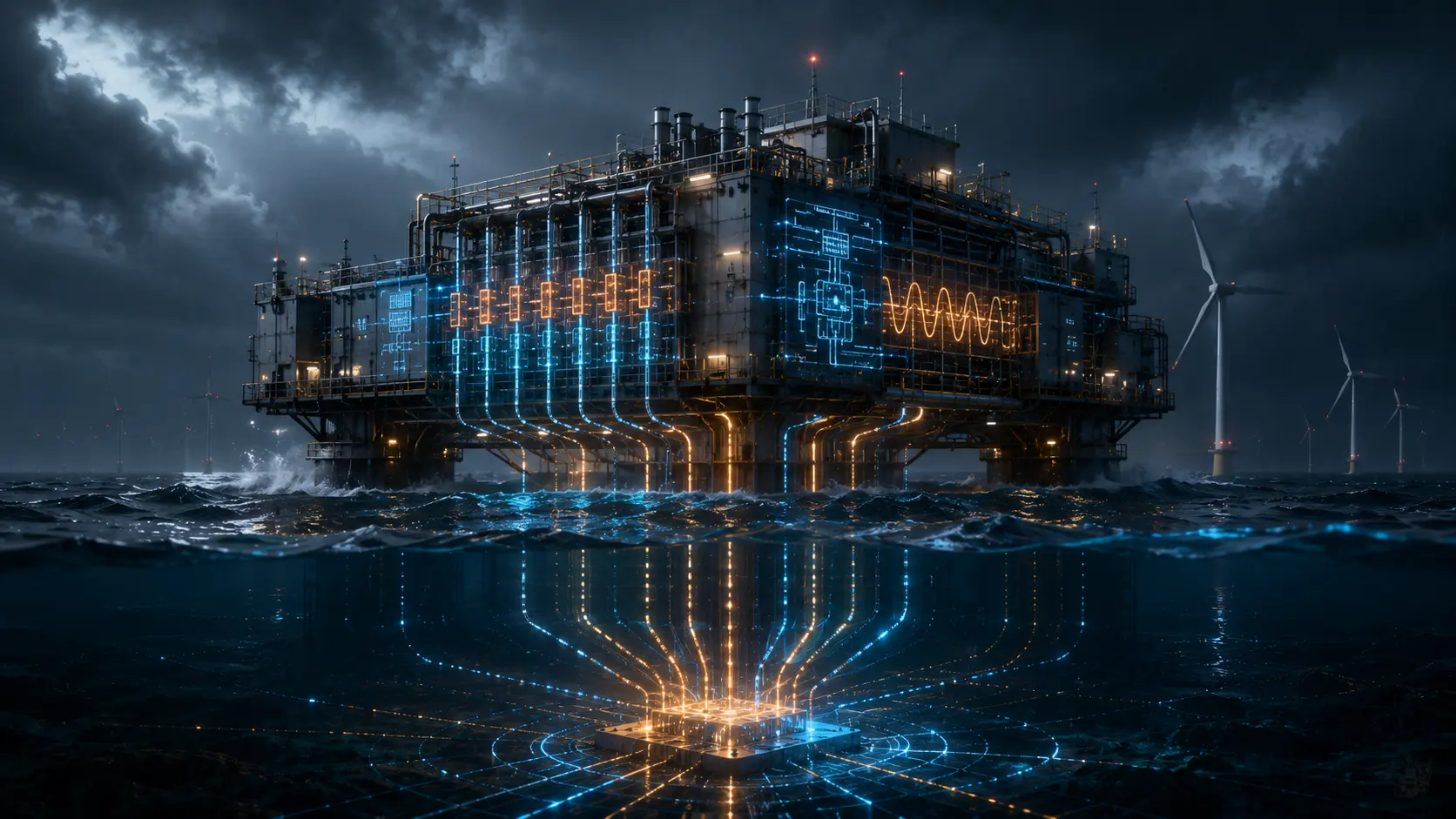

At a Glance
- Concept: Utilizing high-power semiconductor chips (IGBTs) to rapidly chop and mold electricity, allowing for the seamless conversion between Alternating Current (AC) and Direct Current (DC) without destabilizing the host grid.
- Why it matters: Building a massive wind farm 100 miles offshore is useless if you cannot get the power back to the city. Standard AC cables lose massive amounts of power underwater. HVDC cables solve this, and VSC is the “smart valve” at both ends of the cable that makes the entire system possible.
- Who uses it: National grid operators (e.g., National Grid UK, TenneT), offshore wind developers (Ørsted, Equinor), and heavy electrical equipment OEMs (Hitachi Energy, Siemens Energy, GE Vernova).
- Biggest takeaway: Legacy HVDC converters required a strong, existing electrical grid to work. If the grid flickered, the converter failed. VSCs generate their own voltage waveform, meaning they can actually restart a dead grid from scratch—a feature known as “black-start” capability.
In Simple Words
The electrical grid in your city runs on Alternating Current (AC). Think of AC like water sloshing back and forth in a pipe 60 times a second.
Sloshing is great for short distances, but if you try to slosh water through a pipe that is 100 miles long—especially an underwater cable—the friction and pressure cause massive energy loss. To send power long distances, we use Direct Current (DC). Think of DC as a smooth, continuous, high-pressure flow of water in one direction.
To get the power from the sloshing pipe (the city) into the smooth pipe (the long-distance cable), you need a massive valve.
For decades, we used older, “dumb” valves. They worked, but they relied on the water already sloshing perfectly to time their opening and closing. If the city’s power flickered, the valve choked, causing blackouts.
Voltage Source Converters (VSC) are the new “smart” valves. Instead of heavy mechanical parts, they use massive arrays of computer chips. These chips can open and close thousands of times a second. Because they are completely independent and computer-controlled, they do not need the city’s water to be sloshing perfectly. They force the flow exactly how they want it, acting as a digital pacemaker that actively stabilizes the grid while transmitting the power.
Why This Matters
The global transition to net-zero emissions requires rewiring the planet.
The best renewable resources are usually located far away from the people who need them: solar in the deserts, and wind in the deep oceans. Transmitting this power requires thousands of miles of new High Voltage Direct Current (HVDC) lines. The global HVDC converter station market is projected to surpass USD 20 billion by the end of the decade.
However, renewable energy is incredibly erratic. When the wind stops blowing, grid frequency drops. If the grid frequency drops too far, the entire regional power network physically collapses. VSC-HVDC stations act as the ultimate firewall against this collapse. They provide “synthetic inertia”—instantly injecting or absorbing power to artificially prop up a struggling grid. Without the rapid, digital precision of VSCs, integrating gigawatts of offshore wind into coastal cities would cause continuous, catastrophic grid instability.
The Big Picture
The evolution of HVDC transmission is defined by the transition from LCC to VSC.
The first generation was Line Commutated Converters (LCC). LCC uses thyristors—semiconductors that can be turned on, but cannot be turned off by the operator. They rely on the AC grid’s natural voltage dropping to zero (the “line commutation”) to turn off. If the AC grid is weak, the thyristor fails to turn off. This is called a “commutation failure,” and it instantly shorts out the system.
Because offshore wind farms are inherently “weak” grids with wildly fluctuating voltages, LCC is physically incapable of connecting them.
Voltage Source Converters (VSC) utilize Insulated-Gate Bipolar Transistors (IGBTs). An IGBT can be turned on and off instantly by applying a tiny gate voltage. This seemingly small distinction changes everything. It allows the VSC to completely control its own voltage waveform, granting it total independence from the strength or weakness of the surrounding AC grid.
HOW VOLTAGE SOURCE CONVERTERS WORK
Converting hundreds of thousands of volts from AC to DC using fragile silicon chips requires advanced power electronics and complex mathematical topologies.
1. The Fundamental Problem: The Capacitance of Underwater Cables
When AC electricity runs through a subsea cable, the water outside and the copper inside act like a giant battery (a capacitor). The cable constantly absorbs and discharges energy just to maintain the AC wave. Over long distances, this “charging current” consumes 100% of the cable’s capacity, leaving zero room for actual usable power. HVDC cables eliminate this charging current, but require massive conversion stations at both ends.
2. The Insufficiency of Legacy Thyristors (LCC)
LCC converters are highly efficient but incredibly needy. They consume massive amounts of “reactive power” (the electrical pressure required to keep the AC grid stable) and require enormous, football-field-sized filter banks to clean up the dirty electrical “harmonics” they generate. They also cannot operate unless connected to a strong, stiff AC grid.
3. The Core Mechanism: IGBTs and Pulse Width Modulation
A VSC replaces thyristors with thousands of IGBTs. The VSC uses a technique called Pulse Width Modulation (PWM). By turning the IGBTs on and off thousands of times per second, the converter takes a flat DC voltage and chops it into microscopic vertical slices. By varying the width of these slices, it artificially “draws” a perfectly smooth AC sine wave, flawlessly matching the frequency of the local grid.
4. Technical Depth: The Modular Multilevel Converter (MMC)
Early VSCs struggled with high power losses because rapid switching generated too much heat. The industry solved this with the Modular Multilevel Converter (MMC) topology. Instead of switching massive voltages all at once, an MMC uses hundreds of smaller “submodules” (like tiny batteries) stacked in series. By turning these submodules on one by one in a rapid staircase sequence, the MMC builds a nearly perfect AC sine wave without generating heavy electrical noise (harmonics), virtually eliminating the need for massive, expensive physical filters.
5. Real-World Consequences: Independent Reactive Power Control
Because an MMC VSC generates its own flawless voltage waveform, it operates with two distinct “steering wheels.” One wheel controls Active Power (the actual watts powering homes). The second wheel independently controls Reactive Power (the electrical pressure keeping the grid stable). The VSC acts as a massive “STATCOM” (Static Synchronous Compensator). If a city’s voltage begins to drop during a heatwave, the VSC can instantly inject reactive power to prop up the grid, even if no active wind energy is blowing through the DC cable.
Real-World Applications
VSC-HVDC is the indispensable keystone for modern, large-scale infrastructure projects.
Offshore Wind (Dogger Bank): Located 130km off the coast of England, Dogger Bank is the world’s largest offshore wind farm. Due to the extreme distance, transmitting the power via AC cables was physically impossible. The project utilizes massive VSC-HVDC offshore converter platforms built by Hitachi Energy. The platforms sit in the ocean, use IGBTs to convert the erratic wind power into smooth DC, and fire it through subsea cables to an onshore VSC station that perfectly integrates it into the UK National Grid.
Cross-Border Interconnectors (Viking Link): The Viking Link connects the power grids of the UK and Denmark over 760km of subsea cable. This allows the UK to import cheap Danish wind power when it is windy, or import stable Danish hydro power when the UK wind dies. VSC technology allows the flow of power to reverse directions seamlessly—something legacy LCC struggles to do without physically reversing the high-voltage cables using massive mechanical switches.
Black-Start Operations: If a regional power grid completely collapses (a blackout), traditional coal or gas plants need electricity just to start their own massive turbines. A VSC-HVDC station can perform a “black start.” Drawing power from a neighboring country via the DC cable, the VSC can artificially generate a perfect AC heartbeat out of nothing, providing the initial spark required to restart the dead regional grid.
Economic & Strategic Impact
The VSC-HVDC market is fiercely consolidated, creating a geopolitical bottleneck in the energy transition.
Because building a 2-Gigawatt (GW) offshore VSC converter station requires profound expertise in both high-voltage engineering and microscopic semiconductor software, the market is an absolute oligopoly. Only three major Western companies possess the capability to deliver these mega-projects: Hitachi Energy, Siemens Energy, and GE Vernova.
Strategically, this creates extreme supply chain friction. As the EU and US mandate massive expansions in offshore wind, the manufacturing slots for VSC converter stations are booked out years in advance. A wind farm developer can secure the turbines and the subsea cables, but if they cannot secure a manufacturing slot for the VSC platform, the project cannot be connected to the grid. Consequently, governments are beginning to treat High-Voltage IGBTs and MMC topologies as critical national security technologies.
Advantages
- Weak Grid Connection: VSCs generate their own voltage, making them the only viable technology to connect isolated, erratic offshore wind farms to the mainland.
- Independent Control: Operators can control active power (megawatts) and reactive power (megavolt-amperes reactive, MVAR) entirely independently, stabilizing the local grid.
- Smaller Footprint: Because MMCs generate a very “clean” electrical wave, they require significantly fewer harmonic filters, making the onshore and offshore converter stations up to 50% smaller than legacy LCC stations—crucial when building on expensive offshore oil-rig-style platforms.
- Black-Start Capability: The ability to instantly generate a stable AC voltage from a dead stop provides critical resilience against catastrophic regional blackouts.
Limitations
- Power Losses: While MMCs have improved efficiency drastically, the rapid switching of millions of transistors still generates heat. VSCs typically lose about 1% of the total transmitted power per converter station, compared to about 0.7% for older, simpler LCC technology.
- Lower Maximum Capacity: Historically, LCC could handle much higher absolute voltage and power levels (e.g., 800kV and 8GW+ in China). VSCs were limited to lower voltages, though the gap is rapidly closing with recent 525kV, 2GW+ VSC deployments in Europe.
- Extreme Capital Cost: A pair of 2GW VSC-HVDC converter stations can cost upwards of USD 1 billion, making them economically unviable for short-distance transmission where standard AC cables still suffice.
Common Misconceptions
Misconception: HVDC cables replace all AC power lines.
Reality: HVDC is strictly a “data highway” for bulk power over long distances. The vast majority of the electrical grid (distribution to your house) will remain AC because AC is incredibly easy to step down to safe voltages using simple, cheap, and highly reliable iron-core transformers.
Misconception: Wind turbines output DC power.
Reality: Almost all wind turbines use spinning generators that output erratic, “dirty” AC power. The VSC platform sits in the ocean, collects this dirty AC power from dozens of turbines, cleans it up, and converts it into pure DC for the long swim to shore.
Misconception: A Multi-Terminal “DC Supergrid” already exists.
Reality: Today, almost all VSC links are point-to-point (one start, one finish). Building a true “DC Supergrid” (like the internet, with multiple nodes routing power dynamically) is currently blocked by a lack of ultra-fast DC circuit breakers and software interoperability between rival manufacturers.
What Most People Miss
The physical vulnerability of the Submodule Capacitors.
In the Modular Multilevel Converter (MMC) topology, the VSC relies on thousands of “submodules,” each containing an IGBT switch and a capacitor (a small energy storage unit). These capacitors are critical; they hold the specific voltage slice needed to build the AC staircase wave. However, capacitors are notoriously sensitive to heat and voltage spikes. The long-term reliability of a multi-billion-dollar VSC station—expected to sit in the corrosive, violent North Sea for 40 years—is entirely dictated by the lifespan and thermal management of these thousands of localized capacitors. If they dry out or fail prematurely, the entire grid link crashes.
Comparison Table
| Feature | HVAC (Standard Power Lines) | LCC-HVDC (Legacy DC) | VSC-HVDC (Modern DC) |
| Primary Component | Iron-Core Transformers | Thyristors (Semi-controllable) | IGBTs (Fully controllable) |
| Grid Requirement | Self-sustaining | Requires strong AC grid | Can operate on a dead/weak grid |
| Reactive Power | N/A | Consumes massive amounts | Generates/Absorbs dynamically |
| Physical Footprint | Small | Massive (Huge filter banks) | Moderate (MMC requires fewer filters) |
| Ideal Use Case | Local distribution (< 50 miles) | Ultra-high capacity overland | Offshore wind, subsea cables, weak grids |
Case Study
Situation: The UK grid operator and European partners mapped out a massive expansion of offshore wind in the North Sea. However, the best wind resources were over 100 kilometers offshore. Pushing the power through standard AC cables resulted in unacceptable capacitance losses, rendering the projects economically unviable.
Challenge: They required an HVDC link. However, using legacy LCC technology offshore was impossible. LCC requires a stiff AC grid to turn its valves off, and an isolated cluster of wind turbines could not provide that stability. Furthermore, LCC required physical offshore platforms so massive and heavy that they could not be economically constructed at sea.
Solution (The MMC Deployment): The industry deployed Voltage Source Converters using the Modular Multilevel Converter (MMC) topology. Hitachi Energy and Siemens engineered compact VSC platforms utilizing thousands of IGBTs.
Outcome: The VSC stations independently generated the AC voltage waveform required to capture the wind energy, acting as an artificial grid for the turbines. Because the MMC topology produced “clean” power, it eliminated the need for massive harmonic filter yards. The offshore platforms shrank by 50% in weight and size compared to LCC requirements, making them financially viable to install in deep water.
Lessons Learned: VSC technology successfully decoupled offshore generation from onshore grid stability requirements. By injecting the “smart” capabilities of semiconductors into the transmission process, the grid operators turned the crippling liability of long-distance subsea transmission into a mathematically controlled, highly efficient asset.
Future Outlook
Next 12–24 Months
The industry will face an extreme manufacturing bottleneck. As Europe executes its “North Sea Wind Power Hub” vision and the U.S. East Coast attempts to scale its offshore mandates, the waitlist for 2GW and 3GW VSC converter stations from Hitachi, Siemens, and GE will extend deep into the 2030s. Consequently, we will see massive joint ventures and technology-sharing agreements designed to rapidly spin up VSC manufacturing capacity outside of Europe.
Next 3–5 Years
The transition to Silicon Carbide (SiC) semiconductors. Currently, VSCs use standard silicon IGBTs. Silicon Carbide (SiC) is a next-generation wide-bandgap material that can handle much higher voltages, switch significantly faster, and operate at much higher temperatures without liquid cooling. The integration of SiC modules into MMC topologies will drastically reduce the power losses of the converter station (pushing efficiency above 99.5%) and shrink the physical footprint of offshore platforms even further.
Next 10 Years
The birth of the Multi-Terminal DC Supergrid. Currently, VSC links are mostly isolated pipes. By the 2030s, the development of solid-state DC circuit breakers and open-source control software will allow operators to connect these pipes together. An offshore wind farm in the UK will be connected to a VSC node that can simultaneously route 1GW to London, 500MW to Norway, and 500MW to Germany, shifting power dynamically across a pan-European DC mesh network based on real-time locational pricing algorithms.
Most Likely Scenario
Voltage Source Converters are the undisputed future of high-voltage transmission. As the global grid transitions from centralized, spinning fossil-fuel plants to decentralized, erratic renewables, the grid loses its natural mechanical inertia. VSCs will become the digital backbone of the planet’s electrical system, using software and silicon to artificially recreate the stability that heavy iron turbines used to provide, entirely redefining the physics of power flow.
Key Takeaways
- Voltage Source Converters (VSC-HVDC) use advanced semiconductor chips (IGBTs) to convert electricity between AC and DC, allowing for long-distance, low-loss transmission.
- Unlike older LCC technology, VSCs can turn their valves on and off independently, allowing them to operate in isolated, erratic environments like offshore wind farms.
- VSCs use the Modular Multilevel Converter (MMC) topology to build a perfectly smooth AC voltage wave, eliminating the need for massive, expensive physical electrical filters.
- Because they generate their own voltage, VSC stations have “black-start” capability, meaning they can actively restart a dead regional power grid following a catastrophic blackout.
- The VSC can independently control Active Power (megawatts) and Reactive Power, acting as a massive digital shock absorber that stabilizes voltage drops in the local city grid.
- The global rollout of VSC-HVDC is currently constrained by an extreme manufacturing bottleneck, dominated by a small oligopoly of Western OEMs (Hitachi, Siemens, GE).
Glossary
Active Power: The actual, usable electrical power (measured in Watts) that performs real work, like spinning a motor or turning on a light bulb.
Black-Start Capability: The ability of a power station or converter to restore electricity to a completely dead, blacked-out grid without relying on any external electrical transmission network to start up.
IGBT (Insulated-Gate Bipolar Transistor): A high-voltage, high-speed semiconductor switch that can be rapidly turned on and off by applying a small control voltage. It is the fundamental building block of VSC technology.
LCC-HVDC (Line Commutated Converter): The older generation of HVDC technology. It uses thyristors that rely on the existing AC grid’s voltage dropping to zero to turn off. It requires a strong grid and massive filters to operate.
Modular Multilevel Converter (MMC): The modern architecture of VSC stations. It stacks hundreds of small submodules (each containing an IGBT and a capacitor) in series, firing them sequentially to build a perfectly smooth, stair-stepped AC wave.
Reactive Power: The electrical power (measured in VARs) that sustains the electromagnetic fields in an AC grid. It does not perform actual work, but if it drops too low, the voltage collapses and the grid blacks out.
Thyristor: An older type of semiconductor switch used in LCC-HVDC. It can be turned on by a control signal, but can only turn off when the current naturally drops to zero.
Frequently Asked Questions
Why can’t we just use standard AC power lines underwater?
An AC cable acts like a giant capacitor when surrounded by water or buried in the earth. The cable constantly absorbs and discharges energy just to maintain the alternating wave. Over roughly 50 to 80 kilometers, this “charging current” eats up all the power, leaving none to actually exit the other side of the cable. DC power flows in one direction and does not suffer from this issue.
What is the difference between an IGBT and a Thyristor?
Control. A thyristor (used in older LCC) is like a door that can be pushed open, but only closes when the wind (the AC grid voltage) completely stops blowing. An IGBT (used in VSC) is a motorized door that can be forced open or slammed shut instantly by a computer, regardless of what the wind is doing.
If VSC is so much better, why do we still use LCC?
Cost and raw capacity. For ultra-massive, multi-gigawatt overland projects (like transmitting 8GW of hydro power across China), LCC is still slightly more efficient, cheaper to build, and capable of handling much higher absolute voltages.
How does a VSC stabilize the grid?
If a cloud covers a massive solar farm, the sudden drop in power can cause the local grid’s voltage to sag. A VSC station connected to that grid can instantly shift its operation to inject “reactive power,” artificially holding the local grid’s voltage up while backup generators turn on.
Who builds these massive converter stations?
It is one of the most consolidated markets in global infrastructure. Hitachi Energy (formerly ABB Power Grids), Siemens Energy, and GE Vernova possess the advanced software, high-voltage testing facilities, and power electronics manufacturing capability to deliver these multi-billion-dollar installations.
Sources
- Hitachi Energy: HVDC Light (VSC) Technology and Modular Multilevel Converter (MMC) Topology (2025/2026 Documentation)
- Siemens Energy: HVDC PLUS – Voltage-Sourced Converters for Offshore Wind and Grid Stabilization
- ENTSO-E (European Network of Transmission System Operators): Ten-Year Network Development Plan (TYNDP) 2026 – Offshore Grid Integration
- IEEE Power and Energy Society: Evolution of VSC-HVDC Systems and Multi-Terminal DC Grids