Advertisement
)

At a Glance
- Concept: Bypassing traditional ground-based cell towers by launching satellites that act as orbiting base stations, connecting to the exact same 4G/5G chips already inside your pocket.
- Why it matters: Terrestrial cell towers only cover about 15% of the Earth’s surface. D2D extends coverage to the remaining 85%—including oceans, deserts, and mountains—permanently eradicating the “no service” indicator on smartphones.
- Who uses it: Global Mobile Network Operators (MNOs) like T-Mobile, AT&T, Vodafone, and Rogers, partnered with aerospace leaders like SpaceX (Starlink), AST SpaceMobile, and Apple.
- Biggest takeaway: You do not need to buy a new, bulky satellite phone. Through a triumph of standardizing the 3GPP Non-Terrestrial Network (NTN) protocols, your current iPhone or Android cannot tell the difference between a cell tower two miles down the road and a satellite moving 17,000 miles per hour in space.
In Simple Words
A normal cell phone is a very weak radio. It is designed to “whisper” to a cell tower that is, at most, a few miles away.
In the past, if you wanted to talk to a satellite 300 miles up in space, you had to buy a specialized, expensive satellite phone with a massive, thick antenna so it could “shout” loud enough for the satellite to hear it.
Direct-to-Device (D2D) flips this math upside down.
Instead of forcing you to buy a phone with a giant antenna, companies are putting the giant antenna in space. They launch satellites the size of a small house, equipped with highly sensitive “ears” (phased arrays) that can hear your standard smartphone’s whisper from orbit. To your phone, the satellite just looks like a remarkably tall, completely normal cell tower. When you drive out of range of your city’s network, your phone automatically connects to the sky, allowing you to send a text or call for help from the middle of the ocean or deep in a national park.
Why This Matters
The eradication of the cellular dead zone fundamentally alters the economics of the telecommunications industry.
For decades, Mobile Network Operators (MNOs) faced a harsh geographical reality: it is mathematically unprofitable to build million-dollar terrestrial cell towers in rural areas where only a few dozen people live. Consequently, the digital divide persisted.
D2D solves the rural broadband crisis without pouring a single yard of concrete. By launching a constellation of orbiting cell towers, a carrier like T-Mobile instantly expands its coverage map to 100% of a country’s landmass. This shifts the telecom battleground. In 2026, carriers no longer compete merely on city speeds; they compete on ubiquitous global connectivity. The MNO that signs the exclusive D2D partnership for a specific country holds an insurmountable marketing advantage over rivals who still lose service in the wilderness.
The Big Picture
The D2D revolution was unlocked by the convergence of two separate technological leaps: the plummeting cost of launch logistics, and the maturation of 3GPP Release 17 & 18.
Historically, satellite communications were highly proprietary. If you used an Iridium satellite, you used Iridium hardware. The 3rd Generation Partnership Project (3GPP)—the global body that writes the rules for 5G—recently published the Non-Terrestrial Networks (NTN) standards.
Release 17 formally integrated satellites into the standard 5G telecom stack. This meant chipmakers like Qualcomm and MediaTek could bake satellite logic directly into their standard modem chips. Because the protocol is now universal and open-source, an AT&T customer with a Samsung galaxy can talk to an AST SpaceMobile satellite seamlessly. This standardization destroyed the walled gardens of the legacy satellite industry, triggering a multi-billion-dollar gold rush.
HOW DIRECT-TO-DEVICE WORKS
Closing a cellular link between a pocket-sized battery and a spacecraft moving at orbital velocity requires defying classical radio physics.
1. The Fundamental Problem: The Link Budget
In radio engineering, the “link budget” is the accounting of all the power gained and lost when a signal travels from a transmitter to a receiver. A standard smartphone transmits at roughly 0.2 watts. Pushing 0.2 watts through 300 miles of atmosphere, clouds, and the vacuum of space results in massive “path loss.” A traditional satellite simply cannot hear a signal that weak.
2. The Insufficiency of Traditional Satphones
Legacy networks (like Inmarsat) solved the link budget by requiring the user to carry a phone with a thick, directional antenna, outputting higher wattage on proprietary L-band or S-band frequencies. This was fine for maritime shipping, but entirely unscalable for the 7 billion standard smartphones currently in circulation.
3. The Core Mechanism: Massive Phased Arrays
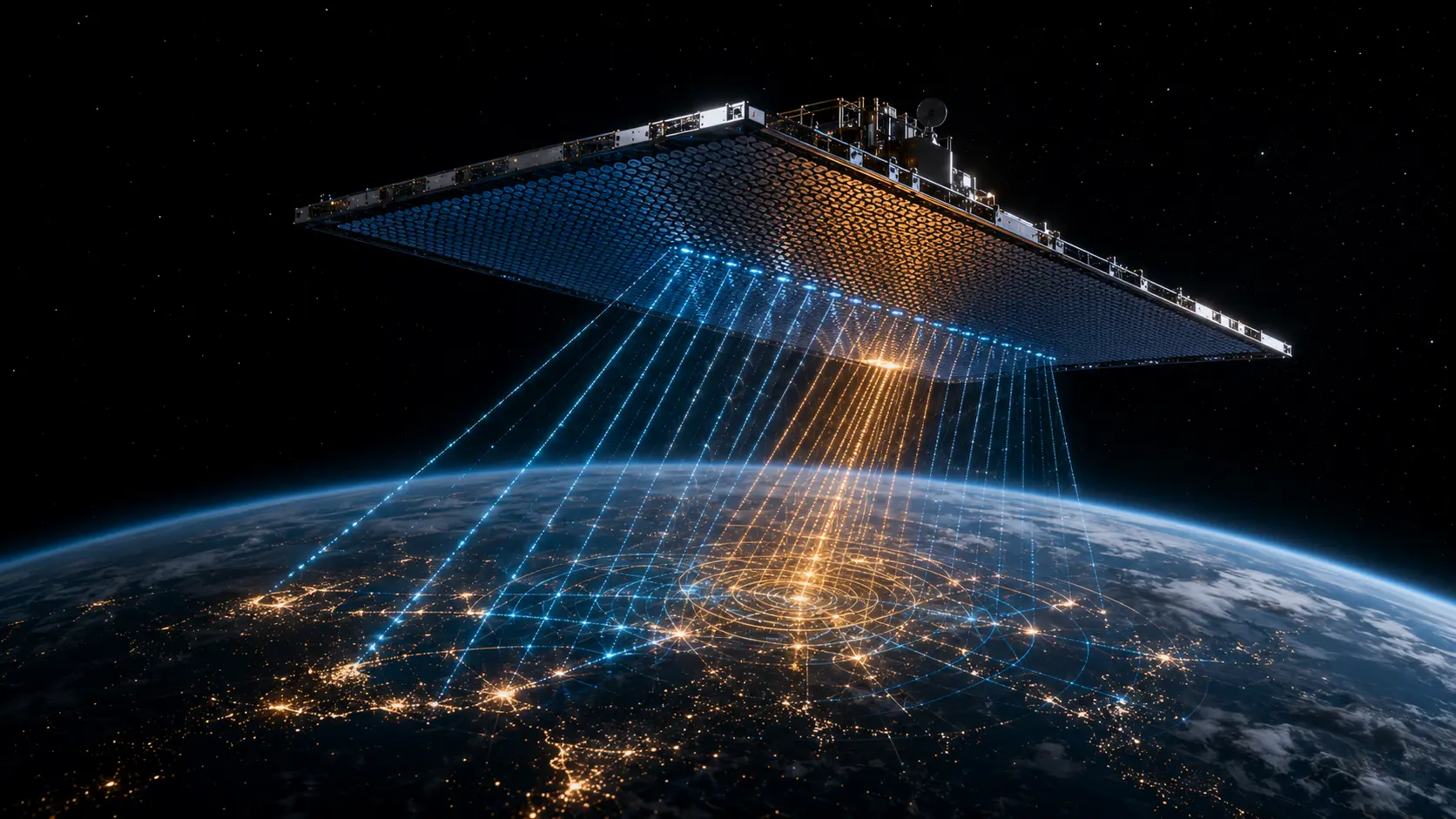
To make D2D work, aerospace engineers placed the burden of the link budget entirely on the satellite. Companies like AST SpaceMobile construct satellites with phased array antennas that unfurl in space to a massive 2,400 square feet. This enormous surface area acts as a hyper-sensitive ear. Using “beamforming,” the satellite electronically steers thousands of individual radio beams directly at specific smartphones on the ground, creating a tight, high-gain connection that perfectly compensates for the phone’s weak transmitter.
4. Technical Depth: Solving the Doppler Shift
A Low Earth Orbit (LEO) satellite travels at roughly 17,000 mph. When it flies toward you, the radio waves compress (higher frequency); as it flies away, they stretch (lower frequency). This is the Doppler Shift. A standard terrestrial phone is completely confused by this; cell towers do not move at Mach 22.
The 3GPP NTN software standards solved this. The network pre-compensates for the Doppler shift at the network level. The satellite calculates its exact speed relative to the user and artificially adjusts its transmission frequency so that by the time the wave hits the smartphone, it appears perfectly stable, tricking the phone into thinking the tower is standing still.
5. Real-World Consequences: Spectrum Sharing
Standard satellites use dedicated space frequencies. D2D satellites are unique: they broadcast on the exact same terrestrial frequencies (like the PCS or 850 MHz bands) that your carrier uses on the ground. This causes massive regulatory friction. If a satellite beams a 4G signal down to a phone in a national park, it must ensure that beam does not accidentally hit a nearby city and interfere with the ground-based cell towers using the exact same frequency. Managing this interference requires incredibly precise, AI-driven geographic beam-steering.
Real-World Applications
D2D technology is currently shifting from beta testing into commercial ubiquity.
Emergency SOS and Texting: The earliest mass-market iteration was Apple’s Emergency SOS via Satellite (powered by Globalstar), which saved hundreds of lives by allowing iPhones to send compressed emergency texts. By 2025, SpaceX and T-Mobile launched commercial, two-way text messaging. Users in the mountains of Colorado or the deserts of Nevada can now send standard SMS texts seamlessly when terrestrial service drops to zero bars.
Maritime and Aviation Logistics: Cargo ships and remote logistics fleets previously relied on expensive, low-bandwidth proprietary satellite terminals. With 3GPP IoT-NTN integration (Internet of Things over NTN), shipping companies can attach cheap, standard 5G cellular trackers to containers, maintaining end-to-end global visibility across oceans without buying specialized satellite modems.
Rural Broadband and Connectivity: While texting is the baseline, the endgame is full broadband. Companies like AST SpaceMobile are deploying their massive BlueBird satellites specifically to deliver 5G broadband (voice, data, and video streaming) to unmodified phones. This targets the billions of people in developing nations across Africa and Southeast Asia where laying terrestrial fiber-optic cable is geographically or economically impossible.
Economic & Strategic Impact
The D2D market has triggered a furious land-grab for spectrum and MNO partnerships.
A satellite company cannot legally broadcast a cellular signal to the ground unless it has permission from the carrier that owns the rights to that spectrum in that specific country. Therefore, companies like SpaceX, AST SpaceMobile, and Lynk Global are engaged in an aggressive diplomatic race to sign exclusive revenue-sharing agreements with national telecoms (e.g., SpaceX partnering with Rogers in Canada, Optus in Australia, and KDDI in New Zealand).
Strategically, this threatens the traditional satellite telecom industry (companies like Viasat or Iridium). As the cost of a global satellite connection drops to a mere USD 5 to 10 add-on to a standard monthly cell phone bill, the market for USD 1,500 proprietary satellite phones and expensive specialized data plans will inevitably collapse to a niche, ultra-secure government and military demographic.
Advantages
- Zero Hardware Friction: The user does not need to buy a new phone, download a special app, or point an antenna at the sky. The phone simply roams onto the satellite network automatically.
- Total Geographic Coverage: Fills in the 85% of the planet—oceans, mountains, and deep rural areas—that are entirely uncovered by ground infrastructure.
- Disaster Resilience: If a hurricane or earthquake destroys the physical cell towers and fiber-optic lines of a city, the D2D satellites remain perfectly intact in orbit, instantly restoring emergency communications to the affected zone.
Limitations
- Line-of-Sight Requirement: Satellites cannot penetrate concrete or heavy foliage. D2D requires a relatively clear view of the open sky; it will not work indoors, underground, or deep inside a dense forest canopy.
- Capacity Bottlenecks: A single cell tower serves a few square miles. A single D2D satellite beam covers hundreds of square miles. Because thousands of users are sharing the exact same satellite bandwidth, D2D networks are prone to extreme congestion. They are a fallback safety net, not a replacement for high-speed urban 5G.
- High Latency: Even in Low Earth Orbit (300 miles up), the round-trip time for a signal to reach space and bounce back to a ground station adds noticeable delay (latency) compared to a cell tower right down the street.
Common Misconceptions
Misconception: D2D will replace normal cell towers.
Reality: Ground-based cell towers offer vastly more bandwidth, faster speeds, and lower latency. Satellite networks are physically incapable of handling the data density of a crowded city. D2D is strictly a complementary extension of the terrestrial grid, designed for when you leave the city.
Misconception: I can use D2D to stream 4K video from the middle of the ocean today.
Reality: As of 2026, most commercial deployments (like Starlink Direct to Cell) are heavily restricted to text messaging and low-bandwidth data. While next-generation satellites (like AST’s BlueBirds) are promising broadband streaming, total system capacity limits will likely result in carriers throttling speeds to ensure all remote users have basic access.
Misconception: Any old phone can connect to any satellite.
Reality: While no special hardware is needed, the phone must still have modern LTE/5G bands compatible with the carrier’s spectrum, and the carrier must have an active legal partnership with the satellite operator.
What Most People Miss
The hidden enabler of this industry is the 3GPP NTN Standardization.
For years, tech companies tried to build proprietary “space-to-phone” links. It was expensive and fragmented. When the 3GPP (the telecom standards body) officially wrote the rules for Non-Terrestrial Networks in Release 17 and 18, it fundamentally changed the math.
It meant that companies building modems for smartphones (like Qualcomm, MediaTek, and Samsung) didn’t have to guess how to talk to a satellite. They simply followed the global, open-source standard. This standardization allowed the entire global smartphone supply chain to quietly become “satellite-ready” simultaneously, shifting D2D from a closed-ecosystem science project into a globally interoperable utility.
Comparison Table
| Feature | Terrestrial Cell Towers | Legacy Satellite Phones | D2D Satellite Networks (NTN) |
|---|---|---|---|
| Hardware Required | Standard Smartphone | Proprietary, Bulky SatPhone | Standard Smartphone |
| Coverage Area | ~15% of Earth (Populated) | Global (Outdoors) | Global (Outdoors) |
| Indoor Functionality | Yes | No | No |
| Primary Use Case | High-speed, dense daily use | Specialized maritime/military | Seamless roaming for dead zones |
| User Friction | Zero | High (New device/plan) | Zero (Automated network switching) |
| Protocol | Standard 4G / 5G | Proprietary (Iridium/Inmarsat) | 3GPP NTN / Standard LTE |
Case Study
Situation: T-Mobile possessed excellent 5G coverage across urban and suburban America, but the vast, empty expanses of the American West and mountainous national parks remained persistent, dangerous dead zones. Building towers in these regions was financially unviable.
Challenge: How to provide baseline connectivity (texting and emergency SOS) to millions of standard smartphone users traversing 500,000 square miles of uncovered territory, without forcing them to buy new hardware.
Solution (The Starlink Integration): T-Mobile partnered with SpaceX. SpaceX launched a specialized constellation of Starlink “Direct to Cell” satellites equipped with advanced eNodeB modems onboard. T-Mobile granted SpaceX the legal right to broadcast on T-Mobile’s existing PCS spectrum.
Outcome: In July 2025, the service commercially launched. A hiker in a remote canyon, carrying a standard, unmodified smartphone, suddenly had bars. The phone, searching for a tower, pinged the PCS spectrum. The Starlink satellite 300 miles above caught the signal, processed the text message, and beamed it to a ground station, completing the circuit. SpaceX rapidly scaled the constellation to over 650 satellites by early 2026, officially establishing the largest 4G coverage area on the planet.
Lessons Learned: The deployment proved that the physical link budget of a standard smartphone could be closed from space. By treating the satellite merely as an incredibly tall, orbiting cell tower utilizing standard LTE spectrum, the telecom industry successfully eradicated the geographic limitations of terrestrial infrastructure.
Future Outlook
Next 12–24 Months
The industry will transition from “messaging only” to “baseline data.” As SpaceX increases its Starlink D2C constellation to over 800 satellites, and AST SpaceMobile launches its massive 2,400-square-foot BlueBird arrays, carriers will begin unlocking native voice calls and low-bandwidth data (e.g., loading a map or checking email) for premium tier subscribers.
Next 3–5 Years
The rollout of 3GPP Release 19 will optimize 5G-Advanced for space. This will improve capacity management and allow for smoother handoffs between the satellite and the ground tower. We will see heavy integration of IoT-NTN. Millions of shipping containers, agricultural sensors, and remote utility meters will be equipped with cheap, standard 5G chips that ping satellites directly, creating a truly omniscient global supply chain network.
Next 10 Years
The lines between terrestrial and non-terrestrial networks will blur entirely. Smartphones will feature advanced, microscopic antenna designs specifically tuned to optimize satellite links without draining battery life. D2D will become a silent, invisible utility. Users will simply pay for “Global Coverage” on their phone bill, entirely unaware of whether their Netflix video is streaming from a tower in their neighborhood or a satellite hurtling through the thermosphere.
Most Likely Scenario
Direct-to-Device satellite connectivity represents the final frontier of mobile telecommunications. It will not replace terrestrial towers, but it completely solves the geographic coverage problem. The telecom operators who successfully secure the most robust satellite partnerships will dominate the market, while specialized legacy satellite phone providers will face total consumer obsolescence as the standard smartphone claims the entire globe.
Key Takeaways
- Direct-to-Device (D2D) technology allows standard, unmodified smartphones to connect directly to satellites in Low Earth Orbit (LEO).
- Because cell phones are weak transmitters, D2D relies on deploying massive phased array antennas in space to capture the faint signals.
- D2D satellites broadcast on standard terrestrial cellular frequencies (spectrum sharing), meaning the phone treats the satellite exactly like a normal cell tower.
- The 3GPP Non-Terrestrial Network (NTN) standards mathematically compensate for the extreme speed of satellites (Doppler shift), allowing seamless connectivity.
- While texting and emergency SOS are live, full 5G broadband streaming remains constrained by total satellite capacity and the number of users sharing a single orbital beam.
- D2D requires a clear line-of-sight to the sky; it will not work indoors, effectively ensuring that terrestrial cell towers remain strictly necessary for high-density urban environments.
Glossary
3GPP (3rd Generation Partnership Project): The global consortium that writes the technical standards for mobile telecommunications, including 4G LTE and 5G.
Doppler Shift: The change in frequency of a radio wave caused by the relative motion of the satellite. NTN networks must mathematically correct this shift so the stationary phone can understand the signal.
Link Budget: An engineering calculation that accounts for all the power gains and losses a radio signal experiences as it travels from a transmitter (phone) to a receiver (satellite).
Non-Terrestrial Network (NTN): The official 3GPP standard that defines how 5G and 4G networks can seamlessly integrate satellites and high-altitude platforms into the terrestrial cellular grid.
Phased Array Antenna: An advanced, flat antenna made of hundreds of tiny transmitters that can electronically steer a radio beam in a specific direction without physically moving the hardware.
Spectrum Sharing: The regulatory practice where a satellite operator uses the exact same radio frequencies legally owned by a ground-based mobile network operator to transmit data.
Frequently Asked Questions
Do I need a new phone to use satellite connectivity?
No. If your carrier (e.g., T-Mobile, AT&T) has a partnership with a D2D satellite provider (e.g., Starlink, AST SpaceMobile), your current LTE or 5G smartphone will automatically connect to the satellite when you lose ground service.
Will D2D work inside my house?
No. A smartphone’s transmitter is too weak to push a signal through a roof and 300 miles into space. You must be outdoors with a relatively clear view of the open sky.
Why can’t I watch 4K video via satellite on my phone yet?
A single satellite beam covers hundreds of square miles. If everyone in a national park tries to stream 4K video at the same time, the satellite’s bandwidth is instantly overwhelmed. Currently, carriers prioritize low-bandwidth messaging and emergency services to ensure everyone gets a connection.
How much does this service cost?
It depends on the carrier. Many carriers are including basic text-messaging satellite coverage for free in their premium plans, while offering voice and data roaming as an optional USD 5 to USD 10 monthly add-on.
What happened to traditional satellite phones?
They still exist and are used by maritime, aviation, and military professionals who require guaranteed, dedicated bandwidth. However, for the average consumer, the advent of D2D on standard smartphones makes bulky, expensive satellite phones obsolete.
Sources
- KeepTrack.space: Starlink Direct to Cell Status and Phones 2026
- SpaceX: Starlink Progress Report 2025 – Direct to Cell Constellation Deployment
- AST SpaceMobile: Next-Generation BlueBird – Phased Array Deployment 2025/2026
- Ericsson Technology Review: Satellite direct to device: 4G or 3GPP NTN?
- Telecom Gurukul: Understanding 3GPP Standardization in Satellite Networks: A Practical Guide 2026