Advertisement
)

At a Glance
- Concept: Submerging advanced semiconductor tapes in a continuous flow of liquid nitrogen to drop their electrical resistance to exactly zero.
- Why it matters: Artificial intelligence data centers require gigawatts of power. Pushing that much electricity into a city using traditional copper wires would require digging trenches the size of subway tunnels. HTS cables fit 5 to 10 times the power into the exact same physical footprint.
- Who uses it: Urban grid operators (e.g., Stadtwerke München, ComEd), hyperscale cloud providers, and global cable manufacturers like Nexans, NKT, and American Superconductor (AMSC).
- Biggest takeaway: Because HTS cables have zero electrical resistance, they emit zero heat and zero electromagnetic fields (EMF). This means they can be buried directly next to sensitive telecommunications fiber or volatile gas pipelines without interference, unlocking existing urban underground real estate.
In Simple Words
Pushing electricity through a copper wire is like trying to force a massive, fast-flowing river through a garden hose. The friction is immense. The wire gets incredibly hot, and a significant percentage of the electricity is burned off as wasted heat before it ever reaches its destination. If you want to push more power, you need a much thicker, heavier copper hose.
For the power grid, this means tearing up city streets to bury massive bundles of thick copper wire.
High-Temperature Superconducting (HTS) cables change the laws of physics inside the hose. Instead of using thick copper, engineers use a cable made of specialized microscopic tape. They wrap this cable in a jacket and pump liquid nitrogen through it, freezing the tape to -200 degrees Celsius. At that exact temperature, a quantum physics threshold is crossed: the electrical friction drops to exactly zero.
Because there is zero friction, there is zero heat. The electricity flows perfectly. A frozen HTS cable the thickness of your wrist can carry the exact same amount of power as a bundle of copper wires the size of a tree trunk.
Why This Matters
The exponential growth of Generative AI has broken the physical limits of the urban power grid.
To train frontier AI models, tech giants are building data centers that consume over 1 Gigawatt (GW) of power—equivalent to the consumption of a medium-sized city. However, these companies want to build these data centers near existing fiber-optic hubs and talent pools, which are in dense metropolitan areas.
City grids were not built to handle gigawatt point-loads. Permitting and digging new transmission trenches through the concrete of Chicago, London, or Tokyo takes a decade and costs billions in civil engineering. HTS cables completely bypass this bottleneck. By pulling out an old copper cable from an existing 6-inch underground pipe and threading an HTS cable into that exact same pipe, the utility can instantly increase the power delivery by 500% to 1,000%. HTS is the only mathematically viable technology capable of sustaining urban AI infrastructure without leveling the city.
The Big Picture
The term “High-Temperature” is highly misleading to the public. In physics, “Low-Temperature” superconductivity requires cooling materials with liquid helium to roughly -269°C (near Absolute Zero). Liquid helium is incredibly expensive and volatile.
In the late 20th century, scientists discovered a class of ceramic materials that became superconducting at warmer temperatures. Today, the industry standard is REBCO (Rare-Earth Barium Copper Oxide). REBCO becomes superconducting at roughly -180°C.
This difference is the holy grail of grid economics. Because -180°C can be achieved using liquid nitrogen—which is inert, environmentally safe, and cheaper than bottled water—superconductivity transitioned from a billion-dollar physics experiment into a commercially viable utility asset. The global HTS cables market is now accelerating rapidly, projected to hit nearly USD 600 million within the decade, entirely driven by grid modernization and data center demands.
How It Works
Extracting gigawatts of power through a frozen pipe requires absolute mastery of cryogenics and materials science. Here is the first-principles breakdown of HTS architecture.
1. The Fundamental Problem: The Thermal Limit of Copper
When alternating current (AC) or direct current (DC) flows through standard Cross-Linked Polyethylene (XLPE) copper cables, the electrical resistance generates heat. If a utility pushes too much power, the copper melts its own insulation, causing a catastrophic short circuit. To carry 1 GW of power, a utility must use massive, heavy copper bundles spaced widely apart in a wide trench to allow the surrounding soil to absorb the heat.
2. The Insufficiency of Higher Voltages
Utilities traditionally solve the heat problem by stepping up the voltage (e.g., to 380 kV). Higher voltage allows more power to flow with less current, reducing heat. However, ultra-high voltage requires massive, football-field-sized substations and massive clearance zones to prevent electrical arcing. You cannot build a 380 kV substation in the basement of an urban data center.
3. The Core Mechanism: REBCO Epitaxy
An HTS cable operates at lower voltages (e.g., medium voltage 10 kV to 69 kV) but carries astronomical current (amperage). It achieves this using 2G REBCO tape. These tapes are manufactured using “epitaxy”—depositing a microscopic, perfectly aligned crystalline layer of the rare-earth ceramic onto a flexible steel ribbon. Despite being thinner than a human hair, a single strip of REBCO tape can carry hundreds of times more current than a copper wire of the same dimensions.
4. Technical Depth: The Cryogenic Envelope
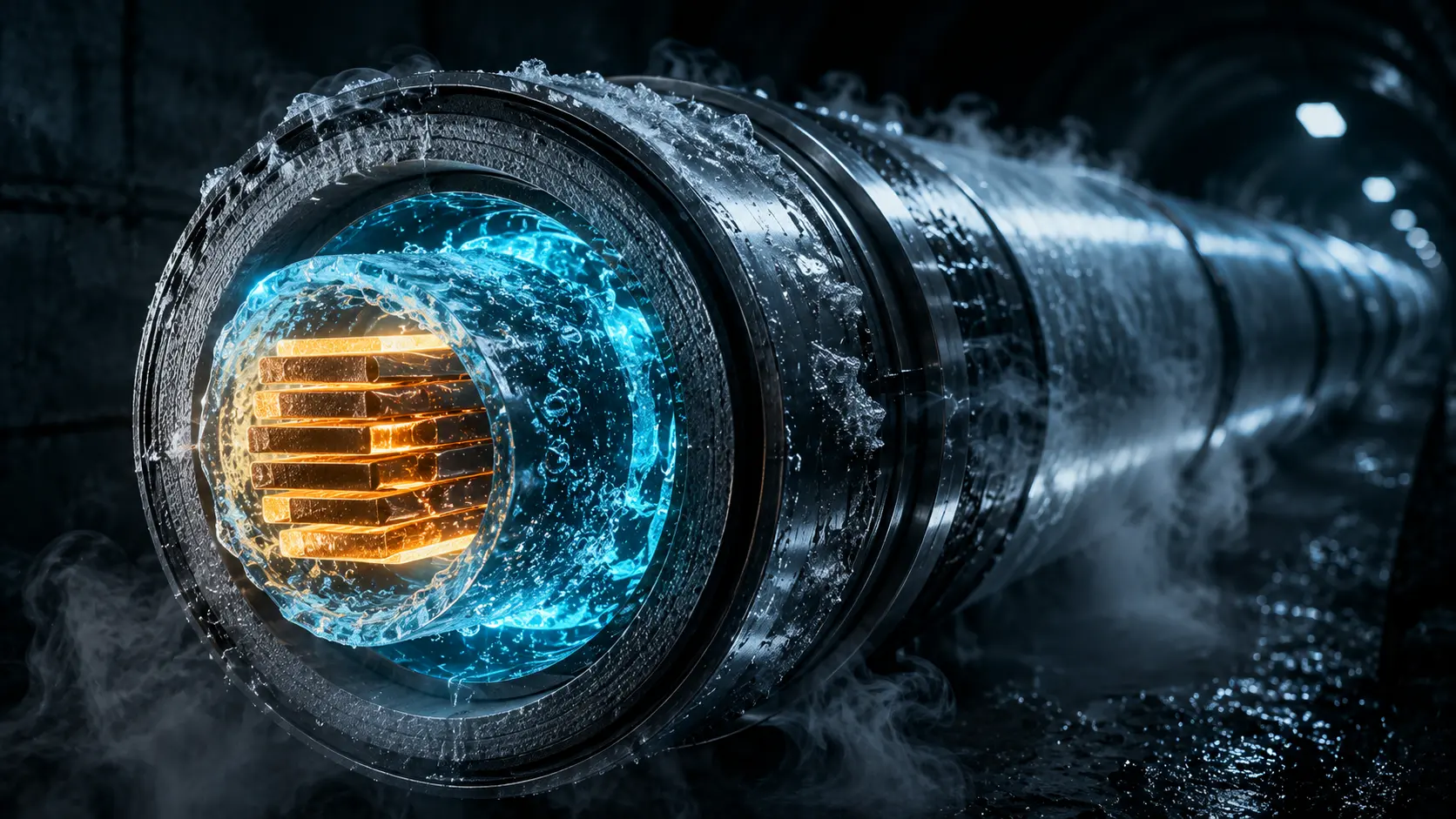
To keep the REBCO tape superconducting, the cable is built as a concentric tube (a cryostat).
- The Inner Core: The REBCO tapes are wound around a central former.
- The Liquid Nitrogen Flow: Super-cooled liquid nitrogen (-200°C) is continuously pumped through the core, absorbing any ambient heat.
- The Vacuum Jacket: Surrounding the nitrogen is a layer of absolute vacuum (like a massive thermos flask), preventing the heat of the surrounding earth from reaching the frozen core. The liquid nitrogen travels down the cable, warms up slightly, and is routed back to a chiller station to be cooled and recirculated.
5. Real-World Consequences: Zero EMF and Rights-of-Way
Because the current is perfectly shielded by the superconducting layers, an HTS cable emits zero heat into the soil and zero Electromagnetic Fields (EMF). Traditional power cables interfere with telecommunications fiber and create magnetic zones that restrict land use. An HTS cable can be buried immediately adjacent to fiber-optic networks or gas mains. This completely eradicates the need to acquire new, highly expensive municipal “rights-of-way.”
Real-World Applications
HTS technology has graduated from pilot testing into foundational infrastructure integration.
The Munich SuperLink: Driven by the electrification of transport and heating, the city grid of Munich reached its physical limits. Rather than tearing up the city, Stadtwerke München initiated the SuperLink project to construct a 12-kilometer superconducting cable route. Operating at 110 kV, a single HTS cable will deliver 500 Megawatts of power, replacing multiple massive XLPE copper cables and saving the city from debilitating construction gridlock.
Hyperscale AI Data Centers: Standard hyperscale data centers require extensive 110 kV or 220 kV high-voltage substations. By utilizing HTS cables, operators can step down the voltage far outside the city limits. The HTS cable then carries the massive power at a safe, lower medium-voltage directly into the dense urban core, eliminating the need to permit and build sprawling, dangerous high-voltage infrastructure next to the data halls.
Superconducting Fault Current Limiters (SFCL): HTS is not just a cable; it is an automatic fuse. If a lightning strike or a transformer failure causes a massive surge of current (a fault), the excessive power instantly heats the REBCO tape above -180°C. In a fraction of a millisecond, the tape loses its superconductivity and its electrical resistance skyrockets. This sudden block of resistance chokes off the dangerous power surge instantly, protecting the downstream AI servers from frying, before seamlessly cooling back down to resume normal operation.
Economic & Strategic Impact
The economics of HTS flip the traditional utility budgeting model from Capital Expenditure (CapEx) to Operational Expenditure (OpEx).
When analyzing pure material costs, an HTS cable is wildly more expensive per meter than a copper cable due to the intricate manufacturing of REBCO tape and the vacuum-insulated cryostat. However, installing an underground cable in a city like London or New York is 80% civil engineering (digging) and 20% material cost. Because HTS requires vastly smaller trenches or simply slides into existing, abandoned utility pipes, the overall project CapEx often breaks even or undercuts traditional copper expansion.
The trade-off is OpEx. A copper cable, once buried, sits there silently for 50 years. An HTS cable requires an active, industrial-grade cryogenic cooling station continuously pumping liquid nitrogen. If the pumps fail, the cable warms up, the resistance returns, and the grid link is severed. Utilities are currently evaluating whether the immense capacity gains offset the permanent maintenance requirement of managing localized liquid nitrogen plants.
Advantages
- Massive Power Density: Delivers up to 10 times the current of conventional XLPE cables in the exact same physical diameter.
- Zero Heat and Zero EMF: Perfect electrical efficiency means the cable does not warm the surrounding soil or emit electromagnetic interference, unlocking tight urban real estate.
- Lower Voltage Operations: Can transmit gigawatt-scale power at medium voltages, eliminating the need for massive, expensive high-voltage substations near the end-user.
- Inherent Grid Protection: Acts as a self-healing Superconducting Fault Current Limiter (SFCL) to block dangerous electrical surges in milliseconds.
Limitations
- Active Cooling Dependency: The system is only active if the liquid nitrogen is flowing. A failure at the cooling station or a breach in the vacuum jacket renders the cable instantly useless.
- Splicing Complexity: Joining two pieces of HTS cable together in the field is an incredibly delicate procedure. Ensuring a flawless vacuum seal and seamless REBCO tape connection requires highly specialized cryogenic technicians, slowing down repair times.
- High Upfront Material Cost: While falling, the cost of manufacturing 2G REBCO tape via chemical vapor deposition or epitaxy remains a premium expense tightly controlled by a small handful of global suppliers (e.g., SuperPower, MetOx, Shanghai Superconductor).
Common Misconceptions
Misconception: “High-Temperature” means the cable operates in the heat.
Reality: In the realm of quantum physics, -200°C is considered a “high” temperature. Legacy superconductors required liquid helium (-269°C). By shifting to liquid nitrogen (-200°C), HTS slashed cooling costs by 99% and removed the volatility of helium handling.
Misconception: HTS will replace all power lines.
Reality: HTS is highly specific to “bottleneck” scenarios. For long-distance overland transmission where space is unlimited, hanging cheap aluminum/copper wires from massive steel towers is vastly more economical. HTS is strictly an underground, high-density urban solution.
Misconception: The liquid nitrogen is dangerous and polluting.
Reality: The atmosphere you breathe is 78% nitrogen. If the HTS cable breaches and leaks, the liquid nitrogen simply boils instantly into harmless gas. It is far safer than older, legacy high-voltage cables that rely on thousands of gallons of toxic, flammable dielectric oil for cooling.
What Most People Miss
The critical transition from 1G (BSCCO) to 2G (REBCO) Tapes.
Early pilot projects in the 2010s used First-Generation (1G) Bismuth-based superconducting tapes. These were brittle, expensive, and suffered heavily when exposed to strong magnetic fields. The modern explosion in HTS viability is entirely due to Second-Generation (2G) REBCO tapes. REBCO is far more robust, can be manufactured in continuous, kilometer-long ribbons, and maintains its superconductivity even when immense magnetic fields are present. This leap in material science is the unsung hero enabling the commercialization of the technology today.
Comparison Table
| Feature | Standard Underground (XLPE Copper) | 1G HTS Cables (Legacy) | 2G HTS Cables (REBCO) |
| Current Capacity | Baseline (1x) | High (3x – 5x) | Extreme (5x – 10x+) |
| Operating Temperature | Ambient to +90°C | -200°C (Liquid Nitrogen) | -200°C (Liquid Nitrogen) |
| Magnetic Field Tolerance | High | Poor (Loses superconductivity) | Excellent (Remains stable) |
| Cooling Requirement | None (Passive soil dissipation) | Active Cryogenics | Active Cryogenics |
| Electromagnetic Fields (EMF) | High (Requires wide clearance) | Zero | Zero |
| Primary Use Case | Standard grid distribution | Experimental pilot projects | Urban AI Data Centers, Dense Grid Retrofits |
Case Study
Situation: The ComEd utility network in Chicago was facing increasingly severe fault currents. As the city grid grew denser and more distributed energy resources (solar, batteries) came online, the potential for a massive electrical surge to overwhelm the existing substations and cause cascading failures became a critical operational risk.
Challenge: Upgrading the massive circuit breakers and substations across the densely packed downtown loop to handle these higher fault currents would require hundreds of millions of dollars and severe disruption to the city’s infrastructure.
Solution (The Resilient Electric Grid): Funded by the Department of Homeland Security and deployed by AMSC (American Superconductor), ComEd installed a localized High-Temperature Superconducting cable system to link two critical substations in downtown Chicago.
Outcome: The HTS cable achieved two simultaneous victories. First, it allowed massive amounts of power to be shared flexibly between the two substations without digging new, massive trenches. Second, the cable possessed inherent Superconducting Fault Current Limiter (SFCL) properties. When a fault was simulated, the REBCO tape instantly lost its superconductivity, acting as a flawless, self-healing resistor that choked the surge before it could damage the broader grid.
Lessons Learned: The Chicago deployment validated that HTS is not merely a high-capacity pipe; it is a dynamic, intelligent grid asset. By doubling as a surge protector, HTS cables allow grid operators to securely link substations together—creating a highly resilient web—without risking the systemic contagion of fault currents.
Future Outlook
Next 12–24 Months
The focus will remain firmly on the hyperscale AI data center bottleneck. As developers realize they cannot secure 1 GW grid connections in places like Northern Virginia or Dublin using traditional infrastructure, we will see major announcements of bespoke, private HTS links. Cloud providers will actively finance the deployment of HTS lines from distant high-voltage nodes directly to their urban campuses, bypassing utility queue delays entirely.
Next 3–5 Years
The scaling of the REBCO manufacturing supply chain. Currently, 2G HTS tape is manufactured in small batches compared to copper. As demand spikes, companies will transition to continuous, roll-to-roll chemical vapor deposition manufacturing, collapsing the price per meter. This price parity will trigger the transition of HTS from “specialized urban retrofit” to the standard baseline for all new sub-surface, high-capacity utility routing.
Next 10 Years
The integration of HTS with Liquid Hydrogen. While liquid nitrogen is currently used to cool the cables, the next leap is synergizing the grid with the emerging hydrogen economy. Liquid hydrogen runs even colder (-253°C). Engineers are testing “hybrid pipelines” where a single, massive underground cryostat pumps liquid hydrogen fuel into the city for heavy transport, while simultaneously using that exact same super-cold liquid to chill a surrounding REBCO HTS cable carrying electricity. This dual-use infrastructure will fundamentally rewrite urban energy economics.
Most Likely Scenario
High-Temperature Superconducting cables are the only physical mechanism capable of reconciling the explosive power demands of artificial intelligence with the spatial constraints of modern cities. While the operational burden of managing cryogenic cooling stations will deter rural and overland use, HTS will become the undisputed, mandatory nervous system for Tier-1 global metropolises, cleanly moving gigawatts of power directly beneath our feet.
Key Takeaways
- High-Temperature Superconducting (HTS) cables carry 5 to 10 times more electricity than traditional copper cables of the same diameter, with absolutely zero electrical resistance.
- The cables utilize 2G REBCO tapes cooled by a continuous flow of liquid nitrogen to -200°C to achieve the superconducting state.
- Because they generate zero heat and emit no electromagnetic fields (EMF), HTS cables can be retrofitted directly into existing, narrow urban utility pipes, avoiding billions in new civil engineering costs.
- HTS technology is the critical enabler for urban AI data centers, which require gigawatts of localized power that traditional high-voltage copper architectures cannot physically deliver.
- The cables double as Superconducting Fault Current Limiters (SFCLs), acting as self-healing fuses that instantly block dangerous electrical surges to protect the grid.
- The primary trade-off is the shift to Operational Expenditure (OpEx)—utilities must actively maintain and run cryogenic cooling plants for the 40-year lifespan of the cable.
Glossary
Cryostat: The highly insulated, multi-layered concentric pipe that houses the superconducting cable. It acts like a massive thermos flask to keep the liquid nitrogen flowing at -200°C while preventing the heat of the surrounding earth from entering.
Epitaxy: The advanced manufacturing process used to create 2G HTS tapes, where a perfectly ordered, microscopic crystalline layer of superconducting ceramic is deposited onto a flexible metal ribbon.
Liquid Nitrogen ($LN_2$): A chemically inert, non-flammable liquid used to cool HTS cables. It is cheap to produce and boils back into harmless nitrogen gas if the cable breaches.
REBCO (Rare-Earth Barium Copper Oxide): The specific class of ceramic chemical compound used to manufacture Second-Generation (2G) superconducting tapes. It maintains its superconductivity under intense magnetic fields.
Superconducting Fault Current Limiter (SFCL): An inherent property of HTS cables. If a massive surge of electricity hits the cable, the temperature spikes, superconductivity is instantly lost, and the sudden wall of electrical resistance blocks the surge from destroying downstream equipment.
XLPE Cable: Cross-Linked Polyethylene cable. The current global standard for underground high-voltage copper and aluminum transmission lines.
Frequently Asked Questions
Is an HTS cable dangerous if it breaks?
No. Unlike traditional underground high-voltage cables that are often cooled using thousands of gallons of flammable, highly toxic dielectric oil, HTS cables use liquid nitrogen. If an HTS pipe breaks, the nitrogen simply turns back into harmless gas (which already makes up 78% of the air we breathe), and the power is safely shut off.
Why not use superconductors for all power lines across the country?
The cryogenic cooling stations. Pumping liquid nitrogen through a vacuum-insulated pipe over hundreds of miles of open countryside is incredibly expensive and operationally complex. For vast, open spaces, hanging cheap aluminum wires from tall steel towers is far more economical. HTS is strictly an underground, high-density solution.
Does cooling the cable waste more energy than the cable saves?
No. Over high-capacity, medium-distance urban routes, the energy required to run the liquid nitrogen chiller plant is generally less than the total energy that would be lost as heat friction (line loss) in a standard copper cable.
Who manufactures the REBCO tape inside these cables?
It is a highly specialized, global niche market. Companies like SuperPower (a subsidiary of Furukawa), MetOx Technologies, Shanghai Superconductor, and Theva are the primary suppliers of the raw tape, which is then bought and assembled into final cables by giants like Nexans, NKT, and LS Cable.
How does this solve the AI data center problem?
AI data centers need massive power (gigawatts). Usually, that requires a 220 kV to 380 kV high-voltage line, which needs a massive substation that takes up acres of land. HTS cables can carry that same gigawatt of power at a much lower medium-voltage (e.g., 69 kV). This means you can drop the massive substation far outside the city, and pipe the massive current directly into the urban data center safely through a very small pipe.
Sources
- Nexans: Superconducting cable systems – HTS cables, SFCLs & cryogenic solutions (2026)
- Department of Energy (DOE): Albany HTS Power Cable and Retrofit Applications
- Congruence Market Insights: High Temperature Superconductor (HTS) Cables Market Insights & Growth Outlook 2025–2032 (July 2026)
- Karlsruhe Institute of Technology (KIT): Liquid Nitrogen operated Cooling Systems for Superconducting Power Lines
- NKT / Stadtwerke München: The Munich SuperLink Project Framework (2025/2026)