Advertisement
)

At a Glance
- Concept: Engineering an optical fiber cable where the light signal travels through a hollow, gas-filled or vacuum center rather than plunging through solid silica glass.
- Why it matters: The speed of light is only the ultimate speed limit in a perfect vacuum. When light hits the solid glass of the modern internet, it slows down by roughly 33%. By removing the glass from the path, HCF pushes data transmission back up to the absolute physical speed limit.
- Who uses it: High-Frequency Trading (HFT) firms, AI hyperscalers (Microsoft, AWS), and national security telecommunications operators.
- Biggest takeaway: Hollow-core fiber does not just reduce latency. Because light is not grinding through solid glass, HCF eliminates “nonlinear effects.” This means operators can blast highly powerful lasers through the hollow tube without the signal distorting or melting the fiber, drastically extending the unamplified reach of the network.
In Simple Words
For decades, the global internet has relied on a brilliant invention: shooting lasers through strands of perfectly clear, solid glass.
But there is a catch. If you try to run through a swimming pool, the water slows you down. Solid glass does the same thing to light. The light “drags” against the atoms in the glass, reducing its speed by about a third. In a world where financial markets and artificial intelligence clusters measure time in microseconds, that delay is a massive bottleneck.
Hollow-Core Fiber solves this by removing the water from the pool.
Instead of a solid strand of glass, engineers build a microscopic glass pipe that is completely hollow in the middle. The laser is fired straight down the empty hole. Because the light is traveling through air instead of solid matter, it travels significantly faster. To keep the laser beam from hitting the walls of the pipe, complex microscopic rings inside the cable act like perfect mirrors, bouncing the light back into the center. The result is an internet cable that physically outpaces the fastest glass networks on Earth.
Why This Matters
Latency is the invisible tax on the digital economy.
In High-Frequency Trading (HFT), a latency advantage of a single millisecond between Chicago and New York can translate to tens of millions of dollars in arbitrage profits per year. Financial firms have historically paid exorbitant premiums to physically straighten their fiber routes, digging through mountains just to shorten a cable by a few miles. HCF achieves that exact same latency reduction through physics rather than geography.
Beyond finance, the explosion of Generative AI has centralized immense computing power. AI data centers are scaling to gigawatt levels, requiring operators to split their computing clusters across multiple geographic locations. For thousands of GPUs to act as a single, synchronized brain, the data connecting them must arrive almost instantly. HCF provides the ultra-low latency optical interconnects required to synchronize massive, distributed AI training clusters across a metropolitan region, making it a foundational infrastructure layer for the next decade of computing.
The Big Picture
The telecom industry has spent the last forty years optimizing single-mode fiber (SMF). They purified the silica glass until it was virtually flawless, pushing attenuation (signal loss) to its theoretical absolute minimum.
However, they hit the Nonlinear Shannon Limit. As we tried to push more data through solid glass by increasing the laser power, the light literally began interacting with the glass molecules, distorting the data signals (nonlinear effects).
Hollow-core fiber completely bypasses the Shannon Limit. Because there is virtually no glass in the light’s path, there is no material for the light to interact with. You can blast vastly more power through an HCF cable than a standard SMF cable without scrambling the data. This allows network architects to utilize complex, high-density modulation formats (like 256QAM) over much longer distances without needing expensive mid-point signal amplifiers.
HOW HOLLOW-CORE FIBER WORKS
Trapping a beam of light inside an empty pipe without it leaking through the walls requires a masterpiece of optical physics. Here is the first-principles breakdown.
1. The Fundamental Problem: The Refractive Index
The speed of light in a vacuum is roughly 300,000 kilometers per second. However, light’s speed in any material is determined by its “refractive index.” Solid silica glass has a refractive index of about 1.45, meaning light travels 1.45 times slower in glass than in a vacuum. To speed up the internet, you must lower the refractive index of the cable to 1.0 (the index of air/vacuum).
2. The Insufficiency of Total Internal Reflection
Standard fiber optic cables trap light using “Total Internal Reflection.” They use a dense glass core wrapped in a slightly less dense glass cladding. When the light tries to escape the core, it bounces off the boundary and stays trapped. However, you cannot use Total Internal Reflection if the core is air, because air is less dense than the surrounding glass jacket. The light simply bleeds straight through the walls and is lost immediately.
3. The Core Mechanism: Anti-Resonant Structures
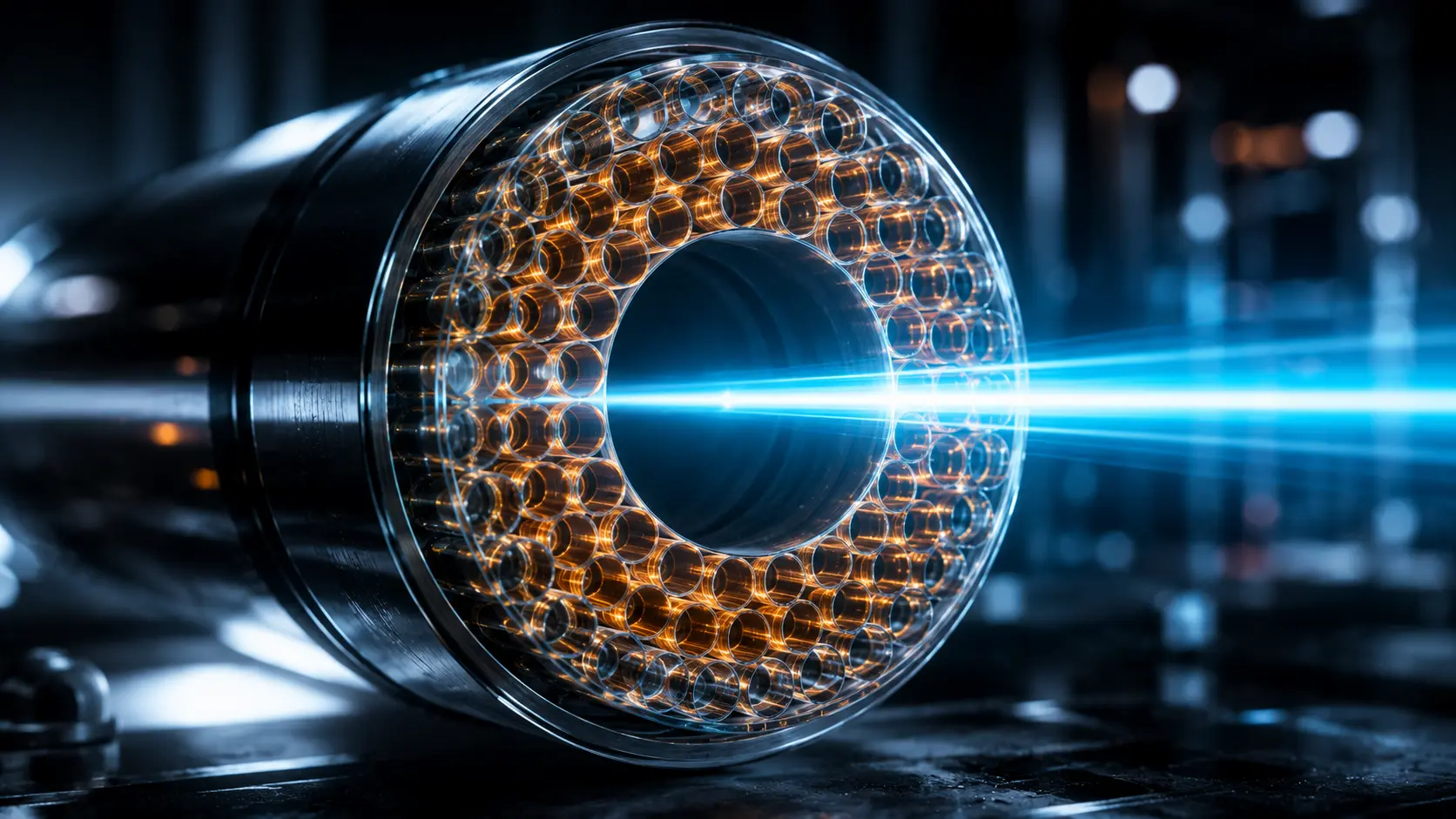
To trap light in a hollow tube, engineers use Anti-Resonant Hollow-Core Fiber (AR-HCF). Instead of solid cladding, the inside of the fiber is lined with a ring of microscopic, ultra-thin glass capillary tubes. These tubes are precisely tuned to an exact thickness. When light tries to escape the hollow center, the optical waves hit the thin glass tubes and create an “anti-resonance” effect—the light waves destructively interfere with themselves at the boundary, creating an impenetrable optical wall that forces the light back into the hollow center.
4. Technical Depth: Chromatic Dispersion and Nonlinearity
Because the light is traveling through air, two massive networking problems disappear.
- Chromatic Dispersion: In solid glass, different colors of light travel at slightly different speeds, causing data pulses to smear and blur over long distances. In air, all colors travel at virtually the exact same speed, keeping the data crisp.
- Nonlinearities: In solid glass, high-power lasers cause the glass atoms to vibrate, which generates phantom signals (Stimulated Raman Scattering). Because air has 1,000 times lower nonlinearity than glass, operators can push radically higher optical power into an HCF link.
5. Real-World Consequences: The Latency and Reach Multiplier
By removing the glass friction, HCF achieves a 30% to 47% reduction in latency compared to traditional fiber. A signal sent across a 1,000 km stretch of HCF will arrive roughly 1.5 to 1.6 milliseconds faster than on a standard SMF network. Furthermore, because operators can use higher launch powers without triggering nonlinear distortion, HCF links can cover up to 1.5 times the distance of standard fiber before requiring an expensive mid-line amplifier to boost the signal.
Real-World Applications
Hollow-core fiber is actively graduating from experimental testbeds into mission-critical production environments.
Hyperscale AI Interconnects: Microsoft’s acquisition of HCF manufacturer Lumenisity in 2022 marked the turning point. Microsoft is actively deploying thousands of kilometers of HCF across Europe. In hyperscale architecture, an AI training cluster is often too large to fit in one building. By using HCF to connect two data centers 50 kilometers apart, the latency drops so low that the AI cluster treats the two separate buildings as if they are in the exact same room, seamlessly sharing GPU workloads.
High-Frequency Trading (HFT): The financial sector is the most aggressive early adopter of HCF. Trading routes linking the Chicago Mercantile Exchange (CME) to New Jersey data centers are continuously upgraded. By retrofitting existing terrestrial routes with HCF, trading firms bypass the physical delay of standard silica, executing arbitrage algorithms faster than competitors trapped on legacy solid-glass networks.
Quantum Key Distribution (QKD): Quantum communication relies on transmitting fragile individual photons. In solid glass, photons often interact with the silica structure, destroying their quantum state (decoherence). Because HCF guides light through an inert air gap, the delicate quantum states of the photons are preserved over much longer distances, making HCF the preferred physical infrastructure for future un-hackable quantum networks.
Economic & Strategic Impact
The mass deployment of HCF introduces a highly complex capital expenditure (CapEx) versus operational expenditure (OpEx) calculation for telecom operators.
Currently, HCF is significantly more expensive to manufacture than standard SMF. The complex “stack-and-draw” manufacturing process—where glass tubes are meticulously arranged and heated to create the anti-resonant internal structure—yields lower commercial volumes than spinning solid silica.
However, the operational savings at scale are immense. In a long-haul network, the most expensive components are not the cables, but the physical inline amplifier huts required every 60 to 80 kilometers to boost the signal. Because HCF tolerates higher launch powers and suffers incredibly low attenuation (pushing toward 0.05 dB/km), telecom operators can skip amplifiers entirely over massive distances. Eliminating the need to buy land, build huts, and power repeating equipment offsets the premium cost of the physical hollow-core cable.
Advantages
- Ultra-Low Latency: Data travels at ~99.97% of the absolute speed of light in a vacuum, reducing propagation delay by roughly a third compared to solid glass.
- Massive Power Tolerance: Operators can launch highly powerful optical signals into the fiber without causing the data to distort or the cable to melt.
- Broad Optical Spectrum: HCF supports data transmission across a much wider range of light frequencies (C-band, L-band, and beyond), vastly increasing the total bandwidth capacity of a single cable.
- Security: HCF exhibits lower optical backscatter than solid fiber. This makes it physically much harder for hostile actors to “tap” the fiber and steal data without immediately breaking the fragile internal optical resonance.
Limitations
- Splicing Complexity: Connecting a hollow cable to a solid glass cable (or splicing two HCFs together) is notoriously difficult. If they do not align perfectly, the light hits the solid glass edge of the tube and scatters. Specialized fusion splicers are required, and splice losses remain higher (0.3 to 0.6 dB) than standard glass-to-glass splices.
- Mechanical Fragility: The internal microscopic glass tubes that trap the light are delicate. HCF requires a larger minimum bend radius than modern, bend-insensitive SMF. If the cable is bent too sharply during installation, the anti-resonant tubes warp, and the light leaks out.
- Testing and Maintenance: Traditional Optical Time Domain Reflectometers (OTDRs) used to find cuts in underground fiber rely on light scattering off the glass. Because HCF has almost no glass in the core, the backscatter is incredibly weak, requiring specialized, expensive diagnostic equipment to locate breaks.
Common Misconceptions
Misconception: The entire cable is a hollow, empty plastic tube.
Reality: The cable looks identical to a standard fiber optic cable from the outside. The “hollow” part is microscopic (roughly 10 to 30 micrometers wide). The outer cladding and structural supports are still made of solid silica glass.
Misconception: Hollow-core fiber is a new, unproven concept.
Reality: The physics of Photonic Bandgap fibers have been known since the late 1990s. What is new in 2025/2026 is the perfection of the Nested Anti-Resonant Nodeless Fiber (NANF) geometry, which finally dropped the signal loss (attenuation) down to levels that rival or beat the best solid glass fibers on the market.
Misconception: We will eventually replace all internet cables with HCF.
Reality: Standard SMF is incredibly cheap and highly reliable. HCF will likely be reserved for premium, high-value “express routes” (inter-data center links, financial corridors, and subsea trunks) where the business case justifies the higher CapEx and specialized handling requirements.
What Most People Miss
The impact of Back-Reflection on Lasers.
In solid fiber networks, when light travels down the cable, tiny imperfections in the glass cause some of the light to bounce backward (back-reflection) directly into the transmitting laser. This back-reflection can destabilize the laser hardware, requiring expensive components called optical isolators to protect the equipment. Because hollow-core fiber uses air, back-reflection is virtually non-existent. This allows hardware engineers to remove expensive optical isolators from their transceivers, significantly lowering the cost of the networking equipment plugged into either end of the cable.
Comparison Table
| Feature | Standard Single-Mode Fiber (SMF) | Hollow-Core Fiber (AR-HCF) |
| Light Propagation Medium | Solid Silica Glass | Air / Vacuum |
| Speed of Light | ~200,000 km/s | ~299,700 km/s (c) |
| Relative Latency | Baseline | ~33% Lower |
| Nonlinear Distortion | High (Limits laser launch power) | Almost Zero (Tolerates high power) |
| Splicing Difficulty | Very Low | High (Requires specialized alignment) |
| Chromatic Dispersion | Moderate (Requires compensation) | Extremely Low |
| Primary Use Case | Ubiquitous global distribution | AI Interconnects, HFT, Quantum links |
Case Study
Situation: As Microsoft expanded its Azure cloud infrastructure to accommodate the immense computational demands of OpenAI’s training models, it faced a severe physical limitation. The massive GPU clusters required for training simply could not be housed in a single regional data center due to power constraints.
Challenge: Microsoft needed to distribute the AI training load across multiple data centers located up to 50 kilometers apart. However, the standard solid-glass fiber interconnecting these buildings introduced latency. This latency caused the GPUs in Data Center A to sit idle while waiting for synchronized data from the GPUs in Data Center B, destroying the efficiency of the billion-dollar cluster.
Solution (The Lumenisity Acquisition & Deployment): Microsoft acquired Lumenisity, a pioneer in Nested Anti-Resonant Nodeless Fiber (NANF) technology. They bypassed the traditional telecom supply chain and directly deployed HCF links between their European hyperscale facilities.
Outcome: By stripping the glass out of the optical path, Microsoft reduced the latency between the facilities by roughly 33%. This drop in propagation delay allowed the distributed data centers to effectively operate as a single, contiguous high-performance computing (HPC) pod. The GPUs achieved vastly higher utilization rates because they spent less time waiting for data to traverse the metropolitan network.
Lessons Learned: The deployment validated that hollow-core fiber is not merely a niche financial trading tool. In the era of Generative AI, network latency is directly tied to compute utilization. Controlling the physics of the optical layer is a mandatory requirement for hyperscalers seeking to extract maximum ROI from their semiconductor investments.
Future Outlook
Next 12–24 Months
The industry will witness the mainstream commercialization of S-Band and L-Band HCF Transceivers. Because HCF opens up entirely new frequencies of light that are unusable in solid glass, optical hardware vendors (like Cisco, Nokia, and Ciena) will rush to market with specialized coherent transponders designed explicitly to exploit the ultra-wide bandwidth of hollow cables, driving immediate adoption in metro-area data center interconnects.
Next 3–5 Years
The scaling of Automated Splicing and Brownfield Integration. The current operational hurdle of deploying HCF is the manual, delicate fusion splicing process. By 2029, field-ready, AI-aligned fusion splicers that can perfectly align the hollow micro-structures to solid glass pigtails automatically will hit the market. This will allow utility contractors to integrate HCF seamlessly into existing terrestrial networks without requiring PhD-level optical engineers on site.
Next 10 Years
The dawn of the Hollow-Core Subsea Cable. The ultimate frontier for HCF is the ocean floor. By laying thousands of kilometers of unrepeatered or lightly-repeatered hollow-core fiber between North America and Europe, global latency will collapse. Transatlantic data will move at the absolute speed of light in a vacuum. The engineering challenge of protecting fragile hollow micro-structures from the crushing hydrostatic pressure of the deep ocean will trigger a revolution in maritime armored cabling.
Most Likely Scenario
Hollow-core fiber will permanently bifurcate the telecommunications market. Solid glass fiber will remain the cheap, ubiquitous utility layer for home broadband and standard enterprise networking. However, HCF will become the exclusive, premium backbone for the artificial intelligence economy. Hyperscalers, sovereign governments, and financial institutions will control these hollow “express lanes,” creating a two-tiered internet where access to the absolute speed of light is dictated by infrastructure capital.
Key Takeaways
- Hollow-Core Fiber (HCF) transmits data by firing lasers through an air-filled center rather than a solid glass core, reducing latency by roughly 33%.
- The technology relies on Anti-Resonant micro-structures (tiny glass tubes ringing the core) to act as mirrors, preventing the light from escaping the hollow center.
- Because light does not interact with solid glass, HCF eliminates nonlinear distortion, allowing network operators to use significantly higher laser power.
- The primary adopters are High-Frequency Trading (HFT) firms seeking arbitrage advantages, and AI hyperscalers (like Microsoft) needing ultra-fast interconnects to synchronize distributed GPU clusters.
- While attenuation (signal loss) has dropped to levels rivaling traditional fiber, the cost of manufacturing and the complexity of splicing HCF remain the primary barriers to ubiquitous rollout.
- HCF enables longer transmission distances without requiring expensive mid-line signal amplifiers, shifting the economic model of long-haul telecom networks.
Glossary
Anti-Resonant Hollow-Core Fiber (AR-HCF): A specific cable geometry that uses a ring of ultra-thin glass capillary tubes to trap light inside a hollow center by causing escaping light waves to destructively interfere with themselves.
Attenuation: The gradual loss of signal strength as light travels down a fiber optic cable, typically measured in decibels per kilometer (dB/km).
Chromatic Dispersion: A phenomenon where different colors (frequencies) of light travel at different speeds through a medium, causing the data signal to smear. This effect is virtually eliminated in hollow-core fiber.
Latency: The total time it takes for a data packet to travel from its source to its destination.
Nonlinear Effects: Distortions in a data signal that occur when high-power lasers physically interact with the atomic structure of solid glass.
Refractive Index: A number indicating how much a material slows down the speed of light. A vacuum has a refractive index of 1.0, while solid silica glass is approximately 1.45.
Single-Mode Fiber (SMF): The current global standard for solid glass telecommunications cables, designed to carry a single ray of light over long distances.
Frequently Asked Questions
Does a hollow-core fiber have literally nothing inside it?
It is filled with air, or in some specialized cases, an inert gas or a partial vacuum. The structure holding the air in place is made of highly engineered silica glass.
If light travels so much faster in air, why didn’t we build this decades ago?
We tried. Early versions (Photonic Bandgap Fibers) suffered from massive signal loss. The light leaked out or was absorbed by the internal structure. It took decades of advanced computer modeling and microscopic manufacturing breakthroughs to invent the “Anti-Resonant” tube geometry that finally trapped the light perfectly.
Will HCF make my home internet faster?
Technically yes, but you won’t notice it. For streaming Netflix or browsing the web, a difference of 2 milliseconds is imperceptible. The massive cost of HCF means it will be reserved for data center backbones, not residential fiber-to-the-home (FTTH) connections.
Is hollow-core fiber more fragile than regular fiber?
Yes. While the thick outer plastic jacket protects it like any other cable, the internal microscopic glass tubes are sensitive to sharp bends. If the installation crew bends the cable too tightly around a corner, the internal tubes warp, and the light escapes.
How do you connect a hollow cable to a solid glass machine?
This is the hardest part of HCF networking. Engineers must use specialized fusion splicing machines to carefully fuse the hollow core cable directly to a standard solid glass “pigtail” that plugs into the router. If the alignment is off by even a micron, the light scatters.
Sources
- Microsoft Research: Real-Time, Fully-Loaded C-band, Low-Latency, Long-Haul Transmission over Hollow-Core Fiber (October 2025)
- TIME: Microsoft Hollow Core Fiber: The Best Inventions of 2025 (October 2025)
- Nokia Blog: Hollow-core fiber: Not just for low latency? (February 2026)
- VIAVI Solutions Inc.: What is Hollow Core Fiber (HCF) Testing?
- Conectronica: Hollow Core Fiber (HCF) Deployment and Testing (March 2026)