Advertisement
)

At a Glance
- Concept: Eliminating the evaporation of fresh drinking water in data center cooling by utilizing sealed, closed-loop mechanical and liquid cooling systems.
- Why it matters: AI models run incredibly hot. A standard AI query can consume over 500 milliliters of fresh water. With hyperscalers building massive data centers in drought-prone regions, local municipalities are protesting the strain on their water tables. Zero-water systems decouple AI growth from regional water crises.
- Who uses it: Tech giants leading the transition, notably Microsoft (deploying zero-water designs at their Fairwater facility in Wisconsin and in Arizona), Google, and advanced immersion cooling hardware providers.
- Biggest takeaway: The data center industry is shifting its primary sustainability metric. For the last decade, companies only cared about Power Usage Effectiveness (PUE). Today, Water Usage Effectiveness (WUE) is equally critical. The new engineering challenge is driving WUE to zero without letting PUE skyrocket.
In Simple Words
When a computer runs, it generates heat. If it gets too hot, it melts.
To cool down massive buildings full of computers, tech companies traditionally used evaporative cooling. It works just like human sweat: the building sprays hot water into a cooling tower, the water evaporates into the outside air, and the evaporation process pulls heat away from the building. It is cheap and uses very little electricity. The problem? A single AI data center using this method can evaporate hundreds of thousands of gallons of fresh drinking water every single day.
In a world facing severe droughts, cities are refusing to let tech companies evaporate their drinking water.
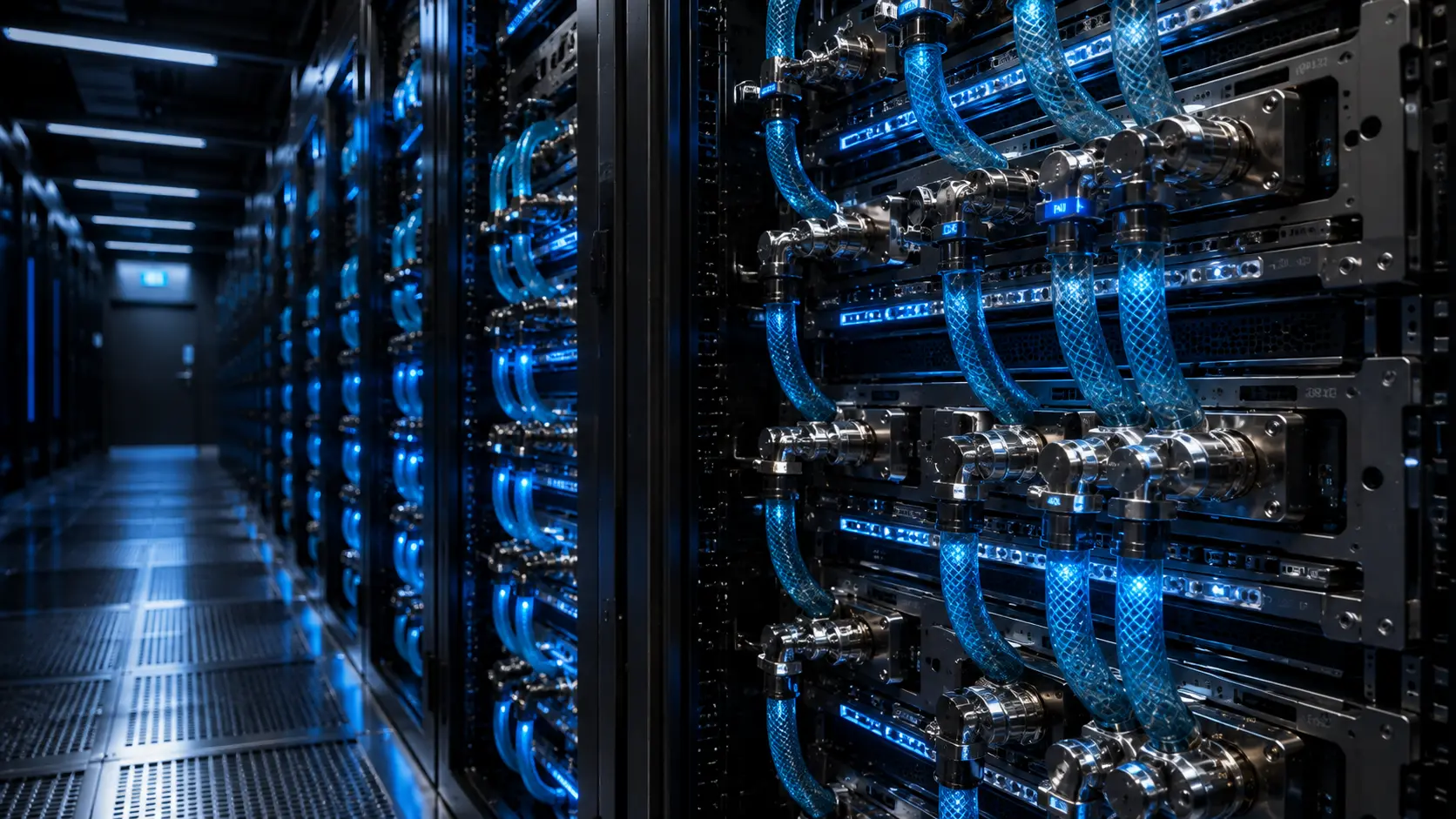
Zero-Water Data Centers fix this by acting like the radiator in your car. Instead of spraying water into the open air to evaporate, a fluid is sealed inside a closed loop of pipes. The fluid absorbs the heat from the computer chips, travels to a massive radiator on the roof, and giant fans blow outside air over the pipes to cool the fluid down. The fluid then loops back inside to cool the computers again. Because the loop is completely sealed, the facility is filled with water exactly once during construction, and it never consumes another drop.
Why This Matters
The sheer computational density of artificial intelligence is altering the physical infrastructure of the internet.
Traditional cloud servers run at about 10 to 20 kilowatts (kW) of power per rack. Modern AI servers filled with high-end GPUs run between 50 and 135 kW per rack. This extreme density produces an astronomical amount of heat. Research from the University of California Riverside estimated that generating a 100-word AI prompt consumes approximately a bottle of water in evaporative cooling.
By 2023, hyperscalers like Google and Microsoft were consuming billions of liters of water annually, with a massive percentage drawn from heavily water-stressed watersheds. This triggered severe geopolitical and municipal backlash. Local communities in places like Oregon, Arizona, and across the globe began actively blocking data center permits to protect their agricultural and residential water supplies. The shift to zero-water cooling is not just an ESG (Environmental, Social, and Governance) public relations move; it is a strict legal and operational necessity to secure construction permits in the 2026 era.
The Big Picture
The evolution of data center sustainability is defined by the tension between two metrics: PUE and WUE.
Power Usage Effectiveness (PUE) measures how much electricity is wasted on cooling. A PUE of 1.0 means perfect efficiency (every watt goes to the computers).
Water Usage Effectiveness (WUE) measures how many liters of water are evaporated per kilowatt-hour of IT energy used.
Historically, evaporative cooling was highly favored because it dramatically lowered PUE. Evaporating water takes very little electricity, so the data center looked incredibly “green” on paper regarding energy. However, this required trading electricity for water, resulting in a terrible WUE (often 1.5 to 2.5 Liters/kWh). As the industry pivots to zero-water mechanical and dry cooling (WUE of 0.0), operators are fighting to ensure their electrical power consumption (PUE) does not skyrocket in the process.
How Zero-Water Data Centers Work
Cooling 100-kilowatt server racks without using the thermodynamic shortcut of evaporation requires aggressive, specialized thermal engineering. Here is the first-principles breakdown.
1. The Fundamental Problem: Heat Rejection
Every watt of electricity that enters a data center leaves as a watt of heat. If that heat is not continuously removed (rejected) from the building, the servers will thermally throttle and shut down in minutes.
2. The Insufficiency of Traditional Air and Evaporative Cooling
Blowing cold air down the aisles (legacy cooling) is highly inefficient for AI because air is a poor conductor of heat. Furthermore, rejecting that heat into the atmosphere using open-loop evaporative cooling towers creates unacceptable municipal water strain and introduces biological risks like Legionella bacteria inside the facility water lines.
3. The Core Mechanism: The Closed-Loop Dry Cooler
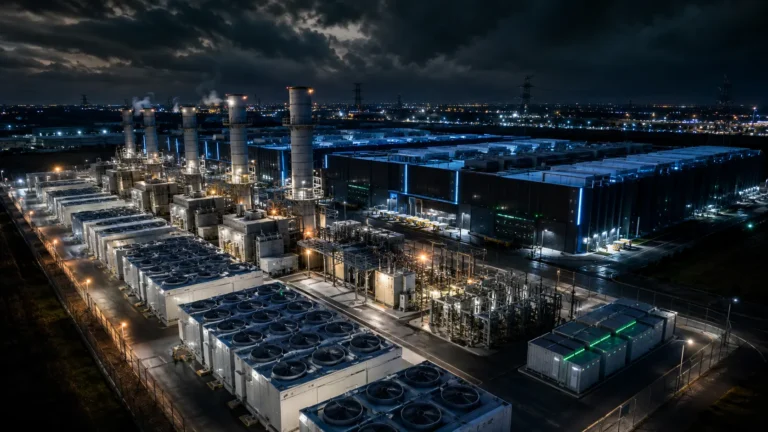
In a zero-water facility, the heat is captured inside the server room and transferred to a closed loop of liquid (often water or a specialized coolant). This hot liquid is pumped to a “dry cooler” on the roof. The dry cooler is essentially a massive heat exchanger (like a car radiator). High-efficiency fans force ambient outside air across the finned coils of the heat exchanger. The heat transfers from the liquid inside the pipes to the air outside the pipes, cooling the liquid down so it can be recirculated. Zero evaporation occurs.
4. Technical Depth: Pumped Two-Phase (P2P) and Direct-to-Chip Liquid Cooling
To prevent the PUE from exploding when using dry coolers, engineers must make the internal heat capture vastly more efficient. They bypass the air entirely using Direct-to-Chip liquid cooling. A metal cold plate is bolted directly onto the GPU. In Pumped Two-Phase (P2P) systems, a dielectric fluid flows into the cold plate. The extreme heat of the GPU causes the fluid to boil and turn into a vapor. This phase change (liquid to gas) absorbs massive amounts of thermal energy. The vapor flows away, condenses back into a liquid, and releases the heat to the closed-loop system. Because liquids transfer heat far more efficiently than air, this slashes internal cooling energy by up to 40 percent.
5. Real-World Consequences: High-Temperature Operation
To make a dry cooler work efficiently, especially in hot climates like Arizona, the liquid coming from the servers must be significantly hotter than the outside air. By using liquid cooling, data centers can safely allow their return-water temperatures to rise much higher than traditional air-cooled rooms. This high temperature differential (Delta T) allows the dry coolers on the roof to reject heat into the atmosphere effectively using only fans, eliminating the need for water evaporation while keeping overall energy consumption stable.
Real-World Applications
The transition from conceptual design to massive physical deployment accelerated rapidly heading into 2026.
Microsoft’s Fairwater Facility (Wisconsin): At the Microsoft Build 2026 conference, CEO Satya Nadella confirmed that their newest AI data centers use only as much water annually as a neighborhood restaurant. The prime example is the Fairwater facility in Mount Pleasant, Wisconsin, opened in late 2025. The site utilizes a closed-loop liquid cooling system that is filled once during construction and recirculates the same water indefinitely, achieving an effective WUE of zero.
Hyperscale Desert Deployments (Arizona): Operating in severely water-stressed regions like Phoenix, Arizona, forces hyperscalers to abandon evaporation entirely. Microsoft and other major operators are implementing completely dry, mechanical cooling systems in these regions. While this historically drove up electricity usage (PUE), pairing dry cooling with highly efficient internal liquid-to-chip infrastructure allows them to operate heavy AI workloads in the desert without drawing the ire of local water regulators.
Immersion Cooling: For the absolute highest density racks, companies are utilizing immersion cooling. Entire servers are submerged in tanks filled with non-conductive, thermally stable dielectric fluid. The fluid absorbs the heat silently without any server fans. The heat is then transferred via heat exchangers to an external dry cooler loop. By eliminating all the internal server fans and traditional CRAC (Computer Room Air Conditioning) units, immersion systems can drive PUE down below 1.05 while maintaining zero water evaporation.
Economic & Strategic Impact
The mandate for zero-water cooling is physically redesigning the data center supply chain.
Companies manufacturing high-efficiency heat exchangers (like Xylem’s Bell & Gossett), dielectric fluids, and dry-cooling hardware are experiencing massive secular growth. Furthermore, the push for advanced coolants is heavily impacting the specialty chemicals market, driving demand for next-generation fluorochemicals that can operate safely inside high-performance server environments without contributing to global warming (shifting away from older HFCs).
Strategically, zero-water capability unlocks real estate. If a hyperscaler no longer requires a million gallons of water a day, they do not need to build near massive rivers or municipal water mains. They can build AI training clusters in remote, arid locations right next to stranded solar or wind farms, fundamentally uncoupling digital infrastructure from the global water table.
Advantages
- Total Municipal Independence: Eliminates the strain on local drinking and agricultural water supplies, streamlining zoning approvals and avoiding fierce community protests.
- Reduced Maintenance and Chemical Use: Open cooling towers require constant chemical treatments to prevent scale buildup and biological growth (like Legionella). Closed-loop systems are sealed, requiring virtually no chemical intervention or makeup water.
- Geographic Flexibility: Data centers can be sited strictly based on power availability (e.g., next to remote solar grids or nuclear plants) rather than water proximity.
- Future-Proofing: Shields the operator from inevitable municipal water rate hikes and drought-induced usage restrictions that will plague water-cooled facilities in the late 2020s.
Limitations
- Higher Capital Expenditure (CapEx): Installing closed-loop dry coolers, massive heat exchangers, and direct-to-chip liquid cooling manifolds costs significantly more upfront than building a traditional evaporative cooling tower.
- The Energy Trade-off in Hot Climates: In places like the Middle East or the American Southwest, if the outside air temperature exceeds the temperature of the liquid in the dry cooler, the system cannot reject heat efficiently without relying on energy-intensive mechanical compressors, driving up electricity costs and PUE.
- Coolant Sourcing and Regulation: Many high-performance two-phase and immersion systems rely on specialized dielectric fluids. The industry faces intense regulatory scrutiny (particularly in Europe) regarding PFAS “forever chemicals,” forcing manufacturers to hastily develop and validate environmentally safe fluid alternatives.
Common Misconceptions
Misconception: Liquid cooling uses a lot of water because it is “liquid.”
Reality: Closed-loop liquid cooling uses almost zero water operationally. The fluid is sealed in a pipe. Evaporative air cooling—which sprays water into the sky to evaporate—is the method that wastes millions of gallons.
Misconception: You cannot cool a data center without water if the outside air is hot.
Reality: You can, but it requires the data center to run hotter internally. By using direct-to-chip liquid cooling, the fluid leaving the servers is extremely hot (often above 45°C / 113°F). Even if the outside air in Arizona is 40°C (104°F), the hotter liquid can still reject heat into the air using a dry cooler without needing evaporation.
Misconception: A low PUE means a data center is environmentally friendly.
Reality: A low PUE only means the facility is highly efficient with electricity. If a facility achieves a 1.1 PUE by evaporating a million gallons of municipal drinking water a day in a desert, it is environmentally destructive. True sustainability requires balancing both PUE and WUE.
What Most People Miss
The strategic avenue for District Heating Recovery.
When a traditional data center evaporates water out of a cooling tower, all of that thermal energy is blasted into the sky and wasted. Closed-loop, zero-water liquid cooling changes this entirely.
Because the heat is captured cleanly inside a sealed liquid loop, the water exiting the servers is highly concentrated thermal energy. Instead of just sending it to a roof to be blown away by fans, operators can pipe this hot water directly into municipal district heating networks. This high-grade heat can be used to warm nearby residential neighborhoods, greenhouses, or industrial facilities during the winter. The data center effectively becomes a utility heat generator, monetizing its waste and turning a massive operational byproduct into a community asset.
Comparison Table
| Feature | Evaporative Cooling (Legacy) | Closed-Loop Dry Cooling (Zero-Water) | Immersion Cooling |
| Water Consumption | Very High (Millions of gallons/year) | Zero (Filled once, recirculated) | Zero (Dielectric fluid) |
| Water Usage Effectiveness (WUE) | ~ 1.5 to 2.5 L/kWh | 0.0 L/kWh | 0.0 L/kWh |
| Power Usage Effectiveness (PUE) | Excellent (1.1 – 1.3) | Moderate (1.4 – 1.8 for air/chiller) | Exceptional (< 1.05) |
| Maintenance Burden | High (Chemical treatments, scaling) | Low (Sealed piping) | Very Low (No dust, no fans) |
| Drought Vulnerability | Critical risk of shutdown | Completely immune | Completely immune |
| AI Density Capability | Low to Moderate (< 30 kW/rack) | High (Direct-to-chip assisted) | Extreme (> 100 kW/rack) |
Future Outlook
Next 12–24 Months
The era of the “Zero-Water Mandate.” Following Microsoft’s aggressive 2026 deployment of zero-water evaporation cooling across new builds in Wisconsin and Arizona, expect hyperscalers (Google, AWS, Meta) to universally adopt closed-loop liquid and dry cooling for all new high-density AI clusters. Local municipalities will increasingly refuse zoning permits for any data center proposing open-loop evaporative cooling towers in water-stressed regions, forcing the industry to adapt or face construction moratoriums.
Next 3–5 Years
The mass retrofitting of legacy facilities. As older enterprise data centers attempt to lease space to AI companies, they will find their legacy air and evaporative cooling systems incapable of handling 100-kW GPU racks. Operators will deploy hybrid transitional cooling—bringing modular, closed-loop liquid-to-liquid heat exchangers directly onto the data center floor to cool specific high-density AI rows without having to rebuild the entire building’s external chiller plant.
Next 10 Years
The convergence of AI infrastructure with energy recovery. By the mid-2030s, the concept of simply “rejecting” heat into the air will be viewed as an economic failure. Zero-water, closed-loop facilities will be structurally integrated into regional energy grids. The massive thermal output of these gigawatt-class AI supercomputers will be recycled entirely, serving as the primary baseload heat source for northern European cities and industrial agricultural hubs, fully redefining the data center from an environmental burden into a foundational civic utility.
Most Likely Scenario
The artificial intelligence boom will completely eradicate evaporative cooling in the data center industry. While the immediate transition requires massive CapEx investments in advanced heat exchangers, dry coolers, and direct-to-chip plumbing, the operational security of decoupling multi-billion-dollar infrastructure from the unpredictable, highly politicized global water supply will prove to be the most critical architectural decision of the decade.