Advertisement
)


What is Epigenetic Editing (CRISPRoff)?
Epigenetic Editing (CRISPRoff) is a therapeutic technology that turns off disease-causing genes without altering the underlying DNA sequence. It uses a deactivated CRISPR protein to deposit chemical tags onto the genome, silencing the targeted gene while avoiding the dangerous permanent cuts and chromosomal damage associated with traditional gene editing.
At a Glance
- Concept: Reprogramming the “software” of the cell (the epigenome) to silence genes using DNA methylation, rather than cutting the “hardware” (the genome).
- Why it matters: Traditional CRISPR acts as molecular scissors. Cutting DNA triggers cellular panic and carries severe risks of off-target mutations and cancer. Epigenetic editing completely removes the scissors, making genetic medicine exponentially safer and unlocking treatments for common, chronic diseases.
- Who uses it: Pioneering biotech firms like nChroma Bio, Tune Therapeutics, and Epic Bio, alongside major pharmaceutical partners aiming to disrupt the chronic disease market.
- Biggest takeaway: Because epigenetic editing does not permanently mutate the genome, it provides a massive regulatory and safety advantage. By early 2026, the technology officially entered human clinical trials, signaling the shift from “gene editing 1.0” to highly tunable, reversible genetic control.
In Simple Words
Imagine the human genome is a massive, multi-volume instruction manual containing the blueprints for your body.
Traditional CRISPR acts like a pair of scissors and a glue stick. If there is a misspelled word causing a disease, traditional CRISPR physically cuts that word out of the page and pastes a new one in. It works, but it is dangerous. If the scissors accidentally slip and cut the wrong page, you could permanently ruin the book, leading to devastating consequences like cancer.
Epigenetic Editing (CRISPRoff) throws away the scissors entirely.
Instead of cutting the page, it uses a highlighter and a paperclip. It finds the misspelled word causing the disease, highlights it, folds the page over, and clips it shut. The cell can no longer open or read that specific page, so the disease stops. The critical difference is that the underlying text of the book is never destroyed or mutated. The cell simply learns to ignore it, making the treatment drastically safer for the patient.
Why This Matters
The first generation of CRISPR was a scientific miracle, but its commercial application has been largely bottlenecked by its safety profile.
Because cutting double-stranded DNA is inherently traumatic to a cell, regulators and doctors currently reserve traditional CRISPR almost exclusively for severe, life-threatening genetic disorders (like Sickle Cell Disease) where the massive risk of off-target chromosomal shredding is outweighed by the guarantee of early death without treatment.
Epigenetic editing shatters this bottleneck. Because it does not break DNA, the safety threshold is drastically improved. This expands the Total Addressable Market (TAM) of genetic medicine from a few thousand patients with rare orphan diseases to hundreds of millions of patients suffering from common, chronic conditions. Instead of taking a daily pill for the rest of your life to manage high cholesterol or Hepatitis B, a single transient dose of an epigenetic editor can safely and durably switch the disease off at its source.
The Biotech Shift Toward Epigenetic Silencers
The biotech sector is actively pivoting toward the epigenome.
Throughout 2025 and 2026, massive capital flowed into companies mastering this space. In late 2024, Chroma Medicine and Nvelop Therapeutics united to form nChroma Bio, immediately securing USD 75 million to accelerate their pipeline. By January 2026, they successfully dosed the first patient in a Phase 1/2 clinical trial for CRMA-1001, an epigenetic silencer targeting Chronic Hepatitis B.
Simultaneously, competitors like Tune Therapeutics advanced their TEMPO platform, raising substantial venture capital to move their epigenetic silencers toward the clinic for both infectious diseases and cardiovascular targets (like PCSK9). The industry has realized that the future of genetic medicine relies on control, not destruction.
How Epigenetic Editing (CRISPRoff) Works
Silencing a gene without altering its sequence requires hijacking the exact mechanisms the human body naturally uses to turn genes on and off during embryonic development. Here is the first-principles breakdown.
1. The Fundamental Problem: Double-Strand Breaks
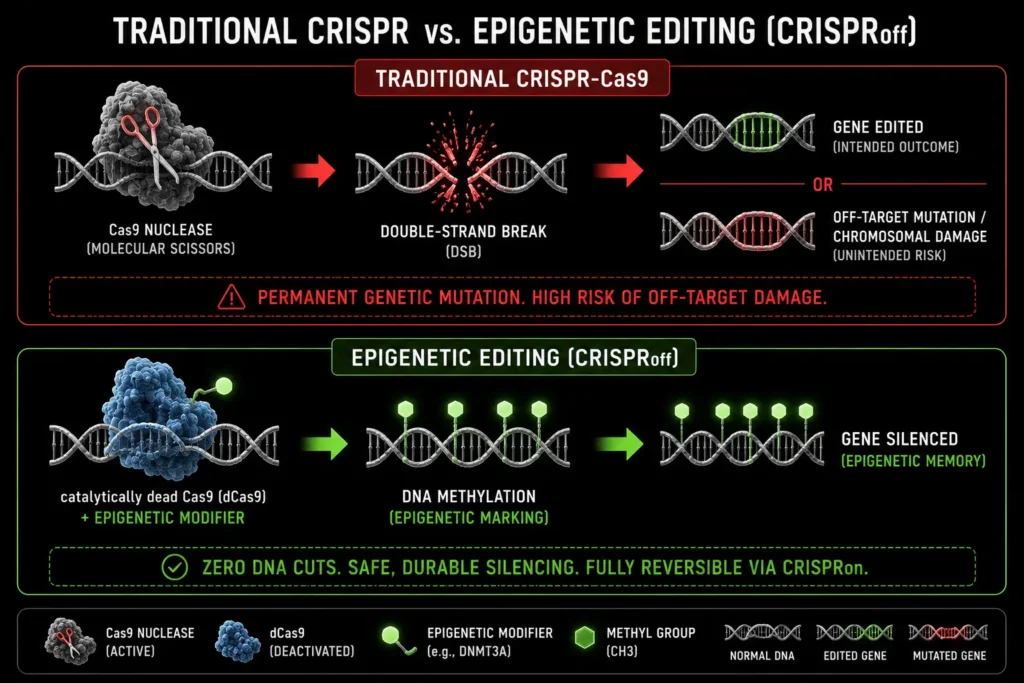
When traditional CRISPR-Cas9 cuts both strands of the DNA double helix, it relies on the cell’s natural repair pathways—either Non-Homologous End Joining (NHEJ) or Homology-Directed Repair (HDR)—to stitch the DNA back together. These repair mechanisms are highly unpredictable and frequently introduce random insertions, deletions, or large structural variations that can trigger oncogenes (cancer).
2. The Insufficiency of Traditional RNA Interference (RNAi)
The pharmaceutical industry previously developed RNA interference (like siRNA) to silence genes safely. However, siRNA only destroys the messenger RNA after the gene has already been read. Because it does not alter the source code, the silencing is temporary. Patients must return for continuous, expensive injections every few weeks or months.
3. The Core Mechanism: dCas9 and Epigenetic Effectors
CRISPRoff solves both problems. It begins with a “dead” Cas9 (dCas9) protein. The cutting mechanism of the Cas9 has been biochemically deactivated, but it retains its guide RNA, allowing it to act as a flawless, programmable GPS system that navigates to the exact target gene. Attached to this dCas9 are specialized effector proteins—most commonly a combination of DNA methyltransferases (like DNMT3A) and repressor domains (like KRAB).
4. Technical Depth: DNA Methylation and Histone Modification
When the dCas9 GPS parks at the target gene, the attached effector proteins go to work. The DNMT3A protein deposits chemical tags (methyl groups) directly onto the cytosine bases of the DNA. Simultaneously, the KRAB domain alters the surrounding histone proteins (the spools that DNA wraps around). This combination tightly winds the local chromatin into a dense, inaccessible knot (heterochromatin). The cell’s transcription machinery can no longer physically access or read the gene.
5. Real-World Consequences: LNP Delivery and Heritable Memory
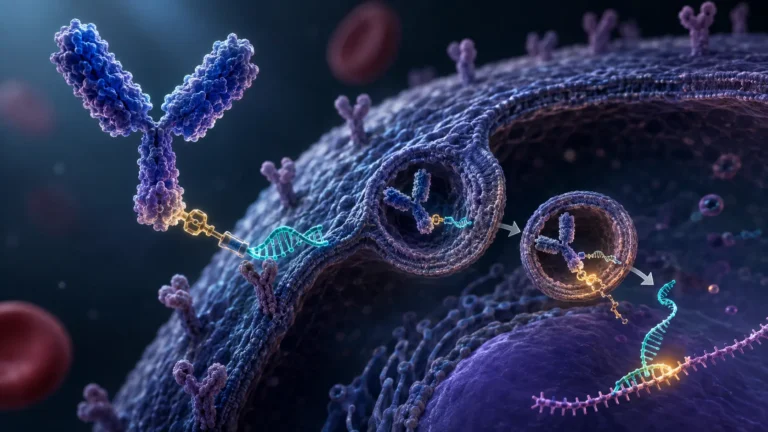
The CRISPRoff instruction manual (mRNA) is encapsulated in a Lipid Nanoparticle (LNP) and injected into the patient. The patient’s cells briefly manufacture the CRISPRoff protein, which immediately navigates to the target and methylates the gene. Within a few days, the CRISPRoff protein degrades and completely disappears from the body. However, the epigenetic methyl tags it left behind remain permanently. Furthermore, these tags are heritable—when the cell divides, the new daughter cells copy the methylation pattern, maintaining the “epigenetic memory” indefinitely without the drug ever needing to be administered again.
Real-World Applications
The clinical footprint of epigenetic editing is advancing rapidly across massive therapeutic verticals.
Chronic Hepatitis B (HBV): HBV is notoriously difficult to cure because the virus hides its genetic material inside the patient’s liver cells in the form of covalently closed circular DNA (cccDNA). Cutting this viral DNA with traditional CRISPR risks shattering the patient’s own liver genome. nChroma Bio’s CRMA-1001 elegantly solves this. It targets the viral cccDNA and deposits methyl tags, permanently silencing the virus’s ability to produce toxic proteins without risking off-target liver toxicity, potentially offering the world’s first functional cure for HBV.
Cardiovascular Disease (PCSK9 Silencing): The PCSK9 gene restricts the liver’s ability to clear “bad” LDL cholesterol from the blood. Preclinical data published in Nature Medicine in 2025 demonstrated that a single LNP-delivered epigenetic editor could durably silence the PCSK9 gene in non-human primates, achieving massive, long-term reductions in cholesterol without requiring patients to take daily statins or monthly monoclonal antibody injections.
Oncology and Chemotherapy Sensitization: Cancer cells often mutate to become resistant to chemotherapy. Researchers have successfully utilized multiplexed CRISPRoff via LNPs to silence specific genes (like MGMT) in glioblastoma (an aggressive brain cancer). By epigenetically erasing the tumor’s resistance mechanisms, the cancer becomes highly sensitive to standard chemotherapy drugs (like TMZ and CCNU) again, opening a powerful new adjunct pathway for oncology.
Economic & Strategic Impact
The transition to epigenetic editing reshapes the intellectual property and regulatory landscape of genetic medicine.
For the last decade, the foundational patents for CRISPR-Cas9 cutting have been locked in a brutal, multi-billion-dollar legal war between the Broad Institute and the University of California/Emmanuelle Charpentier. Epigenetic editing creates a strategic bypass. Companies patenting novel epigenetic effector domains and deactivated fusion architectures are carving out highly lucrative, unencumbered IP moats that bypass the legacy CRISPR patent gridlock.
Regulatorily, the FDA and the EMA look favorably upon therapies that do not permanently alter the DNA sequence. If a company can prove that an epigenetic editor clears the system within 72 hours via transient LNP delivery while establishing durable therapeutic silencing, the path to Phase 3 approval for massive, non-lethal indications (like cholesterol management or chronic inflammation) is significantly faster and cheaper than attempting the same trial with a DNA-cutting editor.
Advantages of Epigenetic Editing Over Traditional CRISPR
- Zero Double-Strand Breaks: Structurally eliminates the risk of catastrophic chromosomal translocations, unintended insertions/deletions, and the activation of cancer-causing oncogenes.
- Multiplexing Capability: Because it does not cut the DNA, CRISPRoff can be used to target and silence multiple different genes simultaneously without causing the genome to physically shatter into pieces.
- Transient Delivery, Permanent Results: The drug is delivered once via an LNP. It does its job and degrades within days, leaving behind a persistent epigenetic memory that does not require chronic redosing.
- Broad Applicability: Capable of controlling the expression of almost any gene, unlocking treatments for autoimmune diseases, infectious diseases, and neurodegeneration that were previously deemed too risky for standard gene editing.
Limitations
- Durability in Rapidly Dividing Tissues: While methylation patterns are copied during cell division, researchers are still mapping exactly how durable this epigenetic memory remains over decades in tissues that turn over extremely rapidly (like the gut lining or bone marrow).
- Off-Target Epigenetic Silencing: While it doesn’t cause off-target cuts, the dCas9 can still occasionally park at the wrong gene and deposit methyl tags, accidentally silencing a healthy gene. Ensuring pristine guide-RNA specificity remains a top priority.
- Delivery Bottlenecks: Like all genetic medicines, the efficacy of CRISPRoff is bound by the limitations of Lipid Nanoparticles (LNPs). While delivering LNPs to the liver is a solved problem, achieving efficient, non-toxic delivery to the brain, heart, or muscle tissue remains an industry-wide engineering hurdle.
Common Misconceptions
Misconception: Epigenetic editing changes your DNA.
Reality: Epigenetic editing fundamentally leaves your DNA sequence (the As, Cs, Ts, and Gs) completely untouched. It only adds chemical control tags (methyl groups) on top of the DNA to dictate whether the cell can read the sequence or not.
Misconception: It is just a temporary treatment, like taking a pill.
Reality: While the physical drug (the LNP and mRNA) is temporary and washes out of the body quickly, the biological effect is highly durable. The deposited chemical tags create an “epigenetic memory” that can last for years or potentially a lifetime.
Misconception: We no longer need traditional CRISPR.
Reality: Traditional CRISPR is still absolutely necessary. If a patient is missing a crucial gene entirely or has a severely mutated gene that produces a toxic, misfolded protein, you cannot just “turn it off.” You must physically insert or correct the underlying genetic sequence, which requires traditional editing or base editing.
What Most People Miss
The profound reality of Reversibility (CRISPRon).
When you cut a genome with traditional CRISPR and the cell repairs it with a random insertion, that change is permanent and irreversible. If a side effect occurs, it cannot be undone.
The epigenetic editing platform is bidirectional. The exact same dCas9 GPS system can be equipped with different effector proteins (like TET1) designed to remove methyl tags and unwind the DNA. This is known as “CRISPRon.” If a CRISPRoff therapy accidentally causes an adverse reaction by silencing a gene too aggressively, a doctor can theoretically administer a CRISPRon LNP to erase the tags and instantly revert the gene back to its original, natural state. This represents the ultimate safety switch in pharmacology.
Comparison Table
| Feature | Traditional CRISPR-Cas9 | RNA Interference (RNAi) | Epigenetic Editing (CRISPRoff) |
| Mechanism of Action | Physically cuts double-stranded DNA | Degrades mRNA after it is produced | Adds chemical tags to silence the gene |
| Durability | Permanent (Genetic mutation) | Temporary (Requires chronic redosing) | Highly Durable (Epigenetic memory) |
| DNA Sequence Altered? | Yes | No | No |
| Off-Target Risk | Permanent chromosomal damage | Temporary suppression | Reversible silencing |
| Reversibility | Impossible | Yes (Stop taking the drug) | Yes (Deploy CRISPRon to reverse) |
Case Study
Situation: Chronic Hepatitis B (HBV) affects nearly 300 million people globally. Despite effective vaccines and antiviral pills that suppress the virus in the blood, the disease remains incurable. The virus embeds a hidden reservoir of DNA—covalently closed circular DNA (cccDNA)—deep inside the nuclei of the patient’s liver cells, waiting to reactivate the moment standard antivirals are stopped.
Challenge: Eradicating the cccDNA using traditional DNA-cutting CRISPR tools poses an unacceptable safety risk. Attempting to physically slice millions of viral copies hidden inside the liver risks off-target cuts that could severely damage the patient’s own cellular genome.
Solution (The nChroma Bio CRMA-1001 Trial): In late 2025 and early 2026, nChroma Bio advanced CRMA-1001, an epigenetic silencer tailored specifically for HBV. Instead of attempting to cut the cccDNA, CRMA-1001 uses a deactivated editor to precisely navigate to the viral DNA and deposit heavy methylation tags.
Outcome: By densely packing the viral cccDNA into an unreadable epigenetic knot, the virus is permanently locked in an “off” state. It can no longer transcribe viral proteins or replicate. In January 2026, nChroma Bio achieved a historic milestone by dosing the first patient in their Phase 1/2 clinical trial.
Lessons Learned: The advancement of CRMA-1001 proved that the safest way to eliminate a deeply embedded genomic threat is not to destroy it, but to silence it. By targeting the epigenome of the virus rather than attempting to physically cut it, developers bypass the catastrophic safety hurdles of traditional in-vivo gene editing, establishing a new blueprint for functionally curing chronic infectious diseases.
Future Outlook
Next 12–24 Months
The biotech industry will closely monitor the safety and biomarker readouts from the initial human trials led by nChroma Bio and Tune Therapeutics. Efficacy data from the Hepatitis B and cardiovascular (PCSK9) cohorts will dictate the immediate flow of venture capital. Simultaneously, major LNP engineering firms (like Acuitas Therapeutics and academic hubs at UPenn) will announce advanced “plug-and-play” delivery lipid formulations specifically optimized to carry the massive payload size of CRISPRoff mRNA constructs into extra-hepatic (non-liver) tissues.
Next 3–5 Years
The explosion of Multiplexed Epigenetic Therapies. As the safety profile is validated, companies will leverage the fact that CRISPRoff does not cut DNA. We will see the launch of single-shot LNP therapies containing multiple guide RNAs designed to simultaneously silence three or four different genes at once. This multiplexing will target complex, polygenic diseases—such as multi-factor autoimmune disorders, obesity, and advanced solid tumors—that cannot be treated by manipulating a single biological pathway.
Next 10 Years
The era of Preventative Epigenetic Tuning. By the mid-2030s, the paradigm of genetic medicine will shift from reactive treatment to proactive longevity optimization. Because the interventions are tunable and reversible (CRISPRon/CRISPRoff), healthy individuals with a high genetic predisposition for Alzheimer’s disease or severe cardiovascular deterioration will receive prophylactic epigenetic editors in their 40s. These editors will gently dial down the expression of risk-associated genes, fundamentally rewriting human healthspans without ever touching the germline sequence.
Most Likely Scenario
Epigenetic editing will not completely cannibalize traditional CRISPR; rather, it will relegate traditional cutting to ultra-rare, single-gene mutation corrections. CRISPRoff will become the dominant, commercially scaling technology for the vast majority of the global population, transforming chronic disease management into a software update that is applied once and remembered by the body forever.
Key Takeaways
- Epigenetic editing (CRISPRoff) utilizes a deactivated Cas9 (dCas9) fused to effector proteins to add chemical tags (methylation) to DNA, silencing genes without cutting the DNA strand.
- Because it does not induce double-strand DNA breaks, CRISPRoff structurally eliminates the risk of chromosomal translocations and permanent, cancer-causing off-target mutations.
- The therapy is delivered transiently via Lipid Nanoparticles (LNPs). The drug degrades within days, but the epigenetic tags create a heritable memory that keeps the disease turned off long-term.
- By early 2026, leading firms like nChroma Bio and Tune Therapeutics had successfully moved epigenetic silencers into human clinical trials for major chronic diseases like Hepatitis B.
- Unlike traditional CRISPR cuts, epigenetic editing is theoretically reversible. Using a “CRISPRon” configuration, scientists can remove the chemical tags and restore the gene to its natural state.
- The superior safety profile of epigenetic editing expands the Total Addressable Market of genetic medicine from rare orphan diseases to hundreds of millions of patients with common chronic conditions.
Glossary
cccDNA (Covalently Closed Circular DNA): A stable, hidden form of viral DNA created by the Hepatitis B virus inside liver cells, making the virus notoriously difficult to cure.
CRISPRoff: A programmable epigenetic memory editor utilizing a dead Cas9 protein and repressor domains (like KRAB and DNMT3A) to silence target genes without cutting DNA.
dCas9 (Dead Cas9): A modified version of the CRISPR-associated protein 9. Its molecular “scissors” have been deactivated, allowing it to bind to DNA precisely without cutting it.
DNA Methylation: A biological process by which methyl groups are added to the DNA molecule, physically blocking transcription machinery and suppressing gene expression.
Epigenome: The multitude of chemical compounds and proteins that attach to DNA and direct its actions, controlling the production of proteins in particular cells without altering the DNA sequence.
Lipid Nanoparticle (LNP): A microscopic sphere of fat used to protect and deliver fragile mRNA payloads directly into human cells.
Frequently Asked Questions
Does epigenetic editing change my DNA?
No. Your underlying genetic code (the sequence of DNA bases) remains entirely unchanged. Epigenetic editing simply adds microscopic chemical tags to the outside of the DNA to prevent the cell from reading specific, disease-causing instructions.
Is it a permanent cure?
It is designed to be highly durable. When the cell divides, it naturally copies the epigenetic methylation tags to the new cells. While long-term human data is still being collected in 2026, preclinical models suggest the silencing can persist for years, potentially acting as a functional lifetime cure.
How is the drug delivered into the body?
Currently, the primary delivery method is via an intravenous infusion of Lipid Nanoparticles (LNPs). These tiny fat bubbles carry the mRNA instructions directly to the target organ (like the liver), similar to how the mRNA COVID-19 vaccines were delivered.
Can it be used to enhance healthy people?
Theoretically, yes, but regulatory agencies firmly restrict trials to severe medical conditions. While future decades may explore “epigenetic tuning” for longevity or disease prevention, current 2026 applications are strictly focused on curing established chronic illnesses and cancers.
What happens if the CRISPRoff targets the wrong gene?
Because no DNA is cut, an off-target event does not cause permanent genetic mutation or chromosomal shattering. Furthermore, if a severe off-target silencing occurs, the process is uniquely reversible; a “CRISPRon” editor could be deployed to remove the tags and restore the gene’s function.
Sources
[1] Press Releases – nChroma Bio: nChroma Bio Announces First Patient Dosed in Phase 1/2 Clinical Trial of Epigenetic Silencer CRMA-1001 for Chronic Hepatitis B. (January 2026)
[2] Tune Therapeutics: Mastering the Epigenome – TEMPO Platform and Clinical Updates (2026)
[3] PubMed: Multiplexed epigenetic memory editing using CRISPRoff sensitizes glioblastoma to chemotherapy (July 2025)
[4] PubMed Central: Next generation technologies for CRISPR-based epigenome and transcriptional modulation (Nat Med, 2025)
[5] University of Pennsylvania: An Improved In Vivo Gene-Editing System Using Plug-and-Play Lipid Nanoparticles (LNPs) (January 2026)