Advertisement
)

Agriculture consumes exactly 50 percent of the Earth’s habitable land. To feed a growing global population and supply a hyper-industrialized economy, we are actively running out of physical space. Yet, the demand for animal proteins, industrial chemicals, and advanced materials continues to climb. Relying on animals and fossil fuels to manufacture these complex molecules is no longer just an environmental liability; it is an incredibly inefficient supply chain bottleneck.
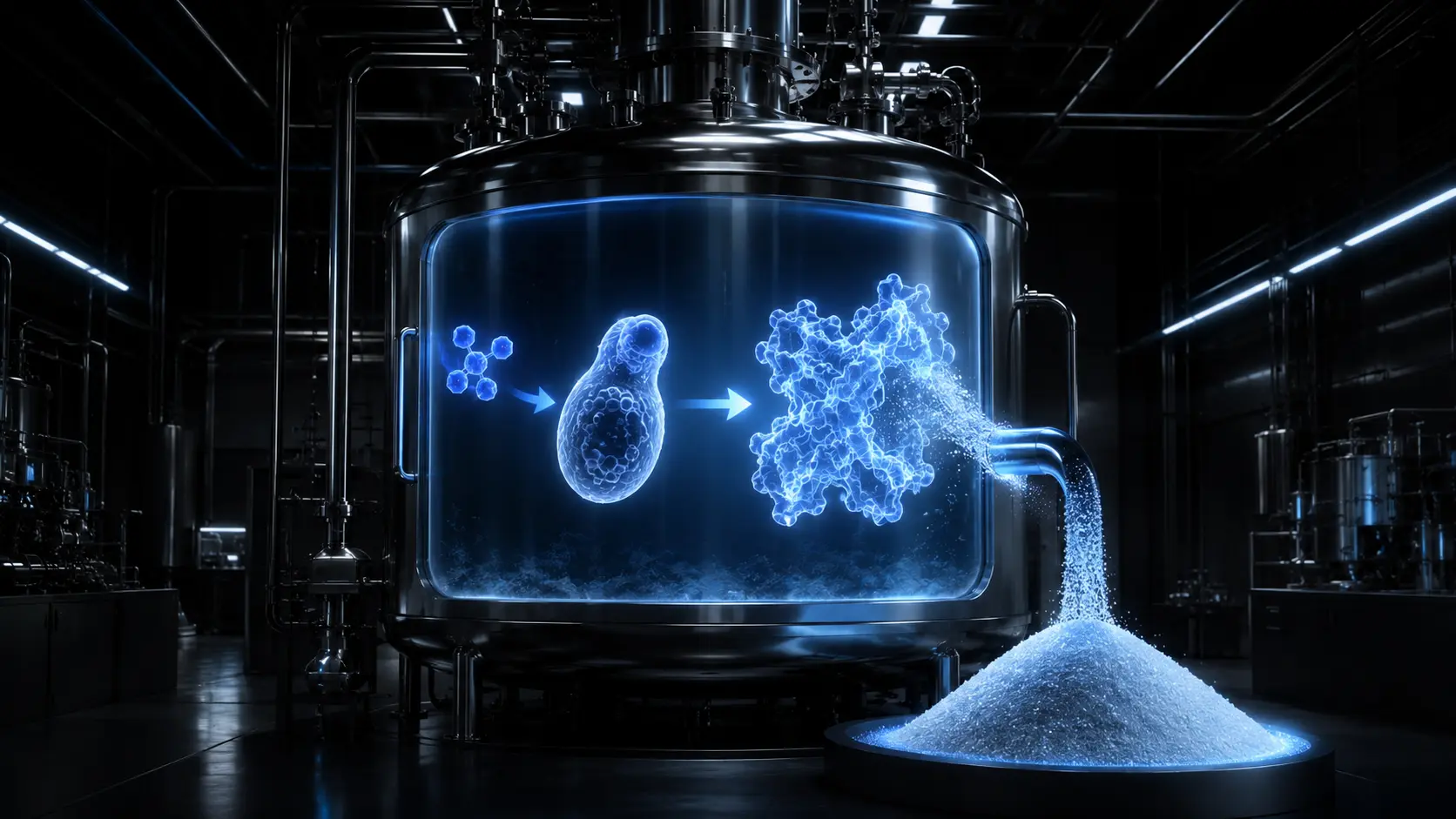
The solution is quietly scaling inside facilities that look exactly like craft breweries. By hijacking the fundamental biology of yeast and microbes, scientists are programming single-celled organisms to “brew” real dairy proteins, spider silk, and even jet fuel in massive steel vats. This isn’t plant-based imitation—it is the exact molecular replica of the target product, produced in days rather than years. Understanding how this technology is moving from the laboratory to industrial-scale manufacturing is critical. It is not just the future of food; it is a fundamental rewiring of how civilization manufactures physical matter.
What is Precision Fermentation?
Precision fermentation is an advanced biomanufacturing process that uses genetically engineered microorganisms, such as yeast or bacteria, to produce specific complex molecules. By inserting target DNA into these microbes, they act as cellular factories, feeding on sugars to brew pure proteins, fats, or industrial materials in fermentation tanks.
At a Glance
- Concept: Utilizing recombinant DNA to program a microbe to produce a specific, high-value molecule, and scaling that production inside massive, controlled steel bioreactors.
- Why it matters: Animals are highly inefficient at converting calories into usable protein. Precision fermentation skips the animal entirely, producing identical proteins with up to 99 percent less water and 97 percent fewer greenhouse gas emissions, decoupling protein production from arable land.
- Who uses it: Pioneers like Perfect Day (dairy), The EVERY Company (eggs), Geltor (designer collagen), and advanced materials startups like Spiber (synthetic spider silk).
- Biggest takeaway: The biology is largely solved; the bottleneck is infrastructure. The global shortage of massive, food-grade biomanufacturing capacity (bioreactors larger than 100,000 liters) is currently the primary barrier preventing these products from reaching price parity with standard agricultural commodities.
In Simple Words
Brewing beer is a form of traditional fermentation. You put yeast into a vat with sugar and water. The yeast eats the sugar and naturally produces alcohol as a byproduct.
Precision Fermentation uses this exact same concept, but gives the yeast a massive software update.
Scientists take a microbe (like a specific strain of yeast) and insert a tiny piece of DNA into it. If they insert the DNA sequence that codes for cow’s milk, the yeast is now programmed to make milk. When you put this reprogrammed yeast into a giant steel vat and feed it sugar, the yeast eats the sugar and produces pure, real milk protein as a byproduct instead of alcohol.
Once the brewing is done, you filter out the yeast entirely. What you are left with is a pure powder of milk protein that is molecularly identical to what comes out of a cow. Because there is no animal involved, there is no need for vast pastures, thousands of gallons of water, or methane emissions. It is agriculture condensed into a brewery.
Why This Matters
The global food and chemical supply chain is dangerously fragile, subjected to climate volatility, geopolitical blockades, and zoonotic disease outbreaks (like Avian Flu decimating egg supplies).
Precision fermentation acts as a localized, shock-proof alternative. A biomanufacturing plant can be built in the middle of a desert in Dubai, a snowy plain in Canada, or a dense urban center in Singapore. As long as you can feed the microbes a carbon source, you can manufacture dairy, fats, and chemicals entirely independent of local weather or soil quality.
For ESG investors and industrial planners, this represents a multi-trillion-dollar disruption. According to think tanks like RethinkX, the cost of precision fermentation proteins is projected to fall below the cost of traditional animal proteins by the late 2020s. When this price parity is achieved, the economic incentive to utilize vast tracts of land for livestock will collapse, freeing up millions of acres of land and fundamentally altering the economics of the global agricultural market.
The Shift to Industrial Biomanufacturing
We are witnessing the industrialization of the cell.
Historically, precision fermentation was restricted to the pharmaceutical industry. In the 1980s, scientists used it to produce human insulin (replacing the need to harvest insulin from the pancreases of slaughtered pigs). Because insulin is a high-value, low-volume product, the high cost of biomanufacturing was easily absorbed.
Today, the industry is attempting to cross the chasm from high-margin pharmaceuticals to low-margin, high-volume commodities (food, cosmetics, plastics). This requires a brutal optimization of unit economics. Moving from producing a $1,000-per-gram therapeutic protein to a $5-per-kilogram whey protein demands an unprecedented evolution in bioreactor engineering, microbial efficiency (titer rates), and feedstock costs.
How Precision Fermentation Works (Mechanics)
Turning a single-celled organism into an industrial factory requires flawless genetic engineering and intense thermodynamic management. Here is the first-principles breakdown.
1. The Fundamental Problem: Agricultural Inefficiency
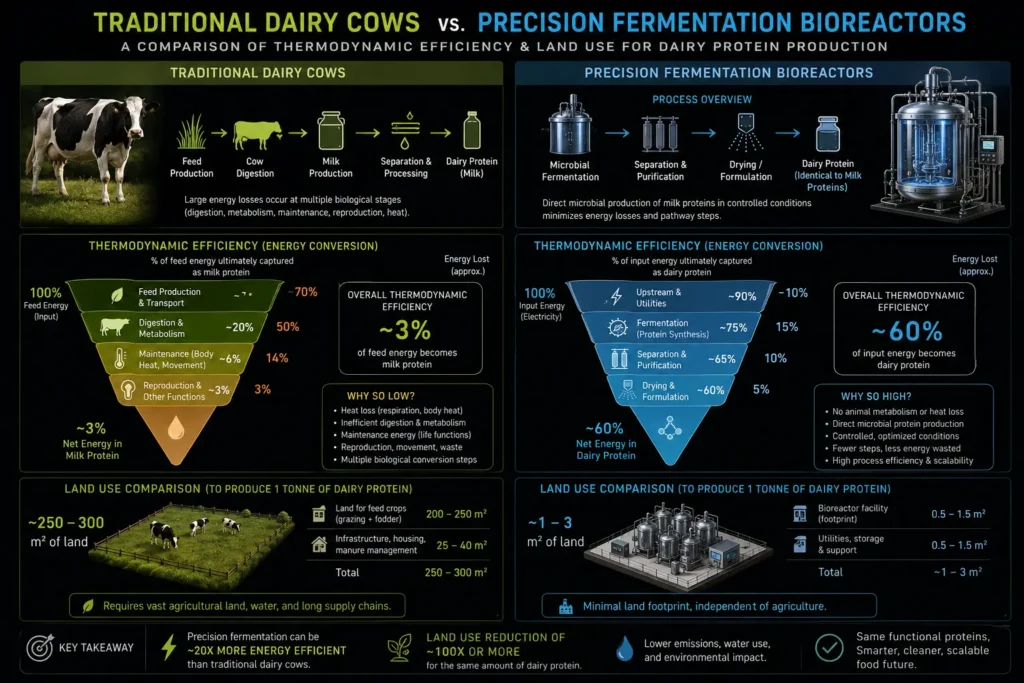
Traditional agriculture is a remarkably poor thermodynamic engine. A cow must consume approximately 100 calories of plant energy to produce just 3 calories of beef or milk. The other 97 calories are wasted on the cow keeping warm, walking, and growing bones. To feed 10 billion people, we need a manufacturing engine that converts raw energy into pure protein without the metabolic waste of a sentient animal.
2. The Insufficiency of Plant-Based Alternatives
Plant-based proteins (like pea or soy) are highly efficient to grow, but they are structurally different from animal proteins. They do not melt, stretch, or bind the same way. A plant-based cheese will not melt on a pizza because it lacks casein (the specific dairy protein that causes melting). To get the exact functionality of animal protein, you must build the exact animal molecule.
3. The Core Mechanism: Recombinant DNA and the Host
Scientists digitize the DNA sequence of the desired target (e.g., the bovine whey protein gene). Using recombinant DNA technology, they insert this genetic code into a “host” microbe. Popular industrial hosts include Pichia pastoris (a highly efficient yeast) or Trichoderma reesei (a filamentous fungus). The host reads the newly inserted DNA and begins assembling the target protein.
4. Technical Depth: Bioreactor Mass-Transfer Limits
The reprogrammed microbes are placed into a massive steel bioreactor filled with a liquid broth of water, nutrients, and a carbon source (usually glucose/sugar). The microbes multiply rapidly. However, operating a 250,000-liter bioreactor introduces severe physics problems.
- Oxygen Transfer: Microbes need oxygen to survive. Pumping enough oxygen into a massive tank without creating shear stress (which physically rips the microbes apart) is incredibly difficult.
- Thermodynamics: Millions of microbes eating sugar generate massive amounts of heat. If the tank is not aggressively cooled, the microbes will boil themselves to death.
5. Real-World Consequences: Downstream Processing (DSP)
Once the fermentation is complete, the liquid in the tank is a messy soup of water, yeast cells, leftover sugar, and the target protein. The most expensive part of the process is Downstream Processing (DSP). The liquid is run through massive centrifuges and specialized chromatography filters to separate the target protein from the microbes. The final product is dried into a pure, inert powder. The genetically modified yeast is entirely filtered out and destroyed; the final product consumed by the public contains zero genetically modified organisms (GMOs).
Real-World Examples of Precision Fermentation
The technology is already deeply embedded in consumer products, often without the public realizing it.
Animal-Free Dairy: Perfect Day successfully commercialized beta-lactoglobulin (whey protein). Because it is molecularly identical to cow’s whey, it creates ice cream and cream cheese that tastes and functions exactly like traditional dairy, but contains no lactose, no cholesterol, and involves zero cows. It is currently utilized by major consumer brands like Nestlé and Mars.
Designer Materials and Textiles: Japanese startup Spiber and US-based Bolt Threads utilize precision fermentation to brew synthetic spider silk. Spider silk is pound-for-pound stronger than steel, but spiders are cannibalistic and cannot be farmed. By programming yeast to brew the silk proteins, companies are spinning these proteins into high-performance, biodegradable textiles for the outdoor apparel and automotive industries.
Palm Oil Alternatives: Palm oil is found in 50% of packaged supermarket goods, but its cultivation drives massive tropical deforestation. Companies like C16 Biosciences are using precision fermentation to brew an exact molecular replica of palm oil using yeast. This allows cosmetic and food manufacturers to maintain product consistency while totally decoupling their supply chains from rainforest destruction.
Economic & Strategic Impact
The primary economic bottleneck in 2026 is the CDMO Capacity Crunch.
Startups can easily prove their microbe works in a 5-liter benchtop bioreactor in a lab. However, to achieve commercial price parity, they must scale up to 100,000-liter or 500,000-liter tanks. Building a massive precision fermentation facility requires hundreds of millions of dollars in Capital Expenditure (CapEx).
Most startups cannot afford this, so they rely on Contract Development and Manufacturing Organizations (CDMOs) to rent tank space. But the global supply of food-grade CDMO capacity is severely limited. This structural shortage is driving intense government intervention. Nations like Singapore, the UAE, and the United States (via the Bioeconomy Executive Order) are actively subsidizing the construction of massive biomanufacturing hubs to attract the intellectual property and secure their future food sovereignty.
Advantages
- Extreme Resource Efficiency: Precision fermentation requires up to 99 percent less land and 90 percent less water than traditional animal agriculture, eliminating the need for fertilizers, pesticides, and antibiotics.
- Product Purity: Because the molecule is manufactured in a sterile steel vat, there is zero risk of bacterial contamination (like E. coli or Salmonella), heavy metals, microplastics, or zoonotic diseases.
- Supply Chain Localization: A bioreactor facility can be placed anywhere on Earth, drastically shrinking logistics footprints and insulating nations from agricultural import shocks.
- Tunability: Scientists can optimize the final product. For example, they can brew milk proteins but intentionally leave out lactose, creating a naturally lactose-free, authentic dairy product.
Limitations
- Feedstock Dependency: Currently, the microbes must be fed sugar (glucose). This means the industry is still tethered to traditional agriculture (sugar cane or corn farming). If sugar prices spike, the economics of precision fermentation collapse.
- High CapEx and OpEx: The stainless steel bioreactors, clean-in-place (CIP) systems, and downstream purification chromatography columns are astronomically expensive to build and operate at food-grade margins.
- Energy Intensive: Maintaining exact temperatures, stirring massive volumes of liquid, and separating the proteins requires immense amounts of continuous electricity. If the facility is not powered by renewable energy, its carbon footprint remains substantial.
Common Misconceptions
Misconception: Precision fermentation is the same thing as “Lab-Grown Meat.”
Reality: These are two completely different technologies. Lab-grown meat (cellular agriculture) involves growing actual animal cells (muscle and fat tissue) in a bioreactor. Precision fermentation does not use animal cells; it uses yeast to produce an ingredient (like a protein or fat).
Misconception: The final product is a Genetically Modified Organism (GMO).
Reality: While the yeast used in the factory is genetically modified, the yeast is completely filtered out and destroyed at the end of the process. The final protein powder sold to consumers is a pure molecule with no DNA or living organisms in it. It is legally classified as non-GMO in most jurisdictions.
Misconception: This is a brand new, untested science.
Reality: You likely consume it every week. Since 1990, the FDA has approved precision fermentation to produce chymosin (rennet). Today, over 90 percent of all hard cheese (like cheddar and mozzarella) made in North America uses enzymes produced via precision fermentation.
What Most People Miss
The impending shift toward Gas Fermentation.
The vulnerability of precision fermentation is its reliance on agricultural sugar as a feedstock. The next evolutionary leap is bypassing agricultural feedstocks entirely.
Advanced companies are utilizing specialized bacteria (lithoautotrophs) that do not eat sugar. Instead, they “eat” carbon dioxide (CO2) and hydrogen gas. By pumping captured CO2 and green hydrogen into the bioreactor, these microbes synthesize proteins and chemicals out of thin air. This effectively creates a closed-loop system where industrial carbon emissions become the raw fuel for food and plastics, permanently severing biomanufacturing from arable land and sunlight.
Comparison Table
| Feature | Traditional Agriculture (Livestock) | Plant-Based (e.g., Soy/Pea) | Precision Fermentation | Cultured Meat (Cellular Ag) |
| Production Engine | Whole living animal | Crops grown in soil | Engineered microbes (Yeast) | Actual animal cells |
| Output | Whole meat, milk, leather | Plant isolates | Specific, pure target molecules | Whole muscle/fat tissue |
| Land/Water Use | Extremely High | Moderate | Extremely Low | Low |
| Molecular Match? | N/A (Original) | No (Imitation) | Yes (Exact Replica) | Yes (Exact Replica) |
| Current Scale/Cost | Massive (Commodity pricing) | Massive (Commodity pricing) | Scaling (Approaching parity) | Pilot scale (Very expensive) |
Case Study
Situation: Historically, cheese making required an enzyme called chymosin (rennet) to curdle milk. The only way to obtain chymosin was to slaughter unweaned calves and extract it from the lining of their fourth stomach. By the 1980s, the global demand for cheese vastly outstripped the supply of calf stomachs, leading to massive shortages and price volatility.
Challenge: The cheese industry needed an infinite, scalable, and humane source of chymosin that functioned exactly like the animal-derived version, without altering the taste or texture of traditional cheeses.
Solution (The FPC Breakthrough): In 1990, Pfizer (and later companies like Chr. Hansen) commercialized Fermentation-Produced Chymosin (FPC). Scientists isolated the exact cow gene responsible for producing chymosin and inserted it into a fungus (Aspergillus niger) and yeast (Kluyveromyces lactis). They brewed the enzyme in large vats and purified it.
Outcome: The FDA granted FPC “Generally Recognized as Safe” (GRAS) status in 1990—the first artificially produced enzyme to receive this. Because the bio-manufactured enzyme was purer, cheaper, and more predictable than calf stomachs, the cheese industry adopted it almost overnight.
Lessons Learned: The chymosin case study is the ultimate proof-of-concept for modern precision fermentation. It proved that if a bio-manufactured ingredient achieves price parity, functional superiority, and regulatory approval, entire legacy agricultural supply chains will willingly transition to it, validating the exact playbook companies like Perfect Day are executing today for wholesale dairy proteins.
Future Outlook
Next 12–24 Months
The focus will remain heavily on High-Value/Low-Volume Ingredients. Because scaling 500,000-liter tanks is still economically challenging, startups will avoid trying to replace cheap commodity milk. Instead, they will commercialize high-value proteins like Lactoferrin (a highly expensive immune protein used in infant formula) and specialized cosmetics (designer collagen). Regulatory approvals will accelerate rapidly in friendly jurisdictions like Singapore, the US, and Israel.
Next 3–5 Years
The activation of Mega-Biomanufacturing Hubs. By 2028-2030, the massive CapEx investments currently underway by CDMOs and sovereign wealth funds will come online. As global capacity expands, the unit economics of downstream processing will drop. We will see precision fermentation ingredients transition from premium niche products into standard, invisible drop-in ingredients in major B2B supply chains, deeply integrating into mass-market chocolate, baked goods, and sports nutrition products.
Next 10 Years
The disruption of Industrial Chemicals and Petrochemicals. By the mid-2030s, precision fermentation will move aggressively beyond food. As feedstock economics shift toward gas fermentation (CO2 and Hydrogen), massive bioreactors will be deployed to brew industrial lubricants, bioplastics, and even sustainable aviation fuel (SAF). Biology will become the new chemical engineering, allowing humanity to synthesize the building blocks of the modern world without extracting a single drop of petroleum.
Most Likely Scenario
Precision fermentation will follow the exact adoption curve of renewable energy. Initially dismissed as too expensive, it will slowly scale until economies of scale trigger a tipping point. By 2035, the majority of the proteins and chemicals used as ingredients in the global supply chain will be brewed in steel vats. Traditional animal agriculture will not disappear, but it will shrink dramatically, returning to a premium, artisanal model rather than functioning as the industrial backbone of global food production.
Key Takeaways
- Precision fermentation programs microorganisms (yeast, fungi, bacteria) to act as microscopic factories, brewing specific target molecules like animal proteins, silk, or oils.
- The process utilizes recombinant DNA to instruct the microbe to build the exact molecular replica of a naturally occurring substance, meaning the final product is not an imitation; it is biologically identical to the original.
- By brewing proteins in steel bioreactors, the technology drastically reduces the land, water, and greenhouse gas emissions associated with traditional animal agriculture.
- The final product is completely purified, meaning the genetically modified microbes are filtered out and destroyed, leaving behind a pure, non-GMO ingredient.
- The primary barrier to global scale is a severe shortage of high-capacity Contract Development and Manufacturing Organization (CDMO) bioreactor infrastructure.
- The technology is already deeply integrated into the global food system; over 90 percent of the hard cheese consumed today relies on enzymes produced via precision fermentation.
Glossary
Bioreactor: A massive, highly controlled stainless steel vessel where microorganisms are provided with the optimal temperature, oxygen, and nutrients to rapidly multiply and produce target molecules.
CDMO (Contract Development and Manufacturing Organization): A company that provides manufacturing services on an outsourced basis, critical for precision fermentation startups that cannot afford to build their own factories.
Downstream Processing (DSP): The complex, expensive process of filtering and purifying the final target molecule out of the messy liquid broth once the fermentation is complete.
Gas Fermentation: An advanced subset of fermentation that uses autotrophic microbes capable of consuming carbon dioxide and hydrogen gas as a feedstock, rather than agricultural sugar.
Recombinant DNA: DNA molecules formed by laboratory methods of genetic recombination to bring together genetic material from multiple sources, creating sequences that would not otherwise be found in the genome.
Titer: A measurement of concentration. In precision fermentation, it refers to the amount of target protein successfully produced by the microbes per liter of liquid in the bioreactor.
Frequently Asked Questions
Is precision fermentation the same as artificial or synthetic food?
No. “Synthetic” implies it was made from artificial chemicals. Precision fermentation uses natural biological processes. The yeast brews the protein identically to how yeast brews alcohol. The final protein is biologically identical to the one produced by a cow or a plant.
Are products made this way safe to eat?
Yes. The technology has been used safely for decades to produce vitamins (like Vitamin B12), food enzymes (rennet for cheese), and life-saving medicines (insulin). Every new product undergoes rigorous FDA (or equivalent local agency) safety and purity reviews before entering the market.
If the protein is identical to cow’s milk, what about dairy allergies?
Because precision fermentation produces the exact molecular replica of the cow’s whey or casein protein, it will trigger a dairy allergy. It is completely vegan and animal-free, but it must still carry a milk allergy warning label. (However, it is naturally lactose-free, as lactose is a sugar, not a protein).
Can this technology replace all farming?
No. We will always need traditional agriculture to grow the staple crops that feed humanity (wheat, rice, corn, vegetables) and to provide the sugar feedstock that the microbes currently eat. It is designed to replace the highly inefficient animal layer of the agricultural supply chain.
Why hasn’t this replaced all animal products already?
Scale and cost. Building massive, sterile steel bioreactors and the required purification filters is incredibly expensive. Until the industry builds enough factory capacity to drive the cost of production below the cost of highly subsidized traditional dairy and meat, it remains restricted to premium products.
Sources
[1] RethinkX: Rethinking Food and Agriculture 2020-2030 (Foundational economic disruption analysis)
[2] Good Food Institute (GFI): State of the Industry Report: Fermentation (2025/2026 update)
[3] Perfect Day: Life Cycle Assessment (LCA) of Animal-Free Whey Protein
[4] Boston Consulting Group (BCG): Food for Thought: The Protein Transformation
[5] U.S. White House / Executive Order: National Biotechnology and Biomanufacturing Initiative