Advertisement
)
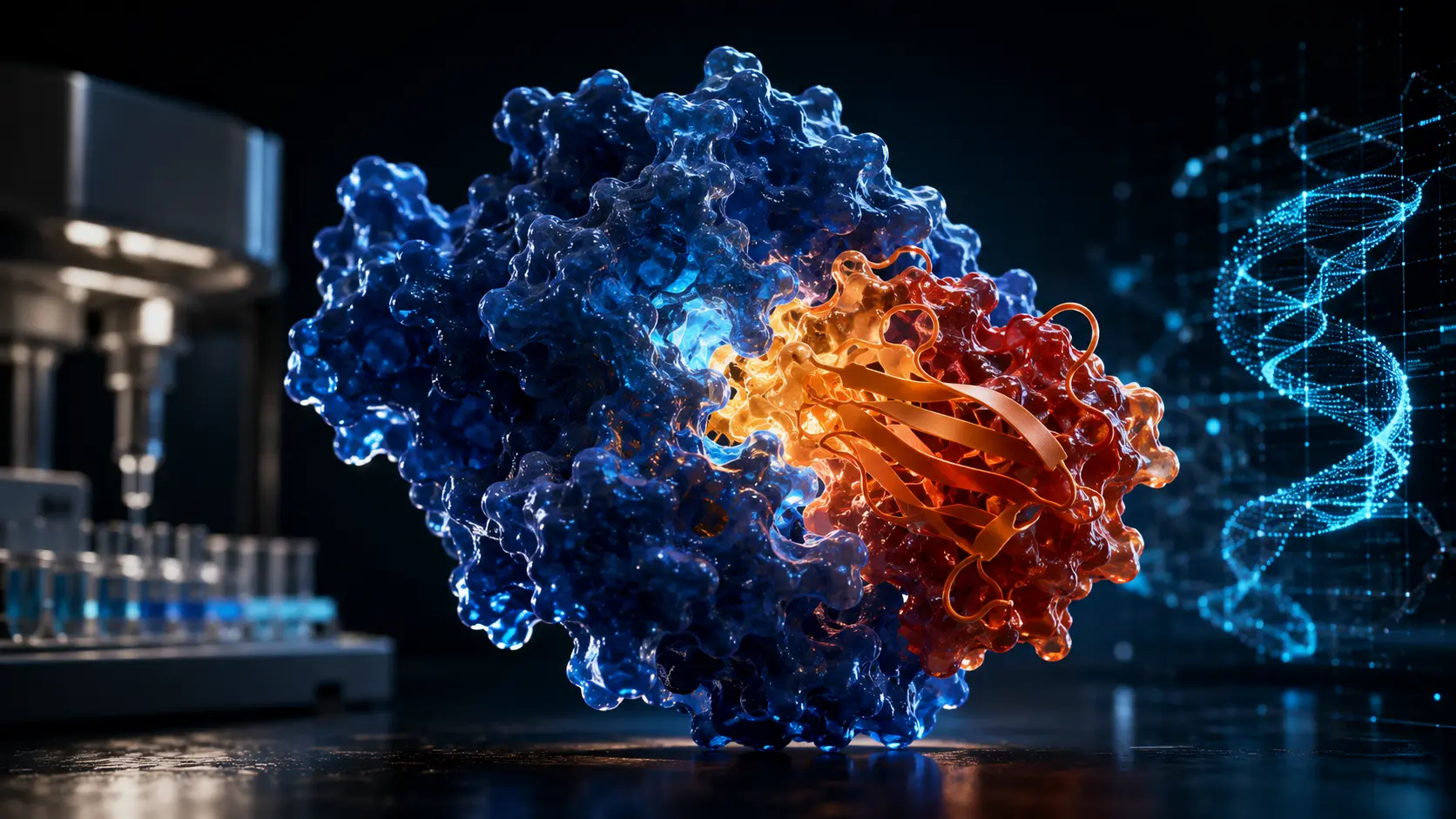

In late 2020, the scientific community celebrated Google DeepMind’s AlphaFold for solving a 50-year-old grand challenge in biology: predicting how natural proteins fold. It was a Nobel-worthy breakthrough, but it harbored a massive limitation—it only mapped the biology that already existed. It was the ultimate search engine for nature. Today, a far more radical revolution has eclipsed it. Scientists have stopped merely reading the code of life; they are now writing it from scratch.
Using the exact same artificial intelligence architecture that powers image generators like Midjourney and text generators like ChatGPT, researchers are prompting AI to invent biological machines that have never existed on Earth. Why should you care right now? Because if you can custom-build a protein to attach to a specific cancer cell, neutralize a mutating virus, or digest industrial plastic, you eliminate the decades of blind trial-and-error required by traditional drug discovery. The pharmaceutical industry is currently pivoting billions of dollars away from finding natural cures toward generating bespoke ones, crossing the ultimate threshold from biological discovery to true biological engineering.
What is Generative Protein Engineering?
Generative protein engineering is the use of artificial intelligence, specifically diffusion models and large language models, to design entirely new, non-natural proteins from scratch. By generating novel amino acid sequences that fold into precise, custom-built 3D structures, this technology allows scientists to manufacture bespoke therapeutics, enzymes, and biomaterials.
At a Glance
- Concept: Transitioning from predicting how natural proteins look (AlphaFold) to actively generating new proteins that perform specific, customized functions (de novo design).
- Why it matters: Traditional drug discovery requires screening millions of existing molecules hoping one fits a disease target. Generative AI mathematically designs the exact molecular “key” to fit the disease “lock,” shrinking discovery timelines from years to days.
- Who uses it: Elite computational biology labs (Institute for Protein Design at UW), massive tech-bio spinoffs (EvolutionaryScale, Isomorphic Labs), and legacy pharma giants (Amgen, Novartis) integrating AI into their pipelines.
- Biggest takeaway: Generating a protein on a computer is only half the battle. The AI is useless without a “wet lab” (a physical biology laboratory) to actually print the DNA, test the protein in human cells, and feed the success or failure data back into the AI to improve its next design.
In Simple Words
Proteins are the microscopic machines that run every living thing. They digest food, fight viruses, and form muscles. A protein’s shape determines its job—like a physical lock and key.
For the last century, if a pharmaceutical company wanted to cure a disease, they had to wander through the forest of nature, testing millions of existing “keys” (natural molecules) hoping to find one that accidentally fit the disease “lock.”
AlphaFold was a breakthrough because it mapped every natural key in the forest. If you found a sequence of biological code, AlphaFold could instantly show you its 3D shape. But it still couldn’t invent a new key.
Generative Protein Engineering (like RFdiffusion) changes everything. You simply show the AI the lock (the disease), and the AI designs a brand new, custom key that has never existed in nature. It writes the exact biological code required to manufacture that perfect shape. We are no longer limited to the proteins nature evolved over billions of years; we can now print the exact tools we need on demand.
Why This Matters
The economic engine of the pharmaceutical industry is deeply broken. It currently takes an average of 10 to 12 years and over USD 2 billion to bring a single new drug to market, with a clinical failure rate hovering around 90 percent. The vast majority of these failures occur because the drug either doesn’t bind to the target effectively or it accidentally binds to healthy cells, causing toxic side effects.
Generative protein engineering attacks this failure rate at its root. By custom-designing therapeutics with atomic precision, scientists can mathematically guarantee higher binding affinities and extreme specificity. If a drug only fits the cancer cell and physically cannot fit a healthy heart cell, the toxicity profile plummets.
For biotech investors, this shifts the risk profile of the entire industry. The value is no longer in owning a massive library of chemical compounds; the value is in owning the proprietary AI models and the automated robotic wet labs capable of churning out perfectly optimized de novo (from scratch) therapeutics at scale.
The Inverse Folding Problem: Beyond AlphaFold
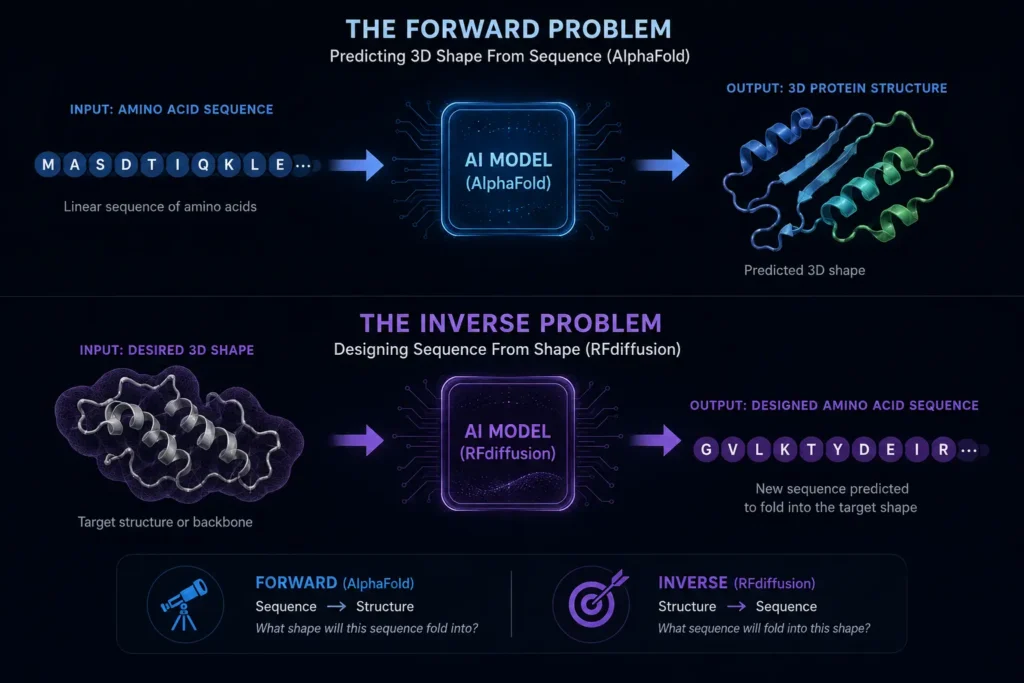
The leap from AlphaFold to generative AI represents the transition from the “forward problem” to the “inverse problem.”
The forward problem was: Here is an amino acid sequence; what is its 3D shape? (AlphaFold solved this).
The inverse problem is: Here is the 3D shape I need to cure a disease; what is the amino acid sequence required to build it?
For decades, the inverse problem was considered computationally impossible. The potential combinations of amino acids outnumber the atoms in the observable universe. However, starting around 2023 and maturing into 2026, the application of diffusion models (the math behind AI image generation) cracked the inverse problem wide open. This spawned an entirely new industrial sector—”TechBio”—where computer scientists and molecular biologists merged, triggering a multi-billion-dollar arms race between academic spin-offs and Big Tech to control the foundational models of biology.
How Generative Protein Engineering Works
Creating life-saving biological machines on a laptop requires merging generative machine learning with quantum chemistry. Here is the first-principles breakdown.
1. The Fundamental Problem: The Protein Folding Funnel
Proteins are long chains of 20 different amino acids. Once printed by a cell, this chain rapidly folds into a 3D structure based on the electromagnetic attraction and repulsion of the acids. This is the “folding funnel.” Finding a sequence that will reliably fold into one exact, stable shape—rather than a useless, floppy clump—is mathematically staggering.
2. The Insufficiency of Directed Evolution
Before AI, scientists used “directed evolution.” They would take a natural protein and mutate it slightly, test it, pick the best one, and repeat. This won a Nobel Prize, but it is slow and strictly limited. You can only tweak what nature already built; you cannot jump to an entirely new structural universe.
3. The Core Mechanism: Denoising Diffusion
To build de novo proteins, systems like RFdiffusion use a diffusion model. The AI starts with a cloud of completely random, chaotic “noise” (a meaningless jumble of atoms). The user provides a prompt—for example, “create a structure that binds to this specific spike on a virus.” The AI then progressively “denoises” the cloud step-by-step, mathematically refining the atoms until a stable, functional 3D protein backbone emerges that perfectly fits the target.
4. Technical Depth: ProteinMPNN and LLMs
Once the diffusion model creates the 3D shape (the backbone), the AI must figure out the “software code” required to build it. A separate neural network, like ProteinMPNN, looks at the 3D shape and works backward, assigning the exact sequence of amino acid letters required to force the chain to fold into that specific shape. Alternatively, Large Language Models (like ESM3) treat amino acids as words in a sentence, predicting the grammar of the sequence directly to achieve specific structural, functional, and evolutionary goals simultaneously.
5. Real-World Consequences: The Wet Lab Feedback Loop
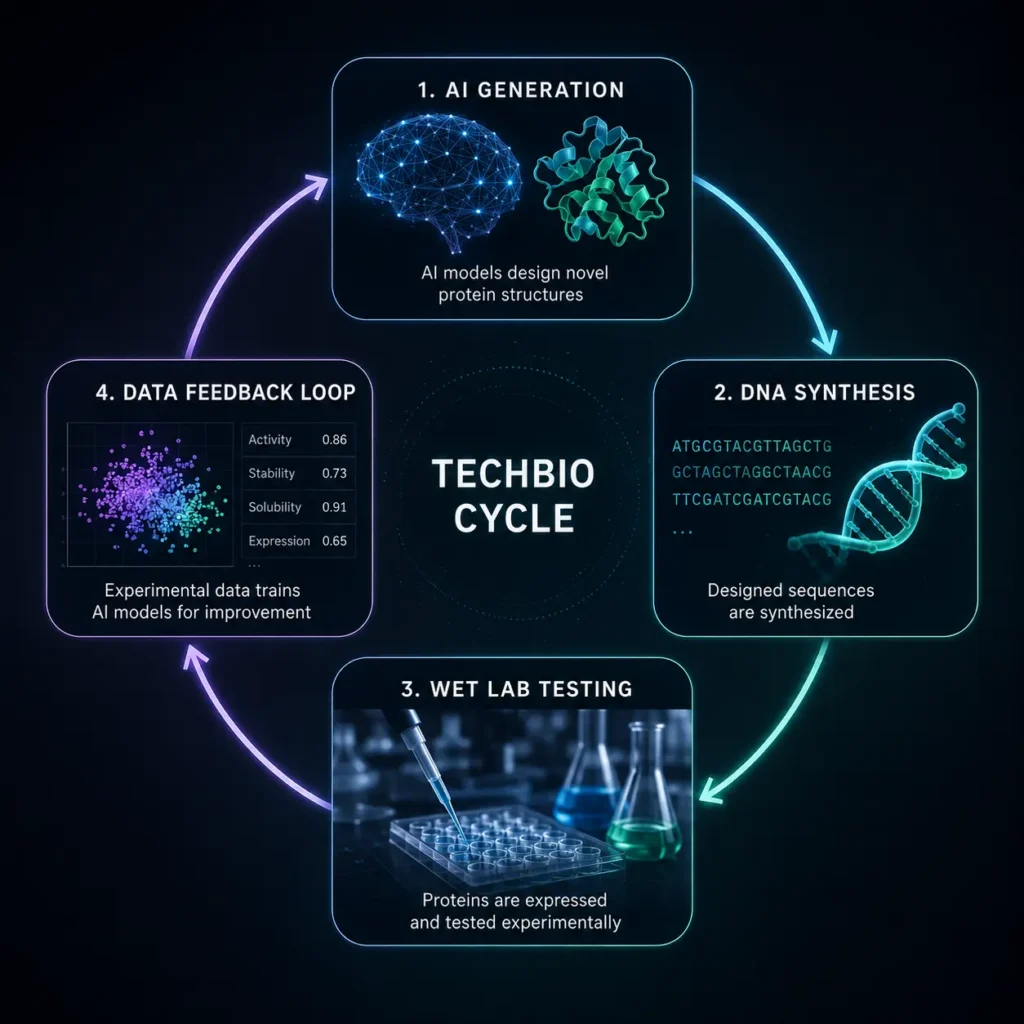
The AI’s output is just a digital file. To be useful, it must be synthesized in the real world. The sequence is sent to a DNA synthesizer, printed, and inserted into bacteria or yeast, which acts as a factory to physically manufacture the AI’s protein. The physical protein is then tested in a “wet lab” against the actual disease. The success or failure data is fed directly back into the AI to train it, creating a closed-loop system of continuous, automated biological engineering.
Real-World Applications of De Novo Protein Design
The technology is already escaping the supercomputer and entering the physical world across multiple high-impact vectors.
Bespoke Oncology Therapeutics: Traditional antibodies used in cancer therapy are massive, bulky proteins that struggle to penetrate dense solid tumors. Using generative models, companies are designing “minibinders”—ultra-compact, purely artificial proteins that bind to tumor targets with picomolar affinity. Because they are a fraction of the size of natural antibodies, they easily slip into solid tumors to deliver toxic payloads without triggering off-target damage.
Enzyme Engineering: Proteins are not just drugs; they are enzymes that facilitate chemical reactions. Generative AI is being used to invent completely novel enzymes capable of digesting Polyethylene Terephthalate (PET) plastics or capturing atmospheric carbon. By designing enzymes that can survive high-heat industrial environments (which natural enzymes cannot), the chemical manufacturing industry is transitioning away from petroleum-based catalysts to sustainable, AI-designed biocatalysts.
Next-Generation Gene Delivery: CRISPR gene editing is limited by delivery; getting the CRISPR payload into the right organ is notoriously difficult. Scientists are now using generative AI to design custom viral capsids (the protein shells of viruses). By inventing non-natural shells, they can engineer delivery vehicles that bypass the liver and target specific tissues (like the brain or heart) while completely evading the human immune system’s preexisting viral defenses.
Economic & Strategic Impact
The bottleneck of the pharmaceutical industry has officially shifted from the “Dry Lab” to the “Wet Lab.”
Ten years ago, finding a viable drug candidate took years. Today, generative AI can output 10,000 highly plausible, novel drug candidates in an afternoon. The economic friction is now entirely physical: who can print, express, purify, and test these 10,000 proteins the fastest?
This dynamic is triggering a massive CapEx boom in automated biology. TechBio companies are building massive, robotic wet labs driven by computer vision and automated liquid handlers. Consequently, legacy pharmaceutical companies that lack proprietary AI models and high-throughput physical automation are being forced into multi-billion-dollar licensing deals with generative startups just to remain competitive in the clinical pipeline race.
Advantages
- Unprecedented Speed: Condenses the target-to-hit timeline from years to days, allowing for rapid medical responses to newly emerging pathogens or highly specific genetic mutations.
- Atomic Specificity: Enables the creation of therapeutics that bind to targets previously considered “undruggable” by traditional small molecules or natural antibodies.
- Novel Intellectual Property: Because these proteins are entirely de novo (invented from scratch), they are free from the tangled webs of legacy biological patents, granting the inventing company total IP ownership over the new molecule.
Limitations
- The Immunogenicity Risk: The human immune system is designed to attack foreign proteins. Injecting an AI-hallucinated protein that has never existed in mammalian evolution runs a severe risk of triggering catastrophic immune responses (anaphylaxis or anti-drug antibodies) in human patients.
- The Multi-Parameter Optimization Problem: A drug must do more than just bind to a target. It must survive stomach acid, avoid liver clearance, and not clump together in a syringe (pharmacokinetics/pharmacodynamics). Training AI to simultaneously optimize all these physical parameters remains highly challenging.
- Hallucination vs. Reality: Generative models inherently hallucinate. A protein that looks perfectly stable in a computer simulation may instantly unfold into useless “spaghetti” when actually manufactured in the wet lab, requiring rigorous and expensive physical validation.
Common Misconceptions
Misconception: AlphaFold and RFdiffusion do the exact same thing.
Reality: AlphaFold solves the forward problem—it looks at an existing biological sequence and tells you its shape. RFdiffusion solves the inverse problem—you give it a desired shape, and it invents a brand new biological sequence to create that shape.
Misconception: The AI completely replaces human biologists.
Reality: The AI replaces the screening process, but the generated proteins must still undergo years of physical preclinical testing, animal modeling, and human clinical trials to prove they are safe and effective. The FDA does not approve computer simulations.
Misconception: AI only tweaks existing natural proteins.
Reality: While AI can optimize existing proteins, the true breakthrough of diffusion models is fully de novo design. They generate proteins with architectures and folds that have never existed in the history of Earth’s biology.
What Most People Miss
The strategic importance of Negative Data.
Historically, when a pharmaceutical company tested a drug and it failed, they threw the data away and moved on. The scientific literature is overwhelmingly biased toward successes.
In the era of Generative AI, failure is just as valuable as success. To train a model to design perfect proteins, the AI must understand exactly why certain proteins fail to fold, clump together, or miss their targets. Companies that capture high-quality, standardized negative data from their wet labs possess a massive, insurmountable advantage over open-source AI models that are trained almost exclusively on the “successful” proteins found in public databases like the Protein Data Bank (PDB).
Comparison Table
| Feature | Directed Evolution (Legacy) | AlphaFold2 / AlphaFold3 | Generative AI (RFdiffusion / ESM3) |
| Core Function | Mutate existing natural proteins | Predict 3D structure from sequence | Invent novel structures and sequences |
| Problem Solved | Optimization | The “Forward” Problem | The “Inverse” Problem (de novo design) |
| Design Space | Limited to nature’s starting point | Limited to known sequences | Unlimited (Non-natural biology) |
| Speed to Novelty | Years of lab work | Minutes (Prediction only) | Hours/Days (Generation) |
| Primary Limitation | Extremely slow and expensive | Cannot invent what doesn’t exist | Requires extensive physical wet-lab validation |
Case Study
Situation: The Institute for Protein Design (IPD) at the University of Washington, led by David Baker, sought to design therapeutics that could bind perfectly to complex disease targets, such as the spike proteins of viruses or specific cancer receptors.
Challenge: Using traditional physical physics-based software (like Rosetta) to calculate the energy states of millions of possible amino acid configurations to find the perfect binder was computationally exhausting and yielded low success rates in the physical lab.
Solution (The Creation of RFdiffusion): In 2023, the Baker Lab adapted the diffusion algorithms used by AI image generators (like DALL-E) to operate on 3D molecular structures. They trained the model on the Protein Data Bank, teaching it how atoms logically fit together. They then prompted the AI to generate a protein that would perfectly conform to the shape of specific disease targets.
Outcome: The results were historic. When the AI-generated sequences were printed in the lab, they folded exactly as predicted and bound to their targets with near-perfect affinity. The success rate of the designs jumped from roughly 1 percent (using legacy software) to over 20 percent using RFdiffusion.
Lessons Learned: The Baker Lab’s breakthrough proved that the complex physics of protein folding did not need to be calculated manually; the AI could intuitively “learn” the rules of biology through pattern recognition. By open-sourcing RFdiffusion, the lab ignited the global TechBio boom, shifting the entire scientific community away from physical simulation toward generative molecular hallucination.
Future Outlook
Next 12–24 Months
The era of Phase I Clinical Validation. The venture capital deployed during the 2023–2024 TechBio boom is maturing. Over the next two years, the first wave of fully de novo, AI-generated therapeutic proteins will enter early-stage human clinical trials. The entire industry is holding its breath for the immunogenicity readouts. If these non-natural proteins successfully evade the human immune system and demonstrate target engagement without toxicity, a massive M&A (Mergers and Acquisitions) wave will trigger as Big Pharma scrambles to acquire the successful generative startups.
Next 3–5 Years
The mastery of Multiparameter Co-Optimization. The AI models will evolve beyond simple structure generation. Next-generation foundational models will simultaneously optimize for structure, binding affinity, thermal stability, solubility, and manufacturing yield in a single prompt. This will drastically reduce the failure rate between the computer simulation and the manufacturing vat, fully digitizing the preclinical drug discovery pipeline.
Next 10 Years
The dawn of Programmable Synthetic Biology. By the mid-2030s, the distinction between a software engineer and a biological engineer will blur. Generative AI will be used to design entirely synthetic molecular machines, logic gates, and cellular circuits. Scientists will program biological nanobots to patrol the bloodstream, detect early-stage oncogenes, and synthesize targeted cures in real-time. Biology will become an entirely programmable, engineered medium, structurally divorced from the limitations of natural evolution.
Most Likely Scenario
Generative protein engineering will become the undisputed standard for drug discovery, permanently replacing high-throughput chemical screening. However, the true winners of this era will not be the pure software companies. The companies that dominate the 2030s will be the “full-stack” TechBio firms that seamlessly integrate elite generative AI models with massive, automated physical wet labs, controlling the proprietary feedback loop of biological data.
Key Takeaways
- Generative protein engineering uses AI diffusion models and LLMs to invent completely new, non-natural proteins from scratch (de novo design).
- While AlphaFold solved the “forward” problem (predicting a shape from a sequence), systems like RFdiffusion solve the “inverse” problem (generating a sequence to build a specific, desired shape).
- This technology slashes drug discovery timelines from years to days by mathematically designing the exact molecular “key” to fit a disease “lock” (like a cancer cell receptor).
- The primary bottleneck in modern drug discovery has shifted from the computer (the dry lab) to the physical testing facility (the wet lab), which must synthesize and validate the AI’s designs.
- Because generative AI can invent things that have never existed in nature, a major clinical risk is “immunogenicity”—whether the human body will violently reject the alien protein.
- The success of generative AI relies heavily on “negative data” (knowing why a protein failed in the lab) to train the models to optimize for real-world physics, not just digital simulations.
Glossary
AlphaFold: An AI system developed by Google DeepMind that predicts the 3D structure of a protein based on its natural amino acid sequence.
De Novo Protein Design: The creation of entirely new protein sequences and structures from scratch, rather than altering proteins that already exist in nature.
Diffusion Model: A type of generative AI that starts with random noise and iteratively refines it into a highly structured output (used for generating images, and now, 3D protein structures).
Immunogenicity: The ability of a foreign substance (like a synthetic protein) to provoke an immune response in the body, a critical safety metric in clinical trials.
ProteinMPNN: A specialized neural network that translates a 3D protein backbone (shape) into the exact sequence of amino acid letters required to build it.
TechBio: The convergence of technology (computational scaling, AI) and biology, where data-driven engineering supersedes traditional, hypothesis-driven biological research.
Frequently Asked Questions
Is an AI-generated protein safe for humans?
This is currently the most critical question in the industry. While the proteins are engineered to be safe and highly specific to a disease target, they are fully artificial. Clinical trials are actively underway in 2026 to ensure the human immune system does not attack these non-natural proteins as foreign invaders.
How is this different from CRISPR?
CRISPR is a tool for editing DNA inside a cell (changing the cell’s genetic instruction manual). Generative protein engineering is the process of designing the actual biological machines (proteins) that carry out tasks. In fact, scientists are using generative AI to design better versions of CRISPR proteins that don’t exist in nature.
Do you still need a laboratory?
Absolutely. The AI only outputs a text file containing the biological code. You must take that code into a highly advanced physical “wet lab” to synthesize the DNA, brew the protein using cells, and test it against actual disease tissue to verify it works in reality, not just in a simulation.
What else can these proteins do besides cure diseases?
Proteins are biological machines. Generative AI is being used to design enzymes that can rapidly digest industrial plastics, capture carbon from the atmosphere, or synthesize sustainable materials like synthetic spider silk, disrupting the chemical and material science industries alongside pharma.
Who owns the rights to an AI-generated protein?
Because de novo proteins are completely novel and do not exist in nature, they are highly patentable. The company that prompts the AI and validates the physical protein typically secures the intellectual property, avoiding the patent wars associated with natural biological discoveries.
Sources
[1] Institute for Protein Design (UW): De novo design of protein structure and function with RFdiffusion (Nature, 2023/2026 Updates)
[2] EvolutionaryScale: ESM3: Simulating 500 million years of evolution with a language model (2024/2026 Validation)
[3] MIT Technology Review: How AI is designing proteins that have never existed
[4] Generate:Biomedicines: Clinical advancement of AI-generated de novo therapeutics (Press Release, 2026)
[5] Nature Biotechnology: The shift from predictive to generative models in molecular biology