Advertisement
)
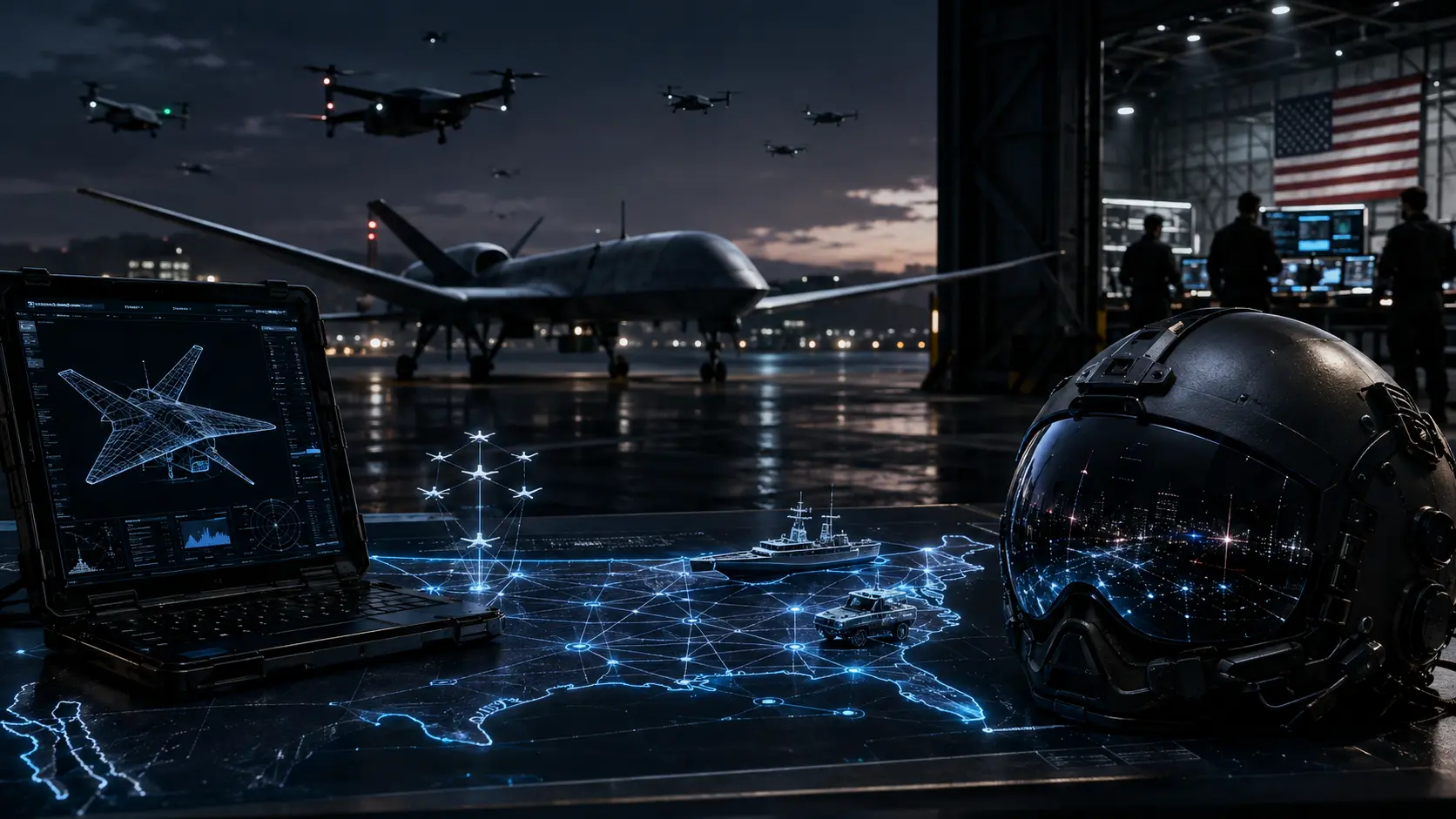

The United States military is terrifyingly outpaced not by enemy soldiers, but by an outdated paperwork process. In an era where artificial intelligence advances by the month, the traditional Pentagon procurement cycle takes up to a decade to deliver a new weapon system. By the time a legacy defense contractor rolls a new fighter jet or drone off the assembly line, its internal software is already fundamentally obsolete. But a massive, systemic shift is underway. Silicon Valley—a sector once famously hostile to the military—is aggressively pivoting to save it.
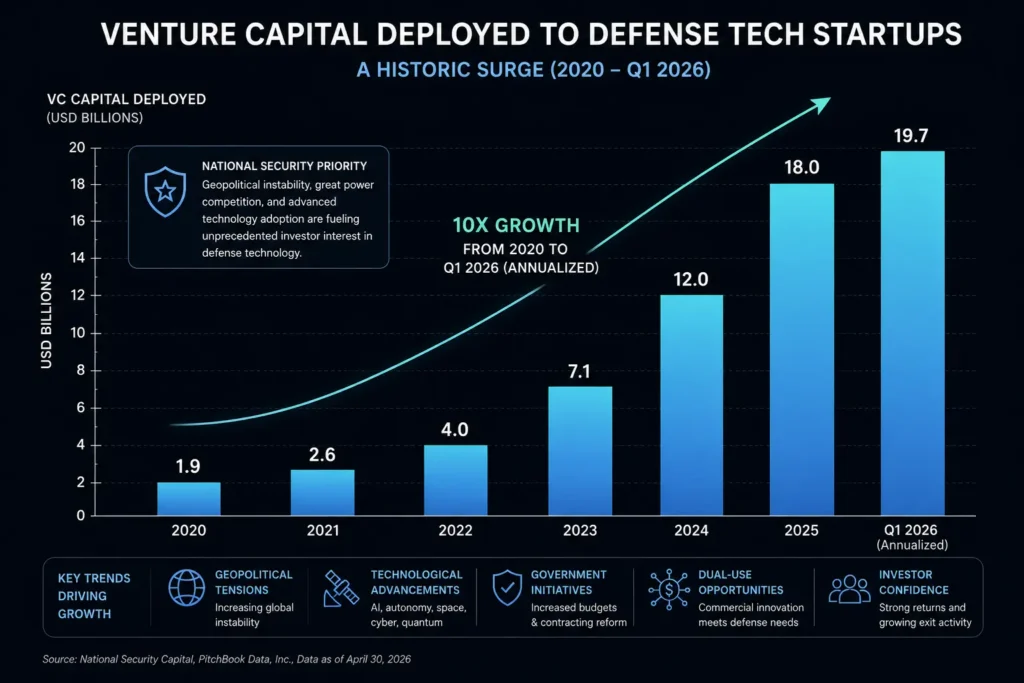
Why should the reader care right now? Because the financial center of gravity for national security has officially shifted from Washington, D.C., to Sand Hill Road. In Q1 2026 alone, a record $19.8 billion in venture capital flooded into defense technology startups. These agile companies are not building massive aircraft carriers; they are building autonomous, AI-driven drone swarms, computer-vision sentry towers, and software-defined weapons that can be updated in hours. By exploiting rapid “Other Transaction Authority” (OTA) contracts, venture-backed founders are actively bypassing the legacy defense oligopoly, completely rewriting how the world’s most powerful military buys its weapons, and preparing to fight the next great power conflict with code rather than steel.
What is The Silicon Valley Defense Pivot?
The Silicon Valley defense pivot is the structural reallocation of venture capital into defense and national security startups. It funds agile technology companies to develop artificial intelligence, autonomous systems, and cybersecurity platforms, leveraging specialized rapid-contracting authorities to sell directly to the military and bypass legacy defense contractors.
At a Glance
- Concept: Utilizing billions in private venture capital to fund military R&D, allowing startups to build operational prototypes of AI and autonomous weapons before the government even issues a formal requirement.
- Why it matters: In a potential Indo-Pacific conflict, mass and autonomy will overwhelm traditional, expensive military hardware. The Pentagon needs thousands of cheap, intelligent, attritable drones. Legacy primes are incentivized to build slow, expensive platforms; venture-backed startups are incentivized to build fast, scalable, software-first systems.
- Who uses it: The Defense Innovation Unit (DIU), elite venture capital firms (Founders Fund, a16z, Shield Capital), and breakout unicorns like Anduril Industries, Shield AI, and Palantir.
- Biggest takeaway: Startups are successfully exploiting Other Transaction Authority (OTA) contracts. This legal loophole allows the military to buy commercial prototypes in weeks rather than years, circumventing the crippling bureaucracy of the Federal Acquisition Regulation (FAR).
In Simple Words
Historically, if the military wanted a new drone, they would write a 1,000-page wish list and ask giant defense companies (like Lockheed Martin or Boeing) to build it. The government would pay for all the research, and the company would take ten years to deliver a drone that cost $20 million each.
Today, Venture Capital (VC) has changed the game.
Instead of waiting for the government to ask for a drone, a group of Silicon Valley engineers builds it themselves using money from venture capitalists. Because they are a tech startup, they build it in six months, it runs on advanced Artificial Intelligence, and it only costs $50,000.
The startup then takes the finished drone to the Pentagon and says, “We already built this with private money. You can buy it today.” To buy it quickly, the military uses a special fast-pass contract (an OTA) to skip the usual ten-year paperwork process. This dynamic shifts the financial risk of developing weapons from the taxpayer to the venture capitalists, and arms the military with cutting-edge technology at software-industry speeds.
Why This Matters
The strategic doctrine of the United States military is actively pivoting from “Exquisite” to “Attritable.”
For decades, the Pentagon prioritized exquisite systems—multi-billion-dollar aircraft carriers and $100 million stealth fighters that are too expensive to lose in a war. However, modern conflicts have proven that cheap, autonomous drones can easily destroy massive, expensive platforms. To survive a great power conflict, the military must field thousands of smart, low-cost, expendable (attritable) assets.
Traditional defense primes operate on “cost-plus” contracts; they make more money when a project takes longer and costs more. They are structurally incapable of delivering cheap, disposable mass. The $19.8 billion deployed by VCs in Q1 2026 acts as a direct subsidy to bypass this oligopoly. By funding startups that excel at rapid manufacturing, autonomous navigation, and machine learning, venture capitalists are single-handedly underwriting the Pentagon’s transition to an “AI-first” force deployment architecture.
The Rise of Venture Capital in Defense Tech Startups
The relationship between Silicon Valley and the Pentagon is completely healed.
A decade ago, employee protests at major tech companies (such as Google’s Project Maven walkouts) created a massive cultural divide between software engineers and the military. Today, driven by geopolitical instability and the realization that technological supremacy is the ultimate deterrent, that stigma has evaporated.
Organizations like the Defense Innovation Unit (DIU) and the Office of Strategic Capital (OSC) have effectively translated the language of the military into the language of Sand Hill Road. However, the ecosystem remains fiercely top-heavy. While the aggregate capital is historic, the vast majority of funding is concentrated in a few mega-rounds for established unicorns. For early-stage founders, navigating the bureaucratic maze to secure a coveted “Program of Record” remains an existential, capital-intensive challenge.
How Defense Procurement Works: Crossing the Valley of Death
Rewriting the procurement pipeline of a massive government bureaucracy requires exploiting specific legal and financial mechanisms. Here is the first-principles breakdown.
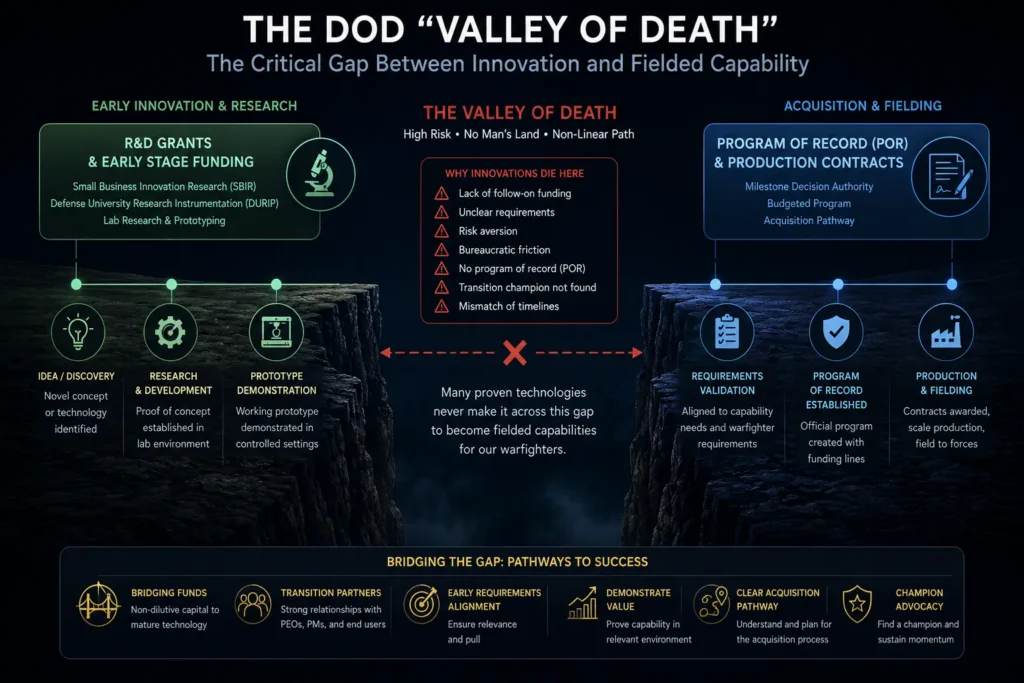
1. The Fundamental Problem: The Valley of Death
The Pentagon’s standard budgeting process is known as PPBE (Planning, Programming, Budgeting, and Execution). It requires the military to predict what technology it will need two to three years into the future before Congress approves the funding. For a startup, waiting two years for a government check is fatal. The period between winning a small initial research grant (Phase I/II SBIR) and securing a massive production contract is known as the “Valley of Death,” where 84 percent of defense startups run out of money and die.
2. The Insufficiency of Traditional Primes
Legacy defense contractors survive the Valley of Death because they are massive corporations sustained by ongoing, decades-long maintenance contracts. They do not use their own money for Research and Development (R&D); they wait for the government to issue a cost-plus contract. This removes innovation speed and guarantees that the military only receives hardware designed using years-old technology.
3. The Core Mechanism: Venture Capital as R&D
The Silicon Valley pivot replaces government R&D with Venture Capital. VC firms inject tens of millions of dollars into defense startups, allowing them to survive the Valley of Death. The startup uses this private capital to hire elite software engineers and build a fully functioning, combat-ready prototype. By the time the startup approaches the Pentagon, the R&D risk has already been assumed by the VCs, not the taxpayer.
4. Technical Depth: Other Transaction Authority (OTA)
To buy this privately funded technology quickly, the Department of Defense relies on Other Transaction Authority (10 U.S.C. 4021). OTAs are not standard contracts. They allow the military to bypass the rigid, slow-moving Federal Acquisition Regulation (FAR). An OTA allows the DoD to engage with “non-traditional defense contractors” (startups), negotiate commercial-style intellectual property (IP) rights, and issue a prototype contract in weeks. Crucially, if the prototype is successful, the DoD has the explicit authority to issue a massive, sole-source “follow-on production” OTA, instantly scaling the startup’s hardware to the battlefield.
5. Real-World Consequences: Software-Defined Warfare
Because the hardware is procured rapidly, the focus shifts to the software. Defense startups build “software-defined” weapons. The hardware (the drone body) is treated as a cheap commodity, while the value resides in the AI operating system driving it. When a new threat emerges, the startup does not need to build a new drone; they simply push an over-the-air software update to the fleet, fundamentally adapting the military’s capabilities in real-time.
Real-World Examples of Defense Tech Startups
The impact of this venture-backed procurement revolution is actively restructuring the modern battlefield.
The Replicator Initiative: In late 2023, the Pentagon announced “Replicator,” an initiative to field thousands of autonomous, attritable systems across multiple domains (air, land, sea) within 18 to 24 months to counter China’s military mass. Replicator bypassed traditional primes entirely, relying heavily on OTA contracts and DIU curation to source venture-backed drones—such as those produced by Shield AI and Performance Drone Works—proving that startup agility is now an official pillar of US defense strategy.
Anduril Industries and Lattice OS: Anduril is the archetype of the defense tech unicorn. Backed by Founders Fund, the company raised a $2.5 billion Series G in 2025 at a $30.5 billion valuation. Anduril does not just build drones; they build Lattice, an AI-powered operating system that fuses data from thousands of sensors, radars, and autonomous vehicles into a single, cohesive command-and-control picture. By using VC money to develop Lattice independently, Anduril successfully forced the DoD to buy a commercial software product rather than attempting to build one in-house.
Dual-Use Space and Cyber: Venture capital heavily favors “dual-use” companies—startups whose products can be sold to both the military and massive commercial enterprises. Companies like ICEYE (SAR satellites) and True Anomaly (orbital defense) leverage VC funding because their intelligence platforms are equally valuable to defense agencies monitoring adversaries and commercial hedge funds monitoring global shipping logistics, drastically expanding their Total Addressable Market (TAM).
Economic & Strategic Impact
The influx of venture capital into defense is radically altering the economics of global security.
For decades, the legacy defense primes (Lockheed, Boeing, Northrop Grumman) operated as an unchallenged oligopoly, functioning essentially as heavily regulated extensions of the government. The defense tech startup ecosystem introduces brutal, free-market capitalism into this dynamic.
As startups win billions in OTA contracts, legacy primes are being forced to adapt. Unable to match the software engineering talent of Silicon Valley, major defense contractors are shifting their strategies toward aggressive M&A (Mergers and Acquisitions) or establishing their own venture arms (e.g., Lockheed Martin Ventures, Booz Allen Ventures). By partnering with or buying the startups, the legacy primes are attempting to co-opt the innovation before it permanently erodes their market share.
Advantages
- Speed to Deployment: Bypassing traditional FAR regulations via OTA contracts cuts the acquisition timeline from a decade down to a matter of months.
- Taxpayer Savings: By forcing venture capitalists to subsidize the high-risk R&D phase of weapon development, the DoD saves billions in failed, cost-plus government research programs.
- Superior Talent Acquisition: Silicon Valley startups can offer equity and dynamic work environments to top-tier AI researchers and software engineers who would never agree to work inside a slow, bureaucratic legacy defense conglomerate.
Limitations
- The Scale-Up Bottleneck: Building 10 brilliant prototypes in a California garage is easy. Vertically integrating the manufacturing supply chain to mass-produce 10,000 artillery shells or drone swarms per month requires a level of heavy industrial CapEx that venture capitalists historically despise.
- Capital Concentration: Despite the record $19.8 billion in funding, the market is highly top-heavy. In recent 12-month periods, the top 10 mega-deals often accounted for nearly 90 percent of all capital, leaving early-stage hardware founders starving in the Valley of Death.
- Integration with Legacy Systems: A brilliant new AI targeting software is useless if it cannot interface with the 40-year-old analog hardware sitting inside a Navy destroyer. Startups constantly fight friction when trying to integrate modern APIs into deeply classified, legacy military mainframes.
Common Misconceptions
Misconception: Startups are replacing companies like Lockheed Martin and General Dynamics.
Reality: Startups are capturing massive market share in software, autonomy, and small drones, but they are not building nuclear submarines or fifth-generation stealth bombers. The legacy primes will retain their monopoly on massive, exquisite hardware platforms for the foreseeable future.
Misconception: Venture capitalists control what the military buys.
Reality: VCs only fund the initial development. The Pentagon (via units like the DIU) strictly dictates the ultimate procurement based on national security requirements. If a VC funds a startup that builds a weapon the DoD does not actually need, the startup will fail to win an OTA and go bankrupt.
Misconception: OTA contracts have no rules or oversight.
Reality: While OTAs bypass the sluggish FAR, they are heavily audited. To execute an OTA, the government must prove the involvement of a non-traditional defense contractor or mandate a significant financial cost-share from the vendor, ensuring the taxpayer is protected.
What Most People Miss
The critical importance of Intellectual Property (IP) Retention.
Under a traditional FAR-based government contract, the military pays for the research and therefore typically demands full ownership of the resulting Intellectual Property and data rights. This is a poison pill for venture capitalists; a tech company is worthless if it doesn’t own its own code.
What most people miss is that the true power of an OTA contract is not just speed—it is legal flexibility. Under an OTA, a startup can negotiate to retain ownership of its proprietary software (like an AI targeting algorithm). The military buys a license to use the software, but the startup keeps the IP. This single legal nuance is the foundational reason venture capital is willing to invest billions into defense today; it ensures the startup can maintain a lucrative, defensible moat and eventually scale into a multi-billion-dollar commercial valuation.
Comparison Table
| Feature | Legacy Defense Primes | Venture-Backed Defense Startups |
| Funding Model | Government-funded R&D (Cost-Plus) | Private Venture Capital (Self-funded R&D) |
| Primary Output | Massive, exquisite hardware platforms | Software-defined, autonomous, attritable mass |
| Contracting Mechanism | Federal Acquisition Regulation (FAR) | Other Transaction Authority (OTA) / CSOs |
| Development Speed | 5 to 10+ Years | Months to 1-2 Years |
| Intellectual Property | Government typically owns rights | Startup retains proprietary software IP |
| Talent Pool | Traditional Aerospace/Mechanical Eng. | Top-tier AI, ML, and Software Engineers |
Case Study
Situation: The Department of Defense recognized a critical vulnerability: defending against cheap, enemy drone swarms using million-dollar Patriot missiles was economically unsustainable. They needed a cheap, autonomous, and reusable counter-drone solution.
Challenge: Issuing a standard request for proposal (RFP) through the traditional FAR process would take years to yield a prototype. By the time a legacy prime delivered a system, drone technology would have evolved, rendering the counter-measure obsolete.
Solution (The Anduril Roadrunner): Anduril Industries utilized venture capital to proactively design and build the “Roadrunner”—a jet-powered, autonomous, reusable drone designed to intercept airborne threats. They built it entirely with private money, assuming all the R&D risk.
Outcome: Because Anduril had an operational, proven prototype ready, the DoD utilized its OTA capabilities to instantly validate and procure the system. By bypassing the sluggish requirement-writing phase, the military was able to adopt the Roadrunner ecosystem directly into its air defense architecture at a fraction of the traditional cost and timeline.
Lessons Learned: The Anduril model proved to the Pentagon that the fastest way to modernize the military is not to tell contractors how to build something, but to present a problem and let heavily funded, agile software companies present a ready-made commercial solution.
Future Outlook
Next 12–24 Months
The normalization of Commercial Solutions Openings (CSOs). As directed by the 2026 NDAA, the Department of Defense will increasingly utilize CSOs—a streamlined process specifically designed to acquire innovative commercial technologies quickly. Startups that have successfully navigated Phase II of the SBIR program will aggressively leverage CSOs and follow-on production OTAs, translating the massive $19.8B Q1 2026 funding rounds directly into recurring, high-margin government revenue.
Next 3–5 Years
The Hardware Scaling Crisis. As autonomous software reaches maturity, defense tech unicorns will hit the physical reality of war: software doesn’t explode. Tech startups will be forced to evolve into heavy manufacturers. We will see massive capital deployed to build automated, robotic micro-factories across the American Midwest to mass-produce solid rocket motors, drone airframes, and artillery shells. The companies that successfully merge elite AI software with relentless, high-volume hardware manufacturing will cement themselves as the “New Primes.”
Next 10 Years
The Software-Defined Force. By the 2030s, the physical platforms (ships, planes, tanks) will be entirely commoditized. The absolute superiority of the US military will be dictated by a unified, interoperable AI network. Venture-backed companies will provide the neural system of the military, utilizing foundation models and orbital sensor meshes to autonomously detect threats, assign targets, and execute strikes with zero human latency. The procurement system will mirror the App Store: the military will continuously download updates to its weapons, ensuring tactical supremacy without ever changing the physical hardware.
Most Likely Scenario
The defense tech ecosystem will consolidate. While thousands of startups currently exist, the unique complexities of security clearances, facility clearances (FCLs), and government sales cycles will force smaller companies to merge or be acquired by the breakout unicorns (Anduril, Palantir, Shield AI). A new, elite tier of “Software Primes” will permanently establish themselves alongside Lockheed and Raytheon, creating a dual-pillar defense industrial base where legacy giants build the steel, and Silicon Valley builds the brain.
Key Takeaways
- The Silicon Valley defense pivot represents a historic shift where venture capital is actively funding the R&D for next-generation military technology, breaking the monopoly of legacy defense primes.
- In Q1 2026, venture investment in defense tech reached a near-record $19.8 billion, cementing defense as a sustained, institutional asset class rather than a cyclical trend.
- Startups are surviving the DoD “Valley of Death” by leveraging private capital to build complete prototypes before the government even asks for them.
- The military procures these technologies rapidly using Other Transaction Authority (OTA) contracts, which bypass sluggish federal regulations and allow startups to retain their proprietary Intellectual Property.
- The strategic focus has shifted from exquisite, expensive hardware to “attritable mass”—thousands of cheap, AI-driven, software-defined autonomous systems deployed across land, air, and sea.
- While startups dominate software and autonomy, they face a severe upcoming challenge in vertically integrating heavy hardware manufacturing at the scale required for a great power conflict.
Glossary
Attritable: Military assets (like drones) that are cheap enough and produced in high enough volumes that losing them in combat is tactically and economically acceptable.
Commercial Solutions Opening (CSO): A competitive procedure used by the DoD to acquire innovative commercial items, technologies, or services quickly, often resulting in an OTA.
Defense Innovation Unit (DIU): A DoD organization established specifically to accelerate the adoption of commercial technology into the military and help startups navigate the procurement process.
Other Transaction Authority (OTA): A legal contracting mechanism that gives the DoD the flexibility to bypass standard FAR regulations, enabling rapid prototyping, commercial IP negotiation, and follow-on production.
Program of Record (POR): The ultimate goal for a defense startup. A POR is an official, established military program that has dedicated, long-term funding appropriated by Congress in the defense budget.
Valley of Death: The treacherous financial gap between a startup receiving initial R&D funding (like a Phase I/II grant) and securing a massive, recurring production contract from the military.
Frequently Asked Questions
Why did Silicon Valley historically refuse to work with the military?
Following the Snowden leaks and various geopolitical controversies in the 2010s, many tech employees had strong ethical objections to building software for weapons or surveillance (e.g., Google’s Project Maven walkouts). However, rising global instability and the war in Ukraine have profoundly shifted the cultural sentiment back toward supporting democratic national security.
Is it safe to put AI in weapons?
This is heavily regulated. The US Department of Defense operates under strict directives (such as DoD Directive 3000.09) regarding autonomous weapons. Currently, AI is used for navigation, sensor fusion, and target identification, but a human must remain “in the loop” to authorize the actual use of lethal force.
How do startups make money if the government takes so long to pay?
This is exactly why the venture capital pivot is so important. VCs provide the millions of dollars required to pay software engineers and rent office space for the 2 to 3 years it takes to navigate the Pentagon’s bureaucracy and secure an OTA contract.
Can regular investors buy into these defense startups?
Most pure-play defense tech startups (like Anduril or Shield AI) are privately held by venture capital firms and are not available on the public stock market. Retail investors generally gain exposure by investing in publicly traded software primes (like Palantir) or the venture capital arms of legacy primes.
What happens if a startup goes bankrupt before finishing a weapon?
Because the government is using OTAs to buy commercially available prototypes—and because the VC investors are the ones funding the R&D—the financial risk of the company failing falls almost entirely on the private investors, saving the taxpayer from footing the bill for a failed project.
Sources
[1] FNEX Capital: Defense Tech VC Opens 2026 Near Record Highs (May 2026)
[2] New Market Pitch: Defense Tech Startup Funding 2025-2026 Analysis (July 2026)
[3] Defence Online: Defence Tech’s Venture Capital Moment: Opportunities, Risks and the New Funding Landscape (July 2026)
[4] J.P. Morgan: Defense Tech Innovation and the Role of Startups (2025/2026 Update)
[5] PilieroMazza PLLC: The Rise of OTA in Defense Contracting: Commercial Solutions Openings (January 2026)