Advertisement
)
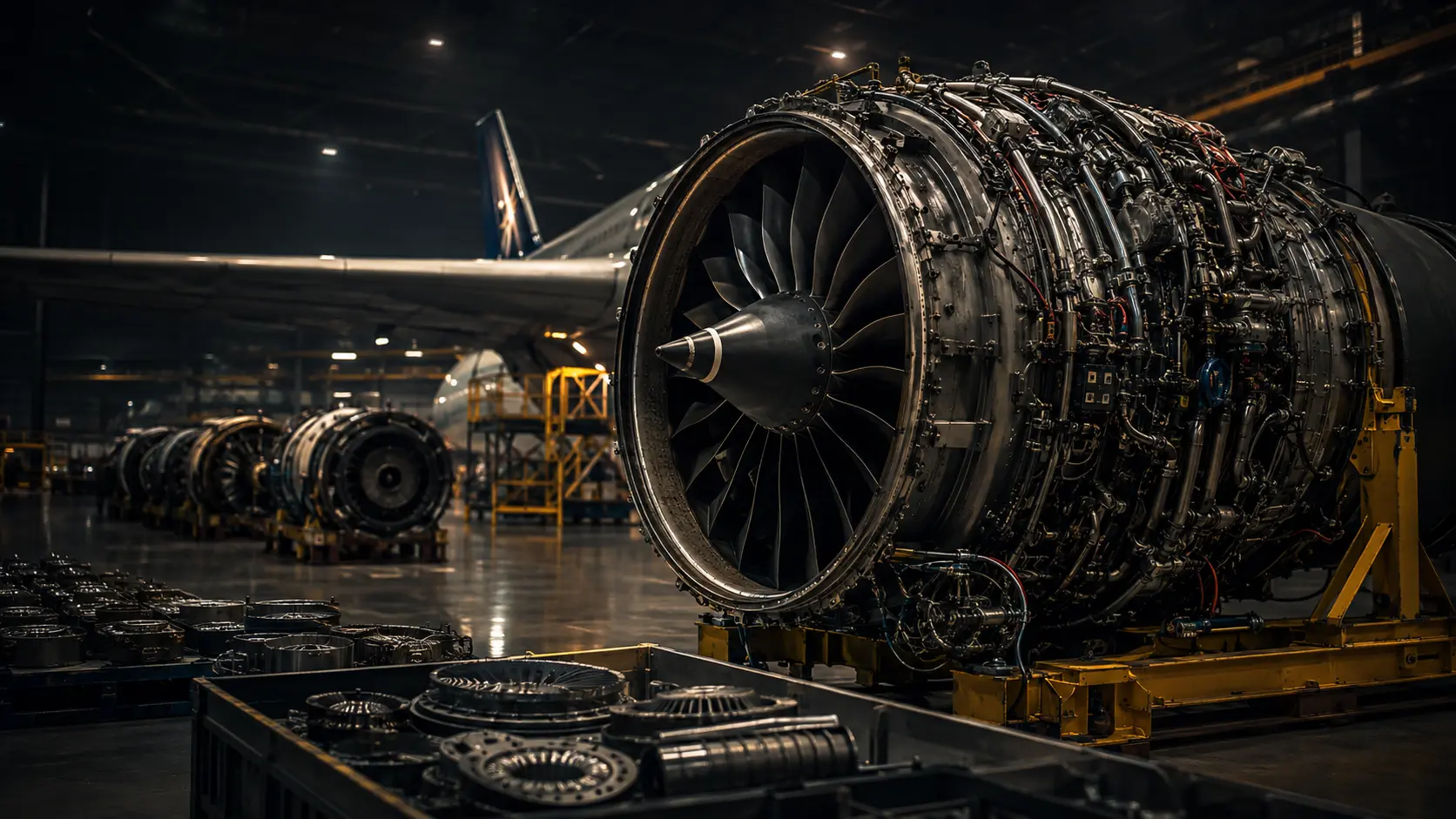

Right now, more than 3,500 commercial jet engines are sitting in warehouses around the world, completely dismantled and unable to fly. This is not because they are broken beyond repair; it is because the global aviation industry has literally run out of people legally certified to put them back together.
While passengers experience this crisis as delayed flights and skyrocketing ticket prices, the reality on the tarmac is far more severe. The global aviation supply chain is buckling under a perfect storm: the premature degradation of next-generation engines, an unprecedented backlog of 17,000 new aircraft orders, and a crippling deficit of licensed aircraft mechanics.
Airlines are being forced to fly older, less efficient planes for years longer than intended, driving the cost of this supply chain crisis past the $11 billion mark annually. For aviation executives and macroeconomists, understanding the mechanics of this maintenance bottleneck is no longer just an operational footnote—it is the single largest constraint on global travel capacity for the remainder of the decade. The multi-billion dollar repair industry has officially become aviation’s tightest choke point.
What are Aviation MRO Constraints?
Aviation MRO (Maintenance, Repair, and Overhaul) constraints are systemic supply chain and labor bottlenecks that restrict the speed at which aircraft can be inspected, repaired, and returned to service. Driven by a shortage of certified technicians and delayed parts, these constraints severely limit global flight capacity and inflate airline operating costs.
At a Glance
- Concept: The structural inability of the global aviation repair industry to keep pace with airline demand due to a lack of certified mechanics, replacement parts, and available hangar slots.
- Why it matters: The global MRO market is projected to hit $97 billion in 2026, but the capacity to perform the work does not exist. When planes sit on the ground waiting for maintenance, airlines bleed capital, leading to reduced flight schedules and historically high ticket prices for consumers.
- Who uses it: Major airline carriers, Original Equipment Manufacturers (OEMs) like GE Aerospace and Pratt & Whitney, and independent third-party MRO providers scrambling to optimize their workforce.
- Biggest takeaway: The root of the crisis is heavily tied to modern engine platforms. New geared turbofans and high-efficiency engines are breaking down much faster than expected, flooding repair shops with unscheduled overhauls and stretching turnaround times from 60 days to over eight months.
In Simple Words
Like a car, an airplane requires routine oil changes, tire replacements, and eventual engine rebuilds to stay safe. But unlike a car, you cannot take a Boeing 777 to a neighborhood mechanic.
Every single bolt removed from a commercial aircraft must be documented, inspected, and replaced by a highly trained, government-licensed technician. This industry is known as MRO (Maintenance, Repair, and Overhaul).
During the pandemic, thousands of these highly skilled mechanics retired early or left the aviation industry entirely. At the same time, the newest generation of highly advanced jet engines started experiencing unexpected wear and tear, forcing airlines to pull them off airplanes much earlier than planned to fix them.
The result is a massive traffic jam. There are too many broken engines and not enough licensed mechanics to fix them. Because new airplanes are severely delayed at the factory, airlines have to keep flying their older planes, which require even more maintenance. The entire system is gridlocked, leaving perfectly good airplanes sitting empty on the tarmac simply because they are waiting in line for a mechanic.
Why This Matters
The MRO bottleneck is fundamentally rewriting airline unit economics.
When an airline cannot secure an engine overhaul slot, it must secure a leased spare engine to keep its aircraft flying. As thousands of engines enter the backlog, the demand for lease engines has skyrocketed, creating a $2.6 billion excess leasing penalty across the industry in 2025 alone. Furthermore, because new aircraft deliveries have fallen nearly 30 percent below pre-pandemic peaks, airlines are flying legacy aircraft well past their intended retirement dates.
These older aircraft burn more fuel and require significantly heavier, more labor-intensive maintenance checks. This creates a vicious, compounding cycle: older planes consume the very MRO hangar slots and mechanic hours needed to fix the newer planes. For logistics planners and institutional investors, the MRO constraint is the ultimate leading indicator of airline profitability; carriers that secured long-term MRO capacity contracts years ago are dominating those currently forced to navigate the spot market.
The Global Aviation Supply Chain Crisis
The capacity crisis is structural, not cyclical.
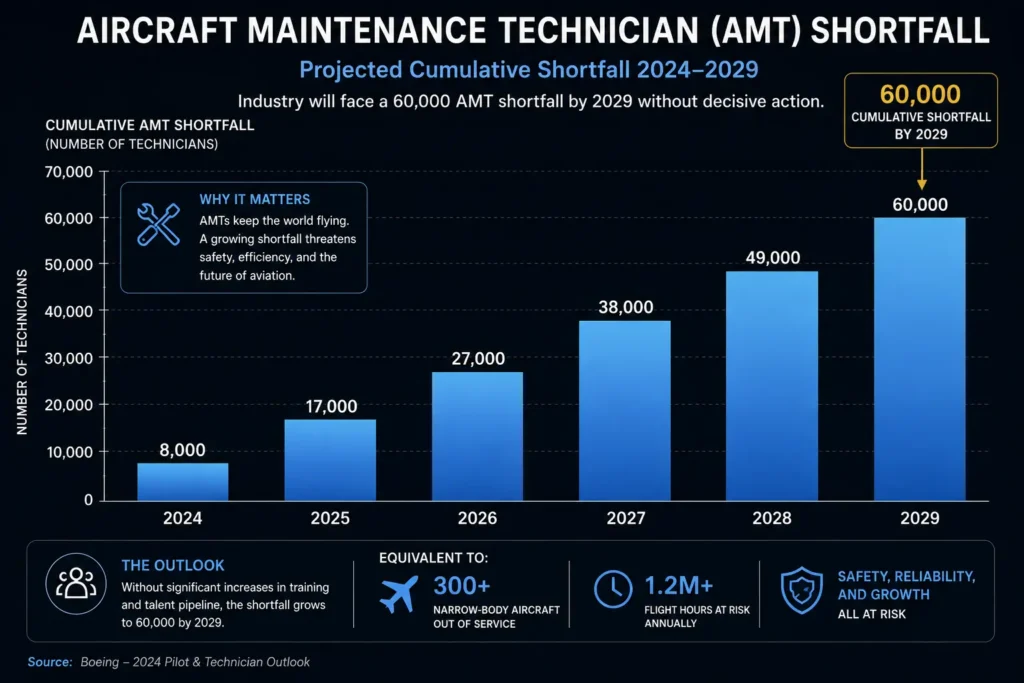
The global aviation MRO market has swelled to $97 billion in 2026, with engine overhauls consuming 47 percent of that total spend. However, throwing more money at the problem no longer yields faster aircraft releases. The industry is facing a projected shortfall of 22,000 Aviation Maintenance Technicians (AMTs) by the end of 2026, a deficit that McKinsey forecasts could nearly triple to 60,000 technicians by 2029 if left unaddressed.
This labor crisis is colliding with a parts shortage. The traditional “safety valve” for MROs was Used Serviceable Material (USM)—harvesting perfectly good parts from retired aircraft to fix active ones. Because airlines refuse to retire their older planes amidst the current capacity crunch, the availability of USM has plummeted by an estimated 25 percent. MROs are trapped: they lack the mechanics to perform the labor, and they lack the parts to complete the rebuilds.
How Aviation MRO Constraints Impact Airlines
To understand why a multi-billion-dollar industry cannot simply scale its way out of a bottleneck, one must deconstruct the physics and regulations of heavy maintenance. Here is the first-principles breakdown.
1. The Fundamental Problem: The Certification Moat
Unlike traditional manufacturing, aviation maintenance operates under absolute regulatory rigidity. An individual cannot legally sign off on a repair without an Airframe and Powerplant (A&P) license, which requires years of schooling and apprenticeship. The pipeline to create a new AMT takes at least 24 to 36 months. As veteran mechanics age out and retire, the industry cannot instantly replace them with uncertified labor, capping the absolute maximum throughput of any MRO facility.
2. The Insufficiency of New Engine Platforms
Airlines purchased the newest generation of engines—like the Pratt & Whitney Geared Turbofan (GTF) and CFM International LEAP—because they promised unprecedented fuel efficiency. However, pushing jet engines to run hotter and leaner compromised durability. These engines are experiencing on-wing lifespans up to 50 percent lower than initial projections, particularly in harsh, sandy environments.
3. The Core Mechanism: Turnaround Time (TAT) Inflation
When an engine is removed from an aircraft, it enters a shop for teardown, inspection, part replacement, and reassembly. Historically, this engine Turnaround Time (TAT) was 60 to 90 days. Today, the massive influx of premature engine failures has overwhelmed the physical capacity of test cells and teardown bays. The average TAT has violently inflated to 180 to 240 days.
4. Technical Depth: The Powder Metal Contamination
The bottleneck was exponentially worsened by specific manufacturing anomalies. Pratt & Whitney discovered that contaminated powder metal used to forge high-pressure turbine discs between 2015 and 2021 required accelerated inspections. This mandate triggered a multi-year wave of completely unscheduled engine removals across the global A320neo fleet. Every GTF pulled for this mandatory inspection represents a shop visit that was not budgeted in the global maintenance forecast, abruptly displacing routine, scheduled overhauls.
5. Real-World Consequences: The Part Scarcity Squeeze
Because TAT has stretched to eight months, Tier 2 and Tier 3 suppliers (who forge the specialized seals, blades, and fasteners) are caught in a perpetual demand cycle. Original Equipment Manufacturers (OEMs) demand parts to build brand new engines to satisfy the 17,000-aircraft order backlog, while MRO shops demand those exact same parts to fix the 3,500 broken engines sitting in warehouses. Suppliers cannot physically satisfy both demands simultaneously, leaving engines dismantled on shop floors for months simply waiting for a single critical fastener.
Airline Strategies to Bypass MRO Bottlenecks
The MRO constraint forces airlines and suppliers into aggressive, unorthodox operational postures.
Technical Robberies and Cannibalization: With Used Serviceable Material (USM) supply decimated, airlines are resorting to “technical robberies”. This involves cannibalizing parts from one grounded aircraft to make another airworthy. While highly inefficient and labor-intensive—requiring a mechanic to perform the labor of removing a part twice—it is often the only way to release an aircraft from a heavy maintenance check when the OEM supply chain fails to deliver a replacement component.
The Rise of Tier 2 & 3 Pricing Power: The scarcity of parts has handed unprecedented leverage to lower-tier suppliers. Smaller foundries and specialized component manufacturers are dictating aggressive pricing terms to MRO networks. As major airlines bypass OEMs to source components directly to speed up turnaround times, these specialized aerospace machine shops are experiencing a generational revenue boom.
Data-Driven “Wrench Time” Optimization: Because they cannot hire enough mechanics, elite MROs are optimizing the mechanics they already have. Studies show that poor parts staging and administrative bloat severely limit a mechanic’s actual “wrench time.” By deploying predictive AI to precisely stage tools and materials ahead of a critical maintenance milestone, best-in-class MROs are increasing effective technician productivity by 15 to 35 percent without adding a single headcount.
Economic & Strategic Impact
The financial penalty of the MRO bottleneck is staggering, effectively acting as an inflation tax on the entire aviation ecosystem.
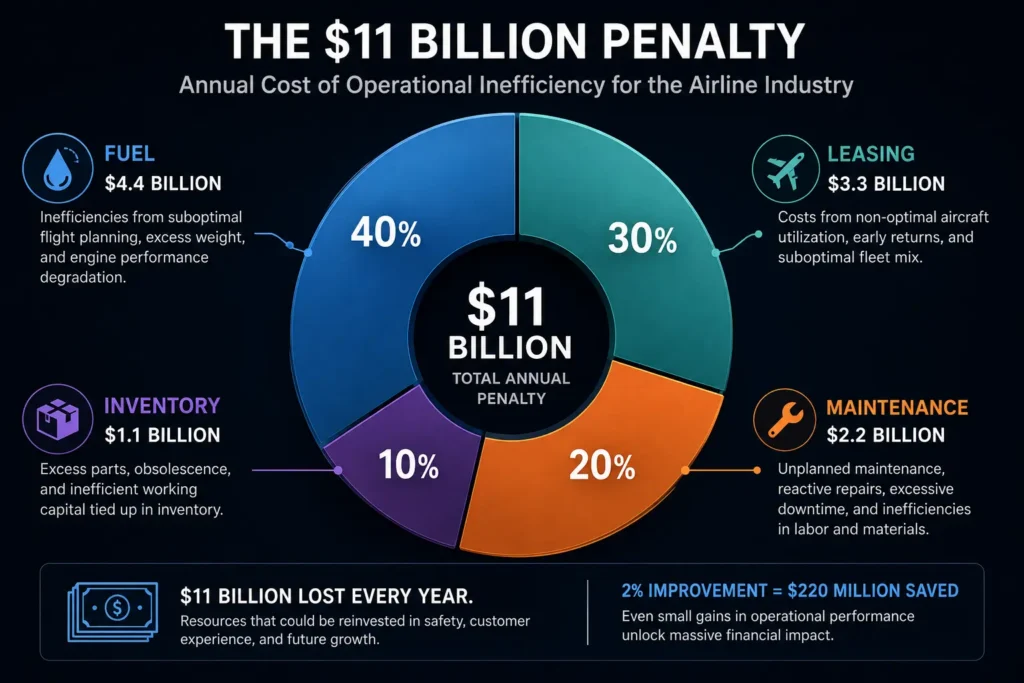
A joint 2025 analysis by IATA and Oliver Wyman quantified the cost of supply chain challenges to the airline industry at over $11 billion. This is not abstract revenue loss; it is a direct erosion of operating margins:
- $4.2 Billion in Delayed Fuel Savings: Airlines are burning significantly more jet fuel because they are forced to fly older, heavier legacy aircraft instead of the highly efficient delayed models.
- $3.1 Billion in Elevated Maintenance: Aging airframes demand more frequent, invasive base maintenance checks, exacerbating the hangar slot shortage.
- $2.6 Billion in Engine Leasing: The cost to rent spare engines has soared due to extreme scarcity while thousands of primary engines sit dismantled in shops.
- $1.4 Billion in Spares Inventory: Airlines are panic-hoarding parts and increasing Aircraft On Ground (AOG) expenditures to mitigate unpredictable logistics delays.
Strategically, this forces a consolidation of power. Major airlines are aggressively bringing MRO capabilities in-house or buying smaller repair shops outright to guarantee their own priority access to labor and engine test cells, leaving smaller, low-cost carriers to fight over scraps in the heavily constrained spot market.
Advantages (Drivers of MRO Growth)
- Generational Revenue Potential: For independent MRO providers and specialized component suppliers, the extreme imbalance of supply and demand guarantees robust, high-margin revenue pipelines for the next decade.
- Accelerated Digital Transformation: The labor shortage is forcing the historically paper-heavy aviation industry to rapidly adopt blockchain tracking for part provenance and AI-driven predictive maintenance, fundamentally modernizing hangar operations.
- Enhanced Valuation of Mid-Life Assets: The inability to acquire new aircraft or new engines has dramatically spiked the residual value of 10-to-15-year-old aircraft and legacy engines (like the CFM56), granting lessors massive windfalls.
Limitations (The Bottlenecks)
- The Structural AMT Deficit: The aviation maintenance technician pipeline is fundamentally broken. Retiring baby boomers, low vocational graduation rates, and intense competition from other skilled trades are driving a projected 60,000-technician shortage by 2029.
- Test Cell Scarcity: Even if a shop has the mechanics to rebuild an engine, the engine cannot return to the wing until it is run in a specialized thrust test cell. The physical lack of certified test cells globally creates an absolute hard cap on engine throughput.
- OEM Parts Monopolies: Modern engines are heavily protected by OEM intellectual property. MROs are often legally barred from repairing a part and are forced to buy a new replacement exclusively from the OEM. If the OEM cannot produce it, the engine stays grounded.
Common Misconceptions
Misconception: The airlines just need to hire more mechanics.
Reality: The mechanics do not exist. Certification requires thousands of hours of FAA (or EASA) approved schooling and testing. The training pipeline simply does not produce enough graduates annually to offset the massive wave of veteran retirements.
Misconception: The supply chain issues are just leftover COVID-19 delays.
Reality: While the pandemic caused the initial disruption, the current crisis is structural. The primary driver in 2026 is the severe durability gap and mandatory powder-metal inspections of next-generation engine platforms, which structurally demand vastly more maintenance than legacy engines.
Misconception: Older aircraft are unsafe because they are flying longer.
Reality: Older aircraft are perfectly safe. Aviation regulations dictate that parts are replaced based on cycles (flights) or flight hours, regardless of age. The issue with older aircraft is purely economic—they cost drastically more money and labor to keep in an airworthy state.
What Most People Miss
The role of MRO Operational Coordination vs. Headcount.
The immediate reaction to a labor shortage is to aggressively attempt to hire. However, data indicates that adding more mechanics to a poorly run MRO shop does not decrease turnaround time.
What most industry observers miss is the metric of “First-Run Yield” and the execution of “Critical Moments.” MRO providers that invest heavily in resource planning technology are extracting vastly more throughput from their existing labor force. If a mechanic has to walk across a hangar to find a tool, or wait three days for an engineering sign-off on a non-routine finding, their “wrench time” drops. By reorganizing shop floors, actively supervising the critical path of a teardown, and utilizing digital supply chain pre-positioning, elite MROs are recovering up to 10 percentage points of lost productivity, fundamentally outperforming competitors who simply try to throw bodies at the backlog.
Comparison Table
| Metric | Pre-Pandemic MRO Environment (2019) | Modern MRO Environment (2026) |
| Engine Turnaround Time (TAT) | 60 – 90 Days | 180 – 240+ Days |
| Global MRO Market Value | ~$82 Billion | $97 Billion |
| Mechanic Supply | Balanced | Severe Deficit (22,000 shortfall) |
| Used Serviceable Material (USM) | Abundant (High retirement rates) | Scarce (Declined ~25% YoY) |
| Engine On-Wing Life | Exceeded Projections (CFM56/V2500) | Fell Short (GTF/LEAP failures) |
| Primary Constraint | Airline Budgets / Cost Negotiation | Physical Capacity / Hangar Slots |
Case Study
Situation: Following the grounding of fleets in 2020, major airlines and OEMs assumed that a gradual recovery would allow the MRO sector to scale back up smoothly. However, the unexpected durability issues of next-generation engines—specifically the Pratt & Whitney GTF and CFM LEAP—shattered all predictive maintenance models.
Challenge: By 2025, an unprecedented wave of unscheduled engine removals hit the system. MRO networks found themselves with over 3,500 engines awaiting shop visits globally. Because OEMs could not produce replacement parts fast enough to feed both new aircraft assembly lines and repair shops, engines were trapped in teardown bays, inflating turnaround times past 200 days.
Solution (The Focus on Core Execution): Realizing that they could not hire their way out of the crisis due to the 22,000-technician shortfall, high-performing MROs pivoted from capacity expansion to operational execution. They instituted strict “critical moments” frameworks, shifting supervisors from passive monitors to active problem solvers, ensuring parts and engineering approvals were dynamically staged before a mechanic ever approached the engine.
Outcome: MROs that focused on data-driven operational coordination significantly improved their on-time release rates despite the labor crunch. Meanwhile, the structural bottleneck penalized the broader industry heavily, costing airlines over $11 billion in elevated maintenance, fuel penalties, and excessive engine leasing fees as they desperately kept older fleets airworthy.
Lessons Learned: The crisis proved that the aviation MRO market has fundamentally shifted from a buyer’s market to a seller’s market. Airlines can no longer treat maintenance as a reactive operational afterthought; securing long-term, high-quality MRO capacity is now a strategic, board-level imperative required to ensure flight schedules and protect operating margins.
Future Outlook
Next 12–24 Months
The peak of the Engine Backlog Squeeze. Through the remainder of 2026 and 2027, the volume of Pratt & Whitney GTF engines undergoing mandatory powder-metal inspections will hit its absolute apex. Turnaround times will remain painfully stretched. Airlines will aggressively lock in extended leases for older A320ceo and 737NG aircraft to bridge the gap. Ticket prices will remain structurally elevated as airlines pass the $11 billion supply chain penalty directly to the consumer.
Next 3–5 Years
The Digital MRO Integration. As the technician shortfall marches toward 60,000 by 2029, the industry will be forced to adopt extreme digital efficiencies. We will see the widespread implementation of AI-driven computer vision systems for automated airframe inspections, augmented reality (AR) headsets to guide junior mechanics through complex teardowns, and blockchain networks verifying the provenance of 3D-printed alternative parts. The MROs that successfully integrate these technologies will decouple their revenue growth from their physical headcount.
Next 10 Years
The Normalization of Supply Chains. The structural mismatch between airline requirements and aerospace production capacity is not forecast to fully normalize until the 2031–2034 window. By the early 2030s, the current generation of GTF and LEAP engines will have undergone extensive block upgrades, curing their durability gaps and returning on-wing lifespans to historical norms. Furthermore, aggressive vocational outreach programs initiated today will finally begin delivering a steady stream of certified A&P mechanics, stabilizing the multi-billion-dollar aftermarket.
Most Likely Scenario
The aviation industry will be permanently altered by this crisis. Airlines will no longer run “just-in-time” maintenance operations with zero inventory buffers. They will structurally maintain higher levels of spare engines and hoarded critical components. MRO providers and Tier 2 suppliers will solidify their newly found pricing power, ensuring that the cost of maintaining a modern commercial jet remains significantly higher than the pre-pandemic baseline for the rest of the 21st century.
Key Takeaways
- The global aviation MRO market faces a structural capacity crisis, driven by an estimated 22,000 technician shortfall in 2026 that is projected to triple by 2029.
- Engine overhauls consume 47 percent of total MRO spend and represent the most severe bottleneck, with average turnaround times inflating from 60 days to over 180 days.
- Premature degradation and mandatory powder-metal inspections of next-generation engines (GTF, LEAP) have flooded shops with unscheduled removals, displacing routine maintenance.
- With a backlog of 17,000 new aircraft orders and 5,300 delivery shortfalls, airlines are forced to fly older, fuel-inefficient planes for years longer than planned.
- The supply chain constraints are costing the airline industry an estimated $11 billion annually, driven by delayed fuel savings, massive engine lease rates, and elevated maintenance costs.
- High-performing MROs are overcoming the labor shortage not by hiring, but by utilizing predictive software and “critical path” supervision to increase mechanic wrench time by 15 to 35 percent.
Glossary
A&P Mechanic (Airframe and Powerplant): A technician officially certified and licensed by a regulatory body (like the FAA) to perform and approve maintenance on commercial aircraft.
Aircraft On Ground (AOG): A highly critical status indicating that an aircraft has a mechanical issue that prevents it from flying. Fixing AOG issues takes absolute priority to avoid massive revenue losses.
Base Maintenance: Heavy, highly invasive maintenance checks (often called C-checks or D-checks) where an aircraft is taken out of service for weeks, largely dismantled, and meticulously inspected.
Original Equipment Manufacturer (OEM): The massive conglomerates (e.g., Boeing, Airbus, GE Aerospace, Pratt & Whitney) that design and build the original aircraft and engines.
Turnaround Time (TAT): The total amount of time required to receive a broken component (like a jet engine), fully overhaul it, and return it to the airline in airworthy condition.
Used Serviceable Material (USM): Recycled parts salvaged from retired aircraft that are cleaned, inspected, re-certified, and used to repair active airplanes, heavily relied upon to mitigate new-part shortages.
Frequently Asked Questions
Why are ticket prices so high? Is it just corporate greed?
While demand is high, the fundamental constraint is capacity. Because of the MRO bottleneck and the lack of new aircraft deliveries, airlines physically cannot put enough planes in the sky. Furthermore, the $11 billion penalty caused by excess engine leasing and older-plane fuel burn drastically raises the operating cost per flight, which is inevitably passed down to the ticket buyer.
Why are the new engines breaking down so fast?
To squeeze unprecedented fuel efficiency out of modern jet engines, engineers designed them to run at extreme pressures and temperatures. Operating continuously at the bleeding edge of physics has caused components (like turbine blades) to degrade faster than expected, especially in environments with high levels of dust and sand.
Can’t airlines just buy parts from a different manufacturer?
Aviation is fiercely regulated. An airline cannot put a generic part into a jet engine. Every single component must be rigorously certified and approved by regulatory agencies. In many cases, the OEM holds the exclusive intellectual property, meaning the airline has only one legal source to buy a replacement part from.
Are planes dangerous right now because of the mechanic shortage?
No. Aviation safety regulations are absolute. An airplane will not fly if it has not passed its mandatory maintenance checks. The shortage of mechanics does not mean corners are being cut; it means the aircraft simply sits on the ground waiting in line until a certified mechanic is available to do the work properly.
How much does an airline pay to lease a spare engine?
Due to extreme scarcity, lease rates for popular modern engines have skyrocketed. Depending on the engine type, airlines are currently paying upwards of $100,000 to $150,000 per month just to rent a single spare engine to keep an aircraft flying while their primary engine sits in the MRO backlog.
Sources
[1] Aerospace Innovations: The Global Aviation Engine Crisis: A Generational Opportunity for Tier 2 & 3 Suppliers (June 2026)
[2] Boston Warwick: The MRO Capacity Crisis: Why a $97 Billion Market Still Cannot Keep Aircraft Flying (July 2026)
[3] McKinsey & Company: Addressing the shortage of aviation maintenance technicians (March 2026)
[4] International Air Transport Association (IATA): Aerospace Supply Chain Bottlenecks Continue to Constrain Airlines (December 2025)
[5] IATA Operations & Infrastructure: Aviation Supply Chain Cost Impacts 2025