Advertisement
)


Private equity firms are no longer just buying companies; they are buying the physical plumbing of the real economy. If you recently took out a solar loan, flew on a leased airplane, or paid off a consumer credit card, there is a high probability a Wall Street mega-fund actually owns that cash flow. For a decade, the private credit boom was fueled by “direct lending”—giving cash to medium-sized corporations to fund buyouts. But that market is tapped out. Saturated by competition and squeezed by high interest rates, the corporate buyout machine has hit a ceiling.
Why should you care right now? Because alternative asset managers have unlocked a massive new $2 trillion frontier. As traditional commercial banks retreat from lending due to draconian new regulatory capital requirements, private credit funds are stepping in to securitize hard assets and consumer debt. This pivot marks the dawn of a massive shadow banking ecosystem. Wall Street is systematically replacing the traditional banking sector, transforming how the global economy finances everything from the construction of artificial intelligence infrastructure to the lease on your car.
What is Asset-Backed Finance (ABF)?
Asset-Backed Finance (ABF) is a form of private credit where loans are secured by a diversified pool of physical or financial assets, rather than the corporate cash flows of a single business. It encompasses financing for infrastructure, consumer credit, real estate, and equipment, providing investors with yield protected by tangible collateral.
At a Glance
- Concept: Shifting private market lending away from risky corporate balance sheets and toward hard, tangible collateral that generates contractual, predictable cash flows.
- Why it matters: Standard corporate direct lending is highly correlated to the broader economy. If a company goes bankrupt, the lender takes a massive loss. In ABF, the loan is backed by thousands of individual assets. Even in a recession, a diversified pool of consumer loans or hard infrastructure provides significant downside protection.
- Who uses it: Mega-cap alternative asset managers (Apollo Global Management, KKR, Blackstone, Ares) replacing regional and global banks as the primary financiers of the real economy.
- Biggest takeaway: The primary driver of the ABF boom is the “Basel III Endgame.” New global banking regulations penalize banks for holding risky loans. Banks are originating the loans but immediately passing the risk to private ABF funds in a complex financial maneuver known as Capital Relief Arbitrage.
In Simple Words
Imagine you are a bank, and two people ask you for a $100 million loan.
The first person owns a software company. They promise that if their software sells well over the next five years, they will pay you back with the profits. If the software fails, the company goes bankrupt, and you lose your $100 million. This is Corporate Cash Flow Lending.
The second person owns 1,000 tractors leased out to farmers across the country. They promise to pay you back using the monthly lease checks the farmers pay. If the person goes bankrupt, it doesn’t matter to you—you legally seize the 1,000 tractors, sell them, and get your money back. This is Asset-Backed Finance (ABF).
For the last decade, Wall Street funds made billions doing the first type of lending. Now, that market is too crowded and too risky. So, the biggest funds on Earth are pivoting all their money into the second type of lending. They are buying the rights to airplane leases, data center mortgages, and credit card debt because holding the keys to the physical tractors is vastly safer than trusting a CEO’s profit projections.
Why This Matters
The private credit market has ballooned to roughly $1.7 trillion, but traditional direct lending (funding corporate buyouts) accounts for nearly 75 percent of it. That well is running dry. M&A activity has slowed, and intense competition among lenders has compressed yields.
To continue growing their Assets Under Management (AUM), alternative asset managers must find a larger pond. The global ABF market represents an estimated $5 trillion to $7 trillion opportunity. By pivoting to ABF, private credit funds can deploy massive, multi-billion-dollar tranches of capital into infrastructure and consumer finance at yields often ranging from 10 to 14 percent. For institutional Limited Partners (LPs) like pension funds and sovereign wealth, ABF offers the “Holy Grail” of investing: equity-like returns with investment-grade, senior-secured downside protection.
The Impact of the Basel III Endgame on Private Credit
The rise of ABF represents the final institutionalization of “Shadow Banking.”
Following the 2008 financial crisis, regulators aggressively cracked down on banks holding subprime and esoteric collateral. The March 2023 regional banking crisis (SVB, Signature) further accelerated this trend. Today, the looming implementation of the “Basel III Endgame” framework forces banks to hold significantly more capital against the loans they originate.
Banks simply cannot afford to keep these loans on their balance sheets. However, they still want the origination fees and the customer relationships. The solution? Banks originate the loans and immediately sell the portfolios to private credit funds (or execute synthetic risk transfers). Wall Street’s mega-funds are effectively operating as unregulated, massive balance sheets for the regulated banking sector.
How Asset-Backed Finance (ABF) Works: SPVs and Tranches
Extracting high yields from hard assets requires complex legal and financial structuring to isolate the risk. Here is the first-principles breakdown.
1. The Fundamental Problem: Corporate Default Risk
In traditional direct lending, a private credit fund lends to a single, medium-sized company. The repayment relies entirely on that company’s EBITDA (earnings). If management makes a mistake or the industry faces a downturn, the EBITDA collapses, the company defaults, and the lender faces a massive, concentrated loss.
2. The Insufficiency of Traditional Asset-Based Lending (ABL)
Historically, companies used Asset-Based Lending (ABL) to get working capital—borrowing against their inventory or accounts receivable. But ABL is usually short-term, revolving credit provided by commercial banks. It is not designed to fund the massive, long-term, multi-billion-dollar construction of modern infrastructure or consumer debt portfolios.
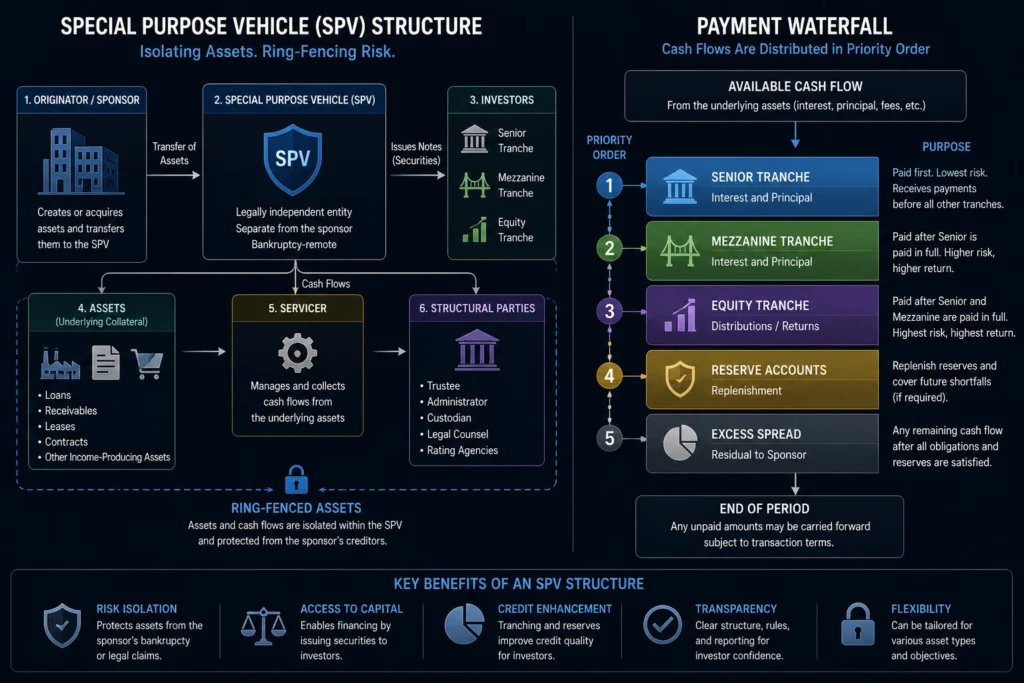
3. The Core Mechanism: The Special Purpose Vehicle (SPV)
To execute ABF, lenders use securitization. A company (the Originator) takes a large pool of assets—say, 50,000 residential solar loans—and legally moves them into a newly created, bankruptcy-remote shell company called a Special Purpose Vehicle (SPV). The private credit fund lends money directly to the SPV, secured solely by those 50,000 loans. If the Originator company goes bankrupt, the SPV is unaffected. The private credit fund still collects the solar loan payments directly from the homeowners.
4. Technical Depth: Tranching and The Waterfall
The cash generated by the SPV is divided into risk layers, or “tranches.” The private credit fund often buys the senior/mezzanine tranches. When cash flows in, it hits a contractual “waterfall.” The senior tranches get paid first, absorbing the least risk and taking the lowest yield. The equity tranche (usually held by the Originator) gets paid last, absorbing any defaults in the 50,000 solar loans. This structural buffer is why ABF is considered highly secure for the private lender.
5. Real-World Consequences: Capital Relief Trades (CRTs)
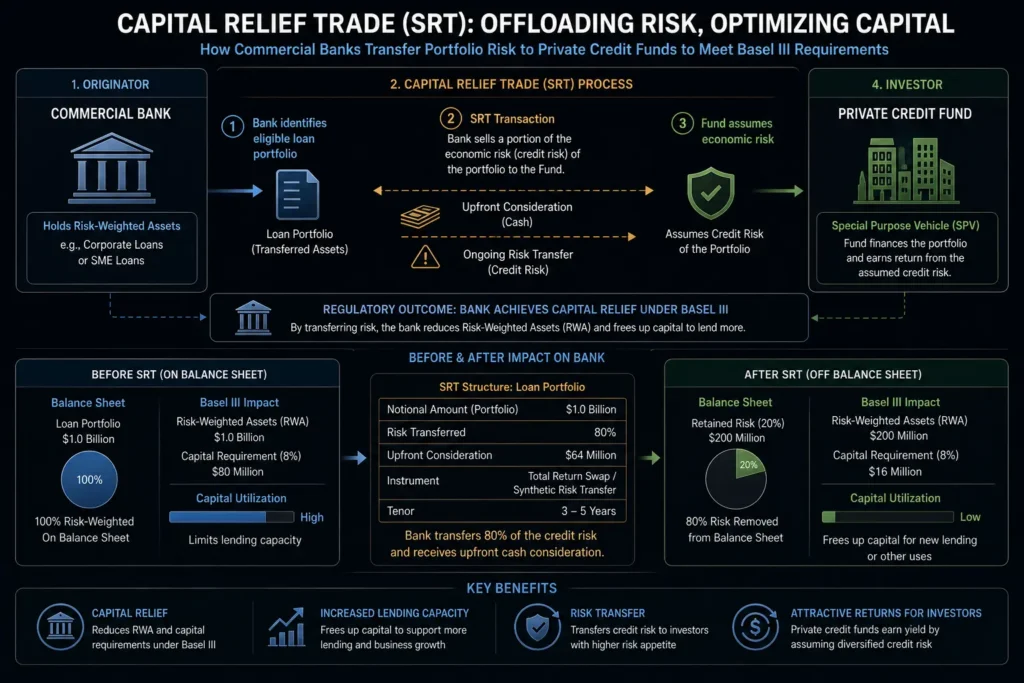
Banks exploit this SPV structure through Significant Risk Transfers (SRTs) or Capital Relief Trades. A bank puts a portfolio of auto loans into an SPV. Instead of selling the loans, the bank pays a private credit fund a high premium (e.g., 11% yield) to insure the “first-loss” equity tranche. Because the private credit fund is absorbing the risk of defaults, regulators allow the bank to lower its capital requirements. The bank frees up its balance sheet, and the private credit fund earns a massive yield without actually having to originate or service the auto loans.
ABF Infrastructure Financing: Data Centers and Aviation
The ABF pivot is aggressively funding the heaviest physical infrastructure of the modern economy.
Hyperscale AI Data Centers: Building a 100-megawatt data center for NVIDIA H100 GPU clusters costs upwards of $1 billion. Traditional banks will not lend a billion dollars to a single developer. Mega-funds like Blackstone and Ares execute ABF structures, creating an SPV that owns the physical data center real estate and the 15-year iron-clad lease agreement signed by Microsoft or Amazon. The private credit fund lends against the guaranteed cash flow of that lease, effectively treating the data center as a massive, high-yield bond.
Aviation and Fleet Leasing: Commercial airlines rarely own their airplanes. They lease them from massive holding companies. Private credit funds execute ABF transactions by lending against a diversified pool of 50 Boeing and Airbus aircraft. The collateral is mobile and globally liquid; if an airline in South America defaults on its lease, the SPV simply repossesses the aircraft and leases it to an airline in Europe, completely insulating the private lender from the initial default.
Esoteric Consumer Assets: ABF is expanding far beyond heavy industry into “esoteric” assets. Private funds are buying up the financing rights for music catalogs (collecting Spotify streaming royalties), medical equipment leases, consumer credit card receivables, and residential fiber-optic internet installations. By bundling thousands of these tiny, uncorrelated consumer payments into a single SPV, the funds manufacture synthetic, institutional-grade yield.
Economic & Strategic Impact
The ABF boom is triggering a massive wave of consolidation in the financial sector.
Alternative asset managers traditionally lacked the thousands of employees required to originate and service millions of small consumer loans. To fix this, private equity firms are simply buying the banks.
A prime example is Apollo Global Management. Apollo aggressively acquired specialized origination platforms, culminating in the acquisition of Credit Suisse’s Securitized Products Group (rebranded as ATLAS SP Partners). By bringing the originators in-house, mega-funds cut out the commercial banking middlemen entirely. They originate the loan, structure the SPV, and feed the high-yielding debt directly to their own affiliated insurance companies (like Apollo’s Athene). This closed-loop ecosystem allows private firms to capture every cent of profit across the lifecycle of the asset, fundamentally disrupting the legacy Wall Street banking model.
Advantages
- Downside Protection: Unlike corporate cash flow loans, ABF is backed by physical assets or diversified consumer pools. If the primary borrower fails, the collateral retains intrinsic value and can be liquidated.
- Uncorrelated Yields: The cash flows from an aircraft lease, a music catalog, and a residential solar array are not strictly correlated to corporate M&A cycles or broader stock market volatility.
- Massive Scalability: The total addressable market for hard assets and consumer finance dwarfs the corporate buyout market, allowing mega-funds to deploy $10 billion to $20 billion tranches of capital efficiently.
Limitations
- Operational Complexity: If a corporate loan defaults, you take over the company’s boardroom. If a consumer ABF pool defaults, you must legally repossess, store, and liquidate 10,000 used cars or 50,000 solar panels. Most private credit funds lack the physical logistics infrastructure to actually execute a mass repossession.
- Valuation Opacity: “Esoteric” assets (like music royalties or intellectual property) do not have highly liquid, transparent spot markets. Marking these assets to market during a recession relies heavily on subjective internal modeling (“mark-to-myth”), which can mask underlying portfolio distress.
- Regulatory Scrutiny: As private credit funds increasingly look and act like traditional banks (originating consumer loans), they are attracting intense scrutiny from global regulators who fear the shadow banking system is bypassing consumer protection laws.
Common Misconceptions
Misconception: ABF is the same thing as Asset-Based Lending (ABL).
Reality: ABL is typically a short-term, revolving credit line used by companies to manage daily working capital (e.g., borrowing against a warehouse full of unsold shoes). ABF is long-term, structural financing backed by massive, income-generating asset portfolios sequestered in bankruptcy-remote SPVs.
Misconception: Private credit only funds distressed or failing companies.
Reality: While distressed debt is a sub-sector of private credit, ABF is generally highly conservative. ABF lenders actively target “investment-grade” risk profiles, prioritizing stable, boring, contractual cash flows (like a 20-year data center lease) over high-risk corporate turnarounds.
Misconception: The banks are losing money because private credit is stealing their business.
Reality: The banks are highly complicit partners. Banks want private credit funds to buy the risk. By utilizing Capital Relief Trades, banks earn massive upfront fees for originating the loans and servicing the customers, while paying private credit funds to hold the actual risk, keeping regulators happy.
What Most People Miss
The strategic role of Affiliated Insurance Companies.
The true driving force behind the ABF explosion is not pension funds; it is life insurance. Over the last five years, giants like KKR (Global Atlantic), Apollo (Athene), and Blackstone have acquired massive life insurance and annuity companies.
Life insurance companies take in billions of dollars in premiums every month. They need safe, long-term, investment-grade assets that pay 6% to 8% to match the payouts they owe to retirees in twenty years. Standard corporate direct lending is too risky and too low-rated for insurance regulators. ABF—with its senior-secured tranches, physical collateral, and high credit ratings—is the absolute perfect asset for an insurance balance sheet. The mega-funds are aggressively originating ABF specifically to feed the insatiable yield appetite of their captive insurance subsidiaries.
Comparison Table
| Feature | Direct Lending (Corporate) | Asset-Backed Finance (ABF) | Traditional Bank Lending |
| Primary Repayment Source | Corporate EBITDA (Earnings) | Contractual Asset Cash Flows | Corporate Earnings & Deposits |
| Collateral | A pledge on the overall business | Specific, isolated physical/financial assets | Real Estate / Broad Liens |
| Structural Protection | Financial Covenants | SPVs and Tranche Waterfalls | Strict Underwriting / Collateral |
| Market Size Constraint | Saturated (Tied to M&A volume) | Massive ($5T+ TAM globally) | Constrained by Basel III capital rules |
| Asset Type | Mid-market companies | Data centers, aircraft, consumer loans | Mortgages, commercial paper |
Case Study
Situation: In 2023, following the collapse of Credit Suisse and the tightening of global capital regulations, legacy investment banks were forced to rapidly shed their securitized product portfolios to stabilize their balance sheets.
Challenge: The broader market needed an entity with the capital scale of a global bank, but without the regulatory capital constraints of the Basel III framework, to absorb billions of dollars in complex, asset-backed consumer and infrastructure loans.
Solution (The ATLAS SP Pivot): Apollo Global Management, leveraging its massive private capital reserves and affiliated insurance balance sheet (Athene), stepped in and acquired a massive portion of Credit Suisse’s Securitized Products Group. They rebranded the entity as ATLAS SP Partners, effectively establishing an unregulated, private securitization powerhouse.
Outcome: By bringing the origination and structuring expertise in-house, Apollo bypassed the traditional banking syndicate. ATLAS SP now actively originates and structures billions of dollars in ABF—from auto loans to heavy equipment leases—funneling the safest senior tranches directly to Athene to back retail annuities, and selling the higher-yielding mezzanine tranches to Apollo’s institutional private credit clients.
Lessons Learned: The ATLAS SP acquisition proved that alternative asset managers are no longer just “investors” relying on banks for deal flow. They have successfully vertically integrated the entire financial supply chain, proving that the future of complex asset securitization lies in the private markets, completely insulated from commercial banking regulations.
Future Outlook
Next 12–24 Months
The explosion of Significant Risk Transfers (SRTs). As the final rules of the Basel III Endgame force US and European banks to dramatically increase their Tier 1 capital ratios, banks will flood the market with SRTs. Private credit funds will deploy hundreds of billions of dollars over the next two years strictly to insure bank portfolios (auto loans, commercial real estate). This symbiotic “capital relief” arbitrage will be the fastest-growing sub-sector of the ABF market.
Next 3–5 Years
The institutionalization of Digital Infrastructure. The $1.5 trillion required to build the global AI data center and localized microgrid infrastructure cannot be funded by equity or traditional bank debt alone. ABF will become the standardized vehicle for digital infrastructure. We will see the creation of specialized “Compute-Backed” SPVs, where private credit funds lend directly against the future revenue contracts of GPU clusters, effectively treating raw computing power as a physical, securitized commodity.
Next 10 Years
The Retailization of Esoteric Collateral. By the mid-2030s, the underlying collateral of ABF will shift from heavy infrastructure to hyper-granular consumer data. Private credit funds will securitize micro-payments, from software-as-a-service (SaaS) subscription revenues to fractionalized intellectual property royalties. Through semi-liquid interval funds, everyday retail investors will be able to buy tranches of ABF, earning monthly dividends generated directly from the aggregated Spotify streams, Netflix subscriptions, and solar panel leases of the global consumer base.
Most Likely Scenario
The $2 trillion ABF market will double by the end of the decade, permanently eclipsing traditional corporate direct lending as the crown jewel of private credit. While a severe macroeconomic consumer recession will test the underwriting standards of esoteric and subprime auto tranches, the structural protections of the SPV waterfall will largely hold. Wall Street mega-funds will cement their status as the new “Shadow Central Banks,” dictating the cost of capital for the physical infrastructure of the 21st century.
Key Takeaways
- Asset-Backed Finance (ABF) is a private credit strategy that lends against diversified pools of physical or financial collateral, such as aircraft, data centers, and consumer loans.
- Unlike traditional direct lending, which relies on a company’s overall profitability (EBITDA), ABF relies on the contractual cash flows generated by the isolated assets themselves.
- To protect the lender, the assets are placed into bankruptcy-remote Special Purpose Vehicles (SPVs) and structured into tranches, offering massive downside protection.
- The ABF boom is heavily driven by new banking regulations (Basel III), which force traditional banks to shed risky loans and execute Capital Relief Trades with private credit funds.
- Mega-funds (Apollo, KKR) are aggressively expanding into ABF to generate the trillions of dollars in high-quality, investment-grade yield required by their affiliated life insurance companies.
- The primary risk in ABF lies in the operational complexity of repossessing and liquidating physical collateral (like thousands of residential solar panels) during a mass default event.
Glossary
Basel III Endgame: A sweeping set of international banking regulations that require commercial banks to hold significantly more capital in reserve against the loans they make, forcing them to lend less.
Capital Relief Trade / Significant Risk Transfer (SRT): A financial transaction where a bank pays a private credit fund to absorb the risk of default on a portfolio of loans, allowing the bank to lower its regulatory capital requirements.
Direct Lending: The traditional form of private credit, where a fund lends money directly to a mid-sized corporation, typically to fund a private equity buyout, relying on the company’s cash flow for repayment.
Securitization: The financial practice of pooling various types of contractual debt (like auto loans or mortgages) and selling them as consolidated, interest-bearing bonds to investors.
Special Purpose Vehicle (SPV): A subsidiary or shell company created specifically to isolate financial risk. If the parent company goes bankrupt, the assets inside the SPV are legally protected and cannot be seized by the parent’s creditors.
Tranche: A “slice” or portion of a pooled investment. Senior tranches get paid first and take the least risk, while equity (first-loss) tranches get paid last and absorb any defaults.
Frequently Asked Questions
Is Asset-Backed Finance just another word for subprime mortgages?
No. While residential mortgages can be part of ABF, the modern ABF market is vastly more diversified. Today’s private credit funds focus heavily on high-quality commercial assets like data centers, aviation fleets, railcars, and prime consumer credit, utilizing much stricter underwriting standards than the 2008 mortgage era.
If the borrower goes bankrupt, how does the lender get paid?
Because the loan is secured by the physical assets inside an SPV, the lender legally forecloses on the collateral. If an airline goes bankrupt, the private credit fund simply takes the airplanes back and leases them to a different, healthy airline to continue generating cash flow.
Why are insurance companies so involved in this?
Life insurance companies hold billions of dollars from consumer premiums and need safe, long-term investments that pay higher yields than government bonds. ABF is perfectly suited for this because it offers investment-grade safety (due to hard collateral) but pays a “private market premium,” making it the ideal asset for an insurance balance sheet.
How does ABF help build AI data centers?
Building a data center costs billions. Instead of issuing corporate stock or borrowing from a single bank, the developer creates an ABF structure. They use the 15-year lease signed by a major tech company (like Microsoft) as the collateral, allowing private credit funds to confidently lend the billions required for construction.
Can regular investors buy into ABF?
Historically, no. But today, massive asset managers are launching semi-liquid “Evergreen” funds and Business Development Companies (BDCs) specifically designed to allow high-net-worth retail investors to allocate money into these private asset-backed credit pools.
Sources
[1] KKR Insights: Asset-Based Finance: A $5 Trillion Opportunity (2025/2026 Macro Outlook)
[2] Apollo Global Management: The Replacement of Bank Balance Sheets and the Rise of SPVs (Investor Day Briefings 2026)
[3] Federal Reserve Board: Significant Risk Transfers and Capital Relief Trades in U.S. Banking (2025)
[4] PitchBook: Private Credit and the Pivot to Hard Assets (Q1 2026 Data Report)
[5] Bloomberg Financial: How Shadow Banking Swallowed the Real Economy