Advertisement
)

The genetic revolution promised humanity the ability to cure any inherited disease by simply turning off the broken code. Over the last twenty years, scientists successfully invented the tools—siRNA, antisense oligonucleotides, and CRISPR—to edit the very software of human life. But they immediately hit a devastating physical wall: the delivery problem.
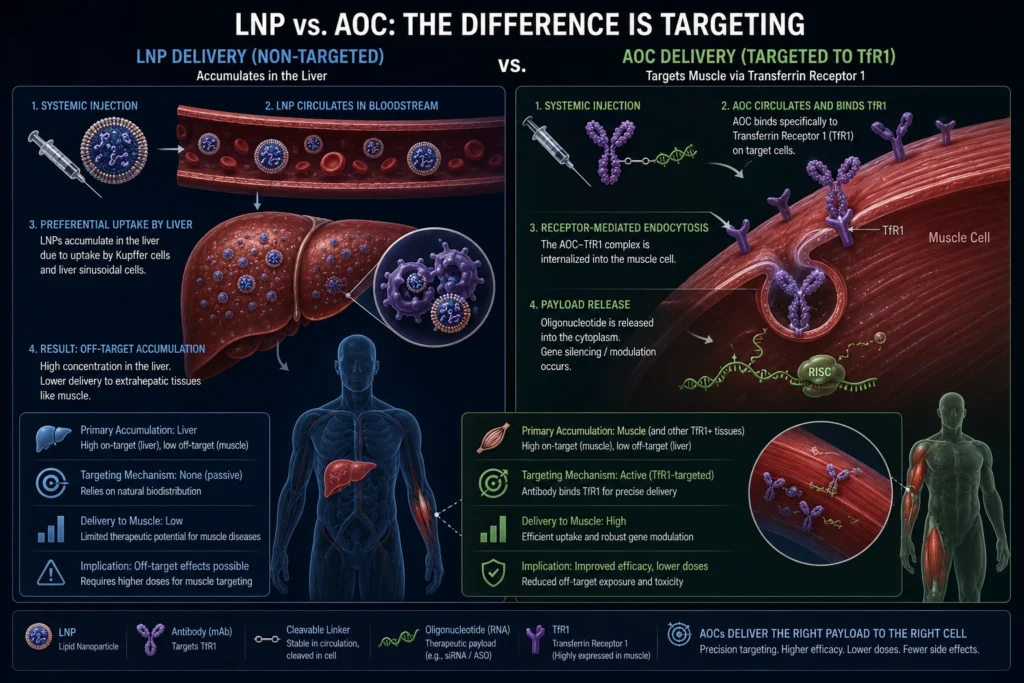
When you inject “naked” RNA into the human bloodstream, the body’s immune system treats it as a viral invader and shreds it in minutes. To protect the payload, scientists wrapped the RNA in microscopic fat bubbles called Lipid Nanoparticles (LNPs). However, these fat bubbles almost exclusively pile up in the liver. If a patient’s genetic disease is in their heart, their brain, or their skeletal muscle, the cure physically cannot reach it.
To solve this, scientists have stopped relying on blunt-force delivery. Instead, they are merging the targeting precision of cancer-hunting antibodies with the silencing power of genetic medicine to create Antibody-Oligonucleotide Conjugates (AOCs). By strapping an RNA payload to a guided biological missile, this technology bypasses the liver entirely. It hacks directly into the specific cells of the muscle or heart, delivering the cure exactly where it is needed. Understanding this mechanism is critical, as it unlocks the remaining 90 percent of the human body for genetic intervention.
What are Antibody-Oligonucleotide Conjugates (AOCs)?
Antibody-Oligonucleotide Conjugates (AOCs) are advanced biopharmaceuticals that combine a targeting monoclonal antibody with a genetic RNA payload, connected by a chemical linker. The antibody acts as a biological homing beacon, delivering the therapeutic oligonucleotide directly into specific, hard-to-reach cells (like muscle tissue) to treat severe genetic diseases.
At a Glance
- Concept: Marrying the localized targeting capabilities of immunology with the gene-editing capabilities of molecular biology into a single, three-part therapeutic molecule.
- Why it matters: 90 percent of the body’s tissues are “extra-hepatic” (outside the liver). AOCs crack open these untreatable markets, bringing viable RNA therapies to fatal neuromuscular and cardiac conditions.
- Who uses it: Cutting-edge biotech firms like Avidity Biosciences and Dyne Therapeutics, deeply partnered with legacy pharmaceutical giants looking to replenish their patent cliffs.
- Biggest takeaway: Having the genetic code to cure a disease is useless if you cannot deliver it to the right organ. AOCs prove that the future of biotechnology belongs to the engineers of the delivery vehicle, not just the editors of the DNA.
In Simple Words
Imagine a specialized SWAT team trying to deliver a crucial software update to a highly secure computer server located inside a specific building.
If they just throw the flash drive (the RNA) at the building, it shatters against the wall. If they put the flash drive in an armored truck (a Lipid Nanoparticle), the truck is incredibly safe, but it only knows how to drive to one specific address: the liver.
An Antibody-Oligonucleotide Conjugate (AOC) changes the strategy. It attaches the flash drive to a highly trained courier (the Monoclonal Antibody). This courier has the exact biometric key required to open the door to a completely different building—like a muscle cell. The courier travels through the bloodstream, ignores the liver, walks right up to the muscle cell, unlocks the door, and securely hands over the flash drive. The software update is installed, and the genetic disease is stopped at the source.
Why This Matters
The pharmaceutical industry has a pipeline problem. Dozens of highly effective RNA sequences sit idle in freezers because there is no way to deliver them to the Central Nervous System (CNS) or the heart without causing severe systemic toxicity.
For biotech investors, AOCs represent the unlocking of a massive Total Addressable Market (TAM). Duchenne Muscular Dystrophy (DMD) and Myotonic Dystrophy Type 1 (DM1) have historically been graveyards for drug development. By successfully demonstrating targeted, extra-hepatic delivery, AOC platforms transform these “undruggable” rare diseases into viable commercial pipelines. The company that establishes the dominant, patent-protected AOC platform will effectively act as the “Amazon Web Services of Biology”—renting out their delivery vehicle to any pharma company that needs to get an RNA payload into a specific human organ.
The Evolution from ADCs to AOCs
AOCs are the evolutionary child of Antibody-Drug Conjugates (ADCs).
In the 2010s, oncology was revolutionized by ADCs, which used antibodies to deliver highly toxic chemotherapy drugs directly into cancer cells, sparing healthy tissue. The AOC field applies this exact same structural logic to genetic medicine. Instead of delivering a dumb toxin, the antibody delivers smart code.
This structural crossover has drastically accelerated AOC development. Chemists are heavily leveraging the decades of data they gathered on linker chemistry and monoclonal antibody engineering from the oncology sector, allowing AOCs to rapidly bypass the typical multi-decade R&D lag that plagues entirely novel biological modalities.
How Antibody-Oligonucleotide Conjugates Work
Getting a large, negatively charged piece of RNA into a living, moving muscle cell requires biochemical manipulation at the atomic level. Here is the first-principles breakdown.
1. The Fundamental Problem: RNA Instability
Therapeutic oligonucleotides (short strands of synthetic RNA or DNA) are designed to silence or repair mutated genes. However, RNA is incredibly fragile. If injected naked into the bloodstream, enzymes called nucleases destroy it almost instantly. Furthermore, because RNA is a large, negatively charged molecule, it physically repels against the fatty, negatively charged protective membrane of a human cell.
2. The Insufficiency of Existing Solutions
To protect the RNA, scientists developed Lipid Nanoparticles (LNPs) and GalNAc conjugates. These work brilliantly, but they have a massive anatomical bias: they naturally accumulate and clear through the liver. If a patient has a muscular disease, their liver is perfectly healthy; it is their skeletal muscle that is dying. Liver-bound LNPs cannot effectively penetrate muscle tissue at safe, systemic doses.
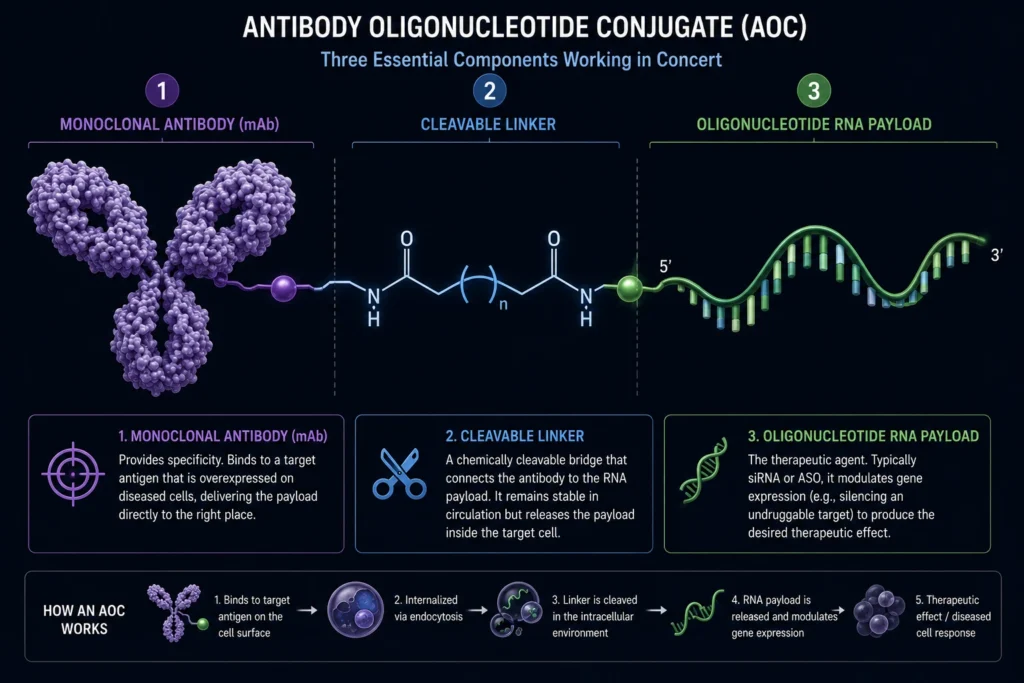
3. The Core Mechanism: The AOC Triad
To reach the muscle, scientists engineer a three-part biological vehicle:
- The Antibody (The Homing Beacon): A monoclonal antibody designed to perfectly attach to a specific receptor found predominantly on the surface of the target tissue.
- The Payload (The Warhead): The therapeutic RNA (like siRNA, ASO, or PMO) that will fix the genetic error.
- The Linker (The Tether): A highly specialized chemical chain that securely ties the RNA to the antibody while it travels through the hostile bloodstream.
4. Technical Depth: Receptor-Mediated Endocytosis
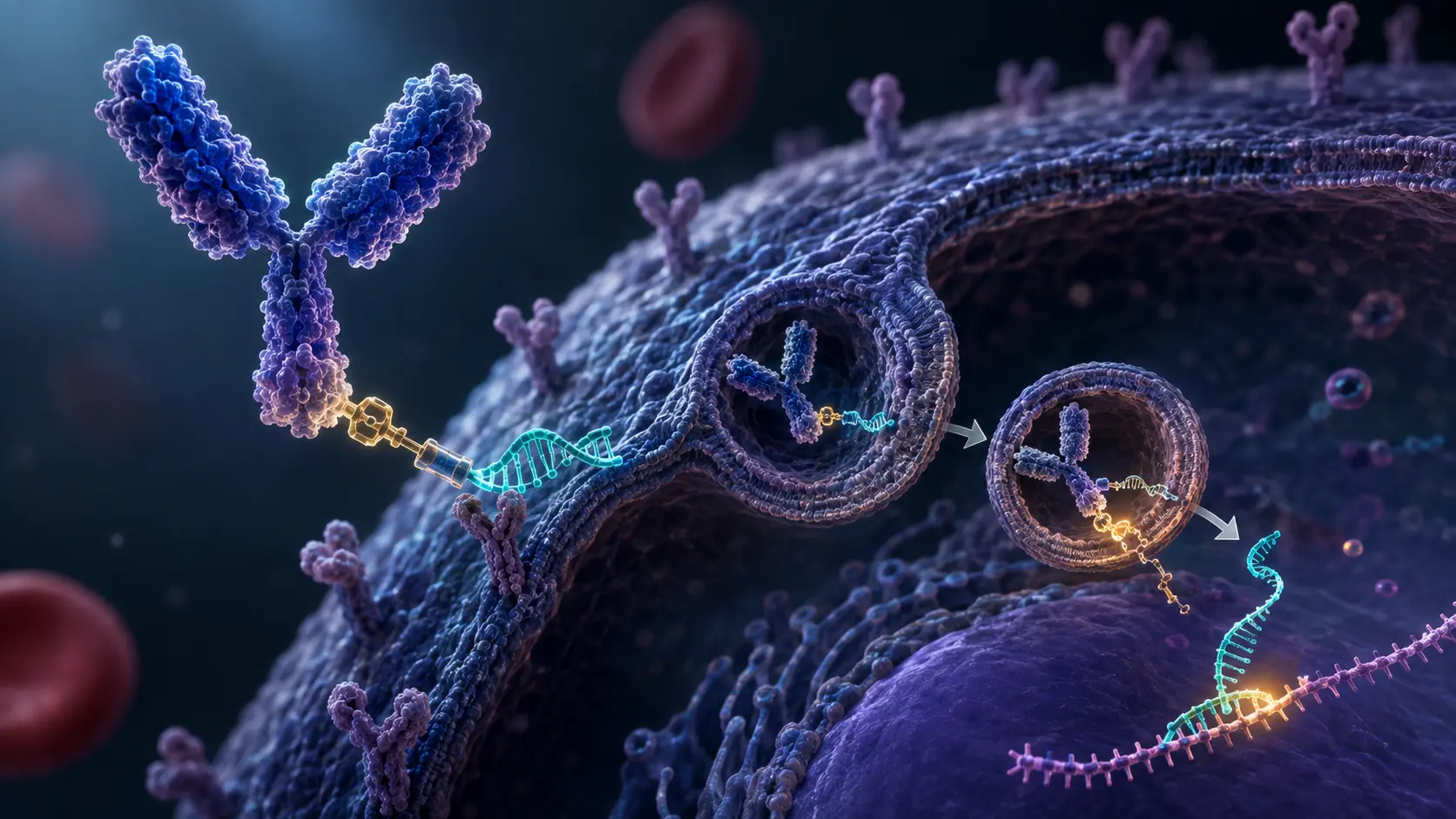
AOCs designed for muscle diseases heavily target Transferrin Receptor 1 (TfR1), a protein highly abundant on the surface of muscle cells. The antibody binds specifically to TfR1. The muscle cell, believing it is receiving necessary iron nutrients, swallows the entire AOC into a cellular stomach called an endosome. As the endosome becomes acidic, the chemical “linker” is triggered to cleave (break).
5. Real-World Consequences: Endosomal Escape and Gene Silencing
Once the linker breaks, the RNA payload executes “endosomal escape,” breaking out of the cellular stomach and entering the cytoplasm or nucleus of the cell. There, the RNA binds directly to the patient’s mutated mRNA, acting like a pair of biological scissors to halt the production of toxic proteins. By hacking the TfR1 receptor, AOCs achieve unprecedented picomolar potency in muscle tissue without overwhelming the liver.
AOCs Treating Muscular Dystrophy (DM1 & DMD)
The theoretical promise of targeted RNA delivery is currently rewriting clinical guidelines for the most devastating rare diseases.
Myotonic Dystrophy Type 1 (DM1): DM1 is a fatal, progressive muscle-wasting disease caused by a toxic accumulation of mutated mRNA that traps essential cellular proteins. AOC platforms have successfully targeted the muscle tissue of DM1 patients to deliver siRNA payloads. These payloads seek out and destroy the toxic mRNA, freeing the trapped proteins and restoring normal muscle function—a feat considered physically impossible just five years ago.
Duchenne Muscular Dystrophy (DMD): DMD is caused by a genetic mutation that prevents the body from producing dystrophin, a crucial muscle-protecting protein. Traditional therapies used phosphorodiamidate morpholino oligomers (PMOs) to “skip” the mutation, but the PMOs couldn’t penetrate the muscle effectively. By attaching the PMO to a TfR1-targeting antibody, AOCs deliver vastly higher concentrations of the drug directly into the skeletal and cardiac muscle, resulting in significantly higher, life-saving dystrophin production.
Expanding to the Central Nervous System (CNS): While muscle targeting dominates the 2026 landscape, the next frontier is crossing the Blood-Brain Barrier (BBB). Researchers are actively designing AOCs with specialized antibodies that bind to the insulin receptor on the BBB. By hacking this receptor, the AOC ferries genetic cures directly into the brain to treat neurodegenerative diseases like Huntington’s, Alzheimer’s, and ALS.
Economic & Strategic Impact
The clinical validation of AOCs has triggered an aggressive restructuring of Big Pharma pipelines.
Legacy pharmaceutical companies possess massive libraries of proprietary RNA sequences, but lack the extra-hepatic delivery mechanisms to commercialize them. As a result, companies like Eli Lilly, Bristol Myers Squibb, and Novartis are spending billions in upfront milestone payments to license proprietary AOC linker-and-antibody platforms from nimble biotech startups.
This licensing dynamic creates highly lucrative, recurring revenue streams for AOC platform developers. Because the antibody and the linker remain exactly the same, a biotech company can simply swap out the RNA “payload” to target a completely different disease. This “plug-and-play” modularity drastically reduces the R&D costs for subsequent drugs, allowing AOC companies to scale their clinical pipelines significantly faster than traditional small-molecule pharmaceutical companies.
Advantages
- Extra-Hepatic Delivery: Successfully delivers potent genetic medicines to skeletal muscle, heart, and immunology targets, completely breaking the liver delivery bottleneck.
- Highly Targeted Modularity: Reduces systemic toxicity by ensuring the RNA payload is only absorbed by specific cells, leaving healthy, non-targeted organs completely unaffected.
- Extended Half-Life: Monoclonal antibodies have a naturally long half-life in the bloodstream (often weeks). By tethering RNA to an antibody, the therapy stays in the body vastly longer than naked RNA, requiring fewer injections for the patient.
Limitations
- The Endosomal Escape Bottleneck: Getting the AOC inside the cell is only step one. A significant portion of the RNA payload often remains trapped inside the endosome and is degraded before it can reach the cytoplasm, requiring higher doses to achieve clinical efficacy.
- Immunogenicity Risks: Injecting large, synthetic antibodies combined with foreign RNA carries a risk of the patient’s immune system creating Anti-Drug Antibodies (ADAs). Over time, ADAs can neutralize the AOC, rendering the life-saving treatment useless.
- Extreme Manufacturing Costs: Manufacturing an AOC requires brewing complex monoclonal antibodies in large bioreactors, synthesizing precise chemical linkers, and printing synthetic RNA, then perfectly combining all three. The biomanufacturing complexity drives the cost of goods sold (COGS) to extreme heights.
Common Misconceptions
Misconception: AOCs are the same thing as Antibody-Drug Conjugates (ADCs).
Reality: They share structural DNA, but their purposes are opposite. ADCs carry toxic chemotherapy meant to physically kill the cell they enter (used in cancer). AOCs carry genetic RNA meant to repair or alter the cell they enter, without killing it.
Misconception: Lipid Nanoparticles (LNPs) are obsolete now.
Reality: LNPs remain the absolute gold standard for liver-targeted diseases and vaccines (like the COVID-19 mRNA vaccines) because of their massive payload capacity. AOCs simply exist to treat the organs that LNPs cannot easily reach.
Misconception: The AOC permanently edits the patient’s DNA.
Reality: Most AOCs currently in clinical trials use siRNA or PMOs, which target the messenger RNA (mRNA) floating in the cytoplasm. They do not enter the nucleus or alter the underlying DNA genome. If the patient stops taking the AOC, the disease symptoms will eventually return.
What Most People Miss
The hidden engineering war over Linker Chemistry.
While the antibody and the RNA get all the media attention, the chemical “linker” that connects them is the true linchpin of the technology.
If the linker is too weak, the RNA snaps off in the bloodstream, gets shredded by nucleases, and causes severe off-target toxicity. If the linker is too strong, the AOC successfully enters the target muscle cell, but refuses to release the RNA payload, rendering the drug totally inert. What most people miss is that the intellectual property battles in the AOC sector are fiercely fought over proprietary, “cleavable” linker designs that strike the exact, microscopic balance between stability in the blood and rapid release inside the cell.
Comparison Table
| Feature | Naked RNA | Lipid Nanoparticles (LNPs) | Antibody-Oligonucleotide Conjugates (AOCs) |
| Delivery Vehicle | None | Lipid (Fat) Bubble | Monoclonal Antibody |
| Primary Target Tissue | Localized (Eye/Spine injections) | Liver (Hepatic) | Muscle, Heart, CNS (Extra-Hepatic) |
| Cellular Entry Method | Poor / Passive | Membrane Fusion | Receptor-Mediated Endocytosis |
| Payload Capacity | Very Low | Massive (Can carry long mRNA) | Targeted (siRNA, ASOs, PMOs) |
| Systemic Toxicity Risk | High (Degraded quickly) | Moderate (Liver accumulation) | Low (Highly targeted) |
Case Study
Situation: Duchenne Muscular Dystrophy (DMD) is a fatal genetic disease resulting in the severe loss of muscle function. While researchers developed highly effective PMO (oligonucleotide) therapies capable of skipping the faulty genetic mutation to restore muscle protein production, injecting the PMOs natively resulted in tragically low absorption rates into the actual skeletal and cardiac muscle.
Challenge: Delivering a high enough concentration of the PMO into the muscle cell to halt the disease without pushing the dosage so high that it caused severe kidney toxicity.
Solution (The AOC Platform): Companies like Dyne Therapeutics and Avidity Biosciences pivoted from native delivery to the AOC architecture. By covalently linking the PMO payload to an antibody designed to hunt down and bind to Transferrin Receptor 1 (TfR1), they turned the muscle cell’s natural iron-uptake mechanism into a drug-delivery Trojan horse.
Outcome: The clinical data marked a paradigm shift in neuromuscular medicine. The AOCs achieved unprecedented concentrations of the PMO in skeletal muscle, driving dystrophin protein production to levels significantly higher than legacy, un-conjugated therapies, fundamentally altering the disease trajectory for DMD patients in Phase I/II trials.
Lessons Learned: The case study proved that extra-hepatic delivery was no longer a theoretical barrier. It validated that hacking cell-surface receptors using monoclonal antibodies is the definitive pathway to unlocking the systemic delivery of genetic medicine to the broader human anatomy.
Future Outlook
Next 12–24 Months
The phase of Pivotal Clinical Readouts. The late 2020s are defined by Phase III clinical trial data. The industry will closely monitor the long-term safety profiles of leading AOCs treating DM1 and DMD, specifically watching for immunogenicity (the development of ADAs) over repeated 12-month dosing cycles. Regulatory approvals in this window will transition AOCs from a promising platform into a commercialized, revenue-generating standard of care for neuromuscular diseases.
Next 3–5 Years
The expansion into Cardiology and Precision Oncology. Once the safety of the linker platform is fully validated in muscle, the aperture will widen dramatically. Companies will swap the muscle-targeting antibodies for antibodies that target the myocardium to treat severe genetic cardiomyopathies. Concurrently, AOCs will be deployed in oncology to deliver siRNA that knocks down specific drug-resistance genes inside solid tumors, resensitizing the cancer to traditional chemotherapy.
Next 10 Years
The delivery of CRISPR and Gene Editors. Currently, AOCs primarily deliver small, transient RNA (like siRNA) to silence genes temporarily. By the 2030s, advancements in linker capacity and antibody engineering will allow AOCs to act as the primary delivery vehicles for massive CRISPR-Cas9 complexes and base editors. This will allow doctors to dispatch guided biological vehicles to specific organs to permanently rewrite the patient’s DNA, offering single-dose, lifelong cures for systemic genetic disorders.
Most Likely Scenario
AOCs will not replace LNPs; rather, the two modalities will bifurcate the market. LNPs will maintain absolute dominance over vaccines and liver-targeted therapies due to their massive payload capacity and lower manufacturing costs. However, AOCs will permanently monopolize the multi-billion-dollar markets for neuromuscular, cardiac, and eventually central nervous system genetic therapies, serving as the undisputed biological couriers of the precision medicine era.
Key Takeaways
- Antibody-Oligonucleotide Conjugates (AOCs) solve the delivery bottleneck of genetic medicine by combining the targeting precision of antibodies with the curative power of RNA.
- Traditional RNA delivery systems, like Lipid Nanoparticles (LNPs), naturally accumulate in the liver, rendering them largely ineffective for treating diseases in the muscle or heart.
- AOCs consist of three parts: a monoclonal antibody (the homing beacon), an oligonucleotide (the RNA payload), and a proprietary chemical linker (the tether).
- By targeting specific receptors (like TfR1) on the surface of muscle cells, AOCs trick the cell into swallowing the RNA payload in a process called receptor-mediated endocytosis.
- The technology is currently revolutionizing the treatment landscape for fatal neuromuscular diseases like Myotonic Dystrophy Type 1 (DM1) and Duchenne Muscular Dystrophy (DMD).
- The primary engineering battleground in the AOC industry revolves around designing proprietary “cleavable linkers” that survive the bloodstream but reliably release the RNA inside the target cell.
Glossary
Antisense Oligonucleotide (ASO): A short, synthetic strand of nucleic acids designed to bind to a specific messenger RNA (mRNA) to alter how a protein is produced.
Endosomal Escape: The critical, highly difficult process where a drug breaks out of the cell’s internal transport bubble (the endosome) and enters the cellular fluid to do its job.
GalNAc Conjugate: A highly successful, first-generation delivery technology that attaches a sugar molecule to RNA to deliver it specifically, and exclusively, to the liver.
Lipid Nanoparticle (LNP): A microscopic bubble of fat used to protect and deliver RNA (famously used in COVID-19 mRNA vaccines) which naturally accumulates in the liver.
Monoclonal Antibody (mAb): A laboratory-produced protein engineered to bind perfectly to one specific substance or receptor in the body, acting as a highly precise homing beacon.
Receptor-Mediated Endocytosis: A biological process where a cell absorbs a molecule from the outside only after the molecule has securely bound to a specific receptor on the cell’s surface.
siRNA (Small Interfering RNA): A class of double-stranded RNA molecules that operate within the cell to intercept and destroy specific, disease-causing messenger RNA before it can create toxic proteins.
Frequently Asked Questions
Why can’t we just put the RNA in a pill?
RNA is incredibly fragile and large. If you swallow it in a pill, the harsh acids and enzymes in your stomach and digestive tract will completely destroy it long before it ever reaches your bloodstream. It must be protected and injected systemically.
Does an AOC edit my DNA?
No. Most AOCs currently deliver siRNA or PMOs, which target messenger RNA (mRNA)—the temporary instruction manuals floating around the cell. They do not enter the nucleus of your cell and do not permanently alter your underlying DNA.
If the liver absorbs LNPs, why is that a bad thing?
It is a great thing if the disease you are trying to cure is located in the liver. However, if you are trying to cure a disease in the bicep or the heart, the liver acts as a giant sponge, soaking up the medicine and preventing it from reaching the actual tissues that need it.
Are AOCs a one-time cure?
No. Because they target temporary mRNA rather than editing the permanent DNA, the therapeutic effects wear off over time as the cell naturally clears the RNA. Patients require ongoing, periodic infusions to keep the disease suppressed.
Why are these treatments so expensive?
Manufacturing AOCs requires three highly complex, distinct manufacturing supply chains: brewing custom antibodies in living cell cultures, chemically synthesizing RNA, and engineering proprietary chemical linkers. Combining them perfectly at scale results in incredibly high manufacturing and quality-control costs.
Sources
[1] Nature Reviews Drug Discovery: Antibody-oligonucleotide conjugates as therapeutic agents (2024/2026 Updates)
[2] Avidity Biosciences: AOC Platform and Clinical Pipeline Data for DM1 and DMD (2025/2026 Clinical Briefs)
[3] Dyne Therapeutics: The FORCE Platform: Engineering extra-hepatic delivery for muscle diseases
[4] Molecular Therapy: Receptor-mediated endocytosis and endosomal escape of oligonucleotide therapeutics
[5] Bioconjugate Chemistry: Advancements in cleavable linker technology for systemic delivery