Advertisement
)
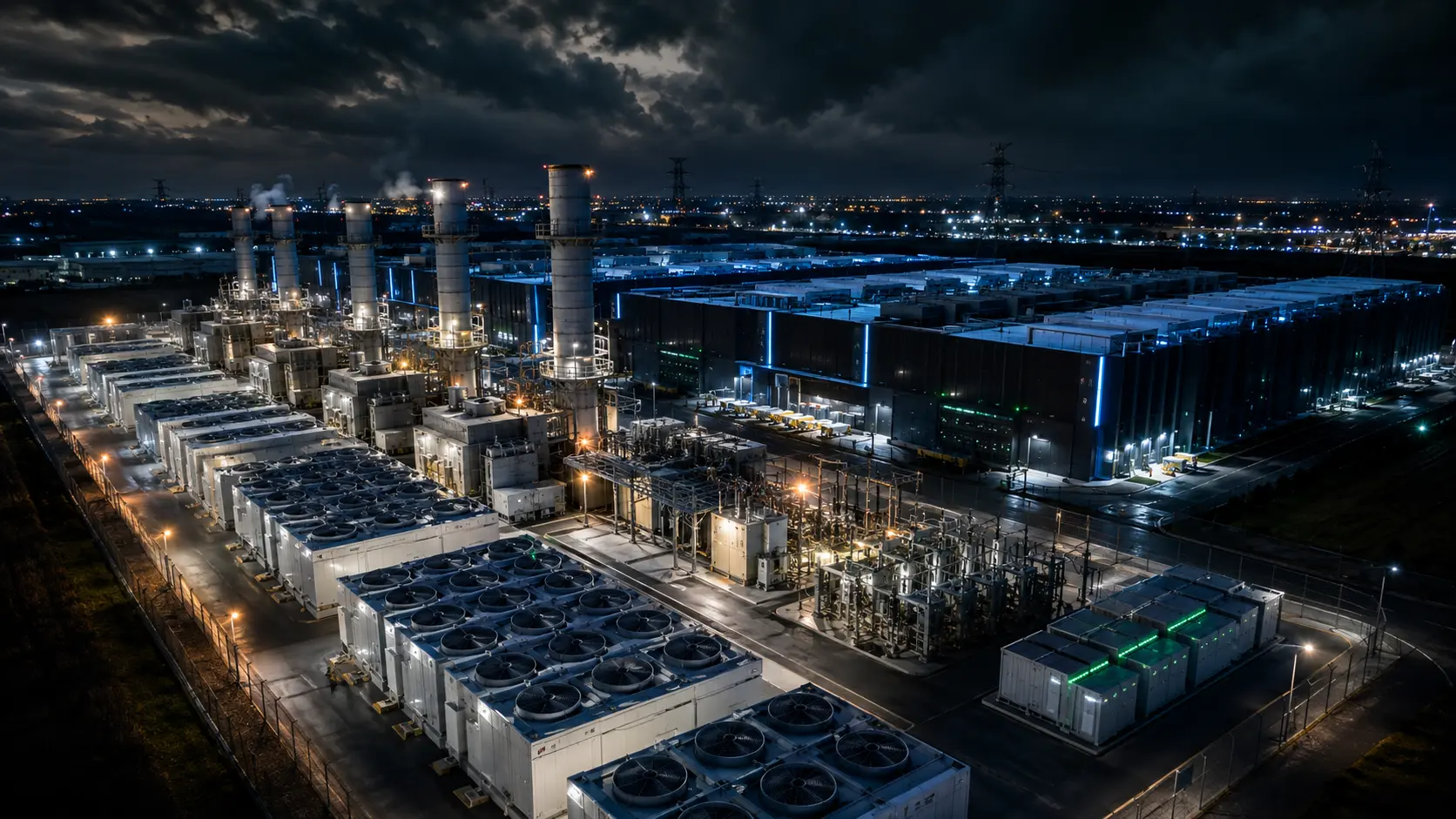

In Northern Virginia, the undisputed data center capital of the world, if a technology company asks the local utility for a new 100-megawatt connection today, they are routinely handed an estimated completion date stretching past 2030. The United States power grid is functionally exhausted. The transmission wires are full, the transformers are tapped out, and the regulatory queue to build new high-voltage lines is paralyzed by years of bureaucratic friction.
But the artificial intelligence arms race cannot wait four years. An idle $2 billion cluster of NVIDIA GPUs waiting for a utility connection is a catastrophic destruction of capital. To survive, the world’s largest hyperscalers—Amazon, Microsoft, Google—are executing a ruthless bypass maneuver. They have stopped acting merely as software companies and are rapidly becoming independent power producers. By building massive, localized “microgrids” powered by natural gas, fuel cells, and advanced battery arrays, they are generating their own electricity directly on-site. Why should you care right now? Because the ability to sever ties with the macro-grid and run a data center autonomously in “island mode” is no longer just a backup plan; it is the ultimate strategic weapon in the race for AI supremacy.
What are Data Center Microgrids?
Data center microgrids are localized, self-contained electrical networks that generate their own power on-site using natural gas, fuel cells, or renewables. Equipped with advanced controllers, these systems can operate in “island mode,” completely disconnecting from the municipal utility grid to bypass multi-year transmission delays and ensure uninterrupted power for artificial intelligence clusters.
At a Glance
- Concept: Building a private power plant directly “Behind-the-Meter” (BTM) at a data center, capable of running continuously without relying on the public utility grid.
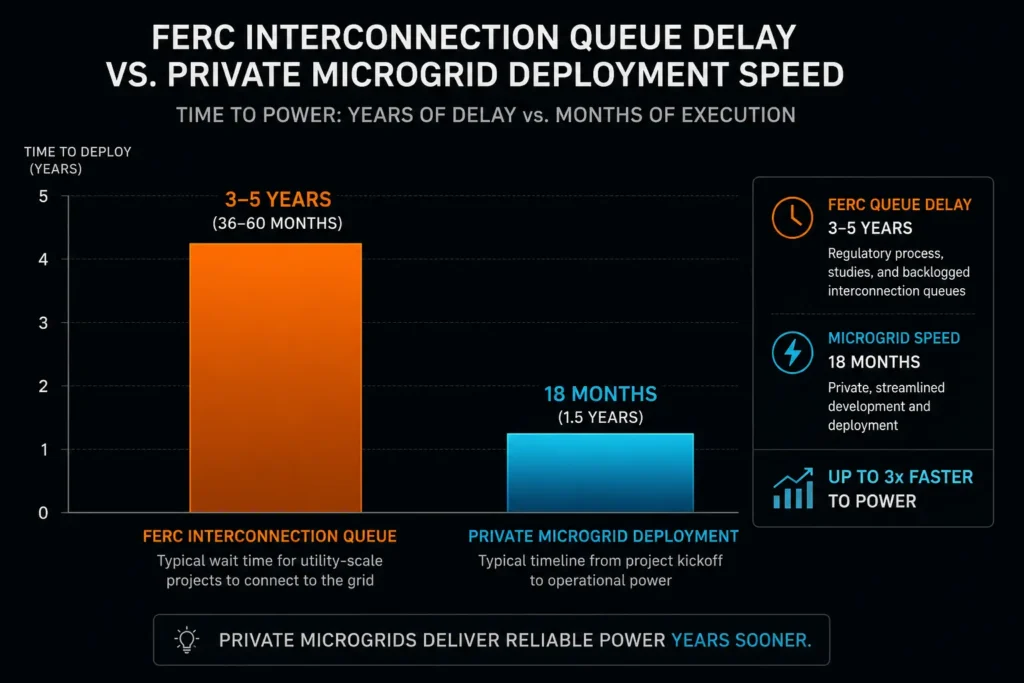
- Why it matters: The Federal Energy Regulatory Commission (FERC) interconnection queue is heavily bottlenecked. Tech giants are losing the AI race if they wait for municipal power. Building a private microgrid costs millions upfront, but it allows a data center to turn on 36 months faster than waiting for the utility.
- Who uses it: Hyperscale cloud providers (AWS, Azure), specialized AI colocation operators (CoreWeave, Switch), and elite industrial power hardware manufacturers (Bloom Energy, Schneider Electric).
- Biggest takeaway: This creates a fierce conflict with corporate climate goals. To get power today, tech companies are heavily relying on natural gas turbines and fuel cells, temporarily abandoning their zero-carbon pledges in exchange for immediate speed-to-market.
In Simple Words
Imagine you buy a massive new house, but the city tells you it will take four years to connect it to the municipal water supply. You can’t live there without water. So, instead of waiting, you hire a drilling company to dig a massive, deep-water well directly in your backyard and install a heavy-duty filtration system.
The public power grid is like that municipal water supply. It is completely backed up.
A Data Center Microgrid is the backyard well. Instead of waiting for the city to build new high-voltage power lines to their facility, tech companies are building their own private power plants right next to their servers. They bring in natural gas pipes, install giant fuel cells and battery banks, and use software to manage the electricity themselves.
When a data center is running entirely on its own self-generated power without touching the city’s power lines, it is operating in “Island Mode.” It is completely self-sufficient, meaning a blackout in the city won’t even make the servers blink.
Why This Matters
The economics of artificial intelligence heavily punish delays.
If a data center developer is sitting on a massive, fully built 50-megawatt facility, the opportunity cost of waiting three years for a grid connection is devastating. A modern AI colocation lease can generate hundreds of millions of dollars in revenue annually.
For developers and infrastructure investors, the math is now decisively tilted toward microgrids. Yes, buying 50 megawatts worth of solid-oxide fuel cells and natural gas generators requires a massive upfront Capital Expenditure (CapEx). However, if that CapEx allows the facility to secure an AI tenant 36 months early, the microgrid pays for itself almost immediately. This realization has triggered an absolute explosion in “Behind-The-Meter” (BTM) energy generation, fundamentally altering how industrial real estate is valued and developed.
The FERC Interconnection Queue Bottleneck
The Federal Energy Regulatory Commission (FERC) interconnection queue is currently the single largest bottleneck to the U.S. economy.
As of late 2025, there were over 2,000 gigawatts of energy generation and storage projects sitting in the queue, waiting for permission to connect to the grid. In prime data center corridors, like the PJM Interconnection (which serves Virginia), the regional transmission organizations (RTOs) simply do not have the high-voltage wires to support the massive load requests of AI hyperscalers.
By building microgrids, tech companies are exploiting a regulatory loophole. If a facility generates its own power “Behind-the-Meter” (meaning on the data center’s side of the utility connection) and does not attempt to sell power back to the city, they largely bypass the FERC interconnection queue. This shifts power generation from a public, regulated utility monopoly into the hands of private, unregulated Silicon Valley corporations.
How Data Center Microgrids Work
Building a private power plant capable of supporting an AI supercomputer requires massive industrial engineering. Here is the first-principles breakdown.
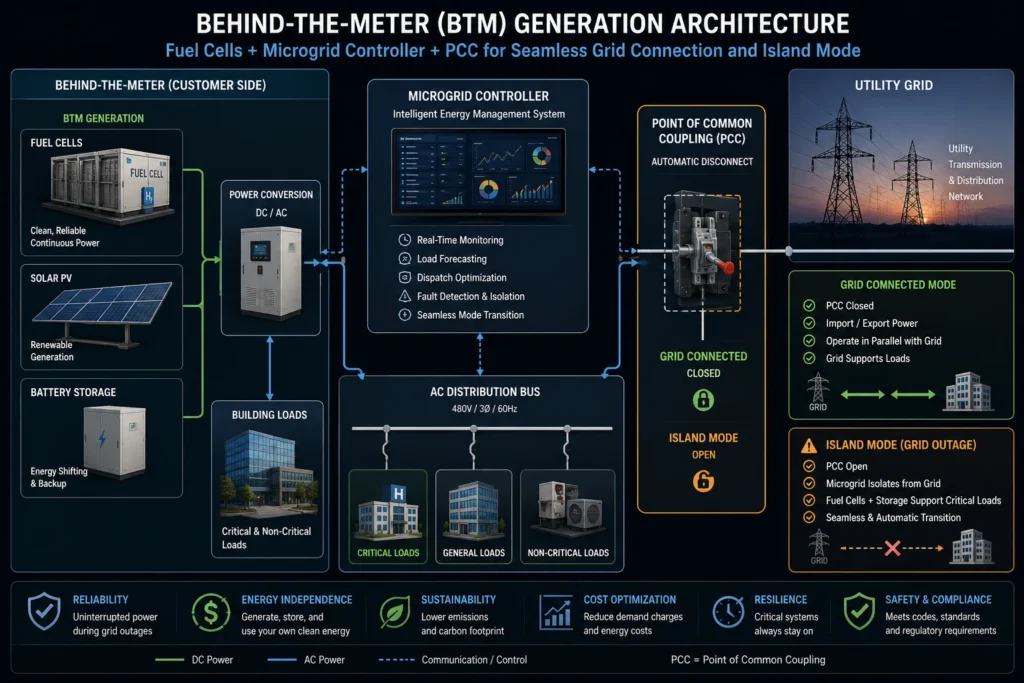
1. The Fundamental Problem: The Interconnection Queue
To pull 100 megawatts from a city, the utility must build a specialized, high-voltage substation. Because the utility is heavily regulated, it cannot just build a substation tomorrow. It must conduct years of impact studies, environmental reviews, and secure supply chains for massive transformers (which currently have a 3-year lead time). This results in unacceptable 3-to-5-year delays for the data center.
2. The Insufficiency of Traditional Backup Generators
Historically, data centers used massive diesel generators for power. But these were strictly for backup. Environmental Protection Agency (EPA) regulations legally restrict these generators from running for more than a few hundred hours a year due to extreme air pollution. A data center cannot legally or physically use diesel generators to run the facility 24/7 as a baseload power source.
3. The Core Mechanism: Behind-The-Meter (BTM) Generation
To run 24/7, the data center must build clean, continuous BTM generation. The most popular 2026 solution is the Solid-Oxide Fuel Cell (e.g., Bloom Energy servers). These devices pull natural gas from an existing municipal gas pipeline. Inside the fuel cell, a chemical reaction between the natural gas and oxygen creates continuous electricity without combustion, producing significantly lower emissions than a diesel generator and allowing it to run legally 24/7.
4. Technical Depth: The Microgrid Controller
A massive data center cannot rely on a single power source. It will have fuel cells, a 20-megawatt solar array on the roof, a massive Lithium-Ion Battery Energy Storage System (BESS), and a minor connection to the utility grid.
The “brain” of the operation is the Microgrid Controller. This software constantly monitors the energy mix. If a cloud covers the solar panels, the controller instantly discharges the batteries to cover the voltage dip while simultaneously commanding the natural gas fuel cells to ramp up their output, perfectly balancing the load in milliseconds so the AI servers never lose power.
5. Real-World Consequences: “Island Mode”
The ultimate capability of this system is Island Mode. If the city grid suffers a massive blackout, or if the city grid is simply too congested to provide power, the Microgrid Controller physically flips a massive mechanical switch (the Point of Common Coupling). The data center is now electrically severed from the outside world. It operates entirely as an autonomous “island,” generating, balancing, and consuming its own power indefinitely.
Hyperscaler Microgrid Deployments
The pivot to self-generation is actively playing out across the largest corporate campuses in the world.
Microsoft and Fuel Cell Pilots: Microsoft has explicitly acknowledged that the grid cannot support its AI ambitions. In recent years, they have aggressively piloted the use of hydrogen and natural gas fuel cells to power server racks directly, completely bypassing traditional diesel backup generators. By embedding natural gas fuel cells directly into the data center design, they are preparing their architecture to eventually swap natural gas for green hydrogen once the pipeline infrastructure matures.
Amazon’s Nuclear Acquisition: The ultimate form of “Behind-The-Meter” generation is a literal nuclear reactor. In 2024, AWS purchased the Cumulus data center campus located directly adjacent to Talen Energy’s 2.5-gigawatt Susquehanna nuclear power plant in Pennsylvania. AWS secured an agreement to pull up to 960 megawatts of power directly from the nuclear plant, bypassing the regional transmission grid entirely to secure massive, zero-carbon baseload power.
The Hybrid “Microgrid-as-a-Service” Model: Mid-tier data center operators who cannot afford a nuclear plant are signing massive contracts with energy-as-a-service providers. Companies like Schneider Electric and Enchanted Rock build, own, and operate the natural gas microgrid on the data center’s property. The data center developer avoids the massive upfront CapEx and simply signs a 20-year Power Purchase Agreement (PPA) to buy the electricity generated in their own backyard.
Economic & Strategic Impact
The microgrid pivot is forcing hyperscalers into a severe collision with their own corporate ESG (Environmental, Social, and Governance) mandates.
Tech giants have promised their shareholders and the public that they will be “carbon negative” or “100% renewable” by 2030. However, you cannot run a 100-megawatt baseload microgrid in Ohio using only solar panels and batteries—it is mathematically and physically impossible. True baseload power requires thermal generation. Consequently, these microgrids are currently overwhelmingly powered by natural gas.
To bridge this cognitive dissonance, hyperscalers are utilizing aggressive “greenwashing” strategies. They purchase Virtual Power Purchase Agreements (VPPAs) or unbundled Renewable Energy Certificates (RECs) from wind farms in Texas to “offset” the carbon they are actively burning in their natural gas microgrids in Virginia. This strategy is drawing intense scrutiny from regulators and investors who argue that accounting offsets do not erase the physical reality of building new fossil-fuel infrastructure to power AI.
Advantages
- Speed to Market: Bypasses the 3-to-5-year FERC interconnection queue, allowing data centers to become operational and generate revenue years ahead of schedule.
- Absolute Reliability: The macro-grid is highly vulnerable to extreme weather (e.g., Texas Winter Storm Uri) and cyberattacks. An “islanded” microgrid ensures uptime through physical and digital isolation.
- Grid Interactivity (Future Revenue): Once the data center is finally connected to the macro-grid, the microgrid can generate revenue. During peak summer heatwaves, the data center can sell its excess self-generated power back to the city at massive premium rates.
Limitations
- Astronomical CapEx: Building a 50-megawatt power plant on-site easily adds tens of millions of dollars to the construction budget of the data center.
- The Carbon Conflict: Heavy reliance on natural gas generators directly violates corporate net-zero pledges. Transitioning these turbines to run on 100% green hydrogen is years away from being economically viable.
- Fuel Supply Logistics: Running a natural gas power plant requires access to high-capacity, high-pressure interstate gas pipelines. If the data center is not located near a major gas main, “island mode” is physically impossible.
Common Misconceptions
Misconception: Microgrids are just a new word for backup diesel generators.
Reality: Diesel generators are legally barred from running continuously; they are purely for emergencies. A microgrid acts as the primary baseload power source, running 24/7/365, utilizing cleaner fuels (natural gas/fuel cells) and complex software to balance loads.
Misconception: Data centers can run on 100% solar and batteries if they build a microgrid.
Reality: An AI data center requires massive, constant power. A solar farm large enough to power a 100-megawatt data center, plus the batteries to run it through the night, would require thousands of acres of land, making it impossible to build in prime data center corridors like Ashburn, Virginia or Santa Clara, California.
Misconception: The utility companies hate data center microgrids.
Reality: Many utilities actually support them. The municipal grid is stretched to its breaking point. When a data center builds its own power plant, it relieves the utility of the impossible burden of finding an extra 100 megawatts on an already failing local grid.
What Most People Miss
The role of Small Modular Reactors (SMRs) as the endgame.
Natural gas is merely the bridge. The true endgame for the “island mode” data center is localized nuclear power.
Companies like NuScale and TerraPower are developing Small Modular Reactors—miniature nuclear plants that can generate 50 to 300 megawatts. They are designed to be factory-built and shipped to the site on trucks. What most people miss is that data center developers are actively acquiring massive tracts of land today with the specific, long-term intent of eventually dropping an SMR on the property. By the mid-2030s, the ultimate data center microgrid will be a completely off-grid, zero-carbon, nuclear-powered fortress.
Comparison Table
| Feature | Municipal Macro-Grid | Traditional Backup (Diesel) | “Island Mode” Microgrid |
| Primary Function | Baseload power | Emergency power (48 hours max) | Baseload power (24/7/365) |
| Speed to Deployment | 3 to 5+ Years (FERC queue) | Months (If grid is already connected) | 12 to 18 Months (Bypasses queue) |
| Primary Power Source | Mixed (Coal, Gas, Nuclear, Solar) | Diesel Combustion | Natural Gas Fuel Cells / Turbines |
| Carbon Profile | Variable | Extremely High (Particulate heavy) | Moderate (Natural Gas) -> Target: Hydrogen |
| Control Architecture | Regulated Utility Monopoly | Simple Automatic Transfer Switch | Advanced Digital Microgrid Controller |
Case Study
Situation: A leading hyperscale cloud provider sought to construct a massive 80-megawatt AI training cluster in the PJM Interconnection region. The facility was critical to launching their new Large Language Model (LLM) ahead of competitors.
Challenge: The local transmission organization informed the developer that necessary high-voltage substation upgrades would delay their grid interconnection by at least 42 months. Waiting four years would surrender the entire AI market advantage to competitors.
Solution (The Microgrid Bypass): The hyperscaler purchased a large plot of land situated directly over an interstate natural gas pipeline. They partnered with an energy-as-a-service firm to install 80 megawatts of solid-oxide fuel cells and natural gas reciprocating engines directly behind the meter. They deployed a microgrid controller to seamlessly manage the localized power generation.
Outcome: The data center achieved “Ready for Equipment” (RFE) status in just 18 months, beating the utility timeline by over two years. The AI servers were booted up and trained the new LLM completely isolated from the municipal grid in “island mode.”
Lessons Learned: The case study proved that energy generation is no longer a downstream utility problem; it is an upstream real estate problem. Data center site selection is no longer determined by the proximity of fiber optic cables alone; it is now fundamentally dictated by the proximity of high-pressure natural gas pipelines capable of feeding private microgrids.
Future Outlook
Next 12–24 Months
The era of the Natural Gas Bridge. As interconnection queues continue to paralyze the industry, we will see a massive surge in the procurement of natural gas reciprocating engines and solid-oxide fuel cells. Data center operators will accept the public relations hit regarding their carbon emissions because the financial imperative to deploy AI GPUs overrides 2030 ESG pledges. Localized natural gas pipelines will become the most valuable real estate assets in the digital infrastructure sector.
Next 3–5 Years
The integration of Green Hydrogen Blending. As corporate boards demand a return to ESG compliance, microgrids will begin transitioning their fuel sources. Modern fuel cells and gas turbines are being manufactured to handle hydrogen blends. Data centers will begin blending 10% to 30% green hydrogen into their natural gas pipelines to lower their localized carbon footprint. The ultimate bottleneck will be the physical lack of national hydrogen pipeline infrastructure to deliver the fuel to remote data center campuses.
Next 10 Years
The Nuclear Off-Grid Paradigm. By the mid-2030s, the regulatory framework for Small Modular Reactors (SMRs) established by the Nuclear Regulatory Commission (NRC) will mature. We will see the first hyperscale data centers intentionally built completely disconnected from the public grid, powered entirely by an on-site 100-megawatt SMR. These facilities will operate as absolute “islands,” providing 60 years of uninterrupted, zero-carbon baseload power, finalizing the tech industry’s total independence from the public utility sector.
Most Likely Scenario
The U.S. power grid will not be upgraded fast enough to support the artificial intelligence boom. Microgrids will become a mandatory feature of every Tier-1 data center build. While the ultimate goal is zero-carbon nuclear or hydrogen power, the reality of the late 2020s is that the artificial intelligence revolution will be overwhelmingly powered by private, behind-the-meter natural gas.
Key Takeaways
- Data center microgrids are private, on-site power plants that allow facilities to generate their own electricity, rather than relying on the municipal power grid.
- The primary driver is speed: the U.S. power grid is heavily bottlenecked, and waiting for a utility connection can delay a data center project by 3 to 5 years.
- By generating power “Behind-the-Meter” (BTM), data centers can operate in “Island Mode,” completely isolated from blackouts and grid congestion.
- Because solar and wind cannot provide continuous 24/7 baseload power, these microgrids currently rely heavily on natural gas turbines and solid-oxide fuel cells.
- This creates a severe conflict: hyperscalers are burning fossil fuels on-site to deploy AI quickly, heavily compromising their corporate zero-carbon pledges.
- The ultimate, long-term solution for off-grid data centers is the integration of Small Modular Reactors (SMRs) or massive green hydrogen pipelines.
Glossary
Behind-the-Meter (BTM): Energy generation or storage equipment located on the owner’s property, on their side of the utility meter, meaning the power is generated and consumed locally without using public transmission lines.
FERC Interconnection Queue: The massive backlog of energy projects waiting for official approval from the Federal Energy Regulatory Commission to physically connect to the U.S. power grid.
Island Mode: The ability of a microgrid to physically disconnect from the broader municipal power grid and continue operating autonomously, sustaining its own power generation and load balancing.
Microgrid Controller: The highly advanced software and hardware “brain” that monitors energy supply and demand in real-time, instantly instructing fuel cells, batteries, and solar panels to ramp up or down to ensure the servers never lose power.
Small Modular Reactor (SMR): A miniaturized nuclear power plant capable of generating 50 to 300 megawatts, designed to be mass-produced in a factory and assembled on-site, offering zero-carbon baseload power.
Solid-Oxide Fuel Cell: A device (like a Bloom Energy server) that uses a chemical reaction between natural gas and oxygen to generate electricity continuously, producing fewer emissions than traditional combustion generators.
Frequently Asked Questions
Why can’t data centers just buy renewable energy?
They do, but buying energy on paper is different from physics. A data center can buy a solar farm in Texas (a Virtual Power Purchase Agreement), but that doesn’t put actual electricity into a building in Virginia. To get physical electricity, you still need power lines, and the lines are full.
Are microgrids just giant diesel generators?
No. Diesel generators are legally restricted by the EPA to only run for a few hundred hours a year during emergencies. Microgrids run 24/7/365 as the primary source of power, requiring cleaner fuels like natural gas or hydrogen to comply with emissions laws.
If they are off the grid, what happens if the microgrid breaks?
Microgrids are designed with massive redundancy. They usually have multiple fuel cells, backup batteries, and often still maintain a small connection to the municipal grid as an absolute last resort emergency backup.
Does this mean tech companies are becoming utility companies?
Effectively, yes. By generating massive amounts of power, companies like Amazon and Microsoft are acting as Independent Power Producers (IPPs). In the future, they may even sell their excess generated power back to surrounding neighborhoods.
How does this impact climate change?
It is currently a step backward. Tech companies want to be 100% green, but building natural gas microgrids burns fossil fuels. They argue this is a temporary “bridge” until green hydrogen and Small Modular Reactors (nuclear) are commercially ready in the 2030s.
Sources
[1] S&P Global: The Data Center Power Crunch: Interconnection Queues and Microgrid Solutions (2026 Analysis)
[2] Bloom Energy: Always-On Power: Fuel Cells and Data Center Islanding
[3] Federal Energy Regulatory Commission (FERC): Interconnection Queue Backlogs and Regional Transmission Organization (RTO) Data
[4] Schneider Electric: The Role of Microgrid Controllers in Hyperscale Data Center Autonomy
[5] U.S. Department of Energy (DOE): Behind-the-Meter Generation and Industrial Microgrids