Advertisement
)
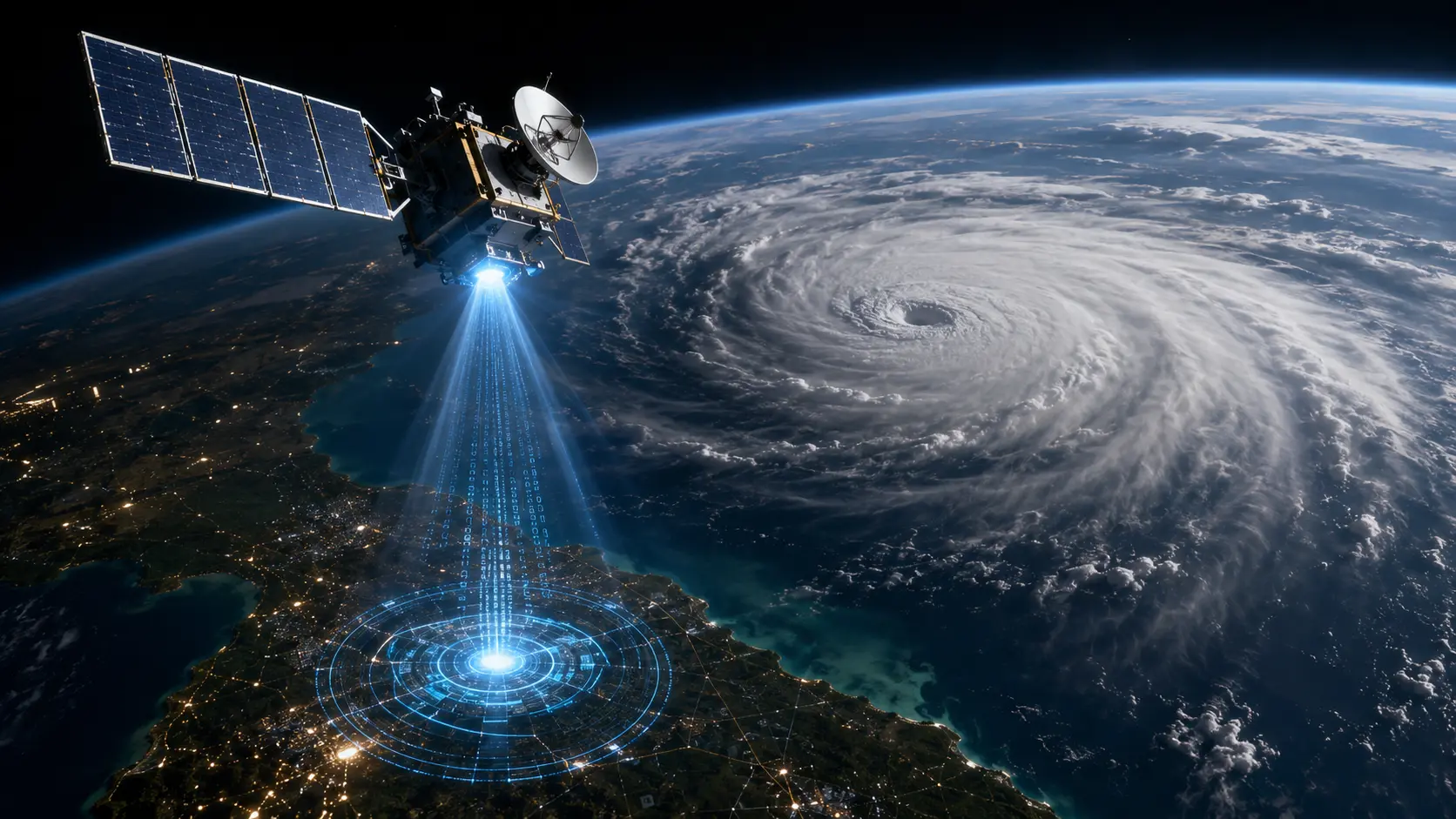

Imagine a Category 4 hurricane tearing through the Florida coastline. The traditional recovery response involves waiting months for an overwhelmed, exhausted insurance adjuster to physically inspect your ruined corporate campus, while your business bleeds cash and mold destroys whatever the wind left behind. As climate change accelerates the frequency of these disasters, traditional insurance markets are buckling. Legacy carriers are entirely abandoning high-risk coastal and wildfire zones because the old model of manually assessing physical damage is mathematically and logistically broken.
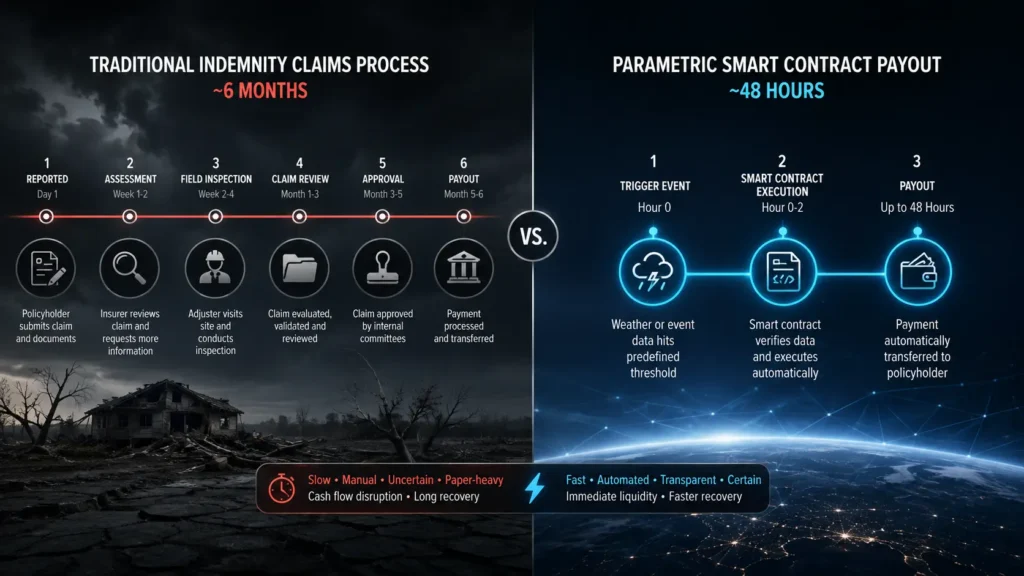
But a new financial architecture is replacing human adjusters with cold, hard math. Before the hurricane even dissipates, a satellite orbiting 300 miles above Earth records the exact barometric pressure and wind speed over your specific GPS coordinates. If that wind speed crosses a pre-agreed threshold, an algorithm instantly triggers a multi-million-dollar wire transfer into your bank account within 48 hours. No physical damage assessment. No arguing over deductibles. No delays. Why should you care right now? Because as extreme weather renders traditional coverage unaffordable or unavailable, the ability to financially survive the next decade will depend entirely on algorithmic, sensor-driven insurance.
What is Parametric Climate Insurance?
Parametric climate insurance is an algorithmic policy that automatically triggers a financial payout when a predefined, objective weather event occurs, such as a specific hurricane wind speed or earthquake magnitude. Instead of paying for assessed physical damage, it pays based strictly on verified sensor and satellite data.
At a Glance
- Concept: Divorcing insurance payouts from actual physical damage. You are not insuring your building against destruction; you are betting that a specific, extreme weather metric will not happen. If it does, you get paid.
- Why it matters: Traditional indemnity insurance takes months or years of legal fighting to pay out. Parametric insurance provides instant, massive liquidity (cash) exactly when a corporation or municipality needs it most to fund immediate emergency recovery.
- Who uses it: Sovereign nations protecting against GDP-crushing typhoons, massive agricultural conglomerates hedging against drought, and coastal hotel chains protecting their revenue streams.
- Biggest takeaway: The system relies entirely on “Oracles”—neutral third-party data providers like the National Oceanic and Atmospheric Administration (NOAA) or the US Geological Survey (USGS). If the Oracle’s data says the event happened, the smart contract pays out automatically.
In Simple Words
Traditional insurance is called Indemnity Insurance. If your house burns down, you call the insurance company. They send a human inspector to look at the ashes, calculate exactly what the house was worth, subtract your deductible, argue with you about the value of your furniture, and finally mail you a check six months later. It is slow, expensive, and full of friction.
Parametric Insurance is completely different. It is basically a highly calculated bet against the weather.
You and the insurance company agree on a “parameter”—a specific number. For example, “If an earthquake hits 7.0 on the Richter scale within 50 miles of my factory, you pay me $10 million.”
When an earthquake happens, nobody comes to look at your factory. The insurance company just looks at the official government seismograph data. If the machine says 7.1, the insurance company wires you $10 million the next day. It doesn’t matter if your factory was completely flattened or if it didn’t suffer a single scratch. The only thing that matters is the data.
Why This Matters
The global “Protection Gap”—the difference between total economic losses from climate disasters and the amount actually covered by insurance—reached an estimated $180 billion in recent years. Traditional insurers are shedding climate risk, leaving massive infrastructure projects, renewable energy grids, and coastal real estate entirely uninsurable under the legacy model.
For Corporate Risk Officers and ESG Investors, parametric insurance is the only scalable lifeline. Because it is purely data-driven, it is highly attractive to capital markets. Hedge funds and pension funds are stepping in to back these parametric policies (often via Catastrophe Bonds) because the algorithmic nature of the payout is clean and predictable, entirely disconnected from the messy, fraudulent, and litigious world of traditional human claims adjustment. Understanding how to structure these data-driven policies is now a mandatory competency for anyone managing physical assets in the 2020s.
The Rise of InsurTech and Hyper-Local Triggers
Parametric insurance is not a new concept—it has been used by massive reinsurance companies and sovereign nations for decades. What is new is the democratization and hyper-localization of the technology.
Historically, only a whole country could buy a parametric policy against a hurricane. Today, thanks to the explosion of private satellite constellations (like Planet Labs), orbital synthetic-aperture radar (SAR), and hyper-local Internet of Things (IoT) weather sensors, an InsurTech startup can write a parametric policy for a single coffee shop in Miami.
This transition from macro-scale national coverage down to micro-scale individual corporate coverage is fueling the InsurTech boom. It shifts the power dynamic of the insurance industry away from companies that employ the best lawyers and adjusters, and toward technology firms that employ the best data scientists, meteorologists, and satellite telemetry engineers.
How Parametric Climate Insurance Works
Creating an automated, multi-million dollar financial trigger requires an ironclad architecture of data and trust. Here is the first-principles breakdown.
1. The Fundamental Problem: The Cost of Assessment
In traditional insurance, verifying the exact cost of damage after a hurricane requires flying thousands of human adjusters into a disaster zone. They must climb roofs, take photos, and write reports. This process takes months, costs the insurance company millions in administrative overhead, and leaves the victim without cash during the critical early days of recovery.
2. The Insufficiency of Existing Solutions
As climate events become more frequent and severe, the sheer volume of simultaneous claims overwhelms the human workforce. Furthermore, “business interruption” (the money lost because your store is closed during the recovery) is notoriously difficult to prove and claim under traditional indemnity policies.
3. The Core Mechanism: The Parameter and the Oracle
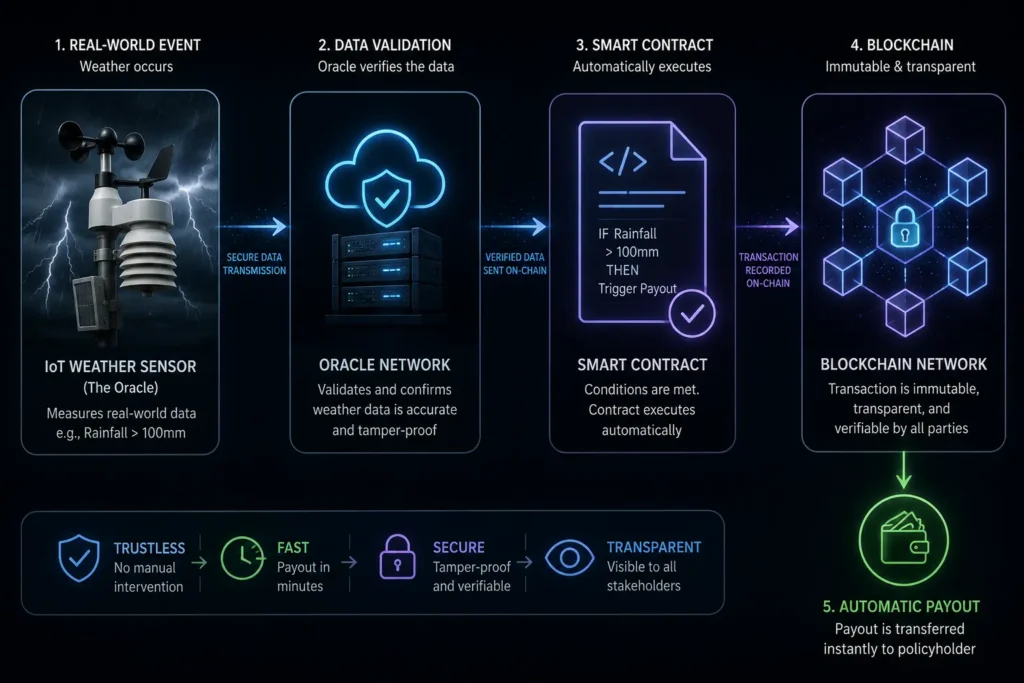
Parametric insurance completely bypasses human assessment. It relies on a “Parameter” (an exact index, like wind speed, rainfall amount, or hail diameter) and an “Oracle” (an independent, indisputable third-party data source, like a government satellite). The contract is simple: If the Oracle records the Parameter crossing the threshold, the payout is triggered.
4. Technical Depth: Catastrophe Modeling and Index Structuring
To price the policy, actuaries use advanced Catastrophe (Cat) Models. They run millions of Monte Carlo simulations of historical weather patterns to determine the exact statistical probability of a Category 4 hurricane hitting a specific 1-square-mile grid over the next 12 months. The policy is often structured with a “stepped” payout index to reflect severity: e.g., Category 3 triggers a 50% payout, Category 4 triggers 75%, and Category 5 triggers 100%.
5. Real-World Consequences: Immediate Liquidity
Because the oracle data is reported in real-time, the smart contract (often built on blockchain infrastructure for total transparency) executes immediately. The insured party receives a massive injection of liquidity within 7 to 14 days. This cash can be used for anything—clearing debris, paying employees while the business is closed, or renting temporary generators—without needing to submit receipts or wait for an adjuster’s approval.
Corporate Use Cases for Parametric Policies
Parametric structures are no longer theoretical; they are actively defending global supply chains and vulnerable geographies today.
Renewable Energy “Lack of Sun/Wind” Hedges: Traditional insurance covers a solar farm if a tornado smashes the panels. But what if the panels are fine, but it is uncharacteristically cloudy for six months, causing the energy company to default on its revenue projections? Parametric policies are written against “solar irradiance” or “wind speed deficits.” If a satellite confirms that cloud cover exceeded a certain index, the energy company receives a payout to cover their lost revenue, smoothing out the extreme volatility of renewable power generation.
Sovereign Disaster Liquidity (CCRIF): The Caribbean Catastrophe Risk Insurance Facility (CCRIF) provides parametric coverage for entire nations. In 2024, when Hurricane Beryl devastated the Caribbean, CCRIF utilized parametric triggers based on wind and storm surge data to automatically disburse over $44 million to Grenada within 14 days. This rapid liquidity allowed the sovereign government to immediately clear roads and restore power, tasks that would have stalled if they had to wait months for international aid.
Agricultural Yield Protection: In sub-Saharan Africa and rural India, smallholder farmers are utilizing micro-parametric insurance. A farmer buys a policy via a mobile phone for a few dollars. The parameter is soil moisture. If satellite data detects that soil moisture drops below the critical threshold required for crop survival during a specific 30-day window, the farmer automatically receives a mobile cash transfer to buy food, preventing famine and financial ruin.
Economic & Strategic Impact
Parametric insurance effectively transforms physical climate risk into a tradable financial commodity.
Because the payout is tied to an objective data point rather than a subjective human assessment, the risk becomes incredibly clean and mathematically predictable. This cleanliness has attracted a massive wave of “Alternative Capital.”
Hedge funds, pension funds, and sovereign wealth funds are eager to invest in Catastrophe Bonds (Cat Bonds) that back these parametric policies. For a Wall Street pension fund, a hurricane in Florida has absolutely zero correlation to the stock market or global interest rates. By underwriting parametric climate risk, institutional investors secure a high-yield asset class that acts as a perfect diversifier for their traditional stock and bond portfolios, pumping desperately needed liquidity back into the collapsing global insurance market.
Advantages
- Extreme Speed (Liquidity): Payouts are dispersed in days or weeks, preventing businesses from collapsing due to cash-flow starvation in the immediate aftermath of a disaster.
- Total Flexibility of Capital: Traditional insurance strictly regulates how you spend the claim money (e.g., you must use it to rebuild the roof). Parametric cash is unrestricted; a business can use it to pay staff, relocate operations, or cover lost revenue.
- Zero Claims Friction: Eliminates the entire adversarial process of traditional insurance. There are no adjusters to argue with, no hidden deductible loopholes, and no drawn-out legal battles over the definition of “water damage” vs. “wind damage.”
Limitations
- Basis Risk (The Fatal Flaw): The ultimate danger of parametric insurance. If the contract requires 115 mph winds to trigger a payout, and a storm hits your factory with 114 mph winds that still manage to tear the roof off, you get paid absolutely nothing. The algorithm does not care that your building is destroyed; it only cares about the number.
- The Oracle Vulnerability: The entire system relies on the integrity of the data source (the Oracle). If a hurricane destroys the specific terrestrial anemometer (wind sensor) tasked with recording the data, or if a satellite suffers a telemetry glitch during the storm, the contract cannot execute properly, triggering massive legal disputes.
- High Upfront Costs: For highly specific corporate risks, designing custom catastrophe models and establishing dedicated IoT sensor networks is an expensive, bespoke engineering process, resulting in higher initial premiums than generic traditional coverage.
Common Misconceptions
Misconception: Parametric insurance will completely replace traditional insurance.
Reality: They are complementary. Parametric insurance is designed to provide immediate, unrestricted liquidity for emergency survival and business interruption. Traditional indemnity insurance is still required to cover the exact, dollar-for-dollar cost of eventually rebuilding the physical structure months later.
Misconception: You can commit fraud by faking the damage.
Reality: Physical damage is irrelevant to the payout. Even if your building survives a Category 5 hurricane completely untouched, if the satellite records a Category 5 hurricane over your coordinates, you receive the full multi-million-dollar payout. You are paid for the event, not the damage.
Misconception: Parametric insurance is only for natural disasters.
Reality: The model is expanding rapidly into cyber and logistics. You can buy parametric policies for cloud outages (e.g., if AWS goes down for more than 4 hours, a payout is triggered) or supply chain delays (e.g., if river water levels drop below a threshold, preventing barge shipping, a payout is triggered).
What Most People Miss
The revolution of Hyper-Local Sensor Densification.
To solve the fatal flaw of “Basis Risk,” the insurance industry cannot rely solely on national weather stations, which might be located 20 miles away from the insured property.
What most people miss is that the future of parametric insurance involves companies installing military-grade IoT weather sensors directly on the roof of their own corporate headquarters. By establishing a hyper-local, cryptographically secure “Oracle” directly on the asset being insured, the data perfectly reflects the reality on the ground. When the wind hits the building, the sensor on the roof instantly signs a data packet to the blockchain, executing the smart contract in real-time, effectively bridging the gap between algorithmic theory and physical reality.
Comparison Table
| Feature | Traditional Indemnity Insurance | Parametric Climate Insurance |
| Payout Trigger | Proof of actual physical/financial loss | Occurrence of an objective data event |
| Assessment Mechanism | Manual inspection by human claims adjusters | Automated verification by data Oracles |
| Speed of Payout | Months to Years (High friction) | Days to Weeks (Zero friction) |
| Use of Funds | Strictly limited to replacing damaged assets | Unrestricted (Can cover lost revenue/payroll) |
| Primary Risk to Buyer | Denied claims, hidden deductibles, delays | Basis Risk (Event causes damage, but misses data trigger) |
Case Study
Situation: A massive hospitality conglomerate operating luxury resorts across the Caribbean and Gulf of Mexico faced an existential threat. Following a string of severe hurricane seasons, traditional insurance carriers either refused to renew their wind-damage policies or raised deductibles so high that a single storm would effectively bankrupt the company’s cash reserves.
Challenge: The company needed guaranteed, immediate liquidity to survive the months of “business interruption” following a storm, a cost that traditional property insurance explicitly refused to cover.
Solution (The Parametric Hedge): The conglomerate worked with a specialized InsurTech broker to design a customized parametric “catastrophe ring.” They drew a virtual 50-mile radius around their flagship resorts. They purchased a policy that stated: If a verified Category 4 hurricane enters this GPS ring, the policy instantly pays out $25 million.
Outcome: When a major hurricane struck the region the following year, the eye of the storm passed directly through the virtual ring. While the physical damage to the concrete resorts was mostly superficial, the local airport was shut down for three weeks, completely wiping out the resort’s revenue. Because the hurricane breached the GPS ring, the parametric algorithm executed automatically.
Lessons Learned: The conglomerate received $25 million in cash in 10 days. They used the unrestricted funds to pay their staff during the closure, fly in private emergency generators, and refund canceled reservations. The case study proved that parametric insurance excels not at rebuilding concrete, but at ensuring the financial survival of the enterprise during the chaotic aftermath of a climate disaster.
Future Outlook
Next 12–24 Months
The era of Blockchain and Smart Contract Integration. As the volume of parametric policies scales, administrative friction will be entirely eliminated through blockchain networks. Oracles (like Chainlink) will feed NOAA satellite data directly into Ethereum or specialized private ledgers. When a weather parameter is breached, the smart contract will automatically execute and disburse stablecoins directly to the insured party’s digital wallet in seconds, without a single human being ever touching the paperwork.
Next 3–5 Years
The explosion of Micro-Parametrics and Embedded Insurance. The technology will scale down to the consumer level. If you book a vacation to a ski resort, you will click a box to buy a $10 parametric snow policy. If satellite data confirms the mountain receives less than 10 inches of snow that week, the algorithm will instantly refund the cost of your lift ticket to your credit card. This “embedded” parametric insurance will become a standard feature integrated directly into travel, event, and agricultural supply chain software.
Next 10 Years
The Data-Driven Capital Market Convergence. By the mid-2030s, the distinction between a tech company, a hedge fund, and an insurance carrier will vanish. As traditional indemnity insurance continues to collapse under the weight of runaway climate change, the only capital willing to assume weather risk will be algorithmic alternative capital. The companies that own the most accurate AI climate models and the densest, most reliable IoT sensor grids will become the undisputed, trillion-dollar arbiters of global climate resilience.
Most Likely Scenario
Parametric insurance will not entirely kill the traditional claims adjuster, but it will permanently relegate them to the background. Within the decade, every major infrastructure project and coastal asset will utilize a “hybrid” stack: a massive parametric policy to guarantee immediate cash-flow survival in week one, layered on top of a highly specific, high-deductible traditional policy to cover the eventual structural rebuild in year two.
Key Takeaways
- Parametric climate insurance pays out automatically based on objective, verified data (like wind speed or earthquake magnitude) rather than human assessments of physical damage.
- By entirely bypassing the traditional claims adjustment process, parametric policies can wire millions of dollars in life-saving liquidity to disaster victims within days.
- The system relies on “Oracles”—neutral, indisputable third-party data providers like government satellites or official seismographs—to trigger the algorithmic smart contracts.
- The fatal flaw of the system is “Basis Risk”: if an extreme weather event destroys your property but the data metric falls just short of the contract’s trigger threshold, you receive zero payout.
- The payouts are unrestricted cash. Corporations use them to cover “business interruption” and lost revenue, which traditional property insurance often refuses to cover.
- Because the risk is cleanly modeled by algorithms and disconnected from human fraud, it is highly attractive to hedge funds and pension funds looking to invest in Catastrophe Bonds.
Glossary
Alternative Capital: Money entering the insurance market from non-traditional sources (like pension funds and hedge funds) seeking high yields uncorrelated to the stock market, often backing parametric policies.
Basis Risk: The fundamental risk in parametric insurance that the algorithmic trigger does not perfectly match the actual physical damage suffered (e.g., suffering heavy damage but the wind speed misses the payout threshold by 1 mph).
Catastrophe (Cat) Bond: A high-yield debt instrument that pays investors a lucrative interest rate, but if a predefined parametric disaster occurs, the investors lose their principal, and the money is used to pay the insurance claim.
Indemnity Insurance: The traditional model of insurance that reimburses the policyholder exactly for the actual, proven physical or financial loss incurred, requiring manual claims adjustment.
Oracle: A secure, highly trusted third-party data feed (like NOAA satellite telemetry or a USGS seismograph) that provides the objective truth required to trigger a smart contract.
Smart Contract: Self-executing code residing on a blockchain or private server that automatically executes the terms of an agreement (like wiring a payout) when specific conditions (like a weather parameter) are met.
Frequently Asked Questions
Can I buy a parametric policy for my house?
Currently, it is very difficult. Parametric insurance is mostly utilized by massive corporations, sovereign nations, and agricultural conglomerates. However, InsurTech startups are actively working to shrink the model down to offer hyper-local “micro-parametric” policies to individual homeowners in hurricane and earthquake zones.
What happens if the satellite tracking the weather breaks?
This is a critical vulnerability. Parametric contracts usually have heavily negotiated “fallback” clauses. If the primary Oracle (e.g., a specific satellite) goes offline during a storm, the contract will stipulate a secondary or tertiary government data source that must be used to calculate the official payout metric.
Do I have to prove I used the money to rebuild my building?
No. This is the greatest advantage of parametric insurance. The cash payout is completely unrestricted. You can use it to pay your employees while your factory is closed, rent emergency equipment, or even invest it. The insurance company does not care what you do with the money once the algorithmic trigger is met.
If my building isn’t damaged, do I still get paid?
Yes. If you buy a policy that triggers when a Category 4 hurricane enters a 50-mile radius of your building, and your building happens to survive completely untouched, you still receive the full multi-million-dollar payout. You are insuring against the occurrence of the event, not the physical damage.
Why are traditional insurance companies pulling out of states like California and Florida?
Traditional insurance relies on historical data to predict future losses. Climate change has broken those historical models. Because extreme wildfires and hurricanes are becoming wildly unpredictable and incredibly destructive, traditional insurers are losing billions and are choosing to abandon the markets entirely rather than face bankruptcy.
Sources
[1] Swiss Re Institute: Parametric Insurance and the Climate Protection Gap (2025/2026 Macro Analysis)
[2] Munich Re: Catastrophe Bonds and the Rise of Parametric Alternative Capital (Q1 2026)
[3] World Bank: The Caribbean Catastrophe Risk Insurance Facility (CCRIF) – Sovereign Parametric Payouts
[4] Artemis: Catastrophe Bond & Insurance-Linked Securities Deal Directory
[5] National Oceanic and Atmospheric Administration (NOAA): Integrating Satellite Telemetry with Private Sector Risk Modeling