Advertisement
)
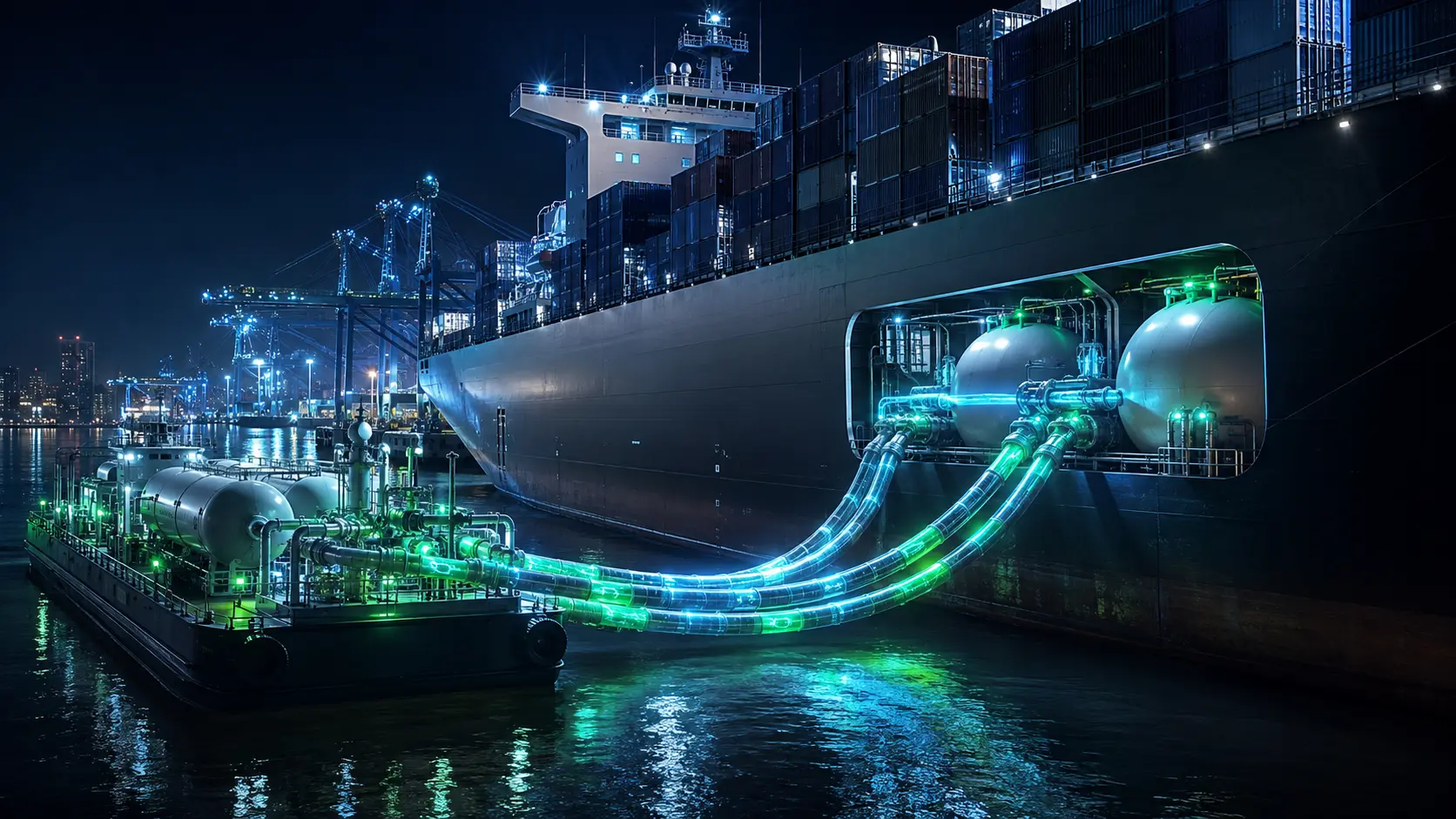

The global shipping industry is the invisible conveyor belt of the modern economy, moving 90 percent of all traded physical goods across the oceans. But this logistical miracle comes with a catastrophic environmental cost. Massive container ships are powered by Heavy Fuel Oil (HFO)—a toxic, tar-like sludge that represents the literal bottom of the petroleum refining barrel. As international climate regulations tighten, the maritime sector faces an existential crisis: it cannot simply plug a 200,000-ton cargo ship into a lithium-ion battery and sail it across the Pacific. The physics of weight and distance demand a dense liquid fuel, but the planet demands zero carbon.
Enter green ammonia. For over a century, ammonia has been synthesized from fossil fuels and used primarily as an agricultural fertilizer. Today, energy giants are utilizing vast arrays of solar and wind power to produce liquid ammonia out of thin air and water, creating a dense, entirely carbon-free fuel. Why should you care right now? Because the maritime industry is investing billions to retrofit its fleets and redesign global port infrastructure to pump this cryogenic liquid into massive marine engines. The race to master green ammonia bunkering will fundamentally rewrite the geopolitics of global trade.
What is Green Ammonia Bunkering?
Green ammonia bunkering is the process of supplying zero-carbon liquid ammonia to ships to use as a primary marine fuel. The ammonia is synthesized using renewable energy, water, and atmospheric nitrogen. When burned in a ship’s engine, it releases zero carbon dioxide, offering a highly scalable decarbonization pathway for the global maritime industry.
At a Glance
- Concept: Replacing the dirty petroleum used by cargo ships with a clean, liquid fuel made entirely from renewable electricity, water, and air.
- Why it matters: The maritime industry emits over 1 billion tons of carbon dioxide annually. Green ammonia is currently the only zero-carbon liquid fuel that scales economically enough to cross oceans.
- Who uses it: Major shipping conglomerates (Maersk, MSC), elite marine engine manufacturers (MAN Energy Solutions, Wärtsilä), and global port authorities (Rotterdam, Singapore).
- Biggest takeaway: While burning ammonia produces no carbon dioxide, the chemical itself is highly toxic. The primary engineering hurdle is designing “bunkering” (refueling) systems that prevent lethal leaks while protecting harbor crews.
In Simple Words
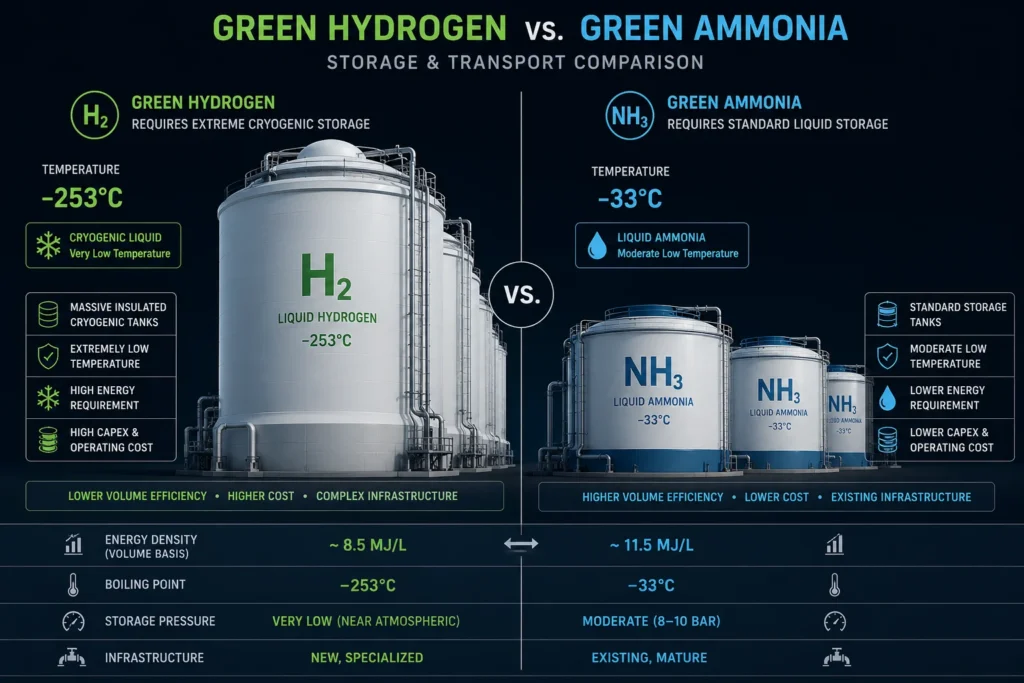
Cargo ships need massive amounts of fuel to cross the ocean. Batteries are too heavy, and liquid hydrogen requires extreme, incredibly expensive freezing (-253°C) to keep it from turning into a gas.
Green Ammonia solves the storage problem. To make it, you use electricity from solar panels to split water into pure hydrogen. Then, you pull nitrogen out of the air. You crush the hydrogen and nitrogen together under high heat to create ammonia. Because it is created using renewable energy, it is “green.”
Ammonia is much easier to keep as a liquid than hydrogen (it only needs to be cooled to -33°C). When a cargo ship pulls into port, special hoses pump this liquid ammonia into the ship’s tanks—a process called bunkering. When the ship’s massive engines burn the ammonia, the exhaust pipe releases nitrogen and water vapor instead of thick, black carbon smoke.
Why This Matters
The International Maritime Organization (IMO) has laid down a draconian mandate: the global shipping industry must reach net-zero greenhouse gas emissions by or around 2050.
For Maritime Logisticians and Energy Investors, this timeline triggers a massive capital expenditure (CapEx) supercycle. There are roughly 50,000 merchant ships operating globally today. Because commercial vessels operate for 25 to 30 years, ships being built right now must be equipped with engines capable of burning zero-carbon fuels, or they will become stranded assets long before they reach the end of their operational lifespans.
Green ammonia is aggressively positioning itself as the undisputed winner of the maritime fuel wars. While competitors like green methanol require sourcing captured carbon (which is expensive and scarce), green ammonia requires only sun, wind, water, and air. The ports and nations that construct the first massive green ammonia bunkering hubs will dictate the new maritime trade routes of the 21st century.
The Evolution of Green Ammonia Marine Fuel
The shift to green ammonia bunkering represents a fusion of the agriculture and energy sectors.
For decades, the Haber-Bosch process—used to make ammonia for fertilizer—relied entirely on natural gas or coal, emitting massive amounts of carbon dioxide (known as “grey ammonia”). The green ammonia revolution simply replaces the dirty natural gas with clean hydrogen produced by water electrolysis.
Because a massive, global infrastructure for shipping grey ammonia already exists (specialized tankers, chemical ports, handling regulations), the maritime industry does not have to invent a new supply chain from scratch. They are simply hijacking the existing fertilizer supply chain, turning a toxic agricultural chemical into the bedrock of global transportation.
How Green Ammonia Bunkering Works
Turning a chemical building block into an efficient, safe marine fuel requires mastering complex thermodynamics and emissions mitigation. Here is the first-principles breakdown.
1. The Fundamental Problem: The Hydrogen Storage Bottleneck
Green hydrogen is the cleanest fuel in the universe, but it is physically impractical for shipping. To turn hydrogen into a liquid, it must be cooled to -253°C (near absolute zero). The thick, heavily insulated tanks required to keep it frozen take up so much space on a ship that there is no room left for profitable cargo.
2. The Insufficiency of Biofuels
Biofuels (like biodiesel) are drop-in replacements for traditional oil, but there simply isn’t enough used cooking oil or agricultural waste on Earth to continuously power the 50,000 ships of the global merchant fleet. The industry needs an artificially synthesized fuel that can scale infinitely.
3. The Core Mechanism: The Green Haber-Bosch Synthesis
Ammonia solves the hydrogen storage problem by using nitrogen as a carrier. Renewable energy powers an electrolyzer to split water into hydrogen and oxygen. An air separation unit extracts nitrogen from the atmosphere. These gases are subjected to high pressure and heat over a catalyst via the Haber-Bosch process:
N₂ + 3H₂ ⇌ 2NH₃
The resulting ammonia (NH₃) contains massive amounts of hydrogen but turns into a liquid at a mild -33°C, making it infinitely easier and cheaper to store on a ship.
4. Technical Depth: Dual-Fuel Marine Engines
Ammonia is notoriously difficult to ignite; it burns slowly and resists combustion. To solve this, marine engineers at companies like MAN Energy Solutions designed two-stroke, “dual-fuel” engines. The engine injects a tiny amount of pilot fuel (like marine diesel or biofuel) to create an initial spark. The intense heat of the pilot fuel instantly ignites the primary spray of liquid ammonia.
5. Real-World Consequences: Nitrogen Oxide (NOx) Mitigation
While burning ammonia produces zero CO₂, it combines with oxygen under high engine temperatures to produce Nitrogen Oxides NOₓ—a potent greenhouse gas and toxic pollutant. Therefore, green ammonia ships must be equipped with massive Selective Catalytic Reduction (SCR) systems. The SCR injects a urea solution into the exhaust pipe, triggering a chemical reaction that breaks the dangerous NOₓ back down into harmless nitrogen gas and water vapor before it leaves the smokestack.
Real-World Green Ammonia Shipping Operations
The transition from theory to operational maritime reality is moving at unprecedented speeds.
The First Ammonia-Powered Cargo Ships: In mid-2024, the Fortescue Green Pioneer, a retrofitted offshore supply vessel, successfully utilized liquid ammonia in combination with diesel in commercial waters. By 2026, major engine manufacturers like Wärtsilä and MAN Energy Solutions have delivered commercial-grade dual-fuel ammonia engines to shipyards in South Korea and China, initiating the first wave of newly built, massive ammonia-powered bulk carriers.
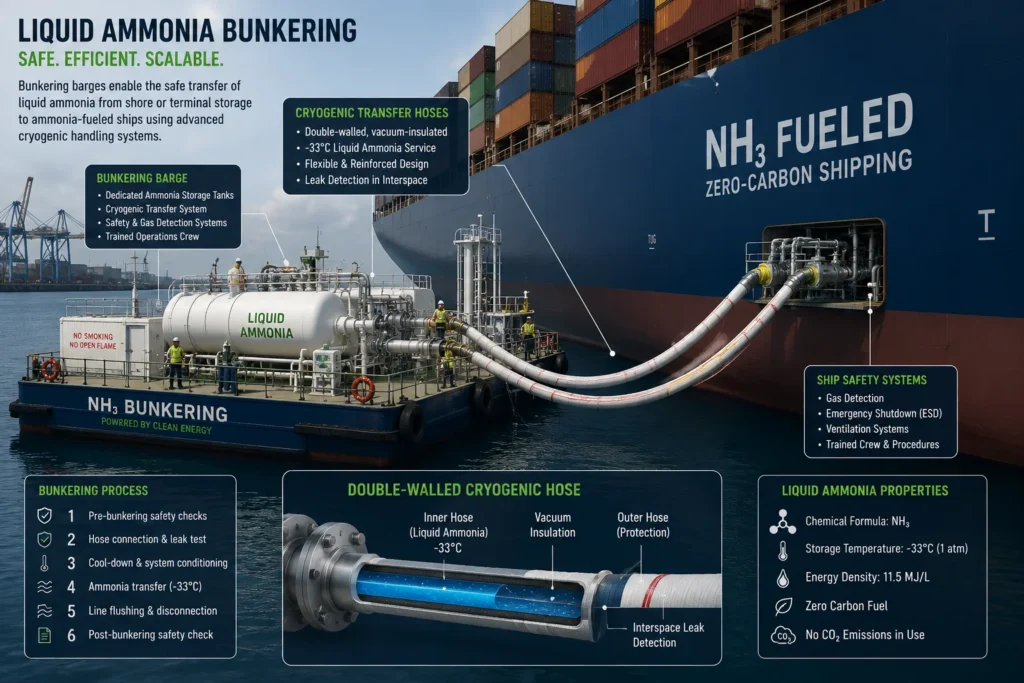
Strategic Bunkering Hubs: A ship is useless if it cannot refuel. Global super-ports are rapidly redesigning their infrastructure. The Port of Rotterdam and the Maritime and Port Authority of Singapore (MPA) have established dedicated safety protocols and built specialized cryogenic bunkering barges. These heavily reinforced barges pull alongside massive container ships to transfer liquid ammonia at -33°C using double-walled hoses equipped with automatic emergency shut-off valves.
The Green Energy Export Market: Countries with massive solar and wind resources but small populations (like Australia, Chile, and Namibia) are building gigawatt-scale green ammonia facilities. Because ammonia is easily shipped in standard liquid gas carriers, these nations are physically exporting their trapped solar energy to energy-starved manufacturing hubs in Europe and Asia, fundamentally shifting the global energy map away from the Middle East.
Economic & Strategic Impact
The greatest headwind for green ammonia is the Energy Density Penalty.
While ammonia is easier to store than pure hydrogen, it only contains about half the energy per volume of traditional Heavy Fuel Oil (HFO).
For a container ship to sail the same distance on green ammonia, its fuel tanks must be roughly two to three times larger than traditional oil tanks. In the maritime industry, space is money. Every cubic meter dedicated to a larger fuel tank is a cubic meter that cannot hold a paying cargo container.
This forces shipping companies into a brutal economic calculus. Do they install massive tanks and lose cargo revenue, or do they install smaller tanks and accept that the ship must stop at ports more frequently to refuel (bunker)? This dynamic guarantees that the first massive adopters of green ammonia will be ships operating on fixed, predictable point-to-point routes (like iron ore carriers between Australia and China) where refueling infrastructure can be strategically guaranteed.
Advantages
- Zero Carbon Emissions: The combustion of ammonia NH₃ fundamentally cannot produce carbon dioxide, instantly neutralizing the primary regulatory threat to the shipping industry.
- Scalable Synthesis: Because it requires only electricity, water, and atmospheric air, the global supply of green ammonia is constrained only by renewable power generation, not by digging finite resources out of the earth.
- Leverages Existing Infrastructure: The chemical industry already transports 20 million tons of ammonia globally by ship every year. The regulatory framework, metallurgical tank requirements, and safety handling protocols are already deeply understood by maritime crews.
Limitations
- Lethal Toxicity: This is the paramount risk. Ammonia is a highly caustic, toxic gas. If a fueling hose ruptures during bunkering in a crowded port, a cloud of ammonia gas can be lethal to humans within minutes, requiring military-grade safety redundancies.
- Ammonia Slip: If the engine does not burn 100% of the ammonia perfectly, unburnt ammonia gas escapes out of the smokestack (slip). This poses severe health risks to the crew on deck and requires heavy, expensive exhaust scrubbers.
- High Initial Cost: Synthesizing green ammonia requires massive amounts of electricity. Until the global price of renewable energy drops significantly, green ammonia will remain two to four times more expensive than traditional dirty bunker fuel, requiring strict carbon taxes to balance the economic scales.
Common Misconceptions
Misconception: Green ammonia is a newly invented chemical.
Reality: The chemical is exactly the same as the ammonia used in household cleaners and fertilizers for a century. The only difference is how it is made—using solar panels and electrolyzers instead of burning natural gas.
Misconception: The ships smell terrible, like cleaning fluid.
Reality: Ammonia has a violent, pungent odor, but it is stored in hermetically sealed cryogenic tanks deep inside the ship. If a sailor smells ammonia, it means there is a critical safety leak, triggering immediate evacuation alarms.
Misconception: Burning it only produces harmless water and nitrogen.
Reality: While it doesn’t produce CO₂, burning ammonia at high temperatures creates Nitrogen Oxides NOₓ and Nitrous Oxide N₂O, laughing gas), which is a greenhouse gas 300 times more potent than CO₂. Without mandatory, high-tech exhaust scrubbers (SCR), burning ammonia would accelerate climate change.
What Most People Miss
The critical challenge of Pilot Fuel Dependency.
Many sustainability reports market ammonia ships as “100% Zero-Emission.”
What most people miss is the thermodynamic reality of the internal combustion engine. Because ammonia is so hard to ignite, current dual-fuel marine engines must use a “pilot fuel”—often comprising 5% to 10% of the combustion mix—to initiate the explosion. If that pilot fuel is traditional marine diesel, the ship is still burning fossil fuels and still emitting carbon dioxide. To achieve a true “absolute zero” emission profile, the pilot fuel must be a clean alternative, such as highly refined biodiesel or pure hydrogen injection, which adds yet another layer of supply chain complexity to the bunkering process.
Comparison Table
| Feature | Heavy Fuel Oil (HFO) | Liquefied Natural Gas (LNG) | Liquid Hydrogen (H2) | Green Ammonia (NH3) |
| Carbon Emissions | Extremely High | Moderate (20% less than HFO) | Zero | Zero |
| Storage Temperature | Room Temperature | Cryogenic (-162°C) | Extreme Cryogenic (-253°C) | Mild Cryogenic (-33°C) |
| Volumetric Energy | Excellent (Baseline) | High | Very Low | Moderate (Requires 2.5x larger tanks than HFO) |
| Toxicity Risk | Low (Environmental spill risk) | Low | Low (High flammability risk) | Extreme (Lethal gas cloud if leaked) |
| Engine Compatibility | Standard | Dual-Fuel | Highly complex | Dual-Fuel (Requires Pilot Ignition) |
Case Study
Situation: A major Nordic maritime consortium, aiming to meet strict European Union carbon emission reduction targets before 2030, needed to design a new class of mid-sized container vessels for inter-European trade. Traditional batteries lacked the energy density to cross the North Sea, and relying on scarce biofuels presented an unacceptable supply chain risk.
Challenge: Selecting a marine fuel that could scale infinitely, guarantee zero carbon emissions, and be handled safely in densely populated European ports like Rotterdam and Hamburg.
Solution (The Yara Eyde Initiative): Yara International, one of the world’s largest fertilizer companies and a master of ammonia handling, partnered with maritime operators to launch the Yara Eyde, billed as the world’s first clean ammonia-powered container ship. Yara leveraged its existing massive ammonia production infrastructure, pivoting a portion of its chemical output toward maritime fuel.
Outcome: By designing the ship with a specialized dual-fuel engine and reinforced cryogenic tanks, the consortium established a secure, point-to-point zero-emission shipping corridor. The Port of Oslo and other maritime hubs worked directly with Yara to establish strict, double-walled bunkering protocols to completely mitigate the toxicity risk during refueling.
Lessons Learned: The initiative proved that decarbonizing shipping requires cross-industry collaboration. Shipping companies cannot adopt ammonia unless chemical giants (like Yara) guarantee the fuel supply, and ports guarantee the bunkering infrastructure. The successful deployment verified that the toxicity of ammonia is manageable through strict industrial protocols, officially crowning green ammonia as a viable commercial reality.
Future Outlook
Next 12–24 Months
The era of Bunkering Standardization. As the first wave of dual-fuel ammonia vessels hits the water, the maritime industry will focus obsessively on safety. Major classification societies (like DNV and Lloyd’s Register) will issue strict, standardized global guidelines for ammonia bunkering. We will see the rollout of automated, robotic refueling arms that connect hoses to ships without human intervention, ensuring that dockworkers are never exposed to potential toxic gas leaks during the cryogenic transfer.
Next 3–5 Years
The scaling of Green Hydrogen Hubs. The bottleneck for green ammonia is the massive amount of renewable electricity required to make the green hydrogen precursor. By the late 2020s, massive gigawatt-scale solar and electrolyzer hubs in Australia, Chile, and the Middle East will come online. As the price of green hydrogen plummets, the cost of synthesizing green ammonia will approach parity with heavily taxed fossil fuels, triggering mass adoption by global freight carriers.
Next 10 Years
The transition to Solid Oxide Fuel Cells (SOFCs). By the mid-2030s, the maritime industry will begin moving away from internal combustion engines entirely. Advanced ships will use Solid Oxide Fuel Cells that run directly on liquid ammonia. These fuel cells electrochemically convert the ammonia into electricity to drive massive electric propellers with near-perfect efficiency and absolute silence. Because there is no combustion (no fire), the formation of dangerous NOₓ gases is eliminated, solving the final environmental hurdle of the ammonia economy.
Most Likely Scenario
Green ammonia will not be the only fuel of the future, but it will be the undisputed king of deep-ocean, heavy-cargo transport. While smaller coastal ferries adopt batteries, and mid-sized regional ships use green methanol, the massive, trans-oceanic container ships that bind the global economy together will rely entirely on the vast, decentralized green ammonia supply chain.
Key Takeaways
- Green ammonia is a zero-carbon maritime fuel synthesized by combining green hydrogen (from water) and nitrogen (from the air) using renewable electricity.
- The global shipping industry is pivoting to ammonia because it turns into a liquid at a mild -33°C, making it vastly cheaper and easier to store on a ship than liquid hydrogen.
- Because it contains no carbon, burning ammonia produces zero CO₂ emissions, directly addressing the strict decarbonization mandates of the International Maritime Organization (IMO).
- Ammonia is highly toxic to humans; the primary engineering challenge is designing foolproof “bunkering” (refueling) systems that prevent lethal gas leaks in crowded ports.
- Current marine engines are “dual-fuel,” requiring a tiny amount of traditional fuel (a pilot fuel) to create a spark hot enough to ignite the slow-burning ammonia.
- Burning ammonia at high temperatures creates toxic Nitrogen Oxides NOₓ requiring ships to be equipped with massive catalytic exhaust scrubbers to protect the atmosphere.
Glossary
Bunkering: The traditional maritime term for the process of refueling a ship with fuel (originally derived from the coal “bunkers” on steamships).
Dual-Fuel Engine: A marine internal combustion engine designed to run on two different types of fuel, usually utilizing a small amount of traditional diesel to ignite a cleaner primary fuel like ammonia or LNG.
Green Ammonia: Ammonia NH₃ produced using a completely carbon-free process, typically relying on solar or wind power to run electrolyzers and power the Haber-Bosch synthesis.
Haber-Bosch Process: The famous 20th-century chemical process that fixes atmospheric nitrogen with hydrogen under immense heat and pressure to synthesize ammonia.
Heavy Fuel Oil (HFO): The dirty, cheap, highly polluting residual oil historically used by the global shipping fleet.
Selective Catalytic Reduction (SCR): An advanced exhaust system that injects a chemical (like urea) into the smokestack to break down toxic Nitrogen Oxides NOₓ into harmless water and nitrogen gas.
Frequently Asked Questions
Why not just use massive batteries to power cargo ships?
Batteries are incredibly heavy and have a low energy density. To power a massive container ship across the Pacific Ocean, the battery would be so massive and heavy that the ship would sink, or there would be absolutely no room left to carry any profitable cargo containers.
Is green ammonia the same as the ammonia under my kitchen sink?
Household ammonia is highly diluted with water (usually 5-10% ammonia). The ammonia used for maritime fuel is 100% pure anhydrous (waterless) liquid ammonia, stored at cryogenic temperatures, making it exponentially more concentrated and dangerous.
If ammonia is toxic, what happens if a ship sinks?
Ammonia dissolves extremely rapidly in water. If a ship’s tank ruptured underwater, the ammonia would dissolve into the ocean, creating a localized, highly toxic alkaline zone that would kill immediate marine life, but it would dissipate quickly, unlike crude oil which forms a sticky, suffocating slick across hundreds of miles of coastline.
Why don’t they just use green hydrogen?
Hydrogen is the lightest element in the universe. To carry enough of it on a ship, you have to freeze it to -253°C to turn it into a liquid. The refrigeration equipment and insulated tanks required for hydrogen take up too much space. Ammonia is essentially just a dense, easy-to-carry “wrapper” for hydrogen.
Will passenger cruise ships use ammonia?
Likely not in the near future. Because ammonia gas is lethal, the risk of a leak on a ship carrying 5,000 civilians is deemed too high by regulators. Cruise ships are pivoting toward green methanol or biofuels, reserving toxic ammonia exclusively for unmanned cargo and industrial shipping.
Sources
[1] International Renewable Energy Agency (IEA): The Role of Green Ammonia in Decarbonizing Maritime Transport (2025/2026 Analysis)
[2] Global Maritime Forum: Ammonia as a Marine Fuel: Safety, Bunkering, and Economics
[3] MAN Energy Solutions: Two-Stroke Dual-Fuel Ammonia Engine Development and NOx Mitigation
[4] Yara International: Clean Ammonia Production and the Yara Eyde Container Vessel (2026 Press Briefs)
[5] Lloyd’s Register: Regulatory Frameworks and Safety Standards for Ammonia Bunkering Facilities