Advertisement
)
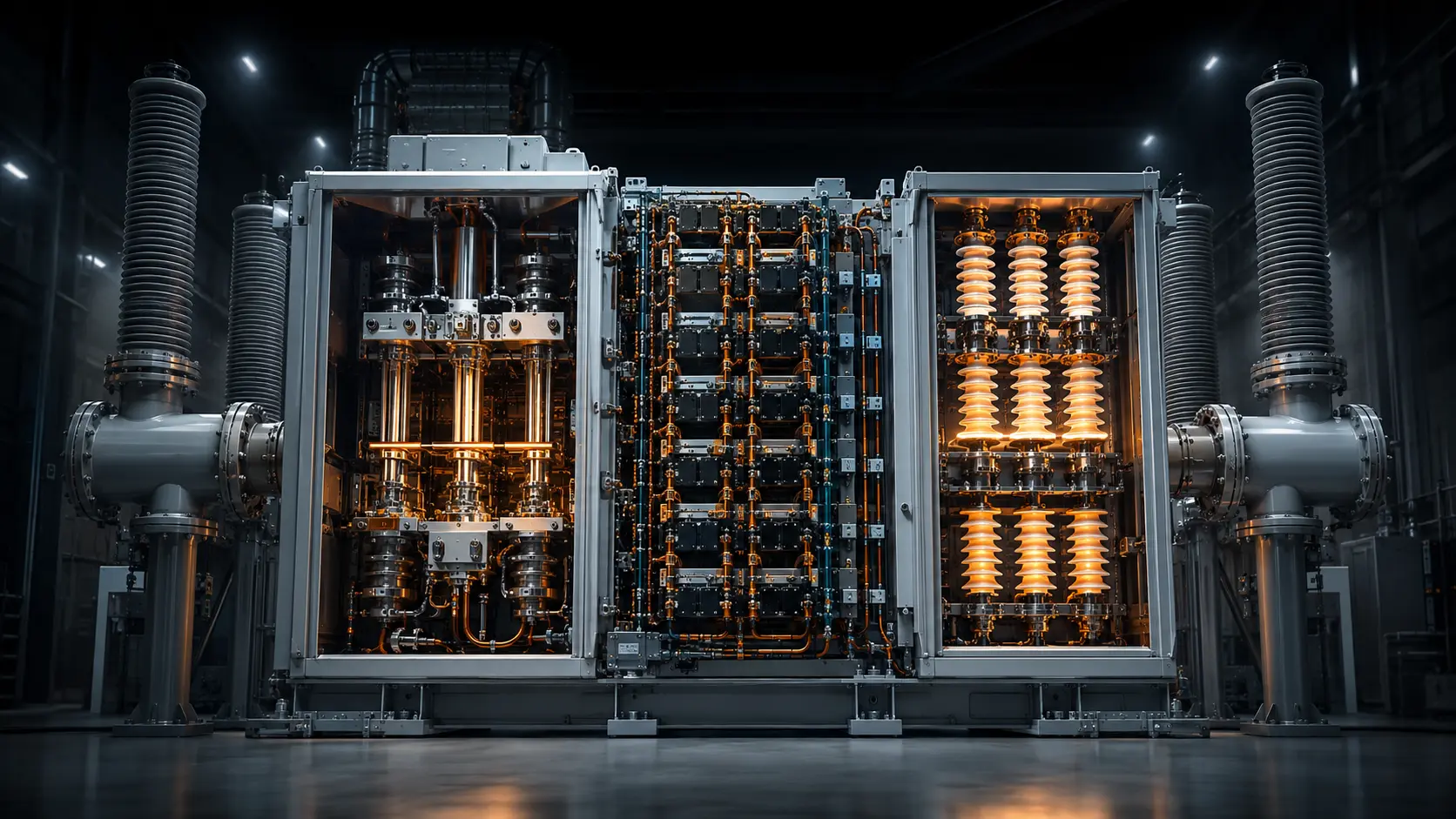

To power Europe entirely with renewable energy, engineers are designing a “Supergrid”—a massive web of underwater cables connecting the offshore wind farms of the North Sea directly to the power grids of Germany, the UK, and Norway. Because standard Alternating Current (AC) loses too much power underwater, this grid must be built using High-Voltage Direct Current (HVDC). But there is a terrifying flaw in the blueprint: lightning strikes. If a massive fault occurs on a DC power line, the electricity does not stop. Unlike AC power, which naturally drops to zero volts 100 times a second, DC power is a continuous, unstoppable firehose of energy. If you try to open a standard mechanical safety switch to stop a 10,000-amp DC fault, the electricity will simply jump the gap, creating a blinding, 10,000-degree plasma arc that melts the steel substation into slag.
Why should you care right now? Because without a way to instantly kill a DC fault, building a multi-country offshore supergrid is physically impossible. You cannot risk a single lightning strike blacking out three nations simultaneously. To solve this, power electronics engineers have invented the Hybrid HVDC Circuit Breaker. By using microscopic silicon chips to “trick” the electricity into changing lanes, these massive machines can safely extinguish a catastrophic fault in just two milliseconds without drawing a single spark. This breakthrough is the technological keystone required to unlock trillions of dollars in stranded renewable energy and wire the continents together.
What are Hybrid HVDC Circuit Breakers?
Hybrid HVDC Circuit Breakers are advanced electrical safety switches that combine low-resistance mechanical disconnectors with ultra-fast solid-state silicon transistors (IGBTs). They divert dangerous direct current (DC) faults into a temporary solid-state pathway, allowing the mechanical switch to open safely without arcing, extinguishing massive faults in under two milliseconds.
At a Glance
- Concept: A massive electrical switch that uses computer chips to temporarily absorb an electrical explosion, allowing a physical metal switch to open safely.
- Why it matters: Direct Current (DC) electricity doesn’t have “off” moments like AC electricity, making it nearly impossible to stop during an emergency. Hybrid breakers solve this, allowing us to build massive, interconnected DC power grids for offshore wind.
- Who uses it: National grid operators (TenneT, National Grid), multi-national utilities, and high-voltage engineering giants (Hitachi Energy, Siemens, GE).
- Biggest takeaway: Pure solid-state (chip-based) breakers waste too much electricity as heat during normal operation. The “Hybrid” approach uses a metal pipe for normal, cheap power flow, and only turns the computer chips on for the two milliseconds it takes to stop a disaster.
In Simple Words
Imagine a massive, high-speed train (the electricity) hurtling down a straight track.
If there is an accident ahead, you need to break the track to stop the train.
In an AC Power Grid, the train naturally stops and reverses direction 100 times a second. You simply wait a fraction of a second for the train to stop, and you pull the track apart. No problem.
In a DC Power Grid, the train never stops. It is a continuous wall of moving steel. If you try to pull the track apart while the train is moving, the train will just blast across the gap and destroy everything (an electrical arc).
A Hybrid HVDC Breaker solves this by building a temporary side-track. When an accident is detected, a computer instantly diverts the massive train onto the side-track. Now that the main track is totally empty, a mechanical arm safely unbolts and opens the main track. Once the main track is safely disconnected, the computer drops a massive concrete wall onto the side-track, completely stopping the train and absorbing the crash safely.
Why This Matters
For Grid Planners, Power Electronics Engineers, and Utility VCs, the Hybrid HVDC Breaker eradicates the Point-to-Point Limitation.
Currently, almost all HVDC cables are “point-to-point.” They connect Point A to Point B. If the cable breaks, the system shuts off the power at the source converters. However, to build a resilient, multi-terminal grid (where Points A, B, C, and D are all connected in a web), you cannot turn off the whole network just because the wire between C and D broke. You need a circuit breaker sitting on the wire to isolate only the broken section, keeping the rest of the grid perfectly operational. The Hybrid HVDC breaker is the only commercially viable technology that provides this selective isolation fast enough to prevent a total grid collapse, fundamentally shifting offshore wind from a niche energy source into global baseload infrastructure.
The Physics of DC Faults vs. AC Zero-Crossing
We have had solid-state breakers (switches made entirely of silicon transistors) for decades. Why couldn’t we just scale those up? Conduction Losses.
Transistors (IGBTs) are incredible at stopping power, but they are inefficient at carrying it. A pure solid-state breaker carrying gigawatts of continuous power has a tiny amount of electrical resistance. That tiny resistance generates massive amounts of heat, meaning a pure solid-state breaker wastes millions of dollars of electricity every year just sitting there during normal operation. The “Hybrid” architecture was a masterstroke of engineering: it utilizes a zero-resistance metal wire for 99.999% of the year, and only wakes up the silicon transistors for the 2 milliseconds required to save the grid.
How a Hybrid HVDC Circuit Breaker Works
Stopping a 10,000-amp DC fault without generating a destructive plasma arc requires a complex choreography of mechanical and solid-state physics. Here is the first-principles breakdown of the architecture.
1. The Fundamental Problem: Inductive Energy
A high-voltage power grid contains massive inductors. Inductors store magnetic energy. When you try to suddenly stop the flow of electricity, the inductors violently fight back, pushing the voltage to extreme, catastrophic levels to keep the current flowing. This is what causes the electrical spark (arc) to jump across the air when a switch is opened.
2. The Core Mechanism: The Three Parallel Paths
A Hybrid HVDC Breaker consists of three separate pathways built perfectly parallel to each other:
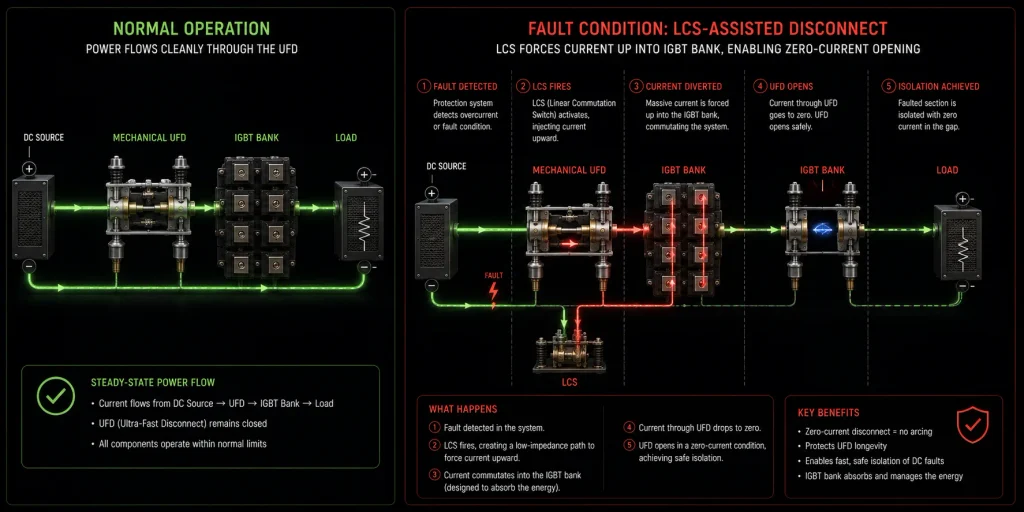
- The Normal Path: Contains a fast mechanical switch (Ultra-Fast Disconnector or UFD) and a small Load Commutation Switch (LCS).
- The Main Breaker Path: A massive bank of solid-state silicon transistors (IGBTs).
- The Energy Absorber Path: A bank of Metal-Oxide Varistors (MOVs).
3. Technical Depth: Commutation
During normal, everyday operation, the electricity flows entirely through the Normal Path. Because it relies on metal contacts, it generates zero heat and wastes no power.
When a lightning strike or short circuit happens, the fault current spikes massively. In microseconds, the system commands the tiny LCS to open. This creates a tiny bit of resistance, which instantly “commutates” (diverts) the massive fault current out of the Normal Path and into the Main Breaker Path.
4. Bypassing the Arc: The Mechanical Disconnect
Now, the heavy fault current is rushing through the silicon chips in the Main Breaker Path. Crucially, the Normal Path is completely empty—zero current is flowing through it.
Because there is zero current, the mechanical UFD can now physically pull its metal contacts apart incredibly fast (in about 2 milliseconds) without drawing any plasma arc. The physical gap is created safely.
5. Real-World Consequences: Absorbing the Explosion
With the mechanical gap safely open, the system commands the silicon chips in the Main Breaker Path to instantly turn off. The flow of electricity is abruptly stopped. The grid’s inductors violently spike the voltage in response. This massive voltage spike is forced into the final path: the MOVs. The MOVs act like an electrical sponge, absorbing the massive magnetic energy and safely dissipating it as heat, permanently extinguishing the fault and saving the multi-billion-dollar supergrid.
Deploying Multi-Terminal HVDC Supergrids
The deployment of Hybrid HVDC Breakers is transitioning from successful laboratory validations into monumental international infrastructure projects.
The Zhangbei HVDC Grid (China): China is currently leading the physical deployment of multi-terminal DC grids. The Zhangbei ±500 kV DC grid project was designed to integrate massive amounts of volatile wind and solar power from the Hebei province and route it to Beijing. To protect this multi-node network, the project successfully deployed custom-engineered high-voltage DC circuit breakers, proving that sub-3-millisecond fault isolation is commercially viable at scale, establishing the blueprint for true grid modularity.
The North Sea Wind Power Hub: European transmission system operators (TSOs) like TenneT and Energinet are actively planning artificial “energy islands” in the North Sea. These hubs will act as central sockets, gathering gigawatts of offshore wind power and distributing it via HVDC cables to the UK, Netherlands, and Germany simultaneously. The entire feasibility of this hub-and-spoke model relies on the imminent commercialization of standardized Hybrid HVDC Breakers to ensure that a severed cable near the UK doesn’t instantly blackout the German connection.
Macro-Grid Interconnectors (US Tres Amigas): The United States power grid is famously divided into three isolated sectors (Eastern, Western, and Texas interconnects). Because these grids operate out of phase with each other, they cannot be connected with standard AC lines. HVDC lines act as the perfect asynchronous bridge. By equipping future HVDC macro-grid interconnectors with hybrid breakers, the U.S. can build a secure, fault-tolerant national supergrid, allowing cheap Texas wind power to seamlessly balance grid demand in New York or California.
Economic & Strategic Impact
The core strategic value of the Hybrid HVDC Breaker is the Eradication of Redundant Converter Costs.
In a traditional point-to-point HVDC system, if you want to connect three offshore wind farms to two cities, you must build separate, dedicated cables and massive AC/DC converter stations for each connection. These converter stations cost hundreds of millions of dollars each.
By utilizing Hybrid HVDC breakers, grid planners can build a true “mesh” network. Multiple wind farms can tap into the exact same DC backbone cable. If a fault occurs, the breaker isolates it, allowing the rest of the shared infrastructure to keep running. This eliminates the need to build billions of dollars of redundant cables and converter stations, drastically lowering the Levelized Cost of Transmission (LCOT) for global offshore wind.
Advantages
- Near-Zero Conduction Loss: Because continuous power flows through the mechanical Normal Path, the breaker wastes virtually zero electricity during normal operation, saving millions of dollars over its lifespan compared to pure solid-state breakers.
- Ultra-Fast Isolation: Safely extinguishes massive fault currents in approximately 2 to 3 milliseconds, vastly outpacing traditional mechanical AC breakers and preventing grid-wide voltage collapses.
- Arc-Free Disconnection: By diverting the power before opening the physical switch, the system completely prevents the catastrophic plasma arcs that would normally melt the substation equipment.
- Unlocks Grid Modularity: Enables the transition from fragile point-to-point DC lines into robust, interconnected multi-terminal DC supergrids.
Limitations
- Massive Footprint and Weight: The physical size of a Hybrid HVDC Breaker is staggering. The enormous banks of IGBTs, cooling systems, and massive metal-oxide varistors require huge tracts of land, making them incredibly difficult and expensive to install on space-constrained offshore wind platforms.
- Astronomical Capital Expenditure (CapEx): The complexity of combining high-speed actuators, thousands of serialized silicon semiconductors, and custom software makes a single breaker cost tens of millions of dollars.
- Interoperability Standards: Currently, HVDC technology is heavily siloed by vendors. An ABB breaker may struggle to communicate fault detection protocols with a Siemens converter station. Without a standardized, open-source “DC Grid Code,” building an international supergrid with different suppliers is a massive regulatory risk.
Common Misconceptions
Misconception: An HVDC breaker is just a bigger version of the circuit breaker in my house.
Reality: The circuit breaker in your house relies entirely on the natural physics of Alternating Current (AC) dropping to zero to kill the spark. HVDC breakers have to completely rewrite the rules of physics, using silicon chips and massive heat absorbers to artificially force the unstoppable DC current to zero.
Misconception: The solid-state chips do all the heavy lifting.
Reality: The silicon chips (IGBTs) are actually the fragile bottleneck. They overheat instantly. They are only used for 2 milliseconds to hold the door open while the heavy, unglamorous mechanical switch does the actual job of physically disconnecting the wire.
Misconception: We already have global supergrids.
Reality: We have massive AC grids, but they are incredibly lossy over long distances. A true, highly efficient DC supergrid that spans continents does not currently exist, precisely because the lack of reliable HVDC breakers has made it mathematically too dangerous to build.
What Most People Miss
The disruptive intelligence value of Proactive Fault Current Limiters (FCLs).
When discussing HVDC breakers, analysts focus entirely on the speed of the switch. What they miss is the role of the surrounding infrastructure, specifically the massive inductor coils (Reactors) placed in front of the breaker.
When a DC fault occurs, the current spikes so violently fast that even a 2-millisecond hybrid breaker might be too slow to catch it before it destroys the silicon chips. To solve this, engineers install massive magnetic coils (Fault Current Limiters) on the transmission line. These coils mathematically “choke” the acceleration of the electrical explosion. They don’t stop the fault, but they buy the breaker exactly 2 milliseconds of time to wake up, execute the commutation, and open the mechanical switch before the tsunami of electricity arrives.
Comparison Table
| Feature | Mechanical AC Breaker | Pure Solid-State DC Breaker | Hybrid HVDC Breaker |
| Operating Principle | Relies on AC zero-crossing | Uses only silicon transistors | Combines mechanical & silicon |
| Fault Clearing Time | ~10 to 50 milliseconds | Ultra-fast (< 1 millisecond) | Ultra-fast (~2 milliseconds) |
| Conduction Loss (Heat) | Near Zero | Massive (Highly inefficient) | Near Zero (Highly efficient) |
| Arcing Risk | Managed by SF6 gas/vacuum | Zero | Zero (Prevented by commutation) |
| Grid Application | Standard local grids | Niche, low-power applications | Continent-spanning DC Supergrids |
Case Study
Situation: As the European Union accelerated its offshore wind targets, grid operators realized that building individual, dedicated cables from every single new wind farm to the shore was financially unsustainable and ecologically destructive to the seabed. They needed a shared, multi-terminal offshore DC grid.
Challenge: Develop a circuit breaker capable of handling 320 kV to 500 kV direct current, operating with zero conduction losses, and reacting fast enough to prevent a localized fault from cascading across the entire European network.
Solution (The Proactive Hybrid HVDC Breaker): ABB (now Hitachi Energy) successfully engineered the world’s first Hybrid HVDC Breaker. Recognizing that pure solid-state wasted too much power, they designed the three-path commutation architecture. They utilized ultra-fast actuators derived from aerospace engineering to physically pull the mechanical contacts apart in under 2 milliseconds, while relying on a massive bank of IGBTs to temporarily shoulder the electrical burden.
Outcome: The successful laboratory and field testing of the hybrid breaker eradicated the primary technical barrier to the HVDC supergrid. It proved to policymakers that multi-terminal DC networks were not a theoretical risk, but a deployable reality. This technological validation directly enabled the funding and planning of the massive North Sea Wind Power Hub and the future European offshore backbone.
Lessons Learned: The breakthrough validated that solving modern infrastructure bottlenecks requires extreme cross-disciplinary fusion. By combining the brute-force metallurgy of high-speed mechanical actuators with the sub-microsecond precision of power electronics and semiconductor physics, the industry effectively bypassed the fundamental limitations of direct current.
Future Outlook
Next 12–24 Months
The era of Vendor Agnostic Grid Codes. As hardware pilot projects succeed, the immediate focus will shift entirely to software and regulation. European regulatory bodies (like ENTSO-E) will aggressively push for standardizing HVDC protection protocols. Currently, hybrid breakers from different manufacturers cannot perfectly synchronize their microsecond reaction times. The industry will establish open-source DC grid codes, ensuring that an offshore converter station built by Siemens can flawlessly communicate a fault-trip command to a hybrid breaker built by Hitachi Energy.
Next 3–5 Years
The scaling of Ultra-Compact Offshore Breakers. The sheer physical size of current hybrid breakers makes them incredibly difficult to install on offshore platforms, where real estate is valued at a premium. R&D will heavily focus on replacing standard silicon IGBTs with next-generation Wide-Bandgap (WBG) semiconductors, like Silicon Carbide (SiC). Because SiC chips can handle massively higher voltages and temperatures, the size of the solid-state main breaker path and its heavy cooling systems will be radically compacted, allowing these massive switches to fit neatly onto offshore wind collector platforms.
Next 10 Years
The Transcontinental Power Arbitrage. By the mid-2030s, the deployment of reliable Hybrid HVDC Breakers will finalize the construction of true, multi-terminal transcontinental supergrids. Grid operators will execute real-time power arbitrage across massive geographies. If the sun is setting in New York but the wind is howling in Texas, a multi-terminal DC grid will instantly, losslessly route gigawatts of power across the continent. This interconnected resilience will drastically lower the requirement for localized grid-scale battery storage, leaning on geographic diversity to balance the renewable energy transition.
Most Likely Scenario
The Hybrid HVDC Circuit Breaker is the unsung savior of the renewable era. While politicians focus on the wind turbines themselves, it is this obscure, highly complex switch that actually makes the math of the energy transition work. By taming the catastrophic power of direct current, the hybrid breaker has transformed the concept of a global, interconnected clean-energy supergrid from an academic pipe dream into an inevitable engineering reality.
Key Takeaways
- To transport offshore wind energy over massive distances efficiently, we must use High-Voltage Direct Current (HVDC) power lines.
- Unlike standard AC power, DC power never stops or drops to zero. If a short circuit happens, standard mechanical switches cannot stop the flow without causing a catastrophic, melting electrical explosion.
- Hybrid HVDC Circuit Breaker solve this by combining a mechanical metal switch with high-tech silicon computer chips.
- During a fault, the system instantly diverts the dangerous electricity into the silicon chips. This leaves the mechanical switch completely empty, allowing it to pull apart safely without sparking.
- Once the mechanical switch is safely open, the silicon chips turn off, and the massive explosion of electrical energy is safely absorbed as heat by massive resistors (MOVs) in just two milliseconds.
- This specific invention is the key to building “Supergrids”—allowing multiple countries and offshore wind farms to share a single massive power line safely.
Glossary
Alternating Current (AC): Electricity that constantly reverses direction (crossing zero volts). This natural “zero-crossing” makes it very easy for standard mechanical breakers to kill a spark and stop the power.
Commutation: The act of artificially forcing an electrical current to leave its normal path and flow into a different, temporary path (like diverting a train onto a side-track).
Direct Current (DC): Electricity that flows continuously in one direction at maximum power. Highly efficient for long distances, but incredibly dangerous to try and interrupt because it lacks a zero-crossing.
IGBT (Insulated-Gate Bipolar Transistor): A highly advanced, high-power silicon microchip that can turn massive amounts of electricity on and off in microseconds.
Metal-Oxide Varistor (MOV): A specialized electronic component that acts like an electrical sponge. It absorbs the catastrophic voltage spikes caused by breaking a DC fault and safely releases the energy as heat.
Multi-Terminal Grid: A power network where multiple points (cities, wind farms) are all connected to a shared web of cables, rather than just a single wire connecting Point A to Point B.
Sources
CIGRE: HVDC Grid Protection and Circuit Breakers
Hitachi Energy (ABB): The Hybrid HVDC Breaker: An Innovation Breakthrough
IEEE Transactions on Power Delivery: Design and Testing of Hybrid HVDC Circuit Breakers
North Sea Wind Power Hub Consortium: System Integration and Multi-Terminal HVDC
U.S. Department of Energy (DOE): HVDC Transmission and Grid Modernization