Advertisement
)

If you walk into a paper mill, a brewery, or a chemical refinery, the sheer scale of the machinery is overwhelming. But the most important element in the entire factory is completely invisible: steam. To pasteurize milk, dry wood pulp, or synthesize industrial chemicals, humanity relies on boiling water. Today, the global manufacturing sector achieves this by burning colossal amounts of natural gas and coal. In fact, industrial heat is the largest single energy end-use on the planet, responsible for roughly a quarter of all global carbon dioxide emissions. The factory floor is an environmental disaster disguised as an economic engine.
For decades, the transition to clean energy completely ignored the industrial steam problem. You cannot power a massive chemical boiler with a wind turbine, and running standard electric heaters is financially suicidal due to the high cost of electricity. Enter the high-temperature industrial heat pump. By running advanced refrigeration cycles in reverse, engineers are now taking lukewarm wastewater and squeezing the heat out of it until it boils. Why should you care right now? Because as carbon taxes like the EU’s Carbon Border Adjustment Mechanism (CBAM) activate, burning natural gas is becoming a severe financial liability. The industrial heat pump is the only mathematically viable technology capable of decarbonizing global manufacturing while keeping operational costs low enough for factories to survive.
What are High-Temperature Industrial Heat Pumps?
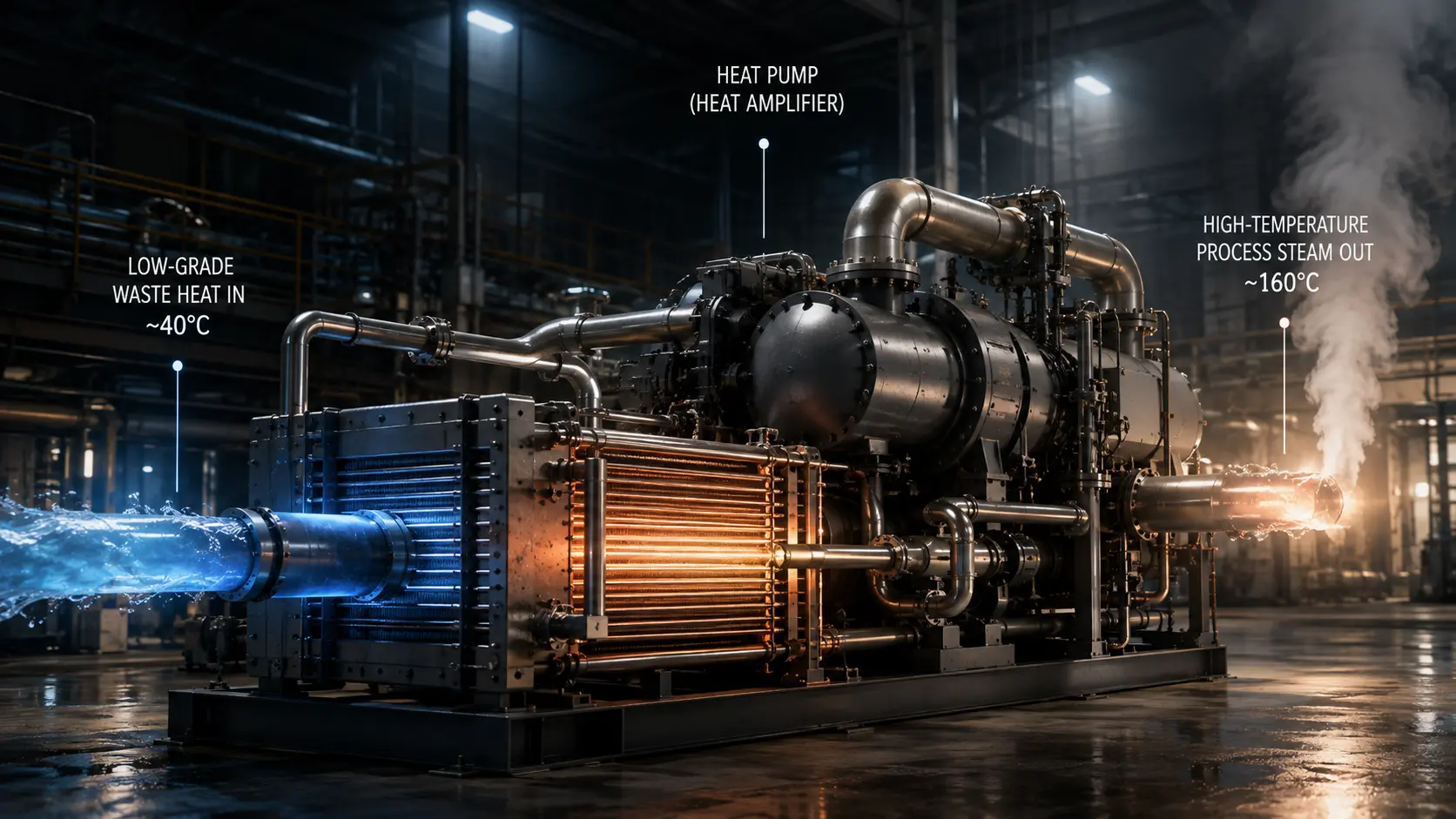
High-Temperature Industrial Heat Pumps (HTHPs) are advanced thermal machines that use a reversed refrigeration cycle to capture low-grade waste heat and compress it into high-temperature process steam. By utilizing electricity to move heat rather than combusting fossil fuels to create it, they provide a highly efficient, zero-carbon alternative to traditional natural gas boilers in manufacturing.
At a Glance
- Concept: Acting as a “heat amplifier,” taking lukewarm waste water from a factory floor, absorbing its thermal energy, and compressing it until it is hot enough to generate industrial process steam.
- Why it matters: Direct electric boilers are 100% efficient (1 unit of electricity makes 1 unit of heat). Heat pumps are 300% efficient (1 unit of electricity makes 3 units of heat). This efficiency is the only way to electrify factories without tripling their energy bills.
- Who uses it: The food and beverage sector (Nestlé, Carlsberg), pulp and paper mills, and light chemical refining industries looking to eliminate natural gas dependencies.
- Biggest takeaway: The physics of heat pumps dictate that the smaller the “Temperature Lift” (the difference between the cold source and the hot destination), the more efficient the machine operates.
In Simple Words
Your kitchen refrigerator is a heat pump. It absorbs the heat from your groceries and pumps that heat out of the back of the fridge, leaving the inside cold and making your kitchen slightly warmer.
An Industrial Heat Pump does the exact same thing, but in reverse and on a massive scale.
Imagine a factory that uses massive vats of water to cool down its machinery. That water heats up to about 40°C. Normally, the factory dumps this lukewarm water into a river (wasting the heat) and then burns expensive natural gas in a separate boiler to create 150°C steam for its manufacturing process.
The heat pump interrupts this waste. It takes that 40°C lukewarm water and runs it through a closed loop of specialized chemicals (refrigerants). An electrical compressor violently squeezes the refrigerant, concentrating the heat until it spikes to 150°C. The factory gets the boiling steam it needs, the wastewater is cooled down, and the entire process uses zero fossil fuels. It doesn’t create heat from scratch; it simply moves and upgrades heat that the factory was already throwing away.
Why This Matters
The “Electrification of Everything” narrative has a massive blind spot: heat. While passenger vehicles and residential home heating are relatively easy to run on electricity, industrial process heat requires immense, concentrated thermal energy.
For ESG Investors and Energy Planners, High-Temperature Heat Pumps (HTHPs) represent the final frontier of industrial decarbonization. As multinational corporations pledge to reach Net Zero emissions by 2040, they are discovering that buying carbon offsets is a temporary, expensive band-aid. True decarbonization requires tearing out the natural gas boilers physically bolted to the factory floor. HTHPs are the only technology that allows an industrial facility to run completely on renewable electricity while maintaining the high-temperature steam required to keep the production lines running.
The Economics of Industrial Heat Pumps: The Spark Spread
The commercial scaling of HTHPs is currently locked in a brutal battle against the “Spark Spread.”
The spark spread is the ratio between the price of electricity and the price of natural gas. In regions like the United States, where natural gas (thanks to shale fracking) is practically free, it is extremely difficult to convince a factory manager to buy a multi-million-dollar electric heat pump, even if it is 300% efficient.
However, in Europe, where natural gas prices are volatile and carbon taxes (like the EU ETS) actively penalize fossil fuel combustion, the spark spread heavily favors electricity. Consequently, European engineering giants like Siemens Energy, MAN Energy Solutions, and Atlas Copco are pioneering the deployment of massive, megawatt-scale HTHPs, aggressively expanding the maximum temperature limits of the technology to capture the global industrial transition.
How High-Temperature Industrial Heat Pumps Work
Extracting useful steam from lukewarm wastewater is governed by the laws of thermodynamics. Here is the first-principles breakdown of the vapor-compression cycle.
1. The Fundamental Problem: The Cost of Electric Heat
If a factory wants to stop burning natural gas, they could simply install a giant electric resistance heater (like a giant toaster coil). However, resistance heating has a maximum theoretical efficiency of 100%. Because industrial electricity is expensive, running a massive factory on 100% efficient electricity will bankrupt the company. The solution must yield >100% efficiency.
2. The Core Mechanism: The Vapor-Compression Cycle
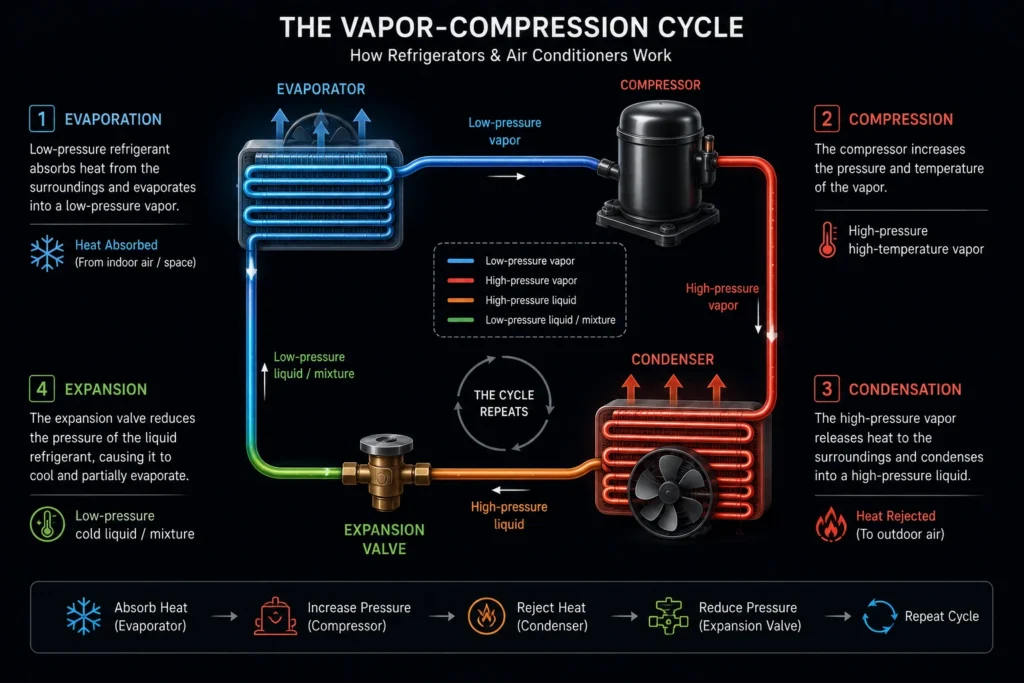
HTHPs utilize a closed-loop thermodynamic cycle consisting of an evaporator, a compressor, a condenser, and an expansion valve. A working fluid (the refrigerant) circulates through this loop.
3. Technical Depth: Evaporation and Compression
- The Evaporator: Lukewarm waste heat (e.g., 50°C) from the factory enters the heat exchanger. The refrigerant inside the loop has a very low boiling point. The waste heat causes the refrigerant to boil and turn into a gas.
- The Compressor: This is where the electricity is used. An industrial compressor violently squeezes the refrigerant gas. Because compressing a gas increases its pressure and temperature simultaneously, the refrigerant spikes to a super-heated state (e.g., 160°C).
4. Technical Depth: Condensation and the COP
- The Condenser: The super-heated 160°C gas passes through a second heat exchanger, transferring its intense heat into the factory’s fresh water supply, instantly boiling it into process steam. As the refrigerant loses its heat, it condenses back into a liquid.
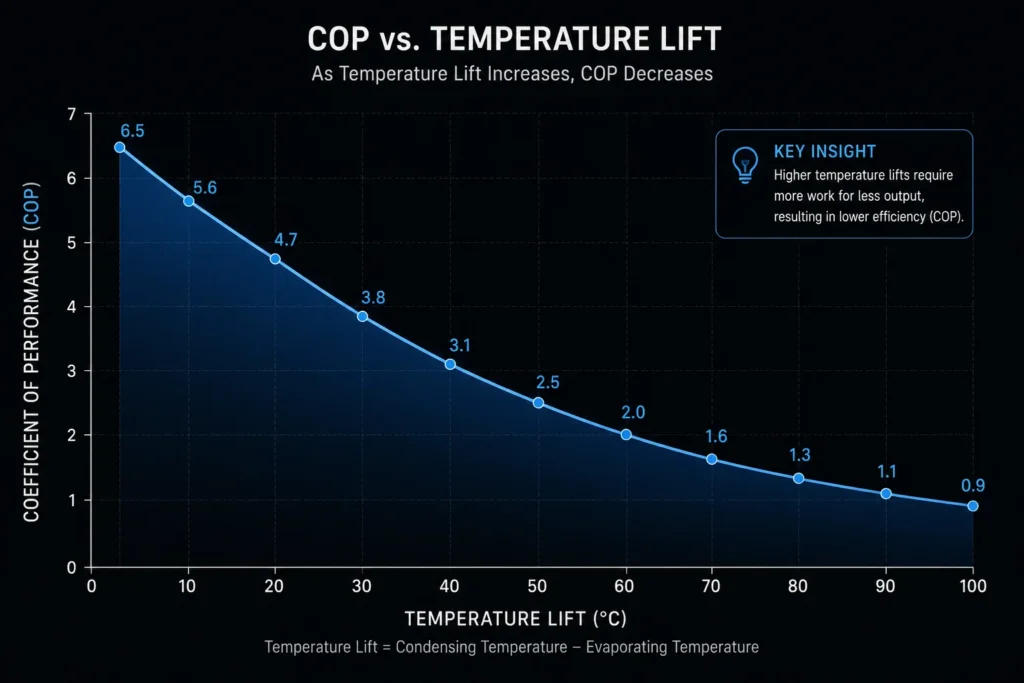
The efficiency of this entire cycle is measured by the Coefficient of Performance (COP). It is the ratio of useful heat provided (QH) to the electrical work required by the compressor (W).
COP = Q_H / W
If a heat pump provides 3 megawatts of heat but only requires 1 megawatt of electricity to run the compressor, the COP is 3.0 (or 300% efficient).
5. Real-World Consequences: The Temperature Lift Penalty
The most critical factor in an HTHP is the “Temperature Lift”—the difference in degrees between the cold waste-heat source and the required hot steam output. The laws of physics dictate that as the required temperature lift increases, the compressor has to work much harder, and the COP drops. A heat pump lifting water from 80°C to 120°C might have a COP of 4.5. But if it has to lift water from 20°C to 160°C, the COP might collapse to 1.8, drastically worsening the economics of the installation.
Commercial Applications for Industrial Heat Pumps
The deployment of HTHPs is actively reshaping the energy flow of light and medium manufacturing.
Food and Beverage Manufacturing: Pasteurization, brewing, and drying processes require massive amounts of steam, usually between 100°C and 150°C. Food plants are the perfect use case for HTHPs because they also require massive amounts of refrigeration to keep ingredients cold. The factory can install a centralized heat pump to simultaneously generate the cold water needed for the refrigerators and the hot steam needed for the pasteurization lines, creating a perfectly balanced, hyper-efficient thermal loop.
Pulp and Paper Mills: Drying wet wood pulp into paper is one of the most energy-intensive processes on Earth. Because the drying process operates continuously at stable temperatures (roughly 140°C), mills can capture the hot, humid exhaust air coming off the drying rollers, run it through an HTHP, and recycle that heat directly back into the drying drums, cutting the mill’s total energy consumption by up to 40%.
District Heating Networks: In Northern Europe, cities are heated by “district heating”—massive networks of underground pipes carrying hot water to homes. Instead of burning coal to heat this water, utility companies are installing gigawatt-scale heat pumps next to massive artificial intelligence data centers. The heat pump absorbs the 35°C waste heat generated by the AI servers, upgrades it to 90°C, and pumps it directly into the city’s heating grid, effectively heating the city using the byproduct of internet computation.
Economic & Strategic Impact
The transition to HTHPs triggers a massive disruption in the Refrigerant Chemical Supply Chain.
Historically, heat pumps used hydrofluorocarbons (HFCs) as the working fluid. However, HFCs are potent greenhouse gases; if they leak, they have a Global Warming Potential (GWP) thousands of times worse than CO2.
Due to strict new environmental regulations (like the Kigali Amendment), the industry is being forced to engineer HTHPs that use “natural refrigerants”—such as ammonia, CO2, or advanced hydrofluoroolefins (HFOs). Designing a compressor that can violently squeeze these new chemicals without the machine exploding or corroding is the primary metallurgical bottleneck of the 2020s. Chemical companies that hold the patents to stable, low-GWP, high-temperature refrigerants currently wield massive pricing power over the industrial hardware sector.
Advantages
- Massive Efficiency Gains: Achieves efficiencies of 200% to 400% (COP 2.0 – 4.0), drastically outperforming the 100% theoretical limit of direct electric boilers.
- Total Decarbonization: Allows heavy industry to sever its reliance on natural gas and coal, eliminating Scope 1 emissions from factory floors when paired with renewable grid electricity.
- Waste Heat Monetization: Transforms cooling wastewater and hot exhaust air from a useless byproduct into a highly valuable energy asset.
Limitations
- The 200°C Hard Limit: Current vapor-compression physics and refrigerant chemistry break down at extremely high temperatures. HTHPs cannot physically generate the 1,000°C+ heat required for heavy industries like cement, steel, and glass manufacturing.
- Massive Capital Expenditure (CapEx): An industrial heat pump is highly complex, requiring specialized compressors and heat exchangers. The upfront cost to install an HTHP is often three to five times higher than buying a standard, cheap natural gas boiler.
- Spark Spread Vulnerability: The operational savings of a heat pump completely vanish if the local price of electricity is too high compared to the price of natural gas, making the technology financially unviable in highly specific geographic regions without government intervention.
Common Misconceptions
Misconception: Heat pumps create heat from electricity.
Reality: They do not create heat; they move heat. The electricity is simply used to power the compressor engine that squeezes the heat from one location to another. This is the sole reason they can achieve efficiencies greater than 100%.
Misconception: Industrial heat pumps can replace all fossil fuels in manufacturing.
Reality: They are strictly limited to low- and medium-temperature processes (typically below 200°C). Heavy industrial processes like smelting steel or forging glass require temperatures exceeding 1,000°C. Those industries must rely on green hydrogen or electric arc furnaces, as a heat pump cannot physically reach those temperatures.
Misconception: Heat pumps don’t work in cold weather.
Reality: While residential air-source heat pumps struggle when pulling heat from freezing winter air, industrial heat pumps pull their heat from the inside of the factory (wastewater, exhaust gas). Because the waste heat source is warm and stable year-round, the outside weather has absolutely no impact on the machine’s efficiency.
What Most People Miss
The strategic value of Thermal Storage Arbitrage.
Factories do not just install heat pumps; they install them alongside massive, insulated water tanks (Thermal Batteries).
Because electricity prices fluctuate wildly throughout the day based on the grid’s Locational Marginal Pricing (LMP), a factory will run its massive 10-megawatt heat pump at maximum capacity during the middle of the night or midday when wind and solar power make electricity practically free. The heat pump fills the massive thermal water tanks with boiling 150°C steam. Later, when the grid gets congested and electricity prices spike, the factory turns the heat pump completely off and simply runs its manufacturing lines using the stored steam from the tanks, effectively isolating the factory from electrical grid volatility.
Comparison Table
| Feature | Natural Gas Boiler | Direct Electric Boiler | High-Temperature Heat Pump |
| Energy Source | Fossil Fuels | Electricity | Waste Heat + Electricity |
| Efficiency (COP) | ~85% (0.85) | ~99% (0.99) | ~250% – 400% (2.5 – 4.0) |
| Carbon Emissions | Massive | Zero (if grid is green) | Zero (if grid is green) |
| Max Temperature | Unlimited (1,000°C+) | Extreme (1,000°C+) | Capped around 160°C – 200°C |
| Upfront Cost (CapEx) | Low | Low to Moderate | Extremely High |
| Operating Cost | Tied to Gas Volatility | Very High (Expensive Power) | Low (Uses 1/3 the electricity) |
Case Study
Situation: A massive multinational dairy and food processing company operated a flagship milk pasteurization plant in Europe. The facility relied entirely on a centralized natural gas boiler to generate the 120°C steam required to sterilize the milk. With the looming introduction of stringent European carbon taxes, the operational expenditure (OpEx) for the natural gas boiler was projected to triple by 2028.
Challenge: Electrifying the plant using standard electric boilers would overwhelm the local municipal electrical grid and increase the monthly energy bill beyond the profit margin of the dairy products.
Solution (The Thermal Loop): The factory engineered a closed thermal loop by installing a megawatt-scale High-Temperature Heat Pump. Instead of pulling heat from the air, the heat pump was connected directly to the effluent wastewater pipes coming off the factory’s refrigeration units (which held water at 45°C).
Outcome: The HTHP compressed the 45°C waste heat, upgrading it to 120°C process steam. The system achieved a Coefficient of Performance (COP) of 3.2. Because it generated over three units of heat for every unit of electricity consumed, the factory’s total energy footprint dropped by 65%. The facility entirely decommissioned its natural gas line, permanently immunizing its operations against future carbon border tariffs.
Lessons Learned: The case study proved that industrial decarbonization is an exercise in thermodynamic auditing. By viewing the factory as a single, interconnected thermal organism—where the cooling systems actively feed the heating systems—manufacturers can mathematically bypass the high cost of industrial electricity and achieve profitable Net Zero operations.
Future Outlook
Next 12–24 Months
The era of Refrigerant Regulation and Retrofits. Over the next two years, the industrial heat pump market will see aggressive product launches centered on ultra-low GWP refrigerants. As environmental agencies phase out legacy hydrofluorocarbons (HFCs), manufacturers like Danfoss and Siemens will push massive ammonia and CO2-based systems. Expect a wave of “plug-and-play” skid-mounted HTHPs designed specifically to be retrofitted into existing factory boiler rooms without requiring a total redesign of the facility’s plumbing.
Next 3–5 Years
The push toward 250°C and Steam Compression. The absolute limit of current technology hovers around 160°C to 200°C. By the end of the decade, the holy grail of thermal engineering—the 250°C heat pump—will achieve commercial scale. This will involve integrating “Mechanical Vapor Recompression” (MVR) technologies directly with the heat pump. By squeezing the generated steam a second time, these systems will unlock decarbonization for medium-heavy industries (like specialized plastics and advanced chemical refining) that are currently entirely dependent on fossil fuels.
Next 10 Years
The Grid-Interactive Industrial Ecosystem. By the mid-2030s, factories equipped with massive HTHPs and thermal storage tanks will become active players in the wholesale electricity market. Because heat pumps can be powered up or down within seconds, grid operators will pay industrial factories to rapidly absorb excess renewable energy on sunny days, or pay them to shut down to prevent grid blackouts. The industrial heat pump will transition from a piece of factory equipment into a vital stabilization asset for the global renewable energy grid.
Most Likely Scenario
High-temperature industrial heat pumps will quietly become the workhorses of the 21st-century clean economy. While they cannot solve the extreme-heat requirements of the steel or cement industries, they perfectly cover the sub-200°C temperature range that accounts for over 40% of all industrial heat demand. As carbon pricing becomes globally standardized, the natural gas boiler will be permanently relegated to obsolescence in light and medium manufacturing.
Key Takeaways
- High-Temperature Industrial Heat Pumps (HTHPs) upgrade low-grade waste heat into high-temperature process steam (up to 200°C), eliminating the need for fossil-fuel boilers.
- They operate identically to a refrigerator in reverse, using electrical compressors and refrigerants to physically move and concentrate thermal energy.
- Because they move heat rather than creating it, HTHPs can achieve efficiencies of 300% or more (a Coefficient of Performance of 3.0), making them vastly cheaper to operate than 100% efficient direct electric heaters.
- The technology is limited by the “Temperature Lift.” If the gap between the cold waste water and the required hot steam is too large, the machine loses efficiency rapidly.
- HTHPs are currently limited to temperatures below 200°C, meaning they are perfect for food, beverage, and paper manufacturing, but useless for smelting steel or glass.
- The economic viability of an HTHP is dictated by the “Spark Spread”—if local electricity is drastically more expensive than local natural gas, the heat pump struggles to compete without carbon tax subsidies.
Glossary
Coefficient of Performance (COP): The metric used to define heat pump efficiency. A COP of 3.0 means that for every 1 unit of electrical energy consumed, the machine outputs 3 units of thermal heat.
Direct Electric Boiler: A machine that uses electrical resistance (like a giant toaster) to boil water. It is 100% efficient but very expensive to operate compared to a heat pump.
Global Warming Potential (GWP): A measure of how much heat a greenhouse gas traps in the atmosphere. Legacy heat pump refrigerants have very high GWPs, forcing the industry to invent natural alternatives.
Mechanical Vapor Recompression (MVR): An advanced process often paired with heat pumps that takes existing steam and mechanically compresses it to increase its pressure and temperature even further.
Spark Spread: The financial difference between the wholesale price of electricity and the price of natural gas. A tight spark spread is required for electric heat pumps to economically outcompete gas boilers.
Temperature Lift: The difference in degrees between the heat source (e.g., 50°C waste water) and the target output (e.g., 150°C steam). A smaller lift yields a much higher COP.
Sources
- International Energy Agency (IEA): The Future of Heat Pumps and Industrial Decarbonization (2025/2026 Analysis)
- European Heat Pump Association (EHPA): High-Temperature Heat Pumps in Industrial Applications
- U.S. Department of Energy (DOE): Industrial Decarbonization Roadmap: Process Heat Alternatives
- Institute for Industrial Productivity: Thermodynamic Limits of Vapor-Compression Cycles in Manufacturing
- Siemens Energy: Large-Scale Heat Pumps and District Heating Integration (2026 Briefs)