Advertisement
)

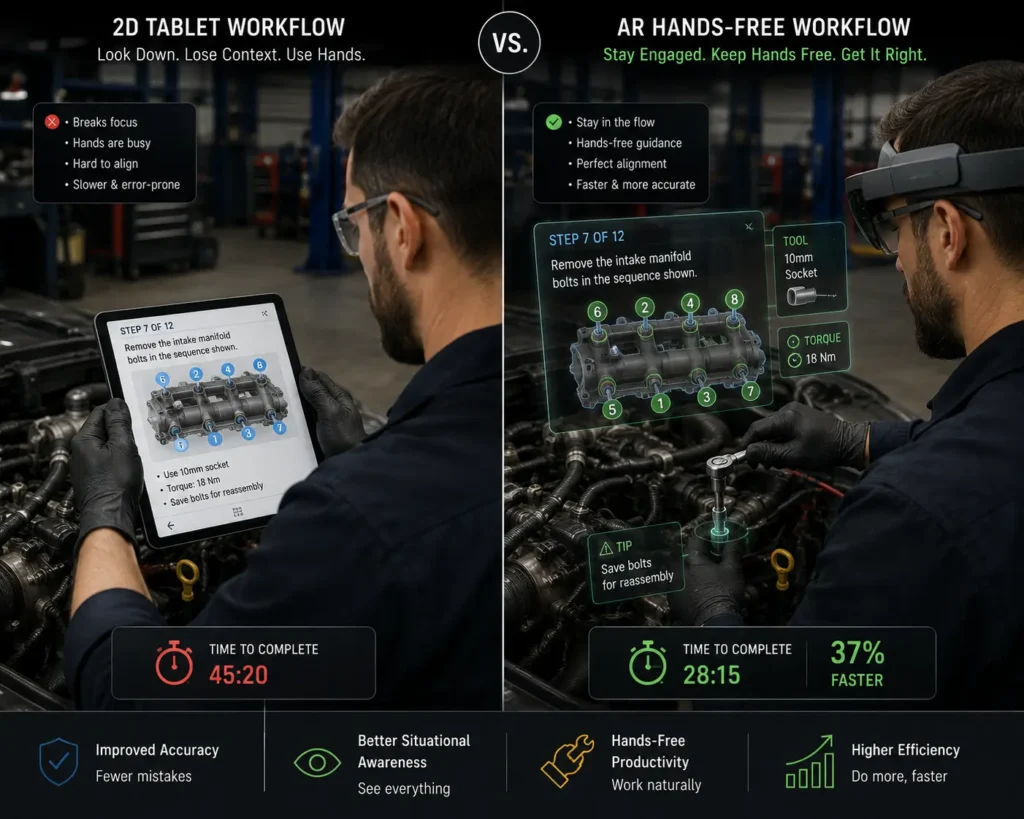
An offshore oil rig is a highly volatile, billion-dollar labyrinth of steel and pressure. If a critical compression pump fails, production halts, and the financial bleed begins instantly, often costing the operator upwards of $100,000 per hour. The mechanic tasked with fixing it is highly skilled but hasn’t serviced this exact model of pump in five years. Historically, this meant flipping through a 500-page paper manual or holding a greasy tablet in one hand while trying to loosen a high-torque bolt with the other. The cognitive disconnect between staring at a 2D schematic and working on a 3D machine is the primary cause of maintenance delays and fatal industrial accidents.
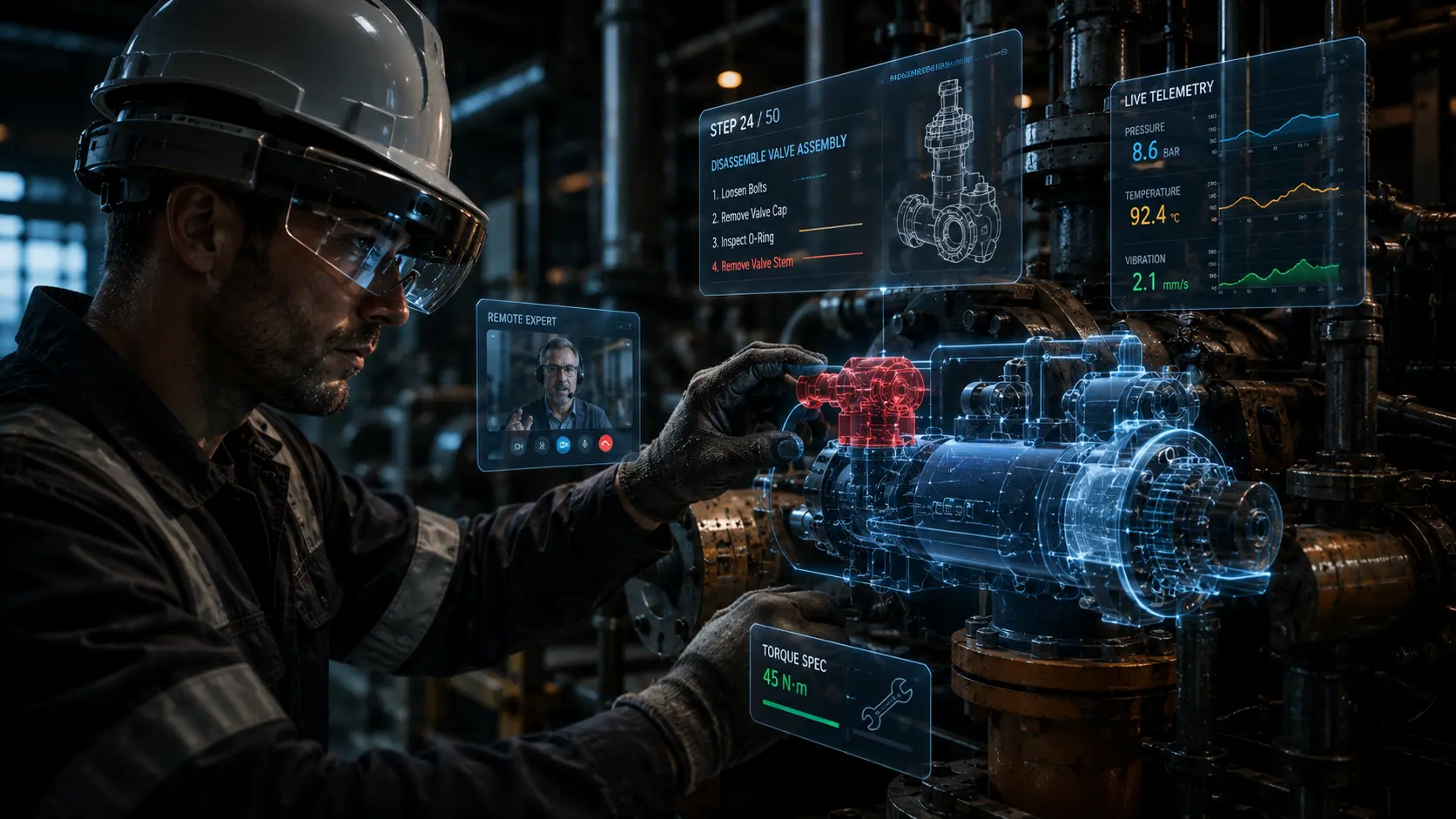
Today, the mechanic doesn’t look at a manual; they put on a pair of smart safety glasses. As they walk up to the broken pump, the glasses map the room, recognize the machine, and project a glowing, 3D holographic arrow pointing exactly to the faulty valve. Beside the valve, live temperature and pressure data float in mid-air. Why should you care right now? Because augmented reality has officially graduated from a consumer gaming gimmick into mission-critical industrial infrastructure. By transforming the physical factory floor into an interactive digital canvas, spatial computing allows frontline workers to execute complex engineering tasks flawlessly on the first try, permanently rewriting the economics of heavy industrial maintenance.
What is Spatial Computing in Heavy Industry?
Spatial computing in heavy industry is the integration of augmented reality (AR) hardware and software with physical manufacturing environments. Utilizing 3D spatial mapping and IoT telemetry, it projects digital twins, live operational data, and hands-free holographic repair instructions directly onto physical machinery, drastically reducing equipment downtime and training requirements.
At a Glance
- Concept: Blending the digital and physical worlds. Head-mounted displays “read” the physical environment and anchor digital information (like schematics or live video feeds from remote experts) onto physical objects.
- Why it matters: It provides a hands-free workflow. Industrial workers need both hands to operate heavy tools safely. Spatial computing delivers critical information directly into their line of sight without requiring them to hold a device.
- Who uses it: Aerospace manufacturers (Boeing, Lockheed Martin), oil and gas conglomerates (Chevron, BP), and automotive assembly lines replacing physical training manuals with immersive 3D guides.
- Biggest takeaway: The true value is not just the 3D graphics; it is the integration with the “Digital Twin.” The headset links the physical machine the worker is touching to the live, cloud-based data model of that exact machine.
In Simple Words
If you use GPS navigation on your phone, you have to look down at the screen, figure out which direction the blue dot is pointing, look back up at the road, and translate the 2D map into a 3D driving decision.
Spatial computing removes the translation step. Instead of looking at a map on a screen, you wear glasses that project a glowing blue line directly onto the physical asphalt in front of your car.
In a massive factory, a mechanic faces the same problem. They have a tablet showing a diagram of an engine, but they have to mentally map that drawing onto the complex, messy engine in front of them. Spatial computing headsets use laser sensors and cameras to instantly recognize the engine. If the mechanic needs to remove a specific bolt, the headset projects a red holographic circle directly over that exact physical bolt. It allows the mechanic to “see” invisible data—like the heat radiating inside a pipe—floating right before their eyes, guiding their hands with absolute precision.
Why This Matters
The global manufacturing sector is facing an unprecedented demographic crisis: the “Silver Tsunami.” The master technicians who understand how legacy industrial equipment works are retiring en masse, taking decades of institutional knowledge with them, while the incoming generation of workers lacks specialized, hands-on experience.
For Plant Managers and Industrial Investors, spatial computing is the only scalable way to bridge this skills gap. Instead of flying a retired expert across the country to fix a specific turbine, the expert can sit in their living room, log into a spatial computing platform, and literally “see” through the eyes of a junior mechanic on the factory floor. The expert can draw a circle on their screen, and that circle appears as a hologram in the junior mechanic’s field of vision. This “Over-the-Shoulder” guidance democratizes expertise, turning every entry-level worker into a master technician.
The Convergence of AR, IoT, and Digital Twins
The foundation of industrial spatial computing relies on the convergence of three previously siloed technologies: Augmented Reality (AR) hardware, Internet of Things (IoT) sensors, and Computer-Aided Design (CAD).
A decade ago, an AR headset could display a floating screen, but it had no context of the physical world. Today, industrial software platforms (like PTC’s Vuforia or Siemens’ Teamcenter) ingest the massive 3D CAD files used to design a factory and feed them into the headset. Because the headset knows the exact mathematical dimensions of the machine, it can perfectly wrap digital data around physical steel. The integration of 5G networking ensures that as the physical IoT sensors detect a pressure spike, the holographic gauge in the worker’s headset updates with sub-millisecond latency.
How Spatial Computing in Heavy Industry Works
Creating an illusion so perfect that a mechanic trusts it with their life requires mastering continuous spatial mathematics and optical physics. Here is the first-principles breakdown of the architecture.
1. The Fundamental Problem: Context Switching
A mechanic performing a 50-step repair must read step 1, memorize it, put the manual down, pick up a wrench, execute step 1, put the wrench down, and find step 2. This context switching breaks concentration, limits situational awareness, and introduces a massive margin for human error in highly volatile environments.
2. The Insufficiency of 2D Screens
Ruggedized laptops and tablets solved the paper problem, but they still occupy a worker’s hands. In heavy industry, holding a tablet while climbing a scaffolding or operating near high-voltage equipment is a severe safety hazard. The data must be integrated directly into the worker’s natural field of view.
3. The Core Mechanism: SLAM and Spatial Anchoring
Head-mounted displays (HMDs) utilize Simultaneous Localization and Mapping (SLAM). The headset fires infrared light (Time-of-Flight sensors or LiDAR) to measure the distance to every wall, pipe, and machine in the room, creating a real-time invisible 3D mesh of the environment.
To place a hologram on a physical pipe, the software calculates the continuous spatial transformation matrix:
P_world = R * P_camera + t
(Where R is the rotation matrix, t is the translation vector, and P_{camera} is the coordinate from the headset’s perspective). This math ensures the digital hologram (P_{world}) stays “anchored” to the physical pipe, even as the mechanic walks around it.
4. Technical Depth: Computer Vision and Occlusion
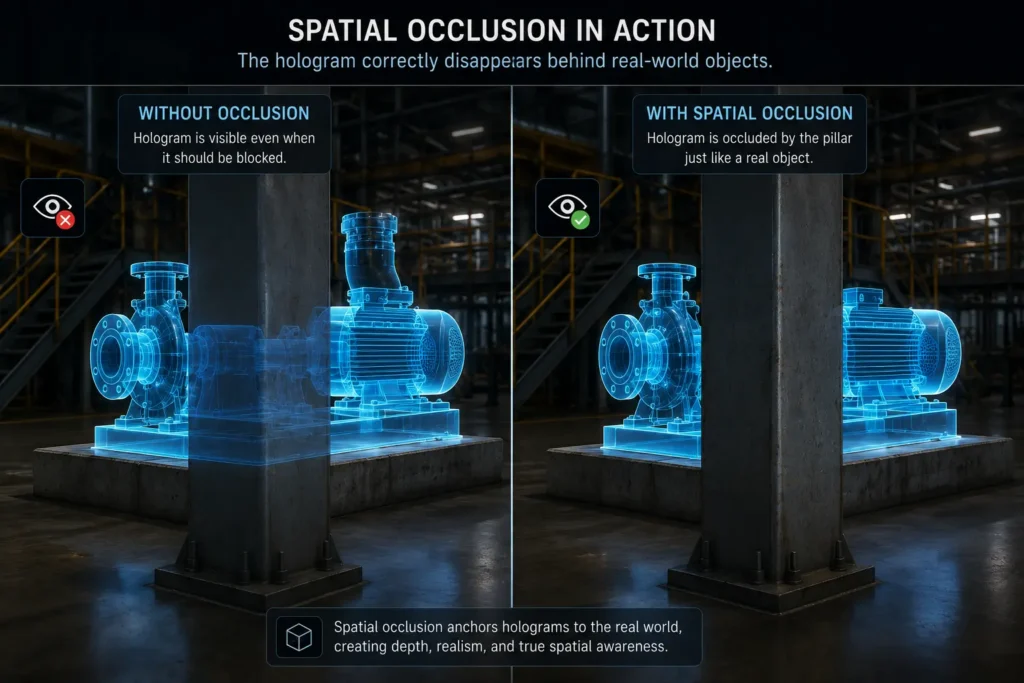
If a mechanic walks behind a steel pillar, a poorly rendered hologram of a pump would float right through the pillar, breaking the illusion. Advanced spatial computing uses Occlusion. Because the SLAM mesh knows the pillar is physically closer to the user’s eye than the pump, the software mathematically deletes the pixels of the hologram that overlap with the pillar. The digital object perfectly disappears behind the physical object, seamlessly integrating the light into the physical depth of field.
5. Real-World Consequences: Step-by-Step Guided Execution
When the mechanic initiates a repair sequence, the spatial application guides them visually. A holographic animation shows the exact wrench required. An animated hand demonstrates the counter-clockwise motion. When the mechanic successfully removes the part, the computer vision verifies the action, checks it off the list, and instantly projects the instructions for the next step, completely eliminating cognitive friction.
Commercial Applications of Augmented Reality Maintenance
The deployment of enterprise AR is optimizing the most heavily capitalized infrastructure on the planet.
Aerospace Manufacturing (Wire Harness Assembly): Building a commercial airliner requires threading miles of complex electrical wiring through the fuselage. Historically, technicians used massive, life-sized physical pegboards to figure out where the wires went. Today, companies like Boeing use spatial computing. Technicians wear headsets that project the exact, color-coded wiring paths directly onto the bare metal of the airplane fuselage. This spatial overlay has reduced wiring production time by 25% and reduced error rates to virtually zero.
Remote Factory Acceptance Testing (FAT): Before a company buys a multi-million dollar manufacturing machine, executives usually fly to the vendor’s facility to inspect it physically. With spatial computing, the vendor puts on a headset, and the buyer logs in remotely from across the globe. The buyer views the 3D spatial feed, directing the vendor to inspect specific tolerances and overlaying the buyer’s own digital 3D models onto the physical machine to ensure it will fit perfectly into their factory floor before it is shipped.
Logistics and Warehouse Order Picking: In massive distribution centers, workers spend the majority of their day simply looking for items. “Vision Picking” replaces handheld barcode scanners. The worker’s smart glasses read QR codes automatically and project a brightly colored holographic path directly onto the warehouse floor, guiding them to the exact shelf and highlighting the specific bin with a glowing digital box, drastically accelerating order fulfillment speed.
Economic & Strategic Impact
The core financial metric driving spatial computing adoption is First-Time Fix Rate (FTFR).
If an industrial machine breaks, an internal mechanic attempts to fix it. If they fail (because the repair is too complex), the plant must call the Original Equipment Manufacturer (OEM) to dispatch an expert. The time waiting for that expert—and the cost of their travel—destroys operational margins.
By equipping frontline workers with spatial computing headsets connected to remote assistance platforms, the internal mechanic becomes the physical avatar for the remote expert. The FTFR spikes dramatically because the expert diagnoses and guides the repair instantly. This eliminates travel costs, slashes equipment downtime, and transforms the maintenance department from an unpredictable cost center into a highly optimized, predictable operational asset.
Advantages
- Hands-Free Operation: Wearable spatial computers allow mechanics to receive vital instructions, view schematics, and communicate with experts while keeping both hands securely on their tools.
- Eliminates the Skills Gap: Empowers junior technicians to perform highly complex, expert-level procedures by projecting the exact spatial workflow into their field of view.
- Reduces Unplanned Downtime: Instant access to remote experts and live IoT telemetry allows plants to diagnose and fix mechanical failures exponentially faster than traditional dispatch methods.
Limitations
- Ergonomic and Environmental Friction: High-end spatial computing headsets (like the HoloLens or Vision Pro) are heavy. Wearing them for an 8-hour shift causes neck strain. Furthermore, transparent holographic displays struggle to compete with blinding, direct sunlight in outdoor environments like oil rigs or construction sites.
- Explosion-Proof Certification (ATEX/IECEx): In chemical plants and refineries, the air is filled with flammable gases. Any electronic device is a potential ignition source. Achieving “intrinsically safe” hardware certifications for spatial headsets is incredibly difficult and drastically limits the types of devices allowed on the factory floor.
- The 3D Content Bottleneck: A spatial computing headset is useless without 3D content. Converting flat PDF manuals or massive, unoptimized engineering CAD files into lightweight, animated 3D holograms requires intense software engineering and 3D modeling resources that most industrial companies lack.
Common Misconceptions
Misconception: Spatial computing completely replaces human workers with AI.
Reality: It does the exact opposite. Spatial computing is an “augmented worker” technology. It accepts that human dexterity and physical intervention are impossible to replace in heavy industry, and instead focuses entirely on making the human worker faster, safer, and smarter.
Misconception: Virtual Reality (VR) and Spatial Computing (AR) are the same thing for industry.
Reality: VR completely blinds the user to the real world, placing them in a 100% digital environment (useful for safe, off-site training). Spatial computing/AR uses transparent lenses or passthrough cameras so the user can see the heavy, dangerous machinery right in front of them, merely overlaying digital data on top of reality. Blinding a worker on an active factory floor is a fatal safety violation.
Misconception: The headsets need massive hard drives to hold all the factory data.
Reality: Modern industrial headsets are largely edge-computing thin clients. The massive 3D models and IoT telemetry streams are stored and rendered in the cloud, streamed down to the headset via 5G networks in real-time, keeping the physical headset lightweight.
What Most People Miss
The strategic convergence of Computer Vision and Predictive Maintenance Auditing.
Spatial headsets are packed with outward-facing cameras constantly scanning the environment to maintain the SLAM tracking mesh.
What most plant managers miss is the secondary value of this video feed. As a mechanic walks the factory floor, the headset is unwittingly capturing petabytes of high-definition visual data of every pipe, valve, and motor. Advanced AI systems running in the background can analyze this passive video feed, spotting microscopic rust on a flange, a tiny oil leak, or an analog gauge reading too high. The spatial computing headset essentially turns every human worker into a mobile, autonomous visual-inspection drone, catching predictive maintenance failures before the human eye ever notices them.
Comparison Table
| Feature | Paper Manuals / 2D Schematics | Rugged Industrial Tablets | Spatial Computing (AR Headsets) |
| Worker Hands | Occupied | Occupied (One hand) | 100% Free |
| Cognitive Load | Extreme (Mental 2D-to-3D translation) | High | Low (Data overlaid on physical asset) |
| IoT Integration | None | Dashboard view | Localized holographic telemetry |
| Remote Support | Voice only (Radio/Phone) | 2D video call | “See-What-I-See” with 3D annotations |
| Environmental Hazard | High risk of damage/loss | Drop/Shatter risk | Intrinsically safe, wearable integration |
Case Study
Situation: A leading global semiconductor manufacturer operated cleanrooms where massive, highly sensitive lithography machines ran 24/7. When a machine required preventive maintenance or calibration, the process was incredibly complex, requiring hundreds of precise steps. A single miscalibrated laser could ruin millions of dollars of silicon wafers.
Challenge: Due to cleanroom contamination protocols, bringing a physical paper manual inside was prohibited, and navigating through hundreds of pages on a localized cleanroom terminal required the technician to constantly walk away from the machine, breaking their physical focus and elongating the maintenance window.
Solution (The Spatial Overlay): The manufacturer deployed an enterprise spatial computing platform utilizing Microsoft HoloLens 2 headsets. They integrated their 3D engineering CAD models directly into the workflow software.
Outcome: When the technician approached the lithography machine, the headset recognized the asset and overlaid a 1:1 scale digital twin. The spatial software guided the technician through the calibration sequence, projecting floating, color-coded outlines over the exact screws that needed turning, complete with animated torque specifications.
Lessons Learned: The deployment demonstrated that reducing cognitive friction directly translates to hard capital savings. By eliminating the context-switching between the terminal and the machine, the manufacturer reduced the calibration time by 35%. More importantly, the spatial verification eliminated “sequence-of-events” errors, practically guaranteeing absolute compliance in a zero-margin-for-error environment.
Future Outlook
Next 12–24 Months
The era of Generative AI Spatial Assistants. Currently, workers must manually select the workflow or command the headset to pull up a specific schematic. Over the next two years, spatial computing platforms will integrate Multimodal Large Language Models (like GPT-4o or Gemini). A mechanic will simply look at a broken pump and ask out loud, “What is wrong with this?” The headset’s camera will feed the image to the AI, which will cross-reference the machine’s historical maintenance logs, diagnose the visual leak, and instantly generate the specific 3D repair workflow hologram without the worker ever touching an interface.
Next 3–5 Years
The scaling of Contact Lens Form Factors and Micro-OLED. The heavy, bulky visors of the 2020s will give way to lightweight “Smart Glasses” that look indistinguishable from standard safety eyewear. Driven by breakthroughs in Micro-OLED displays and pancake optics, the processing power will be entirely offloaded to a small puck worn on the belt (or the worker’s 5G smartphone). This drastic reduction in weight will eliminate ergonomic fatigue, allowing spatial computing to become a mandatory, all-day piece of Personal Protective Equipment (PPE) for every worker on the floor.
Next 10 Years
The Autonomous Human-Robot Teaming Interface. By the mid-2030s, factory floors will be highly populated by autonomous humanoid robots and robotic manipulator arms. Spatial computing headsets will serve as the primary interface for human-machine teaming. If an autonomous robot gets stuck on a task, the human worker will look at the robot, and the headset will project the robot’s intended “path” as a green holographic line on the floor. The human can simply use a hand gesture in mid-air to “drag and drop” the holographic line to a safe route, instantly updating the robot’s internal navigation algorithm.
Most Likely Scenario
Spatial computing is to the industrial frontline worker what the desktop PC was to the office worker. As the physical hardware sheds its bulk and 5G networks achieve ubiquitous low-latency rendering, the concept of repairing machinery without localized, holographic data overlays will seem as archaic as navigating a cross-country road trip using a paper map.
Key Takeaways
- Spatial computing in heavy industry uses Augmented Reality (AR) headsets to overlay 3D digital twins, step-by-step repair guides, and live IoT data directly onto physical machinery.
- By keeping the mechanic’s hands free and eliminating the need to look away at a manual, spatial computing slashes Mean Time To Repair (MTTR) by 30% to 40%.
- The technology relies on Simultaneous Localization and Mapping (SLAM) to understand the 3D geometry of a room, mathematically locking holograms to specific physical coordinates.
- “Over-the-shoulder” remote assistance allows a master expert sitting thousands of miles away to see through the worker’s headset camera and draw holographic annotations in the worker’s field of view.
- The primary bottleneck to adoption is creating the 3D content; converting massive, complex engineering CAD files into lightweight, animated holograms requires significant software infrastructure.
- Spatial headsets act as passive inspection drones; their outward-facing cameras capture factory data that AI analyzes in the background for predictive maintenance failures.
Glossary
Augmented Reality (AR): Technology that overlays digital information (images, text, 3D models) onto the real world, typically through transparent lenses or passthrough cameras, allowing the user to remain fully aware of their physical surroundings.
Digital Twin: A real-time, highly detailed virtual representation of a physical object or system. In spatial computing, the digital twin is often overlaid perfectly on top of the physical machine it represents.
First-Time Fix Rate (FTFR): A critical maintenance metric measuring the percentage of times a technician successfully repairs a piece of equipment on their first attempt, avoiding costly return trips.
Internet of Things (IoT) Telemetry: Real-time data (such as pressure, temperature, or vibration) transmitted by physical sensors attached to industrial machinery.
Occlusion: The spatial computing process where a digital hologram is mathematically hidden when a physical object (like a wall or a person’s hand) passes in front of it, creating a seamless depth illusion.
Simultaneous Localization and Mapping (SLAM): The computational algorithm used by headsets and robots to map an unknown environment in 3D while simultaneously keeping track of their own exact location within that map.