Advertisement
)
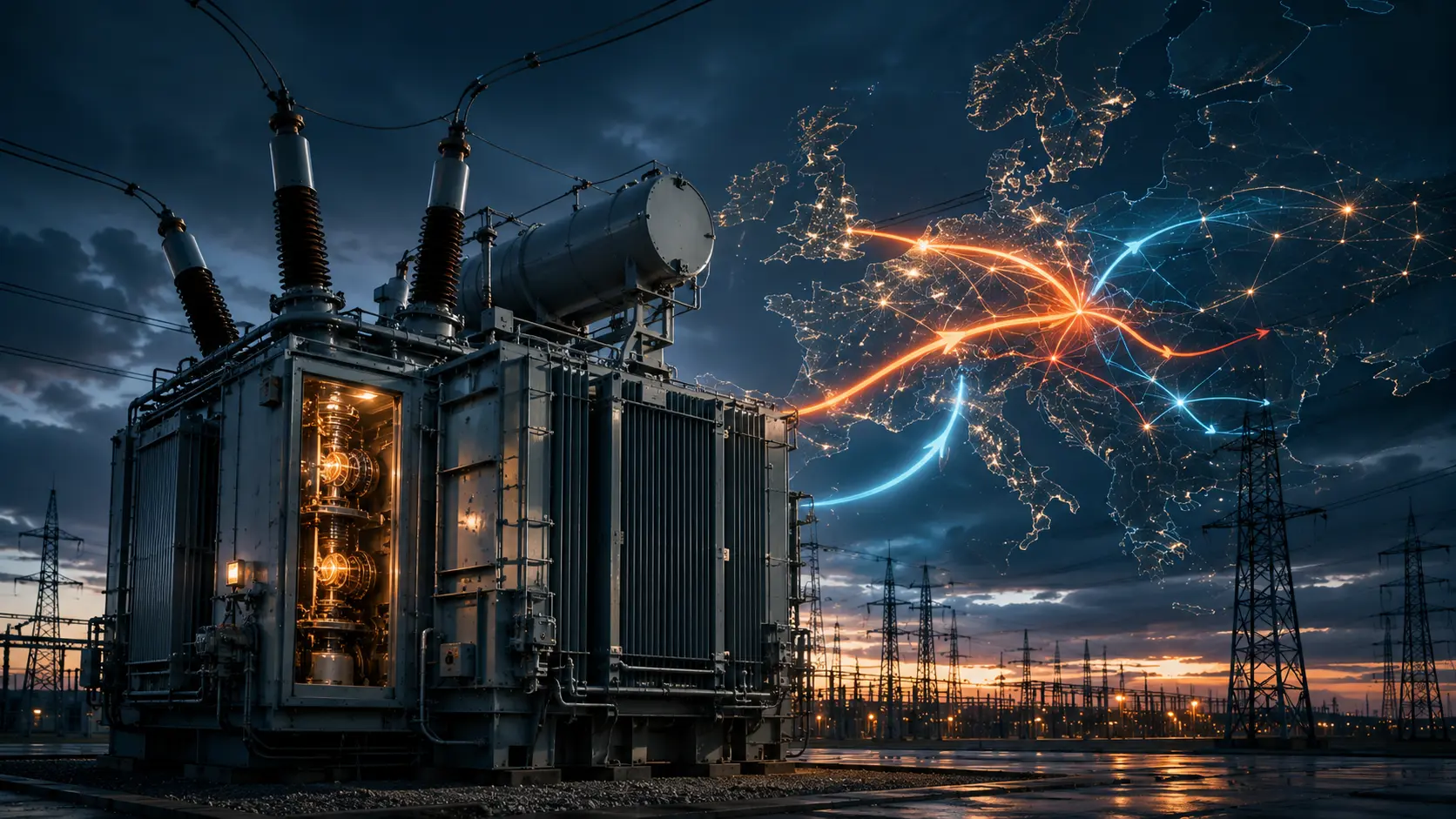

Electricity is fundamentally lazy. It always takes the path of least resistance. When a massive offshore wind farm in northern Germany generates surplus power for factories in the south, that electricity does not politely stay on domestic power lines. Instead, it spills across international borders into Poland and the Czech Republic, flooding their transmission grids with unwanted “loop flows” and pushing foreign infrastructure to the brink of a catastrophic blackout. You cannot simply ask electrons to change direction. To prevent regional grid collapse, engineers must physically alter the physics of the transmission network.
Enter the Phase-Shifting Transformer (PST). These are not standard voltage step-down boxes; they are colossal, mechanical valves for continental electricity. By physically injecting a perpendicular voltage into the line, PSTs alter the phase angle of the current, tricking electricity into taking a longer, underutilized path. Why should you care right now? Because as the world rapidly transitions to intermittent renewable energy, the legacy grid is choking on its own congestion. PSTs allow grid operators to physically route gigawatts of power around bottlenecks, unlocking trapped capacity, saving billions in immediate infrastructure upgrades, and keeping the international lights on.
What are Phase-Shifting Transformers (PSTs)?
Phase-Shifting Transformers (PSTs) are specialized high-voltage devices used to control the flow of active power across alternating current (AC) transmission networks. Also known as quadrature boosters, they operate by injecting a perpendicular voltage to alter the phase angle between the sending and receiving ends, forcing electricity to reroute away from congested lines.
At a Glance
- Concept: Massive electrical machines that act as traffic cops for the power grid, forcing electrons to travel down specific, less-crowded transmission corridors.
- Why it matters: They mitigate dangerous loop flows across interconnected grid systems and drastically increase the usable capacity of existing infrastructure without requiring new, highly controversial overhead power lines.
- Who uses it: Transmission System Operators (TSOs) across Europe (ENTSO-E) and North America, managing heavily meshed grids and cross-border power trading markets.
- Biggest takeaway: A standard transformer only alters voltage magnitude (amplitude); a PST primarily alters the voltage phase angle, which directly dictates the flow of active power across the grid.
In Simple Words
Imagine a highway system connecting two major cities. There is a straight, three-lane highway, and a winding, scenic two-lane detour. Naturally, all the cars (electricity) try to take the straight highway (the path of least resistance), causing a massive traffic jam, while the scenic detour remains completely empty.
A Phase-Shifting Transformer acts like a physical toll booth combined with a traffic director.
If the main highway is about to overload, the grid operator uses the PST to effectively increase the “resistance” or delay on the straight path. This forces the excess cars to take the scenic detour. By actively steering the traffic, the operator prevents the main highway from coming to a standstill and perfectly balances the load across all available routes. In a power grid, instead of physical gates, the PST uses magnetic fields and injected voltage to “push” the electricity onto parallel, underutilized power lines.
Why This Matters
For Grid Planners and Energy Investors, transmission congestion is the silent killer of the renewable energy transition.
When a transmission line is full, grid operators are forced to pay wind and solar farms to shut down (curtailment) and simultaneously pay expensive fossil fuel plants on the other side of the bottleneck to turn on (redispatch). These congestion management costs total billions of dollars annually. Building new high-voltage transmission lines takes up to 15 years due to permitting and environmental lawsuits. PSTs can be installed at existing substations in a fraction of the time. By unlocking hidden capacity in the existing grid, PSTs deliver immediate, massive operational savings and protect the financial returns of renewable energy assets.
The Strategic Value of Phase-Shifting Transformers
The true strategic value of PSTs is realized in highly meshed, multi-national power grids.
In interconnected regions like Europe, the electricity market is liberalized, meaning power is traded continuously across borders. However, the electricity physically flows according to Kirchhoff’s circuit laws, entirely ignoring commercial contracts and national borders. These uncontracted, physical spillover flows—known as “wheel flows” or “loop flows”—can destabilize neighboring countries. PSTs serve as the physical border control. By installing PSTs at the interconnect points between countries, nations can physically block rogue electricity from invading their grid, enforcing sovereign control over their national transmission stability.
How Phase-Shifting Transformers Control Active Power Flow
Steering gigawatts of power moving at the speed of light requires manipulating the fundamental equations of alternating current (AC) power flow. Here is the first-principles breakdown of the architecture.
1. The Fundamental Problem: Active Power Flow
In an AC transmission system, active power (P) naturally flows from a location with a higher voltage phase angle to a location with a lower voltage phase angle. The simplified power-flow relationship is mathematically defined as:
P = (V1 * V2 / X) * sin(δ)
(Where V1 and V2 are the voltage magnitudes at the sending and receiving ends, X is the reactance of the transmission line, and δ is the phase angle difference between the two ends)
2. The Insufficiency of Standard Transformers
A conventional power transformer is designed only to step voltage magnitudes up or down (changing V1 or V2). However, altering the magnitude primarily affects reactive power. It does almost nothing to control the direction of active power (real, usable electricity). To change active power, you must manipulate the phase angle (δ).
3. The Core Mechanism: Quadrature Voltage Injection
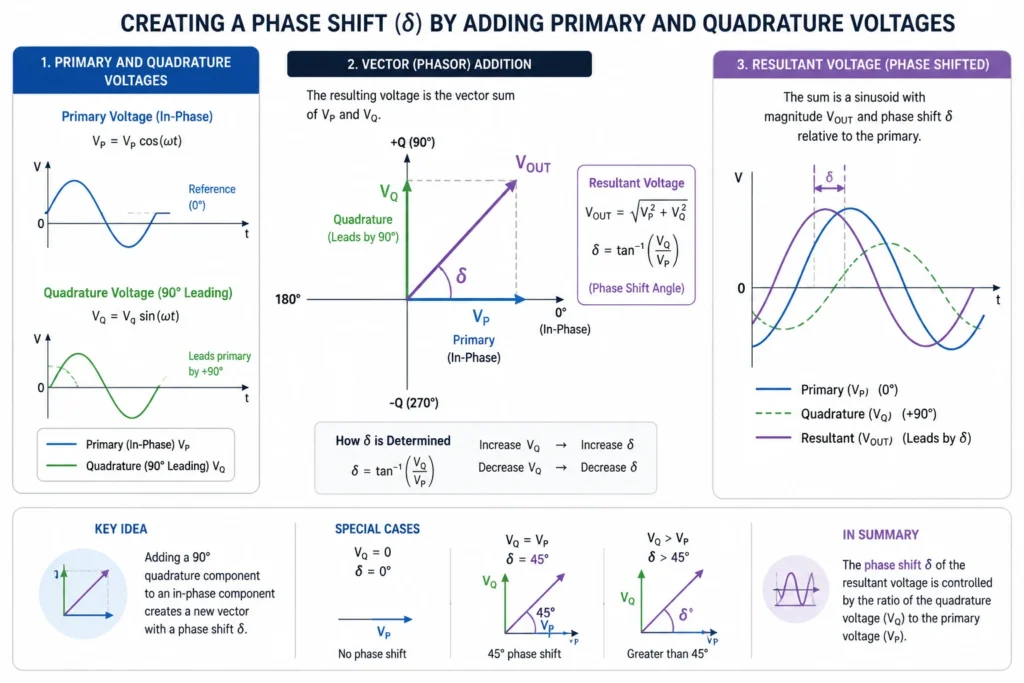
A Phase-Shifting Transformer, also called a Phase Angle Regulating Transformer (PAR), achieves angle manipulation by injecting an additional voltage component in series with the transmission line. Crucially, this injected voltage is shifted by exactly 90 degrees (in “quadrature”) relative to the system’s primary line-to-neutral voltage.
4. Technical Depth: Exciter and Series Units
Large-scale PSTs are often built as a two-core design (indirect PST):
- Exciter (Shunt) Unit: Connected in shunt (parallel) across the phases. It draws a small amount of power and uses it to generate the 90-degree phase-shifted voltage.
- Series Unit: The phase-shifted output from the shunt unit is fed into this unit. Because its secondary winding is in series with the main circuit, it injects the phase-shifted component directly into the line.
When the primary voltage and the injected 90-degree voltage are added together via vector addition, the resulting output voltage has a new, shifted phase angle.
5. Real-World Consequences: The On-Load Tap Changer (OLTC)
To actively control how much power is pushed or pulled, the PST relies on an On-Load Tap Changer mechanism. This massive mechanical switch physically moves between different winding connections inside the transformer while power is actively flowing. By changing the taps, the operator increases or decreases the amplitude of the injected quadrature voltage, which in turn increases or decreases the final phase angle (δ), precisely throttling the megawatts flowing down the line.
Grid Congestion Management Applications for PSTs
PSTs are the ultimate curative and preventive control mechanisms for modern grid operators.
Mitigating Cross-Border Loop Flows: In Central and Eastern Europe (CEE), massive wind generation in Germany often creates severe, unpredictable loop flows through the Polish and Czech transmission systems. To protect their domestic grids from overloading, operators planned and installed massive sets of PSTs at the border interconnections (such as the Mikulowa–Hagenwerder and Krajnik–Vierraden lines). These devices physically repel the unscheduled German wind power, forcing it back onto German lines and restoring stability to the Eastern European grid.
Parallel Line Balancing: If a utility has a high-capacity 400 kV overhead line running parallel to an older underground cable circuit, the electricity will naturally favor the path with the lowest impedance, potentially overloading one line while the other sits half-empty. By installing a PST, operators introduce a phase shift that allows direct control over the division of power flow between the two paths, preventing overload and maximizing total asset utilization.
Post-Fault Curative Actions: Transmission networks operate on the “N-1” security criterion, meaning the grid must survive the sudden loss of any single major component. If a major line trips, power instantly floods into neighboring lines, risking a cascading blackout. PSTs equipped with automatic regulation logic can detect the loading limits and initiate step changes to throttle power flow, rescuing stressed network elements and preventing system collapse.
Economic & Strategic Impact
The primary financial value of a PST lies in CapEx Deferral and Redispatch Avoidance.
Building a new 100-mile, high-voltage transmission line can cost well over $500 million and require a decade of environmental assessments and eminent domain battles. A massive Phase-Shifting Transformer costs roughly $6 million to $9 million (up to $20 million for extreme high-capacity multi-GVA units) and can be installed entirely within the footprint of an existing substation.
By actively balancing the network, a single PST can unlock hundreds of megawatts of hidden transfer capacity on existing wires. This defers the massive Capital Expenditure (CapEx) of new line construction and slashes the daily Operational Expenditure (OpEx) spent on fossil-fuel redispatch measures, creating one of the fastest return-on-investment (ROI) profiles of any heavy grid hardware.
Advantages
- Active Congestion Management: Provides grid operators with a targeted tool to actively increase (boost) or decrease (buck) active power flow on specific transmission lines, completely independent of generator output.
- Grid Stability Enforcement: Allows sovereign grid operators to threaten or execute the installation of a phase shifter to block “inadvertent energy” flows forced upon them by unwilling interchange partners, defending regional stability.
- Enables Renewable Integration: By forcing power toward available transmission capacity, PSTs prevent renewable energy curtailment and ensure variable wind and solar assets can consistently deliver power to market.
Limitations
- Mechanical Wear: The On-Load Tap Changer (OLTC) is a massive mechanical switch. Frequent tapping to adjust to fluctuating wind power causes significant mechanical wear, creating a risk of “hunting” (overshooting the regulation dead band, causing continuous, damaging tap changes) if the automated controls are not optimized.
- Response Time: Because they rely on physical, mechanical switches (OLTCs), PSTs take several seconds to execute a tap change and adjust their phase angle. They cannot react instantaneously (in milliseconds) to transient stability events like a solid-state power electronics device could.
- Size and Transport: Large, two-core PSTs are some of the most colossal and heavy pieces of equipment on Earth. Transporting a multi-ton transformer from the factory to a remote substation often requires specialized rail cars, bridge reinforcements, and months of logistical planning.
Common Misconceptions
Misconception: PSTs generate or consume electricity.
Reality: PSTs are purely routing devices. They do not generate active power. They simply alter the phase angle to redirect the power that is already generated by external power plants.
Misconception: Phase-shifting transformers alter the grid frequency (Hz).
Reality: Phase-shifting transformers strictly do not change system frequency (e.g., 60Hz in the US, 50Hz in Europe). They only alter the phase angle between voltages in the network to control the flow of active power.
Misconception: They are only used to block power.
Reality: While they are often used defensively to block unwanted loop flows (reducing or “bucking” the phase angle), they can also be used offensively to “pull” power (increasing or “boosting” the phase angle), actively drawing more electricity onto a specific, highly rated transmission corridor.
What Most People Miss
The distinction between Active and Reactive Power Control.
Standard components on the grid—like capacitor banks or traditional transformer tap changers—are designed to manage voltage magnitude, which primarily controls reactive power (VArs). Reactive power is necessary to maintain voltage stability, but it does not do actual “work” (like spinning a motor or lighting a bulb).
What most analysts miss is that PSTs are specifically built to target active power (Watts). By shifting the angle rather than the amplitude, PSTs manipulate the actual, usable energy flowing across the continent. This makes them a commercial tool as much as a technical one, allowing TSOs to perfectly align physical electron flows with the commercial trading schedules established by international energy markets.
Comparison Table
| Feature | Conventional Transformer | Phase-Shifting Transformer (PST) | Flexible AC Transmission System (FACTS) |
| Primary Function | Step voltage magnitude up/down | Alter voltage phase angle | Dynamic, instant flow/voltage control |
| Controls Active Power? | No | Yes (Mechanically) | Yes (Solid-state electronics) |
| Response Time | Slow (if equipped with OLTC) | Slow (Seconds via mechanical OLTC) | Instantaneous (Milliseconds) |
| Cost Profile | Baseline | Moderate to High ($6M – $20M+) | Extremely High |
| Maintenance Need | Low | Moderate (OLTC wear) | High (Complex power electronics) |
Case Study
Situation: Following the rapid expansion of variable wind energy in northern Germany, the German transmission grid lacked the intra-country transmission capacity required to transport the power to the industrial hubs in the south. Consequently, the electricity followed the path of least resistance, flooding eastward into the Polish and Czech national grids, creating massive, unscheduled “loop flows”.
Challenge: These unscheduled flows consumed physical transmission capacities on the interconnectors, preventing Poland and the Czech Republic from utilizing their own lines for domestic power trading and pushing their networks dangerously close to critical operational threats.
Solution (The Border PSTs): Rather than waiting a decade for Germany to construct internal transmission corridors, the Polish Transmission System Operator (PSE) and the Czech operators took defensive action. The Polish and German TSOs planned the installation of four sets of PSTs on their common border, including double-circuit lines at Mikulowa–Hagenwerder and Krajnik–Vierraden.
Outcome: By adjusting the phase angle, the PSTs successfully controlled the active power flows. Changing the phase angle allowed the operators to forcefully repel the German loop flows, effectively reducing unscheduled cross-border flows. The operation restored sovereign control over the Eastern European transmission corridors, ensuring domestic grid stability and reopening capacity for legitimate, market-driven commercial power trading.
Lessons Learned: The deployment proved that in highly meshed international grids, physics overrides politics. Sovereign grid stability cannot rely on neighboring countries to balance their own generation; it requires hard, physical infrastructure at the borders to act as a definitive routing valve for active power.
Future Outlook
Next 12–24 Months
The era of Dynamic Line Rating Integration. Currently, PSTs are often adjusted based on conservative, static, seasonal assumptions. Over the next two years, grid operators will increasingly integrate PST control systems directly with Dynamic Line Rating (DLR) sensors and SCADA interfaces (like DNP3 protocol integration). By feeding real-time wind speed and temperature data from the transmission lines into the PST’s algorithms, the mechanical valves will tap continuously to maximize power flow exactly up to the physical thermal limits of the wire in real-time, safely squeezing every available megawatt out of the existing infrastructure.
Next 3–5 Years
The scaling of Thyristor-Assisted PSTs. The primary weakness of a traditional PST is the slow, mechanical wear of the On-Load Tap Changer (OLTC) when attempting automatic regulation against a volatile dead-band. By the late 2020s, manufacturers will increasingly deploy hybrid models combining traditional robust transformers with solid-state thyristor switches. These thyristor-assisted tap changers will allow the PST to shift phase angles in milliseconds with zero moving parts, providing the lightning-fast transient stability response of an expensive FACTS device at a fraction of the cost.
Next 10 Years
The Automated Algorithmic Routing Mesh. By the mid-2030s, individual TSOs will no longer manually adjust their border PSTs in isolation. Across continents like Europe, coordinated operation of PSTs will be linked to a centralized, AI-driven security coordinator. This algorithmic mesh will autonomously calculate power flow equations for the entire continent simultaneously, continuously adjusting the phase angles of PSTs across a dozen countries in perfect synchrony (operating in coordinated parallel or opposition) to automatically route renewable energy away from localized storms and toward high-demand urban centers without human intervention.
Most Likely Scenario
Phase-Shifting Transformers will remain the pragmatic, heavy-metal backbone of congestion management. While advanced power electronics (like HVDC lines) grab the headlines, the robust reliability and superior cost-benefit ratio of PSTs guarantee they will be the primary weapon grid operators use to survive the chaotic, multidirectional power flows of the renewable energy transition over the next decade.
Key Takeaways
- Phase-Shifting Transformers (PSTs) control the flow of active power by altering the phase angle between the sending and receiving ends of a transmission line.
- They act as mechanical valves, injecting a quadrature (90-degree shifted) voltage into the line to forcefully route electricity away from congested corridors and onto underutilized paths.
- PSTs are critical for managing “loop flows” in highly meshed, multi-national grids (like Central Europe), protecting sovereign infrastructure from unscheduled power surges.
- Unlike conventional transformers that primarily step voltage magnitude up or down, a PST specifically
targets the angle (δ)to manipulate active, usable megawatts. - Adjustments are made using an On-Load Tap Changer (OLTC), a heavy mechanical switch that alters the injected voltage amplitude while power is flowing.
- By unlocking hidden capacity on existing wires, PSTs allow grid operators to defer multi-billion-dollar transmission line upgrades and avoid expensive renewable curtailment.
Glossary
Active Power: The actual, usable electricity (measured in Megawatts or MW) that performs real work on the grid, such as powering homes and spinning industrial motors.
Loop Flows (Unscheduled Flows): Unplanned, physical electricity flows that spill across interconnected international borders due to the laws of physics, often blocking physical transmission capacities and ignoring commercial trading agreements.
On-Load Tap Changer (OLTC): A heavy-duty mechanical switch mechanism inside the transformer that allows it to change its winding connections—and thus alter the phase angle—without interrupting the flow of power.
Phase Angle (δ): The angular difference between the voltage waveforms at two different points on the grid. Active power always flows from a larger phase angle to a smaller one.
Quadrature Voltage: A voltage that is mathematically shifted by exactly 90 degrees relative to the primary system voltage. Injecting this is the core mechanism by which a PST alters the phase angle.
Redispatch: The incredibly expensive process where a grid operator pays a wind farm to shut down due to a transmission bottleneck, and pays a fossil fuel plant on the other side of the bottleneck to turn on.
Frequently Asked Questions
Does a Phase-Shifting Transformer create new electricity?
No. PSTs are purely routing devices. They do not generate active power. They simply alter the phase angle to redirect the power that has already been generated by external power plants.
How much does a PST cost?
The capital cost of a quadrature booster can be highly significant, historically ranging from roughly $6 to $9 million for units rated over 2 GVA, though modern ultra-high-capacity installations can easily exceed this range.
Can PSTs completely stop power from crossing a border?
They can significantly reduce and control active power flows to maintain them below safe operational limits (e.g., maintaining flows below 1300 MW in summer), but completely severing ties requires opening physical circuit breakers.
Why don’t we just build more power lines instead?
Building new high-voltage transmission lines takes over a decade due to environmental reviews, permitting delays, and community opposition. PSTs can be installed inside existing substations much faster, providing an immediate solution to congestion.
Are these machines automated?
While historically manually controlled, modern PST installations increasingly use automatic regulation logic (often communicating via SCADA systems) to continuously maintain power flow at a specific operator set point, utilizing adaptive bandwidth logic to prevent the tap changers from “hunting” or overworking.
Sources
[1] ResearchGate: Impact of phase shifting transformers on cross-border power flows in the Central and Eastern Europe region
[2] Wikipedia: Quadrature booster
[3] TutorialsPoint: Phase Shifting Transformer (Quadrature Booster)
[4] Schweitzer Engineering Laboratories (SEL): Innovative Power Flow Regulating Tap-Changer Control Installed on Multiple Phase-Shifting Transformers