Advertisement
)
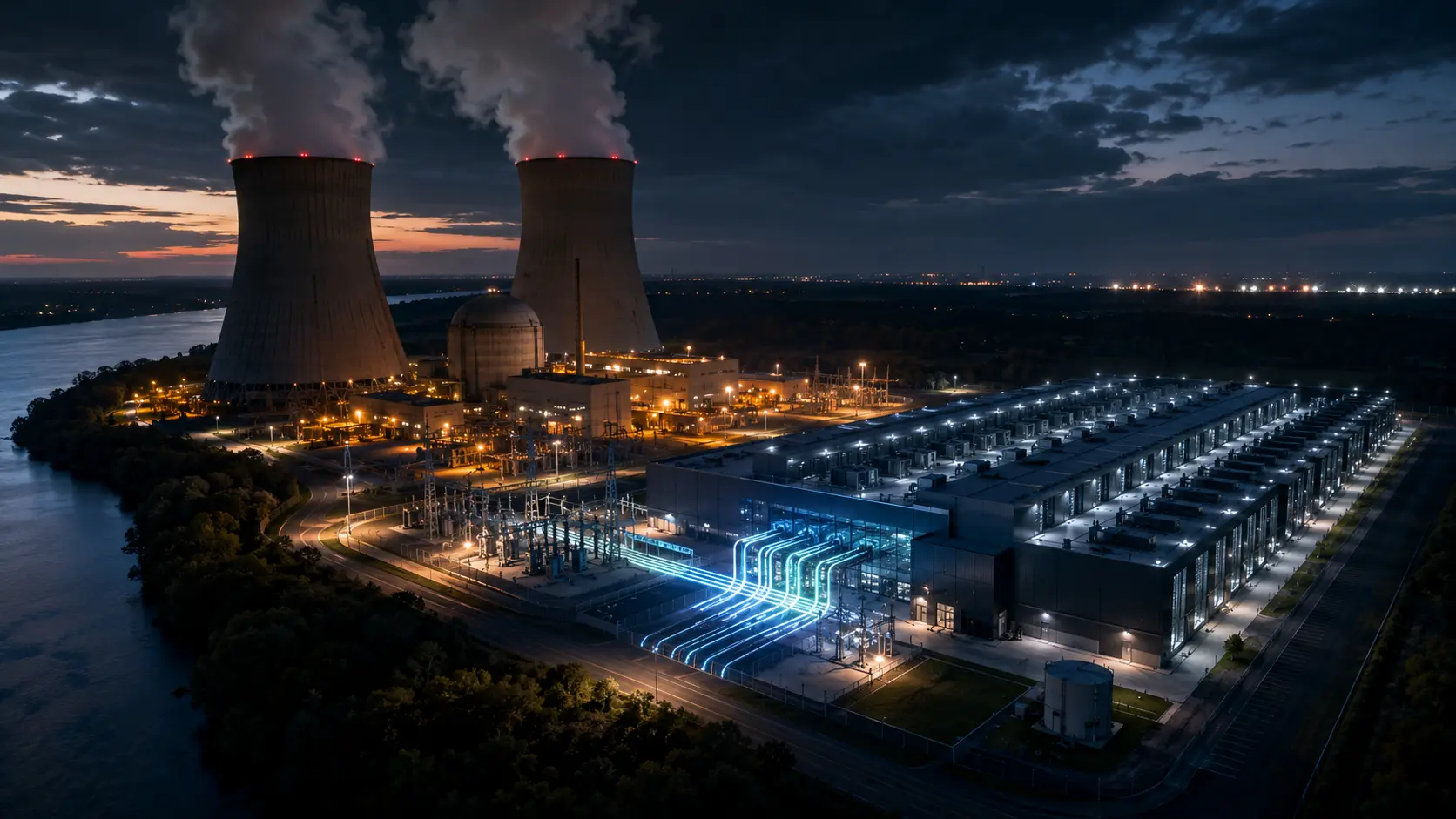

The American electrical grid is effectively full. If you are a hyperscale tech company looking to build a new gigawatt-scale artificial intelligence data center, you cannot simply plug it into the wall. Local utilities will place your project into an “interconnection queue”—a bureaucratic waiting room—and tell you that the transmission wires required to deliver your power will not be built until 2030. In the AI arms race, a five-year delay is an eternity. Forced to choose between waiting for the public grid to catch up or finding their own power, the world’s largest tech companies have decided to secede from the grid entirely.
Why should you care right now? Because Silicon Valley is quietly executing the most aggressive infrastructure land-grab in modern energy history. Tech giants are buying up the physical land directly adjacent to the country’s largest nuclear power plants. By plugging their data centers directly into the atomic reactors—an arrangement known as “behind-the-meter” co-location—they secure limitless, zero-carbon power instantly, completely bypassing the public grid and its associated taxes. This bold maneuver has triggered an explosive, multi-billion-dollar legal war in Washington D.C., pitting the architects of the AI revolution against traditional public utilities in a battle over who truly controls, and pays for, the future of global energy.
What is Behind-the-Meter Nuclear Co-Location?
Behind-the-Meter Nuclear Co-Location is an infrastructural arrangement where a high-capacity energy consumer, such as an AI data center, connects directly to a nuclear power plant’s electrical output. This direct physical connection bypasses the public transmission grid, eliminating transmission tariffs and avoiding multi-year interconnection queue delays.
At a Glance
- Concept: Buying the empty lot next to a nuclear plant and running a giant extension cord directly over the fence, rather than waiting for the city to build new power lines.
- Why it matters: It is the ultimate growth hack for AI. It guarantees 24/7 zero-carbon power immediately, shielding data centers from the bottlenecks and price volatility of the public energy markets.
- Who uses it: Hyperscalers (Amazon Web Services, Microsoft), nuclear fleet operators (Talen Energy, Constellation), and independent power producers looking to monetize their baseload assets.
- Biggest takeaway: Public utilities are furious. They argue that if tech companies pull gigawatts of power off the grid without paying any grid maintenance taxes, everyday residential customers will be forced to foot the bill to keep the rest of the electrical system running.
In Simple Words
Imagine you run a massive factory, and you need a massive amount of water every day.
Normally, you connect your factory to the city’s water system. You pay the city for the water, and you also pay a heavy “delivery tax” to cover the cost of the city maintaining the underground pipes, pumps, and sewers. But currently, the city’s pipes are too small for your factory, and the mayor says it will take five years to build bigger ones.
Instead of waiting, you buy a piece of land sitting directly on top of the city’s primary water reservoir. You drop your own private pipe straight into the reservoir before the water ever enters the city’s public pipe network. Because you aren’t using the city’s pipes, you refuse to pay the delivery tax. This is Behind-the-Meter Co-Location.
The tech companies get their power instantly and cheaply. But the city (the utility company) argues: “If you take all that water directly from the source, there is less for everyone else, and the rest of the citizens now have to pay higher taxes to maintain the pipe network without your financial help.”
Why This Matters
For Utility Regulators, Cloud Infrastructure Executives, and Energy Investors, nuclear co-location represents a profound threat to the traditional utility business model.
The U.S. power grid operates on cost socialization. Everyone pays transmission and distribution (T&D) charges, which fund the upkeep of the network. If the wealthiest, most power-hungry entities on Earth (hyperscalers) successfully isolate themselves behind the meter, they successfully evade these T&D charges. This leaves a shrinking pool of standard commercial and residential ratepayers to shoulder the multi-billion-dollar burden of maintaining the national grid. Resolving this “free rider” economic paradox is the single most critical task currently facing the Federal Energy Regulatory Commission (FERC).
The Economics of Merchant Nuclear Plants and AI
The rise of BTM nuclear co-location exposes a structural flaw in deregulated energy markets.
In competitive wholesale markets (like PJM in the U.S. Mid-Atlantic), merchant nuclear plants have struggled for a decade to compete with cheap natural gas and subsidized wind power. They were forced to sell their power into the grid at razor-thin margins. The AI boom changed everything. Hyperscalers offer nuclear plant owners a dream scenario: a 20-year, fixed-price Power Purchase Agreement (PPA) at a massive premium, with zero transmission risk. For the nuclear operator, it is the ultimate financial rescue. For the grid operator, it is a nightmare, as gigawatts of stable baseload generation suddenly “go dark” and vanish from the public market.
How Behind-the-Meter Data Centers Evade Tariffs
Bypassing the greatest machine ever built—the U.S. electrical grid—requires an intricate manipulation of physical engineering and legal accounting. Here is the first-principles breakdown of the architecture.
1. The Fundamental Problem: The Interconnection Queue
To pull 1,000 megawatts (1 GW) from the grid, regional transmission organizations (RTOs) must ensure the high-voltage lines won’t melt. This requires complex grid impact studies and massive physical infrastructure upgrades (new substations, thicker high-voltage lines). This process currently takes an average of five years, representing a fatal delay for AI scaling laws.
2. The Core Mechanism: The Switchyard Bypass
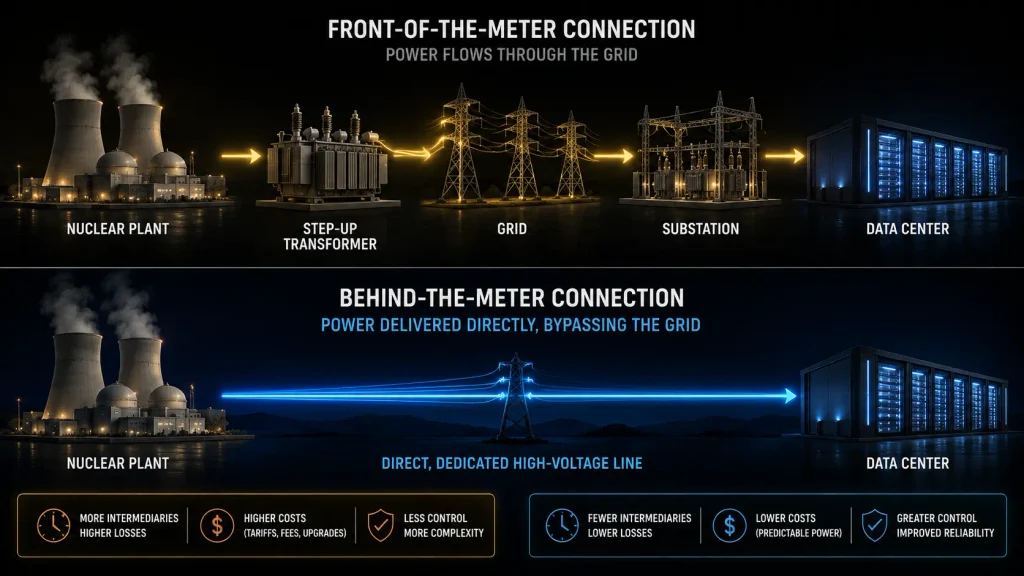
A nuclear power plant generates electricity at a generator. That electricity is sent to a “switchyard,” where massive step-up transformers increase the voltage so it can travel across long-distance public transmission lines.
In a Behind-the-Meter (BTM) setup, the data center is physically constructed adjacent to the switchyard. Engineers physically wire the data center to the plant’s generator before the electricity hits the step-up transformers and enters the public grid.
3. Technical Depth: Auxiliary Load Extraction
From an engineering perspective, the data center is legally classified as “auxiliary load” or “co-located load.” It is treated exactly the same as the internal lights, pumps, and control rooms that the power plant runs to sustain itself. Because the electrons never cross the formal boundary into the jurisdiction of the Regional Transmission Organization (like PJM or ERCOT), the transaction is legally isolated.
4. Financial Depth: Evading Transmission Network Charges
Because the power doesn’t touch the public wires, the hyperscaler does not have to pay Transmission Network Service charges, ancillary service fees, or grid-loss penalties. For a 1 GW facility running 24/7, evading these tariffs saves the tech company hundreds of millions of dollars over the lifespan of the facility, drastically lowering the Levelized Cost of Compute (LCOC).
5. Real-World Consequences: The ISA Protest
This physical and financial isolation requires amending the plant’s Interconnection Service Agreement (ISA) with the federal government. This legal document essentially requests permission to divert power that was previously promised to the public grid into a private facility. It is at this exact legal chokepoint that rival utility companies file lawsuits to block the transaction.
The AWS and Talen Energy Susquehanna Deal
The theoretical arbitrage of BTM co-location became an undeniable market reality in early 2024, setting a precedent that upended the utility sector.
Amazon Web Services & Talen Energy (Cumulus Data): In the watershed moment for the industry, AWS acquired the Cumulus data center campus from Talen Energy for $650 million. The campus sits directly adjacent to Talen’s 2.5 GW Susquehanna nuclear power plant in Pennsylvania. The deal included a 10-year PPA ensuring AWS could scale its power draw up to 960 megawatts of direct, BTM nuclear power. This deal instantly catalyzed the market, proving that hyperscalers were willing to pay massive premiums to secure off-grid baseload generation.
The FERC Backlash (AEP and Exelon): Immediately following the AWS/Talen deal, the PJM grid operator filed an amended Interconnection Service Agreement (ISA) with the Federal Energy Regulatory Commission (FERC) to officially route the power to AWS. Major utilities, including American Electric Power (AEP) and Exelon, filed formal protests against the ISA. They argued that the deal was illegal because AWS was still relying on the public grid for “backup power” and frequency stability without paying for those specific ancillary services, forcing a historic regulatory showdown in Washington D.C.
Micro-Grid Islanding: Beyond mega-plants, smaller data center operators are purchasing defunct industrial sites (like old aluminum smelters) that already possess high-capacity grid connections. By deploying natural gas fuel cells or planning for future Small Modular Reactors (SMRs) directly on these sites, developers are creating legally “islanded” micro-grids capable of generating their own power and severing their reliance on the host utility’s transmission queues.
Economic & Strategic Impact
The core friction of BTM co-location is the “Standby Power” Paradox.
Data centers require 99.999% uptime. Nuclear power plants are incredibly reliable, but they must occasionally shut down for refueling outages or emergency scrams. If the nuclear plant shuts down, the co-located data center will instantly go dark unless it has backup power.
Therefore, BTM data centers still want a connection to the public grid as a backup. Utility companies argue: “You cannot claim to be ‘off-grid’ to avoid paying daily transmission taxes, but then demand that we maintain a 1-Gigawatt emergency backup line for you just in case your nuclear plant fails.” Resolving this paradox will likely result in the creation of a new, highly expensive “Standby Transmission Tariff,” fundamentally altering the profitability models of future co-location deals.
Advantages
- Speed to Market: Bypasses the 5-to-10-year interconnection queue entirely. If the nuclear plant is running and the land is clear, the data center can be energized the moment the physical servers are installed.
- Absolute Carbon-Free Baseload: Secures true 24/7/365 zero-carbon energy, fulfilling corporate ESG pledges without relying on complex, often heavily scrutinized Renewable Energy Certificates (RECs) or volatile solar/wind outputs.
- Cost Certainty: By signing a multi-decade, fixed-price PPA directly with the generation asset, hyperscalers insulate their operating expenditures (OpEx) from the extreme volatility of wholesale natural gas and electricity spot markets.
Limitations
- Extreme Regulatory Risk: FERC and state Public Utility Commissions (PUCs) possess the power to block these deals retroactively. If regulators rule that BTM setups must pay public grid tariffs to prevent ratepayer cost-shifting, the financial arbitrage of the model collapses.
- Physical Land Scarcity: There are fewer than 100 commercial nuclear power plants in the United States. Many are located in complex topographies or lack the massive, flat acreage required to build a 1-Gigawatt hyperscale campus, severely limiting the total addressable market for this strategy.
- Single Point of Failure: While highly reliable, a nuclear plant relies on a single massive turbine. If that turbine trips offline, the entire data center campus loses power instantly unless it is supported by a massive, highly expensive array of on-site battery storage or diesel generators.
Common Misconceptions
Misconception: The data center is “stealing” power from residential homes.
Reality: The data center is buying power from a private merchant plant. The power is legally owned by the plant, not the public. However, by removing that power from the open market, it decreases the total supply of electricity available to the public, which can drive up wholesale energy prices for everyone else.
Misconception: The tech companies are building the nuclear plants.
Reality: Currently, hyperscalers are simply buying the output of existing nuclear plants built in the 1980s and 1990s. While tech companies are funding research into future Small Modular Reactors (SMRs), the current wave of co-location is purely a real estate and contracting play around legacy assets.
Misconception: BTM co-location requires no grid approval.
Reality: Modifying how a massive power plant distributes its electricity alters the physics of the entire regional grid. The Regional Transmission Organization (RTO) must heavily study the impact of removing a gigawatt of baseload power from the network, and FERC must ultimately approve the amended ISA.
What Most People Miss
The geopolitical vulnerability of Resource Monopolization.
Most analysis focuses on the domestic fight between tech companies and utility ratepayers. What is fundamentally missed is the geopolitical risk of monopolizing strategic national assets.
A gigawatt-scale nuclear power plant is critical national infrastructure. If five major U.S. hyperscalers successfully buy the exclusive rights to the output of twenty different nuclear plants, a massive percentage of the nation’s most reliable energy supply will be completely captured by private technology corporations. If the U.S. industrial base requires that clean baseload power to onshore semiconductor manufacturing or run defense logistics in a national emergency, the government will find its own atomic power locked behind 20-year exclusive contracts with AI companies, potentially forcing aggressive federal intervention or nationalization.
Comparison Table
| Feature | Front-of-the-Meter (Standard Grid) | Behind-the-Meter (Nuclear Co-Location) |
| Power Source | Blended grid power (Fossil/Renewable) | 100% Direct Nuclear Baseload |
| Time to Energize | 5 to 10 Years (Interconnection Queue) | 1 to 2 Years (Immediate Access) |
| Transmission Tariffs | Very High (Paid to Utility) | Zero (Currently contested at FERC) |
| Pricing Volatility | High (Subject to market wholesale rates) | Zero (Fixed via long-term PPA) |
| Regulatory Friction | Low (Standard process) | Extreme (Utility protests & FERC reviews) |
Case Study
Situation: The rapid scaling of generative AI fundamentally broke the capacity planning of cloud infrastructure providers. Amazon Web Services (AWS) required gigawatt-scale data center capacity to maintain its market dominance, but the PJM Interconnection queue in the U.S. Mid-Atlantic was frozen, threatening to delay new deployments into the 2030s.
Challenge: Secure immediate, massive, zero-carbon baseload power without waiting for public transmission upgrades, while establishing a replicable legal framework for bypassing standard utility tariffs.
Solution (The Susquehanna Acquisition): AWS executed a $650 million acquisition of the Cumulus data center campus from Talen Energy. The campus was physically integrated Behind-the-Meter at the 2.5 GW Susquehanna Steam Electric Station in Pennsylvania. The deal included an escalating Power Purchase Agreement, allowing AWS to draw up to 960 MW of power directly from the nuclear plant before it touched the PJM grid.
Outcome: The physical acquisition was successful, but it triggered a historic regulatory detonation. Major utilities (AEP and Exelon) immediately filed protests at FERC, demanding the agency reject the amended Interconnection Service Agreement. They argued AWS was illegally bypassing up to $140 million annually in transmission charges while still expecting the PJM grid to provide backup stability.
Lessons Learned: The Talen/AWS standoff proved that while the engineering of BTM co-location is flawless, the legal and economic architecture of the U.S. grid cannot currently support it. It demonstrated to global infrastructure investors that the ultimate bottleneck to AI scaling is no longer silicon or capital—it is the archaic, heavily politicized regulatory framework governing how electricity is taxed and transported.
Future Outlook
Next 12–24 Months
The era of FERC Precedents and Standby Tariffs. The immediate future will be dictated by the Federal Energy Regulatory Commission. Within the next 24 months, FERC will issue binding rulings on the Talen/AWS dispute, effectively writing the rulebook for all future co-location deals. The most likely outcome is a regulatory compromise: FERC will allow BTM co-location to proceed, but will mandate the creation of a “Standby Ancillary Tariff.” Hyperscalers will be forced to pay a recurring fee to the grid operators for the privilege of using the public grid as an emergency backup, slightly compressing the financial arbitrage of the model.
Next 3–5 Years
The scaling of Brownfield SMR Integration. As the supply of available land next to existing legacy nuclear plants is exhausted, tech giants will pivot to brownfield development. Hyperscalers will purchase decommissioned coal plants (which already possess massive, pre-approved grid interconnections and water rights). Instead of building standard data centers, they will partner directly with advanced nuclear startups (like TerraPower or Oklo) to deploy Small Modular Reactors (SMRs) directly on the data center campus, fully integrating generation and consumption into a single, private corporate asset.
Next 10 Years
The Bifurcation of the National Grid. By the mid-2030s, the energy landscape will split. The public grid will become increasingly volatile, managing the chaotic fluctuations of residential solar, wind, and EV charging. Completely segregated from this chaos will be the “Hyperscale Grid”—a privately owned network of gigawatt-scale data centers powered by dedicated, off-grid nuclear reactors and next-generation geothermal plants. Tech conglomerates will effectively become the most powerful energy providers on Earth, managing private energy portfolios larger than the national grids of many sovereign countries.
Most Likely Scenario
Behind-the-meter co-location is an unstoppable market force; the financial incentive for tech companies to bypass the grid is simply too immense to abandon. While utilities will successfully fight to claw back some transmission revenues via new tariffs, the physical decoupling of AI infrastructure from the public utility network is permanent. The future of artificial intelligence will be built entirely off-grid.
Key Takeaways
- Behind-the-Meter (BTM) co-location involves building a massive AI data center right next to a nuclear power plant and plugging directly into its generators.
- This strategy allows tech giants (like Amazon and Microsoft) to bypass the 5-to-10-year waiting line to connect to the public electrical grid.
- By not using the public power lines, tech companies avoid paying massive “transmission tariffs” that normally fund the upkeep of the national grid.
- Public utility companies are furiously protesting these deals at the federal level, arguing that if tech companies don’t pay grid taxes, everyday homeowners will be forced to pay higher bills to maintain the infrastructure.
- Because the data center still needs a connection to the public grid “just in case” the nuclear plant breaks down, regulators are likely to force tech companies to pay “standby fees” to access emergency backup power.
- This trend is permanently shifting control of America’s most reliable, zero-carbon power sources (nuclear plants) from the public market into the private hands of Silicon Valley.
Glossary
Ancillary Services: Functions that help grid operators maintain a reliable electricity system, such as frequency regulation and spinning reserves. BTM data centers rely on these but attempt to avoid paying for them.
Behind-the-Meter (BTM): An energy system situated on the user’s side of the utility meter. The power is generated and consumed locally without ever traversing the public transmission grid.
Cost Socialization: The economic principle where the cost of building and maintaining the electrical grid is spread out (socialized) among all users who are connected to it.
Federal Energy Regulatory Commission (FERC): The independent U.S. federal agency that regulates the interstate transmission of electricity, natural gas, and oil. The ultimate judge in the co-location regulatory battle.
Interconnection Queue: The massive backlog of energy projects waiting for permission and physical infrastructure upgrades to connect to the public electrical grid.
Interconnection Service Agreement (ISA): A legally binding contract between a power generator and the grid operator detailing how power will be injected into the grid. Amending an ISA is required to divert power to a BTM data center.
Sources
Federal Energy Regulatory Commission (FERC): Docket No. ER24-1610-000 – PJM Interconnection, L.L.C. (Susquehanna ISA Protest)
S&P Global Market Intelligence: AWS nuclear data center deal sparks battle over grid cost-shifting
Utility Dive: AEP, Exelon challenge PJM interconnection agreement for Talen’s Amazon data center
Data Center Dynamics: Talen Energy sells Cumulus data center campus to AWS for $650m
RMI (Rocky Mountain Institute): The Impact of Data Center Co-Location on Grid Decarbonization