Advertisement
)
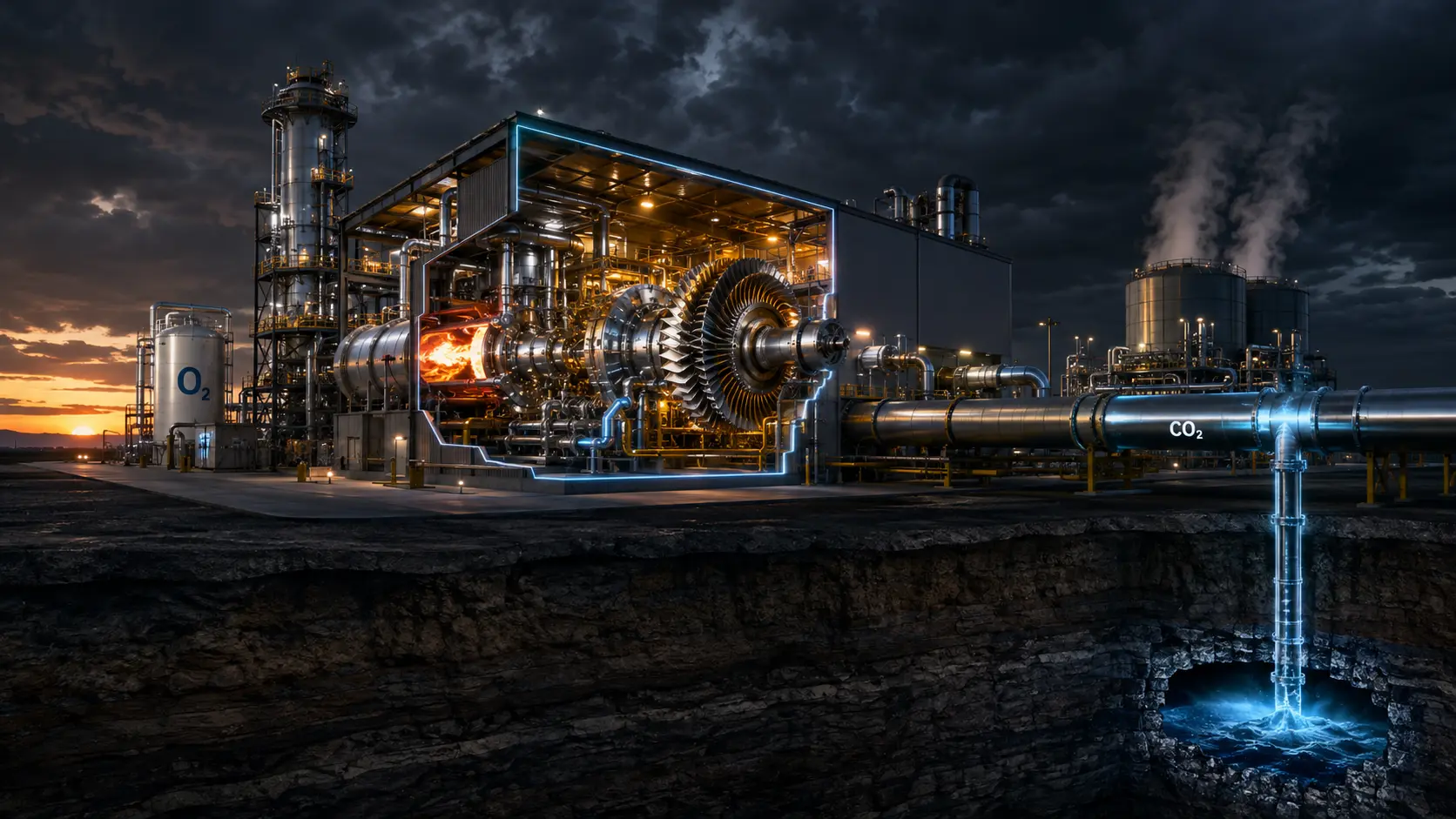

Natural gas is the necessary evil of the modern electrical grid. It provides the firm, dispatchable power required to keep the lights on when solar and wind fail, but it does so by venting billions of tons of carbon dioxide into the atmosphere. For decades, the energy industry’s only solution was “post-combustion carbon capture”—a phenomenally expensive, parasitic process of bolting massive chemical scrubbers onto factory smokestacks to catch the pollution before it escapes. Capturing carbon this way consumes so much energy that it financially cripples the power plant.
Why should you care right now? Because thermodynamic engineers have figured out how to eliminate the smokestack entirely. By completely redesigning the physics of power generation, a revolutionary architecture known as the Allam-Fetvedt Cycle has achieved the impossible: generating electricity from fossil fuels with absolute zero atmospheric emissions. Instead of burning gas in the air to boil water for steam, this system burns gas in pure oxygen and uses high-pressure, supercritical carbon dioxide to spin the turbine. In this cycle, carbon dioxide isn’t a waste product that needs to be scrubbed; it is the very fluid that powers the machine. As companies like NET Power prepare to launch their first utility-scale deployments, this technology offers the ultimate geopolitical compromise: the limitless reliability of natural gas, with the clean emissions profile of a solar farm.
What is The Allam-Fetvedt Cycle?
The Allam-Fetvedt Cycle is a thermodynamic power generation process that burns fossil fuels in pure oxygen, utilizing supercritical carbon dioxide (sCO₂) as the primary working fluid in a semi-closed Brayton cycle. This oxy-combustion eliminates nitrogen, producing a pure stream of high-pressure CO₂ and water, inherently capturing 100% of carbon emissions without parasitic scrubbing equipment.
At a Glance
- Concept: A natural gas power plant that doesn’t boil water to make steam. Instead, it uses high-pressure, super-hot carbon dioxide to spin the electricity-generating turbines.
- Why it matters: Trying to filter CO₂ out of normal exhaust smoke is like trying to extract a drop of ink from a swimming pool. The Allam Cycle produces only CO₂ and water, making it effortless to separate and bury the carbon underground.
- Who uses it: Energy technology company NET Power, backed by major industrial partners like Baker Hughes and Occidental Petroleum.
- Biggest takeaway: It completely eliminates toxic NOₓ (smog) emissions. Because the system burns fuel in pure oxygen rather than normal air (which is 78% nitrogen), no nitrogen enters the system, meaning no nitrogen oxides can be formed.
In Simple Words
Imagine a traditional car engine. It sucks in regular air, mixes it with gasoline, burns it, and shoots a chaotic mix of toxic exhaust gases out the tailpipe. If you want to stop that pollution, you have to attach a massive, heavy, expensive filter to the tailpipe that chokes the engine and ruins your gas mileage.
The Allam-Fetvedt Cycle is like building a completely different engine.
Instead of sucking in regular air, it only sucks in pure oxygen. When you burn natural gas with pure oxygen, the only things that come out are water and carbon dioxide.
But here is the genius part: instead of letting that carbon dioxide escape, the engine traps it, pressurizes it until it acts like a dense liquid, and uses it to physically push the engine’s pistons. Once it has done its job, the excess CO₂ is cleanly siphoned off into a pipe and buried underground. There is no tailpipe, no exhaust smoke, and no massive filter choking the system.
Why This Matters
For Utility Planners, Energy Investors, and ESG Analysts, the Allam Cycle rescues trillions of dollars in “stranded assets.”
The global push for decarbonization threatens to outlaw the vast infrastructure of natural gas extraction, pipelines, and power plants. If natural gas is banned due to climate mandates, energy companies lose trillions. The Allam Cycle provides an immediate, mathematically sound lifeline. It allows the global economy to continue extracting and burning the Earth’s massive reserves of natural gas for reliable, 24/7 baseload power, but entirely decouples that fuel from climate change. It transforms the natural gas industry from an environmental liability into a zero-carbon utility provider.
The End of the Steam Rankine Cycle
For over a century, the power industry relied almost exclusively on the Rankine cycle (boiling water to make steam) and the standard Brayton cycle (burning fuel in air).
The physics of these legacy cycles dictate that carbon capture will always be an afterthought—an inefficient band-aid applied at the end of the process. The Allam-Fetvedt Cycle is the first major thermodynamic leap in decades to successfully design carbon capture into the core physics of the turbine itself. By treating CO₂ as a valuable working fluid rather than a waste product, it effectively breaks the financial penalty that has stalled global carbon capture and sequestration (CCS) efforts for twenty years.
How the Allam-Fetvedt Cycle Works
Eliminating the smokestack requires mastering extreme-pressure thermodynamics and oxy-combustion. Here is the first-principles breakdown of the architecture.
1. The Fundamental Problem: Parasitic Scrubbing
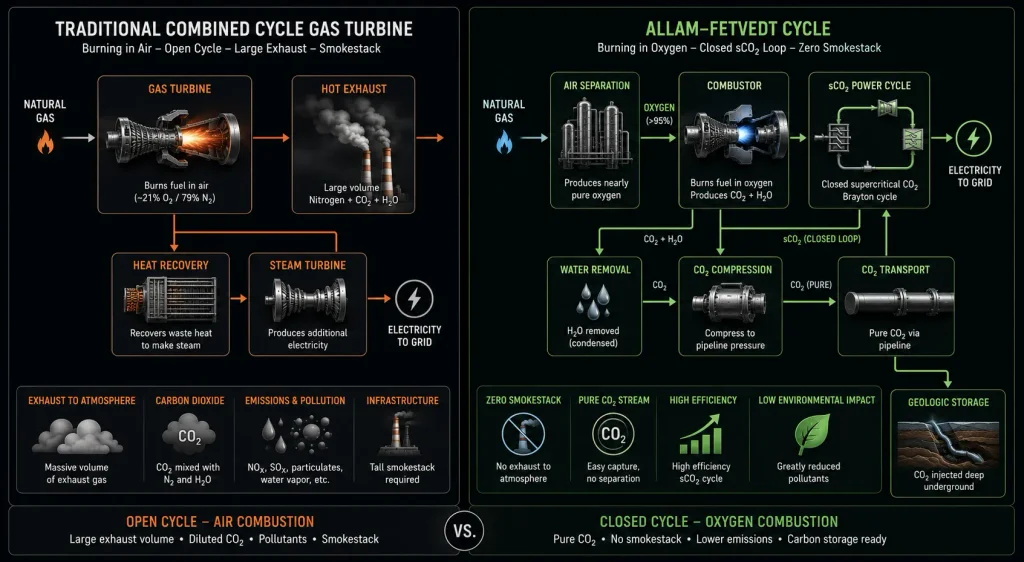
In a traditional Combined Cycle Gas Turbine (CCGT), natural gas is burned in ambient air. Because air is 78% nitrogen, the resulting exhaust is massive and highly diluted, containing only about 4% to 8% CO₂. Extracting that tiny amount of CO₂ requires chemical amine scrubbers that consume up to 20% of the power plant’s total electricity output. This parasitic load destroys the plant’s profitability.
2. The Core Mechanism: Oxy-Combustion
To solve this, the Allam Cycle introduces an Air Separation Unit (ASU). The ASU chills ambient air to separate out pure oxygen. In the combustor, natural gas (CH₄) is burned with this pure oxygen (O₂).
Because there is no nitrogen, the chemical reaction is perfectly clean:
CH₄ + 2O₂ → CO₂ + 2H₂O
The only resulting products are carbon dioxide and water vapor.
3. Technical Depth: The Supercritical CO2 Loop
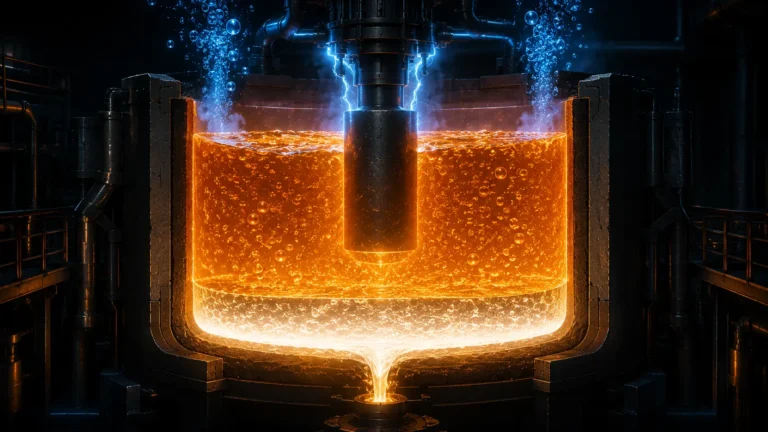
Burning gas in pure oxygen creates temperatures so extreme they would melt any metal on Earth. To control the flame, the system pumps a massive amount of recycled, high-pressure CO₂ into the combustor.
This acts as a thermal buffer and creates the “working fluid.” The resulting mixture exits the combustor at roughly 300 bar (4,300 psi) and 1,150°C. In this state, the CO₂ is “supercritical”—a phase of matter where it possesses the density of a liquid but expands like a gas. This ultra-dense supercritical CO₂ (sCO₂) is blasted through a single, highly specialized turbine to generate raw electricity.
4. Cooling and Separation
After spinning the turbine, the hot sCO₂ and water vapor mixture enters a recuperative heat exchanger (to recycle its leftover heat) and then a cooler. As the mixture cools to near ambient temperatures, the water seamlessly condenses into a liquid and drops out of the system.
You are now left with a stream of nearly 100% pure CO₂.
5. Real-World Consequences: Pipeline-Ready Output
Approximately 95% of this pure CO₂ is compressed and recycled back into the combustor to keep the engine running. The remaining 5%—which represents the exact amount of new carbon created by burning the natural gas—is siphoned off. Because it is already pure and under extreme pressure, it requires no chemical scrubbing or extra compression. It is immediately “pipeline-ready” to be pumped deep underground for permanent geological sequestration.
Commercial Deployments: NET Power and Project Permian
The Allam-Fetvedt cycle is moving from the validation phase into commercial utility-scale deployment.
Project Permian (NET Power): NET Power is developing its first utility-scale plant near Odessa, Texas. The plant aims to produce roughly 300 MW of power while seamlessly piping the captured CO₂ to Occidental Petroleum’s nearby permanent underground sequestration hubs. By locating the plant directly on top of the Permian Basin, the facility minimizes fuel transport costs and ensures immediate access to vast geological carbon storage vaults.
Behind-the-Meter Data Centers: In recent quarters, hyperscale tech companies have triggered an unprecedented surge in electricity demand for artificial intelligence data centers. In response, NET Power has expanded its commercialization strategy to include “behind-the-meter” generation. Data center developers who cannot wait 5-10 years for a public grid interconnection are partnering with natural gas innovators to build dedicated, off-grid power plants. The Allam Cycle allows tech giants to secure gigawatts of 24/7 baseload power without violating their strict corporate “net-zero” climate pledges.
Water-Scarce Industrial Hubs: Traditional steam turbines require massive amounts of fresh water for cooling towers. The Allam Cycle turns this dynamic upside down. Because the combustion of methane and oxygen inherently produces H₂O, as a byproduct, an Allam Cycle plant actually generates pure water. For arid regions (like the Middle East or the U.S. Southwest), this means a 300 MW power plant can operate without draining local aquifers, creating a profound industrial advantage in water-scarce geopolitics.
Economic & Strategic Impact
The core economic disruption of the Allam Cycle is the Monetization of Section 45Q Tax Credits.
In the United States, the Inflation Reduction Act (IRA) radically expanded the 45Q tax credit, offering up to $85 for every ton of CO₂ captured and permanently stored underground. For a traditional power plant, capturing that ton of CO₂ costs more than the $85 tax credit, making it a money-losing proposition.
Because the Allam Cycle captures the CO₂ inherently with almost zero parasitic penalty, the cost of capture is effectively baked into the baseline operational cost of generating electricity. This allows developers to harvest the full $85-per-ton tax credit as pure margin. For a utility-scale plant running 24/7, this tax credit transforms carbon sequestration from an environmental burden into a multi-million-dollar primary revenue stream, permanently shifting the financial math of fossil fuels.
Advantages
- 100% Carbon Capture by Design: There is no smokestack. The CO₂ never mixes with the atmosphere, emerging from the process fully pressurized and ready for pipelines.
- Elimination of Smog and Acid Rain: By burning pure oxygen instead of ambient air, the system entirely avoids the creation of Nitrogen Oxides (NOₓ) and Sulfur Oxides (SOₓ , stripping away the most toxic pollutants associated with heavy industry.
- Massive Footprint Reduction: Supercritical CO₂ is incredibly dense. A turbine powered by sCO₂ is roughly 1/10th the physical size of a steam turbine generating the exact same amount of electricity, drastically lowering the capital cost of steel and concrete for the facility.
- High Thermodynamic Efficiency: Despite the energy required to run the Air Separation Unit (ASU) and the CO₂ compressors, the cycle achieves a net efficiency target (LHV) of roughly 55% to 59% for natural gas—highly competitive with the best unabated natural gas plants in the world.
Limitations
- Air Separation Unit (ASU) Capital Costs: While the power plant itself is compact, building a cryogenic ASU capable of generating thousands of tons of pure oxygen daily is a massive, highly expensive capital expenditure (CapEx).
- Metallurgical Extremes: Subjecting a rapidly spinning turbine to 300 bar of pressure at 1,150°C using supercritical CO₂ pushes the absolute boundaries of modern metallurgy. Preventing oxidation, creep, and blade fatigue over a 30-year lifespan requires intensely expensive superalloys.
- Geographic Dependency on Storage: The power plant is only zero-emission if it has somewhere to put the carbon. The facility must be built physically near an approved Class VI underground geological sequestration well or a massive CO₂ pipeline network, limiting where these plants can be deployed.
Common Misconceptions
Misconception: The plant is a traditional gas plant with a really good filter on the chimney.
Reality: The plant does not have a chimney for combustion exhaust. The combustion happens in a closed loop. The CO₂ is literally the engine fluid that turns the turbine, not a waste gas floating out of a pipe.
Misconception: It boils water to make steam.
Reality: It is entirely steam-free. Water is produced as a chemical byproduct, but the turbine is spun exclusively by supercritical carbon dioxide, completely abandoning the Rankine (steam) cycle.
Misconception: The technology only works with natural gas.
Reality: The cycle is highly adaptable. While currently focused on natural gas, the oxy-combustion regime can theoretically be adapted to burn syngas derived from coal gasification or even raw biomass, bringing zero-emission baseload power to heavy coal-dependent nations.
What Most People Miss
The disruptive intelligence value of ASU Thermal Integration.
When critics look at the Allam Cycle, they point out that freezing air to extract pure liquid oxygen (in the Air Separation Unit) takes massive amounts of electricity, which should mathematically ruin the plant’s efficiency.
What most people miss is how the inventors bypassed this penalty through sheer thermodynamic elegance. When the ASU compresses air to freeze it, it generates a massive amount of low-grade waste heat. Instead of throwing this heat away, the Allam Cycle actively routes it back into the main power cycle. This recycled heat is used to pre-heat the CO₂ before it enters the combustor. By cross-wiring the waste heat of the oxygen factory directly into the fuel efficiency of the power plant, the cycle claws back its lost efficiency, pushing the net performance up to 59%.
Comparison Table
| Feature | Traditional CCGT | CCGT with Post-Combustion Scrubbers | Allam-Fetvedt Cycle (sCO2) |
| Working Fluid | Steam & Air | Steam & Air | Supercritical CO₂ |
| Combustion Oxidant | Ambient Air (78% Nitrogen) | Ambient Air | Pure Oxygen (O₂) |
| CO₂ Capture Rate | 0% | ~90% (Maximum) | ~100% (Inherent) |
| Efficiency Penalty | N/A (Baseline ~60%) | Severe (~15% drop in efficiency) | Minimal (Maintains ~55-59%) |
| NOₓ / SOₓ Emissions | Moderate to High | Low | Absolute Zero |
Case Study
Situation: The global energy transition exposed a fatal flaw in the renewable narrative: the grid requires 24/7 dispatchable baseload power that wind and solar cannot provide. Natural gas provided this reliability, but deploying it violated international climate targets. Traditional post-combustion carbon capture proved to be too expensive and too energy-intensive to scale commercially.
Challenge: Prove that the fundamental thermodynamics of fossil fuel combustion could be rewritten to inherently capture carbon without the crippling efficiency penalty of chemical scrubbers.
Solution (The La Porte Demonstration Facility): In 2018, NET Power, backed by a consortium of industry leaders including Exelon, McDermott, and Oxy Low Carbon Ventures, completed the construction of a 50 MWth demonstration plant in La Porte, Texas. They designed and manufactured a first-of-its-kind supercritical CO₂ combustor and turbine capable of withstanding the extreme oxy-combustion environment.
Outcome: In the autumn of 2021, the La Porte facility successfully synchronized to the Texas electric grid (ERCOT). It proved that the Allam-Fetvedt cycle was not just a theoretical computer model; the physical turbomachinery worked. It burned natural gas, spun the turbine with sCO₂, and produced pure, pipeline-quality carbon dioxide without venting emissions. This technical validation triggered the launch of NET Power’s commercial phase, securing partnerships with Baker Hughes to mass-produce the specialized turboexpanders required for global deployment.
Lessons Learned: The La Porte demonstration verified that carbon capture does not have to be an expensive afterthought. By elevating carbon dioxide from a toxic waste product into a high-value thermodynamic working fluid, the industry established a viable, bankable pathway to preserve the reliability of natural gas in a zero-carbon future.
Future Outlook
Next 12–24 Months
The era of Behind-the-Meter AI Triage. Through 2026 and 2027, the primary catalyst for Allam Cycle deployment will not be utility companies, but hyperscale tech giants. Desperate to power massive new AI data centers without waiting for decade-long grid interconnection queues or violating corporate ESG pledges, hyperscalers will seek out off-grid solutions. NET Power’s strategy of deploying unabated or fully integrated sCO₂ plants directly adjacent to massive computing loads will provide the exact high-reliability (99.9% uptime), high-density power that battery storage cannot mathematically achieve.
Next 3–5 Years
The scaling of Project Permian and Baker Hughes Integration. The completion and commissioning of Project Permian in Texas will act as the defining commercial benchmark. As the facility proves its Levelized Cost of Electricity (LCOE) against traditional combined-cycle plants, the focus will shift heavily to the supply chain. Baker Hughes will transition the bespoke sCO₂ turboexpanders from custom prototypes into standardized, factory-line components, drastically lowering the upfront capital expenditure (CapEx) for subsequent project developers globally.
Next 10 Years
The Global Replacement of CCGT Fleets. By the mid-2030s, older Traditional Combined Cycle Gas Turbines (CCGT) will face massive regulatory pressure and escalating carbon taxes (like the EU’s Carbon Border Adjustment Mechanism). Rather than attempting to bolt multi-million-dollar amine scrubbers onto 30-year-old smokestacks, utility companies will simply retire the legacy fleets. The Allam-Fetvedt Cycle will become the undisputed, legally mandated baseline architecture for any new natural gas power plant built on Earth, permanently decoupling human electricity generation from atmospheric pollution.
Most Likely Scenario
The Allam-Fetvedt Cycle ensures that fossil fuels will survive the energy transition. By perfectly neutralizing the climate impact of natural gas, it prevents trillions of dollars of subterranean energy reserves from becoming stranded assets. While the deployment speed will be constrained by the availability of underground CO₂ storage networks, the undeniable elegance of its thermodynamics secures its position as the ultimate bridge technology for the 21st-century grid.
Key Takeaways
- The Allam-Fetvedt Cycle is a revolutionary power plant design that burns natural gas with zero atmospheric emissions.
- Unlike traditional plants that burn fuel in the air, this cycle burns gas in pure oxygen (oxy-combustion), completely eliminating toxic smog (NOₓ) emissions.
- Instead of boiling water to make steam, it uses extreme-pressure, super-hot carbon dioxide (supercritical CO₂) to spin the turbines.
- Because the only byproducts are water and CO₂, the system inherently captures 100% of the carbon. There is no smokestack, and no need for expensive, energy-draining chemical filters.
- The pure CO₂ leftover from the combustion is immediately ready to be pumped underground for permanent safe storage.
- NET Power is currently commercializing the technology, aiming to deploy utility-scale plants to power the grid and provide off-grid, zero-carbon electricity for massive AI data centers.
Glossary
Air Separation Unit (ASU): A massive industrial refrigerator that chills ambient air until it turns to liquid, allowing engineers to separate out pure oxygen. Crucial for oxy-combustion.
Allam-Fetvedt Cycle: A specific type of Brayton thermodynamic cycle that uses oxy-combustion and supercritical CO₂ as the working fluid to inherently capture carbon emissions.
Combined Cycle Gas Turbine (CCGT): The traditional, legacy way to burn natural gas for power. It uses a gas turbine followed by a steam turbine, but vents massive CO₂ into the atmosphere.
Oxy-Combustion: The process of burning a fuel using pure oxygen instead of ambient air. It prevents nitrogen from entering the engine, stopping the creation of NOₓ pollution.
Parasitic Load: The amount of electricity a power plant consumes just to run its own equipment. Traditional carbon capture scrubbers have a massive, crippling parasitic load.
Supercritical Carbon Dioxide (sCO₂): A phase of matter where carbon dioxide is held at such high pressure and temperature that it acts like a dense liquid but expands to fill a space like a gas. It is a highly efficient fluid for spinning turbines.
Sources
NET Power: NET Power Announces its First Utility-Scale Clean Energy Power Plant Integrated with CCS (November 2021)
Journal of Thermal Engineering: Thermodynamic analysis of the Allam cycle and its pressure sensitivity (September 2021)
ResearchGate / Energy Procedia: Demonstration of the Allam Cycle: An Update on the Development Status of a High Efficiency Supercritical Carbon Dioxide Power Process
Supercritical CO2 Energy Technologies Symposium: Exergy Analysis of the Allam Cycle
TradingView / MarketBeat: NET Power Q2 Earnings Call Highlights (August 2026)