Advertisement
)
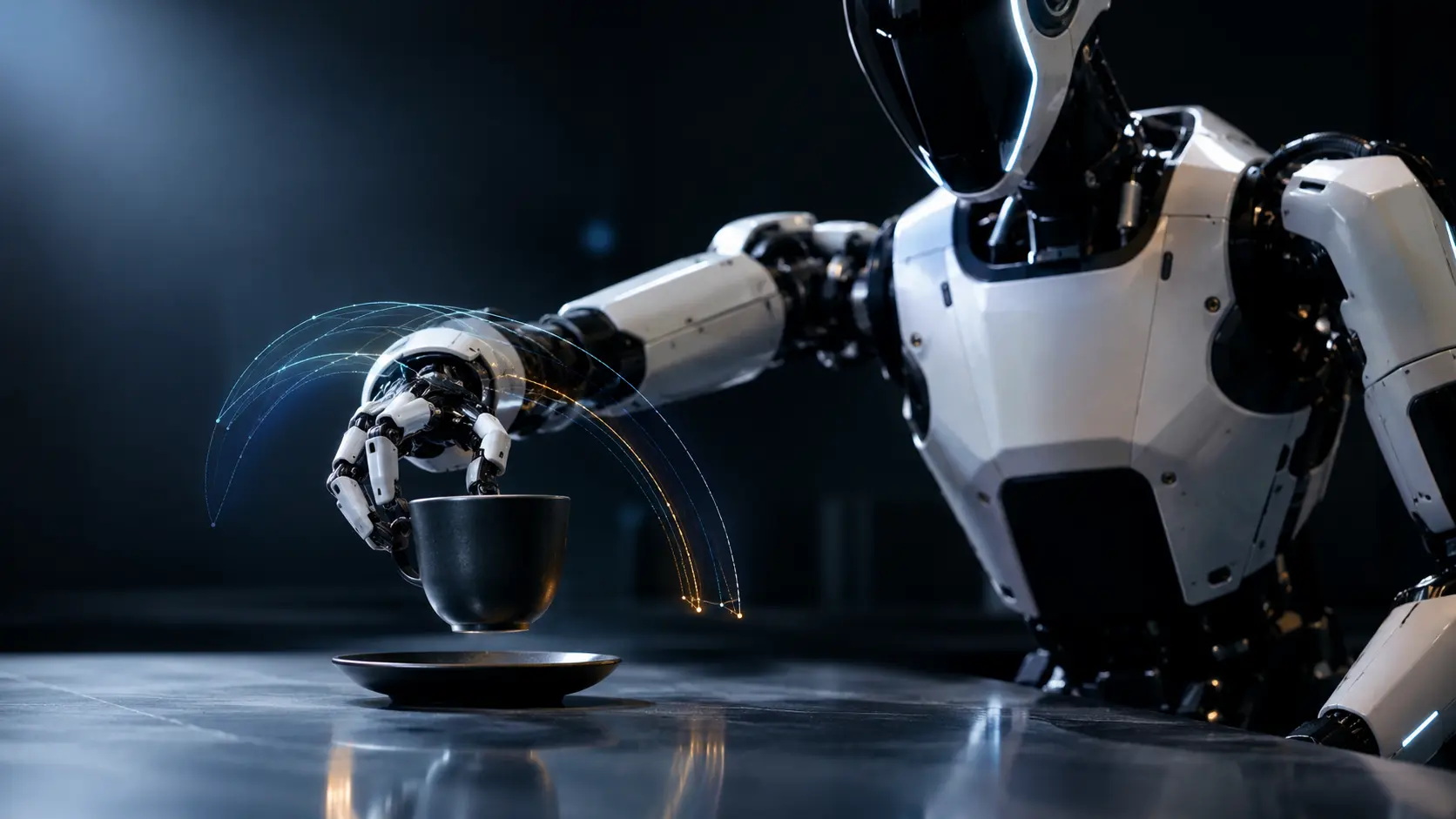

A multi-million-dollar autonomous robotic arm perfectly pours a cup of coffee 99 times in a row. On the 100th attempt, a one-millimeter miscalculation in its wrist angle causes it to panic, veer wildly off course, and dump boiling liquid onto the floor. In the world of robotics, this is the compounding error crisis. When engineers try to teach robots by simply having them copy human demonstrations frame-by-frame, tiny physical mistakes instantly snowball. The robot enters a physical position it has never seen in its training data, makes erratic guesses, and completely fails the task. This mathematical fragility has kept highly dexterous robots locked inside controlled laboratory environments for decades.
Why should you care right now? Because a new mathematical framework called Action Chunking with Transformers (ACT) has cured robotic stuttering. Instead of forcing the artificial intelligence to guess its next movement millisecond by millisecond, ACT forces the robot to predict an entire, fluid trajectory of movement all at once. By combining Transformer architectures with generative autoencoders, engineers have finally taught robots how to execute smooth, long-horizon physical manipulation. This is the precise algorithmic breakthrough allowing humanoid robots to step off the factory floor and autonomously perform delicate, highly variable real-world tasks like cooking, sorting, and surgical suturing.
What is Action Chunking with Transformers (ACT)?
Action Chunking with Transformers (ACT) is an imitation learning AI architecture that teaches robots to perform complex physical tasks by predicting sequences of actions as a single cohesive “chunk.” By utilizing a Conditional Variational Autoencoder (CVAE) and temporal ensembling, it eliminates compounding errors and enables smooth, highly accurate autonomous manipulation.
At a Glance
- The Physics Problem: Traditional AI learns to move a robot one frame (millisecond) at a time. A tiny physical deviation causes a chain reaction of bad guesses, ending in complete failure.
- The Chunking Solution: The AI is trained to predict the next 100 frames of movement simultaneously. It plans a cohesive trajectory, heavily reducing the frequency of its decision-making.
- The Mechanism: It uses a Transformer to process camera feeds and joint positions, and a CVAE to understand that there are multiple “correct” ways a human might reach for an object.
- The Strategic Value: It democratizes robotics. Instead of spending months hardcoding physics equations into an industrial arm, a human can simply teleoperate the robot for 50 repetitions, and the ACT framework allows the robot to master the task autonomously.
In Simple Words
Imagine you are driving a car down a winding road.
Standard robotic learning (behavioral cloning robotics) is like driving while only looking one inch in front of your bumper. You make tiny, frantic adjustments to the steering wheel every millisecond. If you hit a small bump and veer one inch to the right, you panic, overcorrect, and instantly crash into the ditch.
Action Chunking (ACT) is like looking 50 feet down the road. Instead of making frantic micro-adjustments, you plan a smooth, continuous curve that follows the road ahead. If you hit a bump, it doesn’t matter; your eyes are locked on the trajectory 50 feet away, and your hands naturally smooth out the steering to stay on the curve.
By teaching robots to predict their movements in 50-step “chunks” instead of 1-step increments, they stop twitching and start moving with the smooth, continuous grace of a human being.
Why This Matters
For Robotics Engineers, AV Startups, and Tech VCs, ACT solves the Causal Confusion Bottleneck.
In the past, when engineers trained a robot to copy a human, the robot would suffer from “causal confusion.” If a robot is trying to tie a shoelace, and it pauses for a second, the standard AI looks at the previous frame (where the robot was paused) and incorrectly assumes the correct next action is to continue pausing. It gets stuck in a loop.
Action Chunking destroys this loop. Because the AI is forced to output a sequence of 100 future steps, it physically cannot get stuck predicting a single paused frame. It is forced to understand the macro-goal of the physical movement. For Venture Capitalists funding the humanoid robot race, ACT robotics is the critical software layer that transforms a $100,000 piece of titanium hardware from a clumsy puppet into a commercially viable, autonomous worker.
Micro-Insight: ACT shifts robotic AI from reactive processing (guessing what to do right now) to proactive orchestration (executing a verified plan).
The End of Hardcoded Robotics via Imitation Learning
We are witnessing the End of Hardcoded Robotics.
For 40 years, the robotics industry relied on classical control theory. To make a robot pick up an egg, PhDs spent months writing complex kinematic equations and hardcoding physical coordinates. This works for building cars on a perfectly structured assembly line, but it fails in the chaotic environment of a human home or a dynamic warehouse.
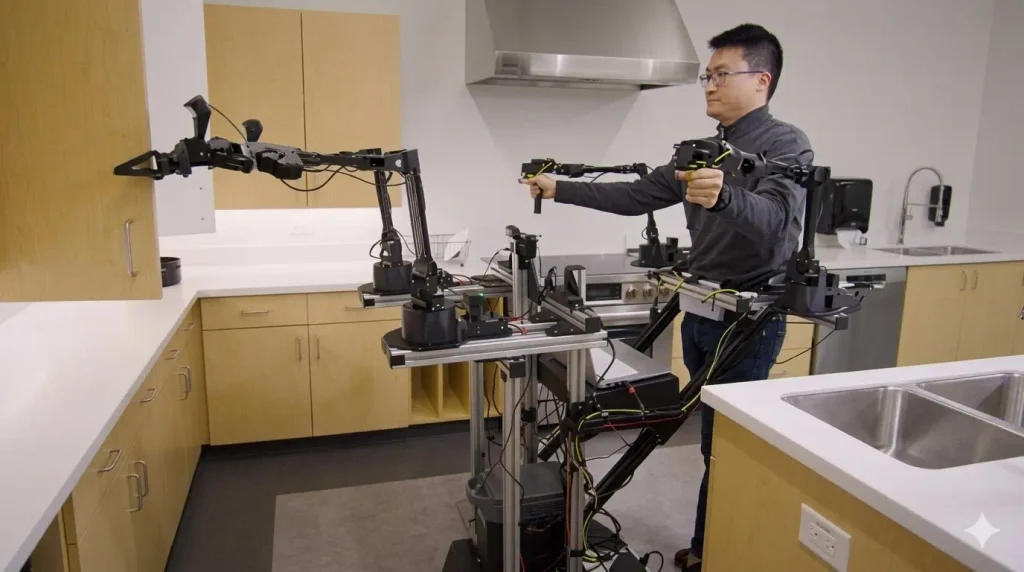
ACT enables end-to-end imitation. A human operator simply uses a VR headset and controllers to pick up the egg a few dozen times. The robot observes the cameras, records the joint angles, and uses ACT to learn the exact physical intuition required. The transition from coding to teaching is the absolute prerequisite for general-purpose robotics.
How Action Chunking with Transformers (ACT) Works
Eliminating robotic stuttering while seamlessly copying chaotic human data requires a delicate orchestration of generative AI and temporal mathematics. Here is the first-principles breakdown of the architecture.
1. The Fundamental Problem: Covariate Shift
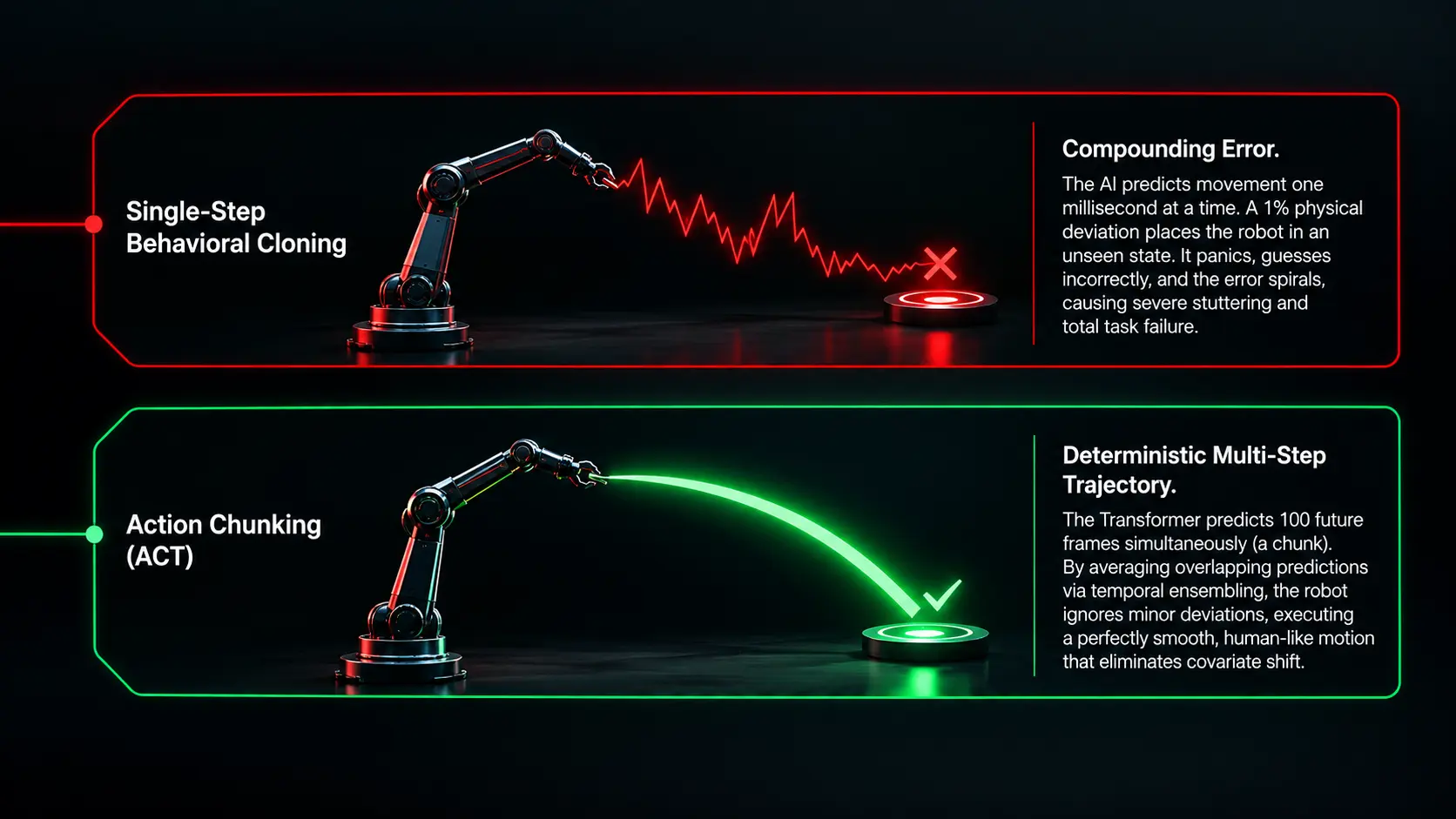
In pure Behavioral Cloning (BC), a neural network learns a policy: given an image from a camera (state), output the motor torque (action).
The fatal flaw is the Markov property constraint in continuous space. During training, the AI only sees perfect human demonstrations. During deployment, the robot makes a 0.1% error. It is now in a state (covariate) that was never in the training data. The AI’s next prediction is slightly worse. The error compounds exponentially, and the robot physically collapses.
2. The Core Mechanism: Action Chunking
Instead of predicting aₜ (the action at time t), the ACT framework predicts an action sequence: aₜ to aₜ₊ₖ (where k is the chunk size, typically 10-100 steps).
By predicting a full chunk, the robot commits to a deterministic physical trajectory. Even if a minor physical disturbance occurs at step 20, the robot doesn’t recalculate and panic; it continues executing the smooth, cohesive physical arc it planned for the remaining 80 steps, preventing the error from cascading.
3. Technical Depth: Handling Human Multimodality (CVAE)
Humans are inconsistent. If you ask a human to grab a cup 10 times, they will approach it from 10 slightly different angles. This is “multimodal” data.
If a standard neural network tries to learn this, it will mathematically average all 10 approaches together, resulting in a robotic trajectory that reaches straight down the middle and completely misses the cup.
ACT solves this using a Conditional Variational Autoencoder (CVAE). The CVAE does not output a single, deterministic average. It models the human demonstrations as a latent probability distribution. It understands that there are multiple distinct, valid ways to grab the cup. The robot mathematically samples one of these valid “styles” and executes it cohesively.
Plain-English Takeaway: Because humans are messy, teaching a robot to copy them normally results in a confused robot that tries to do everything at once. The CVAE allows the robot to pick one specific, successful style and commit to it.
4. Technical Depth: Temporal Ensembling
If a robot predicts a 100-step chunk, executes all 100 steps, and then pauses to predict the next 100 steps, its movement will be extremely jerky.
ACT uses “temporal ensembling” to solve this. At time t, the robot predicts a 100-step chunk. A millisecond later at time t+1, it predicts another 100-step chunk. The robot now has 99 overlapping predictions for what it should do next.
The system takes an exponentially weighted average of these overlapping predictions. Older predictions are given less weight; newer predictions (based on the most recent camera data) are given more weight. The result is a butter-smooth, continuously updating physical trajectory that never stutters.
5. Real-World Consequences: Bimanual Dexterity (ALOHA)
The ultimate validation of ACT was Stanford’s Project ALOHA (A Low-cost Open-source Hardware System for Bimanual Teleoperation).
Using the ALOHA robot architecture, researchers trained a dual-armed robot to perform tasks previously considered impossible for AI imitation: threading a zip tie, cracking an egg, and tossing a salad. The temporal ensembling allowed the two arms to perfectly synchronize their movements without lagging or dropping the objects.
BC vs. ACT Robotic Trajectory Simulator
Solving Compounding Errors in Imitation Learning with Temporal Ensembling
Environmental Noise / Disturbance
2
Learning Algorithm
Single-Step BC
Action Chunking (ACT)
Trajectory Smoothness
–%
Compounding Error (Max)
— px
Task Completion Status
IDLE
Kinematic Arm Trajectory Tracking
WAITING FOR COMMAND
Covariate Shift (Compounding Error) Over Time
Real-World Applications
The transition from theoretical mathematics to physical hardware is accelerating at breakneck speed.
Mobile ALOHA and Domestic Robotics: Building on the original bimanual ALOHA system, researchers mounted the robotic arms onto a mobile base. Using ACT, they trained the robot to autonomously navigate a kitchen, open cabinets, wash pans, and operate an elevator. Because ACT heavily reduces the frequency of computational decision-making, the entire transformer model can run locally on consumer-grade GPUs mounted directly to the robot’s chassis, eliminating latency.
Surgical Robotics (End-to-End Automation): Current surgical robots (like the Da Vinci system) are purely teleoperated; every movement is directly controlled by a human surgeon. Startups are now using ACT to train AI on thousands of hours of surgical video and kinematic data. By chunking the intricate movements of suturing, the system can autonomously complete repetitive closing procedures with sub-millimeter precision, freeing the human surgeon to focus strictly on the complex, critical phases of the operation.
Industrial Sub-Assembly: While legacy car manufacturing uses hardcoded robots, fine electronics assembly (like plugging ribbon cables into a smartphone motherboard) requires extreme dexterity and visual feedback. Hardware startups are deploying ACT-powered arms in Chinese and Taiwanese manufacturing hubs. A human operator performs the delicate task 50 times in VR. The robot learns the chunked trajectory and can autonomously repeat it 24/7, adjusting perfectly to slight variations in the placement of the motherboards on the conveyor belt.
Economic & Strategic Impact
The core strategic consequence of ACT is The Commoditization of Robotic Hardware.
For decades, the value of a robotics company was tied to its proprietary hardware and the army of PhDs required to write the kinematic control software. ACT shifts the value entirely to the data.
If any cheap, off-the-shelf robotic arm can learn to do anything simply by watching a human do it 50 times, the physical hardware becomes a low-margin commodity. The new moat in the robotics industry is high-quality human demonstration data. Companies like Tesla (with Optimus) and Figure AI are aggressively paying humans to teleoperate robots in diverse environments, building massive datasets of human movement. Whoever aggregates the largest, highest-quality dataset of chunked human actions will build the foundational “brain” for the entire global robotics industry.
Advantages of the ACT Framework in Robotics
- Eliminates Compounding Errors: By committing to a multi-step trajectory, the robot ignores minor deviations that would normally cause a single-step AI to panic and crash.
- Butter-Smooth Execution: Temporal ensembling (averaging overlapping predictions) mathematically removes the erratic, robotic “twitching” associated with legacy imitation learning.
- Handles Human Inconsistency: The CVAE architecture allows the robot to learn from messy, contradictory human data without mathematically averaging those actions into a failure state.
- Sample Efficiency: ACT requires shockingly little data to learn a task. Many complex bimanual manipulation tasks can be mastered with fewer than 50 human demonstrations (roughly 15 minutes of data collection).
Compute and Teleoperation Limitations of ACT
- Out-of-Distribution (OOD) Brittleness: If a human completely blocks the robot’s path or moves the target object to the opposite side of the room during the task, the chunked trajectory fails. ACT is excellent at local recovery, but terrible at extreme macro-recovery without explicit reinforcement learning safeguards.
- Compute Intensity for Temporal Ensembling: Averaging overlapping 100-step predictions every single millisecond requires massive, continuous matrix multiplication, which heavily drains the onboard battery of untethered mobile robots.
- The Teleoperation Bottleneck: ACT requires human demonstration data mapped perfectly to the robot’s kinematic structure. You cannot easily train an ACT model by just watching YouTube videos; a human must physically operate a specialized, expensive teleoperation rig to generate the initial joint-angle data.
Takeaway: ACT is the perfect apprentice. It learns incredibly fast if you hold its hand and physically show it what to do. But if the environment changes drastically from what you showed it, the apprentice will freeze.
Common Misconceptions
Misconception: ACT is a form of Reinforcement Learning (RL).
Reality: ACT is purely Imitation Learning (Behavioral Cloning). Reinforcement learning requires the robot to explore randomly and learn via trial and error (rewards/punishments). ACT simply learns to copy a dataset of perfect human demonstrations.
Misconception: The robot predicts the entire task at once.
Reality: A task (like cooking a meal) might take 50,000 steps. ACT predicts “chunks” of typically 10 to 100 steps (a fraction of a second of movement). It constantly generates new overlapping chunks to eventually complete the 50,000-step task.
Misconception: Transformers are only used for text.
Reality: Transformers are simply sequence processors. Just as a Large Language Model (LLM) predicts the next sequence of words, the ACT Transformer predicts the next sequence of physical joint angles. The underlying math is identical.
What Most People Miss
The disruptive capability of Proprioceptive State Integration.
When a human picks up a heavy object, their muscles instantly feel the weight, and they adjust their grip. To make ACT work in the real world, visual data (cameras) is not enough.
Modern ACT architectures concatenate the visual data with real-time proprioception—the exact physical position, velocity, and torque load on every single motor in the robot’s arm. By feeding this unified, multimodal state into the Transformer, the AI predicts action chunks that naturally account for gravity, friction, and weight, allowing the robot to seamlessly manipulate soft, squishy, or surprisingly heavy objects without crushing or dropping them.
Comparison Table
| Metric | Traditional Behavioral Cloning (BC) | Reinforcement Learning (RL) | Action Chunking with Transformers (ACT) |
| Learning Paradigm | Supervised Imitation | Trial and Error (Reward based) | Supervised Imitation (Chunked) |
| Action Horizon | 1 Step (Millisecond) | 1 Step | Multi-Step (e.g., 100 frames) |
| Susceptibility to Covariate Shift | Extremely High (Crashes easily) | Low (Explores failures during training) | Low (Suppresses error compounding) |
| Data Requirements | Moderate | Massive (Requires simulators) | Extremely Low (~50 demonstrations) |
| Movement Quality | Jittery / Twitchy | Often unnatural / jerky | Butter-smooth / Human-like |
Future Outlook
Next 12–24 Months
The era of VLM (Vision-Language Model) Integration. Over the next two years, the ACT framework will be merged directly with massive Vision-Language Models (like GPT-4o or Gemini). You will be able to give a robot a high-level verbal command (“Make me a sandwich”). The VLM will act as the brain, parsing the scene and breaking the command into sub-tasks (“Pick up bread”), while the ACT model acts as the cerebellum, executing the precise, chunked physical motor control to grasp the bread perfectly.
Next 3–5 Years
The scaling of Cross-Embodiment Imitation. Currently, a dataset recorded on a KUKA robotic arm cannot be used to train a Universal Robots arm. By 2029, cloud-based foundation models for robotics will master “cross-embodiment.” The Transformer trunk will learn the universal, chunked physics of object manipulation, and specialized output heads will instantly translate those chunks into the specific joint constraints of any physical robot hardware, breaking the data silos of the robotics industry.
Next 10 Years
The Autonomous Humanoid Deployment. By the mid-2030s, the compounding error problem will be entirely relegated to history. Combining ACT’s smooth local execution with deep reinforcement learning for macro-recovery, general-purpose humanoid robots will safely integrate into human environments. They will perform variable tasks—from folding laundry in unpredictable homes to executing complex logistics in unmapped warehouses—without requiring any human intervention or specialized hardcoding.
Most Likely Scenario
The dream of autonomous, dexterous robots was paralyzed by the mathematical fragility of predicting single, isolated actions in a continuous physical world. By forcing the AI to predict fluid, overlapping chunks of future movement, ACT mathematically bridges the gap between chaotic human demonstration and deterministic robotic execution. While extreme edge-case recovery will still require reinforcement learning safety nets, Action Chunking is the definitive algorithmic architecture that will unlock the mass commercialization of autonomous physical manipulation over the next decade.
Key Takeaways
- Traditional robotic imitation learning (Behavioral Cloning) fails because tiny physical mistakes compound exponentially, causing the robot to jitter, panic, and crash.
- Action Chunking with Transformers (ACT) fixes this by predicting a sequence of future actions (e.g., 100 steps) simultaneously, committing the robot to a smooth, cohesive physical trajectory.
- Humans are inconsistent when demonstrating tasks. ACT uses a Conditional Variational Autoencoder (CVAE) to mathematically handle this messy, multimodal data, allowing the robot to choose one distinct, successful style.
- To prevent jerky movement between chunks, ACT uses “temporal ensembling”—constantly averaging overlapping predictions to create butter-smooth, human-like motion.
- This architecture allows robots to master highly complex, bimanual tasks (like cooking or surgical suturing) with as few as 50 human demonstrations, massively lowering the barrier to robotic automation.
Glossary
Action Chunking: The process of predicting a sequence of multiple future robotic actions (a chunk) simultaneously, rather than predicting a single action at a time.
Behavioral Cloning (BC): The simplest form of imitation learning, where an AI is trained to perfectly map a human’s observed state (camera feed) to a specific action (motor movement).
Conditional Variational Autoencoder (CVAE): A type of generative AI architecture used to model probability distributions. In ACT, it allows the robot to understand that there are multiple valid, different ways to accomplish the same physical task.
Covariate Shift (Compounding Error): In robotics, when a tiny mistake places the robot in a physical position it never saw in its training data, causing its next prediction to be worse, leading to rapid failure.
Proprioception: A robot’s internal sense of its own physical state, specifically the precise angle, velocity, and torque load on every single one of its motor joints.
Temporal Ensembling: The mathematical process of taking an exponentially weighted average of overlapping future predictions to generate a perfectly smooth, continuous robotic movement.
Sources
Stanford University: Learning Fine-Grained Bimanual Manipulation with Low-Cost Hardware (Project ALOHA)
arXiv Preprints / Robotics: Action Chunking with Transformers for Imitation Learning
Berkeley Artificial Intelligence Research (BAIR): Overcoming Causal Confusion in Imitation Learning
IEEE International Conference on Robotics and Automation (ICRA): End-to-End Visuomotor Policies for Manipulation
Mobile ALOHA Project: Learning Bimanual Mobile Manipulation with Whole-Body Control