Advertisement
)
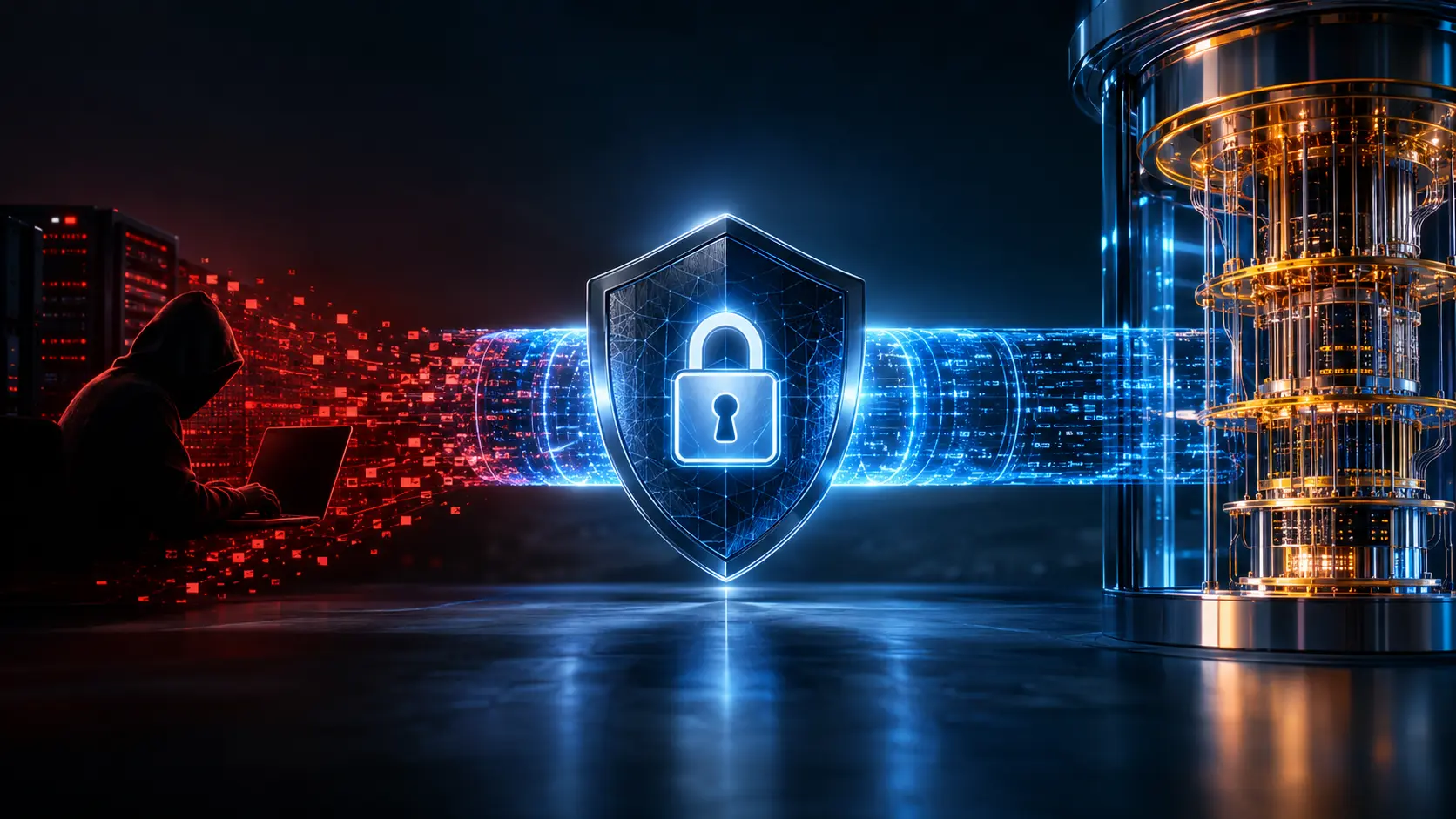

Right now, petabytes of highly classified corporate data are being systematically stolen by nation-state actors, and no security alarms are ringing. The data is heavily encrypted, rendering it temporarily useless to the attackers. But they are not trying to read it today; they are putting it in cold storage. Why should you care right now? Because of a strategy known as “Harvest Now, Decrypt Later.” When the first cryptographically relevant quantum computer comes online, every encrypted file, trade secret, and strategic communication stolen today will be instantly unlocked. If your company’s intellectual property has a shelf life of more than five years, your current Virtual Private Networks (VPNs) are already fundamentally compromised. To prevent total exposure, enterprise cybersecurity is undergoing a massive, urgent overhaul. By deploying Quantum-Resistant VPNs (PQC-VPNs) integrated with new NIST-approved cryptographic standards, network architects are mathematically immunizing their data tunnels against the quantum threat, securing zero-trust architectures before the quantum decryption window permanently closes.
What are Quantum-Resistant VPNs (PQC-VPNs)?
Quantum-Resistant VPNs (PQC-VPNs) are secure network tunnels that utilize Post-Quantum Cryptography PQC to protect data transmissions. They replace vulnerable classical encryption with advanced lattice-based algorithms, ensuring that encrypted corporate communications cannot be decrypted by future quantum computers using the “Harvest Now, Decrypt Later” strategy.
At a Glance
- The Physics Problem: Standard VPNs use math (RSA/ECC) that classical computers cannot solve but quantum computers can solve almost instantly using Shor’s Algorithm.
- The Cyber Threat: Adversaries are currently hoarding encrypted internet traffic. They will wait 10 years, build a quantum computer, and read your 2026 secrets.
- The PQC Solution: Quantum-Resistant VPNs swap out the vulnerable math for “Lattice-based” math, creating cryptographic puzzles so complex that even a quantum supercomputer gets lost.
- The Strategic Value: Transitioning to PQC-VPNs halts the “Harvest Now” threat immediately, safeguarding long-term intellectual property (IP), biotech patents, and financial algorithms from retrospective exposure.
In Simple Words
Imagine you secure your house with a combination lock. A normal burglar (a classical computer) would have to try millions of combinations one by one. It would take them 10,000 years to open it, so you feel safe.
But a Quantum Computer is a magical lockpick. Instead of trying combinations one by one, it tries every single combination simultaneously. It opens your lock in five seconds.
Because hackers know this magical lockpick is being built, they are currently stealing your locked safe boxes and hiding them in their garage (“Harvest Now, Decrypt Later”). They will open them when the lockpick arrives.
A Quantum-Resistant VPN changes the lock. Instead of a combination lock, it uses a massive, multidimensional labyrinth (Lattice Cryptography). Even if the burglar tries every path at the exact same time, the maze is so chaotic and filled with intentional noise that the lockpick is completely useless. By installing this new lock on your data today, the boxes hackers steal tomorrow will remain permanently sealed.
Why This Matters
For CISOs, Cloud Architects, and Cybersecurity VCs, PQC-VPNs address the Data Shelf-Life Crisis.
Every piece of data your enterprise transmits has a “shelf life”—the amount of time it must remain secret to hold value. An employee’s lunch order has a shelf life of one hour. But aerospace schematics, pharmaceutical clinical trial data, and sovereign wealth investment strategies have a shelf life of 10 to 25 years.
If experts estimate a quantum computer will be built by 2033, and your data has a 10-year shelf life, your security horizon has already crossed the threshold. Any data sent over a standard IPsec or WireGuard VPN today is currently compromised. Chief Information Security Officers (CISOs) must abandon the “we’ll fix it when quantum gets here” mindset; the laws of encryption mean the fix must be deployed years in advance.
Micro-Insight: The quantum threat to cybersecurity is retrospective. You do not get breached the day the quantum computer turns on; you get breached today, you just won’t know it until the machine is turned on.
Securing Zero-Trust Architecture (ZTA) with PQC
We are witnessing the Re-Plumbing of the Zero-Trust Architecture (ZTA).
Over the last five years, enterprises spent billions moving from perimeter firewalls to Zero-Trust Network Access (ZTNA). Zero-Trust assumes the network is always hostile, relying entirely on continuous encryption and identity verification. However, if the underlying cryptographic algorithms (RSA and Elliptic Curve) are broken, the entire Zero-Trust paradigm collapses. Upgrading the underlying VPN and TLS tunnels to PQC is the mandatory foundation required to keep the Zero-Trust philosophy viable in the 2030s.
How Quantum-Resistant VPNs Work (ML-KEM & Hybrid)
Replacing the mathematical foundation of the internet without breaking the internet requires a delicate hybrid approach. Here is the first-principles breakdown of the architecture.
1. The Fundamental Problem: Shor’s Algorithm vs Asymmetric Keys
VPNs use two types of encryption: Asymmetric (to securely exchange the keys over the open internet) and Symmetric (to lock the actual data).
Symmetric encryption (like AES-256) is highly resistant to quantum computers. The vulnerability lies entirely in the Asymmetric key exchange (Diffie-Hellman/ECC). If a quantum computer uses Shor’s algorithm to break the asymmetric handshake, the attacker steals the symmetric key, and the entire VPN tunnel is compromised.
2. The Core Mechanism: Lattice-Based Cryptography
To fix the handshake, NIST standardized ML-KEM FIPS 203 (Module-Lattice-Based Key-Encapsulation Mechanism).
Instead of relying on prime numbers, ML-KEM uses “Lattices”—vast, multi-dimensional grids of points. The algorithm hides the cryptographic key at a specific coordinate within a 1,000-dimensional grid and injects intentional mathematical “noise” (errors) into the directions. While the intended recipient knows how to filter the noise, an attacker (even a quantum one) gets mathematically lost trying to find the exact point.
3. Technical Depth: The Hybrid Handshake
CISOs face a dilemma: PQC algorithms are brand new. What if a classical mathematician discovers a flaw in ML-KEM tomorrow?
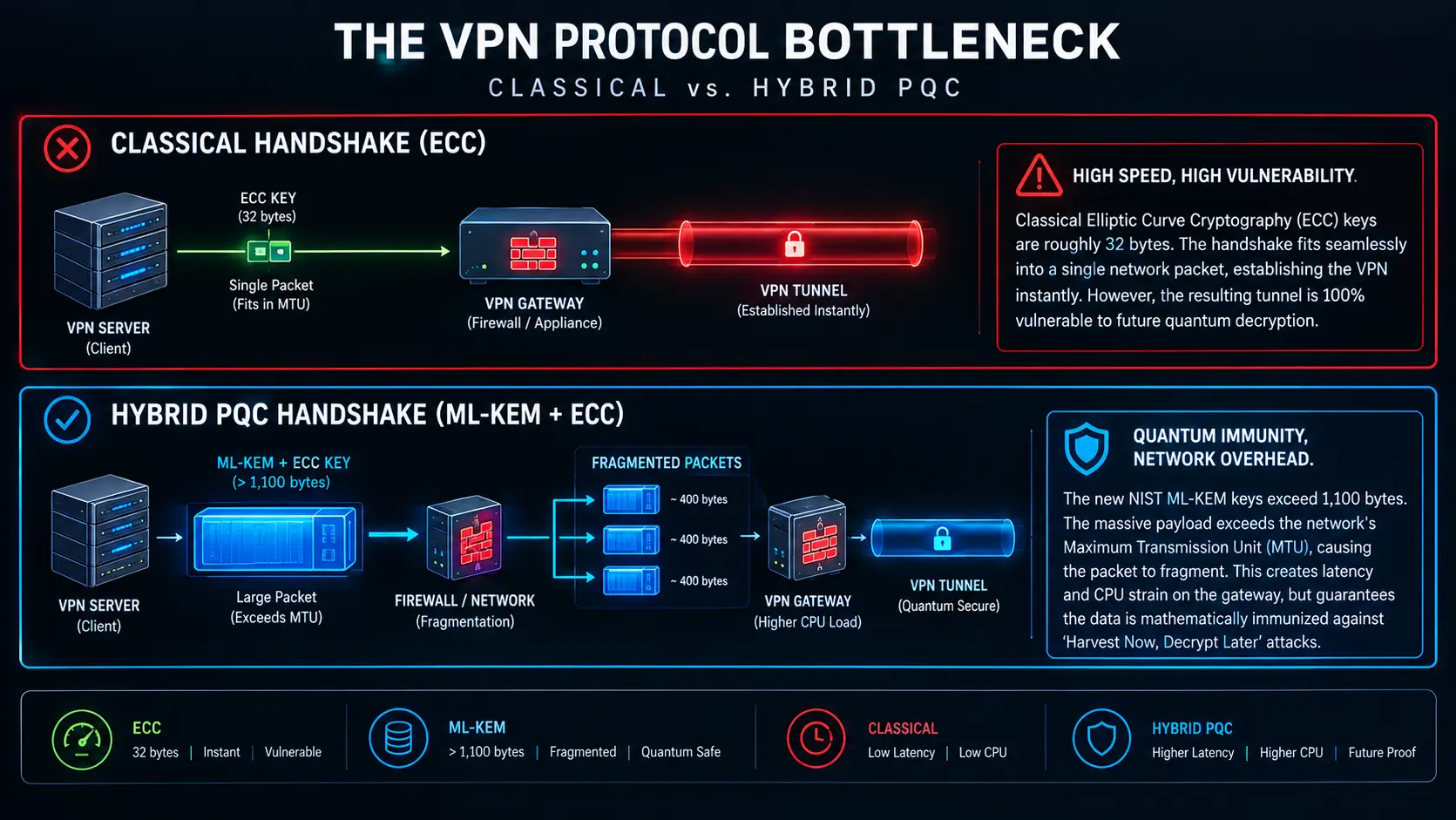
To solve this, PQC-VPNs use a Hybrid Key Exchange. During the VPN handshake, the client and server negotiate two separate keys—one using proven classical math (like X25519) and one using the new quantum-resistant math (ML-KEM). The two keys are cryptographically mashed together. For an attacker to break the tunnel, they must simultaneously break the classical math and possess a quantum computer to break the PQC math.
Plain-English Takeaway: A hybrid PQC-VPN puts two different padlocks on the data. One is proven to stop regular thieves; the other is designed to stop quantum thieves. You only get in if you can pick both.
4. Technical Depth: The Packet Fragmentation Bottleneck
This upgrade comes with a severe physical cost. A classical ECC public key is tiny—around 32 bytes. An ML-KEM public key is massive—over 1,184 bytes.
Internet networks transmit data in packets with a Maximum Transmission Unit (MTU), typically 1,500 bytes. Because the PQC keys and certificates are so bloated, the VPN handshake no longer fits inside a single packet. It gets chopped up (fragmented).
5. Real-World Consequences: Network Overhead and Latency
Packet fragmentation is the enemy of network performance. In protocols like IPsec (IKEv2) and WireGuard, processing fragmented packets across firewalls causes latency spikes, dropped connections, and massive CPU overhead on VPN gateways. Network architects deploying PQC-VPNs are currently forced to redesign network routing, increase MTU allowances (Jumbo frames), or upgrade hardware accelerators just to handle the sheer size of quantum-resistant math.
Quantum-Resistant VPN (PQC-VPN) Simulator
Harvest Now, Decrypt Later (HNDL) Defense vs. Cryptanalytic Qubit Attack
Adversary Quantum Capacity
1024 Qubits
VPN Cipher Architecture
Classical ECC (X25519)
Hybrid PQC (ML-KEM-768)
Handshake Key Overhead
32 Bytes
Tunnel Latency / MTU
18 ms (1 Pkt)
Cryptographic Resilience
50.0% SECURE
Zero-Trust Network Tunnel & Adversary Interception Node
TRAFFIC ENCRYPTED
Cryptographic Immunity vs. Packet Overhead Over Time
Real-World Applications
The transition to PQC is no longer theoretical; it is actively being deployed across tier-one internet infrastructure.
Google Chrome and Cloudflare (PQ-TLS): The underlying technology of VPNs (secure tunnels) is identical to web browsing encryption (TLS). Google Chrome and Cloudflare have already enabled hybrid PQC key agreements (X25519Kyber768) by default for millions of users. If you are browsing a Cloudflare-hosted site on an updated Chrome browser today, your connection is already quantum-resistant, acting as the largest real-world stress test of PQC packet fragmentation in internet history.
Commercial ZTNA Upgrades: Leading cybersecurity vendors like Palo Alto Networks, Cisco, and Fortinet are aggressively updating their Zero-Trust Network Access ZTNA gateways and IPsec architectures to support FIPS 203. Because hardware-based VPN concentrators rely on specialized ASICs (silicon chips) optimized only for classical AES and RSA, vendors are pushing massive software upgrades to shift PQC math processing onto general-purpose CPUs, entirely restructuring the hardware economics of enterprise edge networking.
CNSA 2.0 Mandates (US Government): The US National Security Agency (NSA) released the Commercial National Security Algorithm Suite 2.0 (CNSA 2.0). It mandates that all national security systems, defense contractors, and critical infrastructure providers must stop using classical algorithms and transition exclusively to PQC for software and firmware updates by 2025, and for all VPNs and network tunnels by 2030, sparking a multi-billion-dollar compliance rush across the defense industrial base.
Economic & Strategic Impact
The core strategic consequence of PQC is The Cryptographic Hardware Refresh Cycle.
For decades, cryptography was static. You bought a VPN appliance, bolted it into a data center rack, and it ran RSA/AES for seven years without issue.
The shift to PQC forces a massive hardware and software refresh cycle. Because lattice-based math is computationally heavier and requires moving large keys across the network, legacy firewalls and routers physically lack the RAM and CPU power to maintain high-throughput VPN tunnels without crashing. This is a massive tailwind for cybersecurity hardware manufacturers and cloud security providers (SSE/SASE), forcing Fortune 500 companies to repurchase their entire edge network infrastructure to maintain line-rate speeds under the new PQC standard.
Advantages of Post-Quantum Cryptography (PQC) Tunnels
- Defeats "Harvest Now, Decrypt Later": Immediately inoculates high-value, long-shelf-life corporate data against future quantum decryption.
- FIPS/NIST Compliant: Aligns enterprise infrastructure with the finalized NIST standards (FIPS 203/204), ensuring compliance with upcoming federal and industry data protection mandates.
- Hybrid Safety Net: By combining classical and PQC algorithms, enterprises ensure they are never less secure than they were yesterday, protecting against the risk that the new PQC math is flawed.
Network Latency and Fragmentation Limitations of PQC
- Massive Bandwidth Overhead: PQC keys are exponentially larger than classical keys, causing IP fragmentation, packet drops, and severe latency during the initial VPN connection establishment phase.
- Hardware Acceleration Lack: Modern CPUs and network cards have dedicated silicon circuits to compute AES and RSA instantly. PQC algorithms do not yet have dedicated silicon, forcing the math to run inefficiently on the CPU, causing thermal and power spikes.
- Cryptographic Agility Debt: Many legacy enterprise applications hardcoded their cryptography. They literally cannot accept a key larger than 256 bytes. Rewriting the legacy software just to fit the new, massive ML-KEM keys is a developer nightmare.
Takeaway: PQC is not a simple software patch. It is a heavier, bulkier form of math that clogs up network pipes and overworks processors. Securing the future requires paying a harsh performance tax today.
Common Misconceptions
Misconception: PQC uses quantum physics to secure data.
Reality: Post-Quantum Cryptography does not use quantum mechanics or qubits. It is entirely classical mathematics (run on standard silicon computers) that is specifically designed to be extremely difficult for a quantum computer to solve.
Misconception: We have to replace AES symmetric encryption too.
Reality: Symmetric encryption (like AES-256) is generally safe. A quantum computer using Grover's algorithm only halves its effectiveness (reducing AES-256 to AES-128 security), which is still virtually unbreakable. The upgrade is strictly for the asymmetric handshake (RSA/ECC) that establishes the tunnel.
Misconception: We can wait until a quantum computer is built to upgrade.
Reality: Due to "Harvest Now, Decrypt Later" and the fact that migrating an enterprise network takes roughly 5 to 7 years of discovery and testing, waiting until "Q-Day" guarantees a catastrophic, unmitigated breach.
What Most People Miss
The disruptive imperative of Crypto-Agility.
The defining lesson of the PQC transition is not that lattice-based math is perfect; it is that no math is permanent. In 2022, a promising PQC candidate called SIKE made it to the final rounds of the NIST competition, only to be completely broken by a researcher using a standard laptop over a weekend.
Enterprises are realizing they cannot hardcode ML-KEM into their systems and forget about it. They must build "Crypto-Agility"—an architectural framework where cryptographic algorithms exist as modular plugins. If ML-KEM is broken in 2028, a crypto-agile PQC-VPN can seamlessly hot-swap to a different mathematical standard (like Hash-based signatures) via an API call, without requiring a multi-year hardware refresh.
Comparison Table
| Metric | Classical VPN (IPsec/WireGuard) | Quantum-Resistant VPN (Hybrid PQC) |
| Asymmetric Handshake | RSA or Elliptic Curve (ECC) | Classical ECC + ML-KEM (FIPS 203) |
| Quantum Vulnerability | Catastrophic (Broken by Shor's) | Immune (Lattice-based) |
| Public Key Size | Tiny (~32 Bytes) | Massive (~1,184 Bytes) |
| Network Overhead | Negligible | High (Frequent Packet Fragmentation) |
| Strategic Goal | Standard secure transport | Defeating Harvest Now, Decrypt Later |
Future Outlook
Next 12–24 Months
The era of Discovery and Hybrid SASE Deployment. Over the next two years, enterprises will deploy automated cryptographic discovery tools to map out exactly where vulnerable RSA/ECC algorithms are hidden in their legacy stacks. Meanwhile, Secure Access Service Edge (SASE) providers will roll out hybrid PQC-VPNs by default. Network architects will battle the resultant latency spikes by tuning MTU sizes and optimizing UDP protocols to handle the bloated lattice key exchanges.
Next 3–5 Years
The scaling of PQC-Native Silicon. By 2029, semiconductor manufacturers (Intel, AMD, Broadcom) will integrate dedicated PQC hardware accelerators into their enterprise SmartNICs and CPUs. This will offload the heavy lattice math from the main processor, resolving the latency and thermal bottlenecks. Concurrently, government contractors will complete their CNSA 2.0 mandates, entirely dropping the "hybrid" safety net and running pure PQC infrastructure.
Next 10 Years
The Q-Day Reckoning. By the mid-2030s, the probability of a Cryptographically Relevant Quantum Computer (CRQC) coming online from a sovereign adversary reaches critical mass. Enterprises that fully migrated to PQC-VPNs will experience no disruption. However, organizations that failed to migrate will face a retroactive apocalypse—every gigabyte of legacy intercepted data, and every remaining classical tunnel, will instantly become plain text, triggering the largest mass-extinction event of intellectual property in modern economic history.
Most Likely Scenario
The transition to Post-Quantum Cryptography is the most significant, and logistically treacherous, cybersecurity upgrade since the invention of the internet. While PQC-VPNs introduce severe, short-term networking friction—primarily packet fragmentation and processing overhead—the existential threat of "Harvest Now, Decrypt Later" removes any option for delay. Driven by strict federal mandates and the integration of FIPS 203 into commercial ZTNA platforms, the enterprise adoption of hybrid quantum-resistant tunnels is inevitable, permanently altering the underlying mathematics of global trust.
Key Takeaways
- Quantum computers running Shor's Algorithm will easily break the RSA and Elliptic Curve math that currently secures all standard internet VPNs.
- Adversaries use "Harvest Now, Decrypt Later" to steal and store encrypted corporate data today, waiting for a quantum computer to read it in the future.
- Quantum-Resistant VPNs (PQC-VPNs) fix this by upgrading the tunnel handshake using new NIST standards (FIPS 203/ML-KEM) based on highly complex lattice mathematics.
- Because the new PQC keys are exponentially larger than classical keys, they cause packet fragmentation, slowing down network performance and requiring enterprise hardware upgrades.
- To hedge against the risk that the new PQC math might be flawed, modern VPNs use a "Hybrid" approach, running both classical and quantum-resistant locks simultaneously.
Glossary
Asymmetric Cryptography: An encryption system that uses two different keys: a public key to encrypt data and a private key to decrypt it. (e.g., RSA, ECC).
Cryptographically Relevant Quantum Computer (CRQC): A future quantum computer with enough stable, error-corrected qubits to run Shor's Algorithm and break standard internet encryption.
Crypto-Agility: The architectural ability of an IT system to rapidly switch out its underlying cryptographic algorithms without requiring a complete rewrite of the software.
Harvest Now, Decrypt Later (HNDL): A cyber espionage strategy where an attacker intercepts encrypted data that they cannot currently read, storing it long-term until future computing power allows them to decrypt it.
Lattice-Based Cryptography: A class of post-quantum algorithms that rely on the extreme mathematical difficulty of finding the shortest or closest point in a complex, multi-dimensional grid (a lattice).
ML-KEM (Module-Lattice-Based Key-Encapsulation Mechanism): Formerly known as Kyber, this is the primary PQC algorithm finalized by NIST in FIPS 203 to replace traditional key exchanges in secure tunnels.
Shor’s Algorithm: A quantum computer algorithm formulated by Peter Shor that can find the prime factors of an integer exponentially faster than the best-known classical algorithms, rendering RSA and ECC obsolete.
Sources
National Institute of Standards and Technology (NIST): FIPS 203: Module-Lattice-Based Key-Encapsulation Mechanism Standard
National Security Agency (NSA): Commercial National Security Algorithm Suite 2.0 (CNSA 2.0) Cybersecurity Advisory
Cloudflare Research: The Post-Quantum Era is Here: Defeating Harvest Now, Decrypt Later
Google Security Blog: Protecting Chrome Traffic with Hybrid Kyber KEM
Cybersecurity and Infrastructure Security Agency (CISA): Quantum-Readiness: Migration to Post-Quantum Cryptography