Advertisement
)

AT A GLANCE
- Concept: Latent Heat Absorption: Materials absorb massive thermal energy without rising in temperature while changing physical states.
- Concept: The Sub-80°C Threshold: Advanced biological therapies require extreme deep freezing to halt cellular metabolism completely.
- Concept: Passive Micro-Environments: Engineered chemical jackets maintain strict thermal parameters without relying on fragile electrical compressors.
- Concept: Phase-Change Chemistry: Specialized synthetic alkanes and salts act as sacrificial thermal buffers against external weather volatility.
HOW IT WORKS
Standard refrigeration uses mechanical compressors to blow cold air across a cargo hold. This active system fails immediately if the truck loses electrical power or turns off its engine. Advanced biopharmaceutical logistics abandons active mechanics entirely, relying instead on passive physical chemistry.
The core mechanism is the Phase-Change Material (PCM). When a solid substance melts into a liquid or sublimates into a gas, it absorbs a massive amount of thermal energy to break its molecular bonds. Crucially, the material absorbs this energy without changing its own temperature.
This hidden thermal buffering capacity relies on the latent heat equation:
$$Q = m \cdot L_f$$
Where $Q$ represents the total thermal energy absorbed, m is the physical mass of the phase-change material, and L_f is the specific latent heat of fusion. By maximizing the mass and selecting highly specific chemicals, engineers construct an optimized thermal battery.
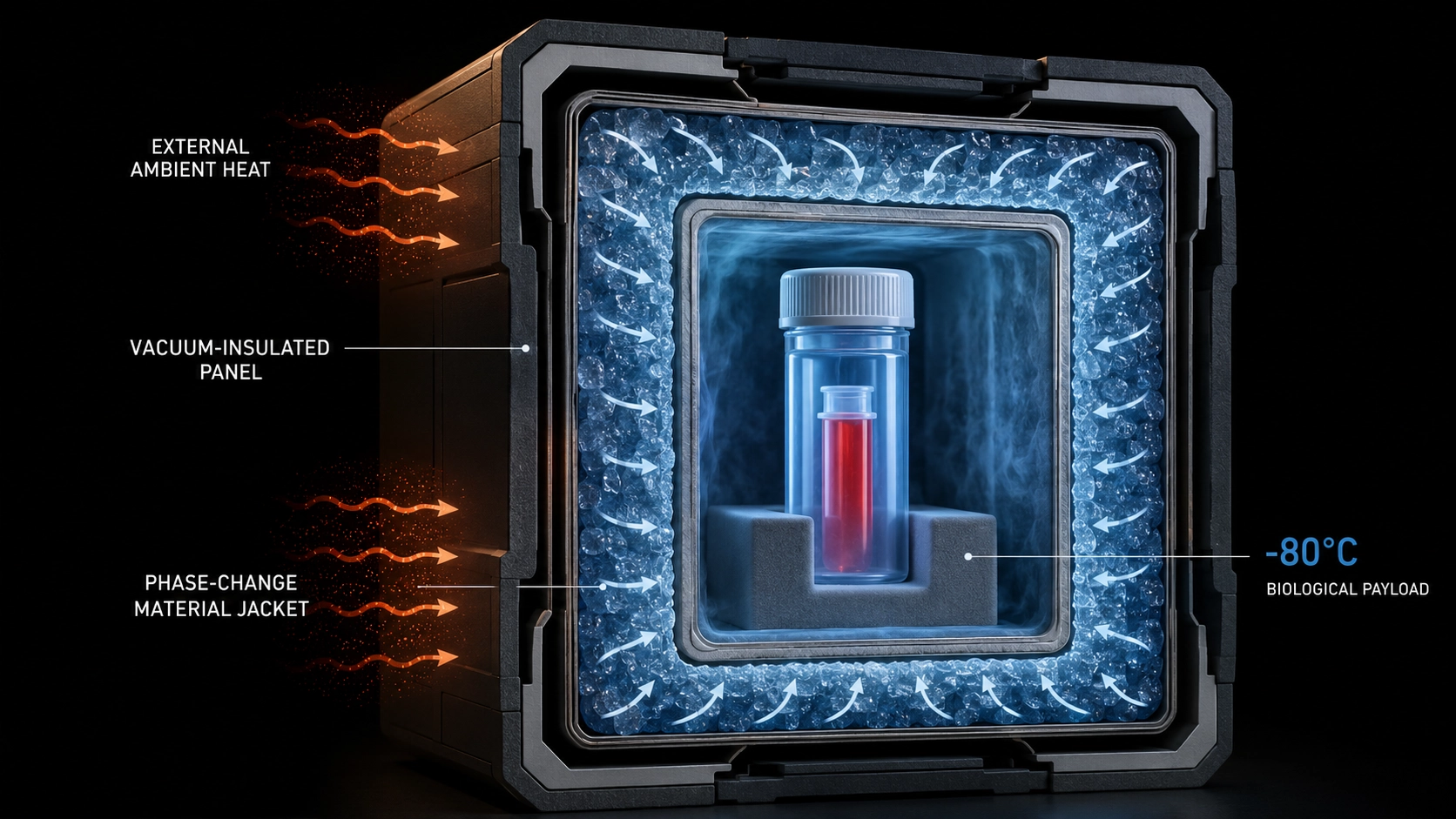
To maintain a strict -80°C environment, packaging technicians surround the biological payload with jackets filled with specific synthetic dry ice or advanced ester-based PCMs. These jackets sit inside a highly rigid vacuum-insulated panel box.
As external ambient heat bleeds through the vacuum walls, the PCM absorbs that kinetic energy to fuel its own phase transition. The internal biological payload remains locked at precisely -80°C until every single gram of the surrounding PCM has fully changed state.
WHY IT MATTERS NOW
The global pharmaceutical industry is pivoting rapidly from mass-produced chemical pills to highly personalized cell and gene therapies, such as CAR-T treatments for oncology. This shift replaces stable chemical compounds with living biological tissue.
These living cellular medicines are highly unstable. If the temperature of a patient’s extracted white blood cells rises above -80°C for even a few minutes, the cells aggressively metabolize, consume their finite energy stores, and die. This extreme biological fragility turns supply chain logistics directly into a critical medical procedure.
Companies like Cryoport design these passive shippers to act as mobile, autonomous life-support pods for million-dollar genetic payloads. The chemistry provides absolute operational certainty against the chaos of global shipping routes.
If a standard refrigerated truck blows a tire and idles on a summer highway, the electrical compressor fails, and the payload perishes. A precisely engineered PCM matrix guarantees up to ten days of absolute thermal autonomy, allowing living cells to survive unpredictable international customs delays without violating strict FDA temperature compliance standards.
WHAT MOST PEOPLE MISS
Logistics operators often assume that protecting temperature-sensitive freight simply requires adding thicker physical insulation to block the heat. They miss the fundamental thermodynamic reality that advanced PCMs do not block heat; they intentionally absorb it to self-regulate.
The chemical composition of the PCM acts as a programmable thermal hard drive. By swapping out a -80°C block for a -20°C salt hydrate matrix, logistics firms can reuse the exact same physical shipping hardware for entirely different classes of mRNA vaccines. This modularity turns rigid metallic hardware into a highly flexible, chemistry-defined logistics network.
THE TRAJECTORY
Next 12–36 Months: Logistics providers will integrate low-energy Bluetooth thermal probes directly into the PCM jackets. These sensors will transmit real-time phase-change metrics, alerting couriers exactly how many hours of latent heat absorption remain before the material fully melts.
Next Five Years: The industry will transition to metal-organic frameworks (MOFs) as highly stable, next-generation phase-change matrices. These complex crystalline structures will double the latent heat capacity by weight, drastically reducing the physical shipping mass and premium air-freight costs of personalized medicine.
Next Ten Years: Autonomous cold-chain drone networks will standardize around modular PCM pods. These drones will bypass congested ground traffic entirely, executing direct hospital-to-hospital delivery of custom organ tissues with zero breaks in the cryogenic chain.
What Could Go Wrong: Micro-punctures in the external vacuum-insulated panels caused by rough automated baggage handling instantly destroy the box’s thermal insulation rating. Ambient heat violently floods the container, exhausting the PCM in a matter of hours rather than days, leading to catastrophic and undetected therapeutic death.
Most Likely Outcome: Passive phase-change matrices will completely replace active mechanical refrigeration for all high-value biological freight. The mathematical certainty of chemical thermodynamics will supersede the mechanical unreliability of compressors and human drivers.
KEY TERMS
- Phase-Change Material (PCM): A substance engineered with a high heat of fusion, capable of storing and releasing massive amounts of energy while transitioning between physical states.
- Latent Heat: The hidden thermal energy absorbed or released by a thermodynamic system during a constant-temperature phase transition.
- Vacuum-Insulated Panel (VIP): A structural shipping container wall that utilizes a complete internal vacuum void to physically prevent the transfer of heat via conduction or convection.
- Cell and Gene Therapy: Advanced medical treatments that modify a patient’s own genetic material or living cells to cure diseases, strictly requiring extreme deep-freeze logistics.
SOURCES
- Food and Drug Administration (FDA) — Temperature Control Regulations for Cellular and Gene Therapy Products
- Journal of Pharmaceutical Sciences — Thermodynamic Modeling of Phase-Change Materials in Cold Chain Logistics
- Cryoport Systems — Advanced Cryogenic Logistics and Vacuum-Insulated Shipper Architectures
- International Safe Transit Association (ISTA) — Thermal Profile Testing Standards for Biological Packaging