Advertisement
)

At a Glance
- Concept: Deploying modular static synchronous series compensators (m-SSSC) directly onto high-voltage lines to actively manipulate line reactance and steer electricity.
- Why it matters: The global power grid is highly congested, blocking new solar, wind, and AI data centers from connecting. U.S. congestion alone cost over USD 12 billion recently. APFC unlocks hidden capacity on existing wires in a matter of months, rather than the decade it takes to permit and build new physical lines.
- Who uses it: Forward-thinking utilities and system operators globally, including National Grid (UK), ISA TRANSELCA (Colombia), and Central Hudson (US).
- Biggest takeaway: Power grids historically lacked “routers.” Electricity simply flooded the path of least resistance, causing one line to overheat while the line next to it sat half-empty. APFC finally brings internet-style traffic routing to the physical electrical grid.
In Simple Words
Imagine a massive highway system where cars have no steering wheels. Drivers just hit the gas, and the cars automatically take the shortest, most direct route to the city.
Because everyone takes the shortest route, that main highway becomes a massive traffic jam. Meanwhile, a slightly longer scenic route right next to it is completely empty. The traditional utility solution to this problem is to spend a billion dollars and 10 years building a brand new lane on the main highway.
Advanced Power Flow Control (APFC) is a smarter solution.
Instead of building a new highway, engineers install digital traffic lights on the existing roads. When the main highway gets too crowded, the APFC device turns “red,” artificially making that route look longer and harder to travel. This forces the cars (the electricity) to automatically detour onto the empty scenic route. By actively directing the traffic, the utility can double the total amount of cars reaching the city using the exact same roads they already have.
Why This Matters
The electrical grid is the single largest bottleneck to the artificial intelligence boom and the energy transition.
We are attempting to plug gigawatt-scale AI data centers and massive offshore wind farms into a transmission network built in the 1970s. When lines max out their thermal capacity, grid operators are forced to curtail (shut off) cheap renewable energy and turn on expensive, local fossil-fuel plants to keep the lights on—a localized phenomenon known as congestion.
Building new transmission lines to solve this congestion takes 7 to 10 years due to intense permitting battles, land rights disputes, and supply chain delays. Data centers and renewable developers cannot wait a decade. APFC can be manufactured, delivered, and bolted onto existing grid infrastructure in 12 to 18 months. It is the ultimate “bridge technology,” buying the grid crucial time to absorb exponential load growth while long-term infrastructure is slowly built out.
The Big Picture
The deployment of APFC is shifting from an experimental pilot project to a strict legal mandate.
For years, utilities ignored Grid Enhancing Technologies (GETs) because their financial incentives were tied to building massive, expensive new infrastructure (they earn a guaranteed return on capital expenditure).
This changed with FERC Order 1920. Finalized by the Federal Energy Regulatory Commission in mid-2024, Order 1920 explicitly forces transmission providers to evaluate Grid Enhancing Technologies—specifically including advanced power flow control devices—during their long-term regional planning processes. Regulators recognized that defaulting to multi-billion-dollar line upgrades was actively harming ratepayers. By forcing utilities to prove they cannot solve the problem with APFC first, regulators have officially moved dynamic grid routing from an optional upgrade to a mandatory operational baseline.
How Advanced Power Flow Control Works
Commanding gigawatts of raw power to change direction requires manipulating the fundamental physics of alternating current (AC). Here is the first-principles breakdown.
1. The Fundamental Problem: Kirchhoff’s Laws
In an AC power grid, electricity cannot be actively steered; it distributes itself across all available paths based inversely on the electrical resistance (reactance) of those paths. If Path A has low reactance and Path B has high reactance, the vast majority of the power will flood Path A. Operators historically had to sit back and watch Path A overload and overheat, even if Path B was sitting idle.
2. The Insufficiency of Legacy Flow Control
Utilities previously tried to manage this using Phase Shifting Transformers (PSTs) or Fixed Series Capacitors. However, these are massive, custom-built, highly expensive machines that require vast amounts of substation real estate. Worse, if a massive PST breaks down, the entire routing capability goes offline. They are inflexible and slow to deploy.
3. The Core Mechanism: Modular SSSC (m-SSSC)
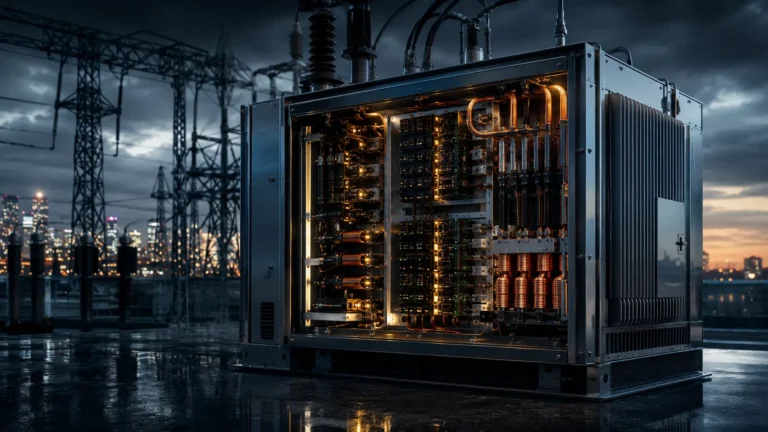
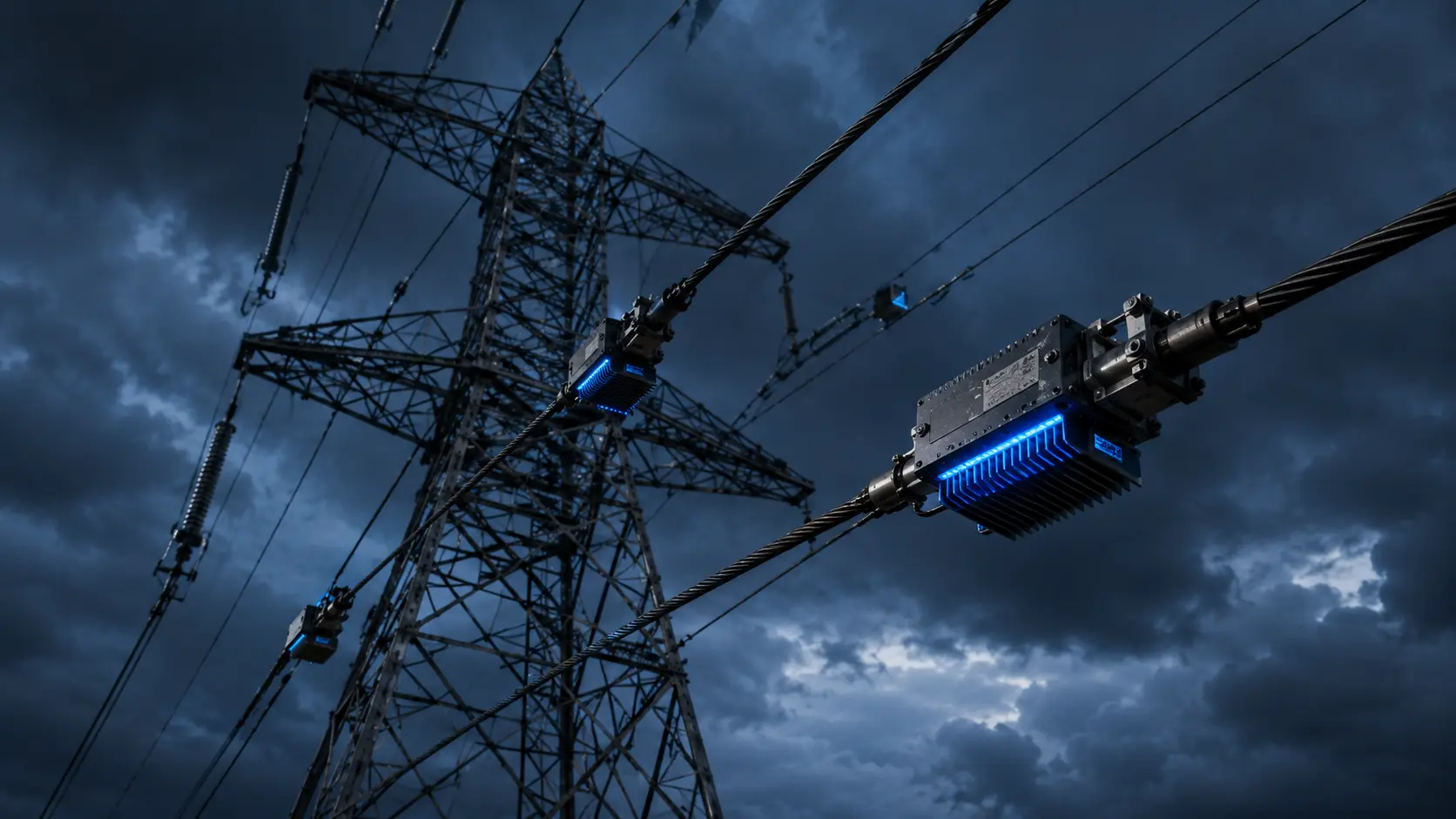
Modern APFC uses modular Static Synchronous Series Compensators (m-SSSC). These are compact, highly advanced power electronics devices mounted directly onto the transmission line structures or on small racks inside a substation. They use Voltage-Sourced Converter (VSC) technology and Insulated-Gate Bipolar Transistors (IGBTs).
4. Technical Depth: Impedance Injection
The m-SSSC intercepts the power flow and actively injects a voltage at a 90-degree angle (in quadrature) to the line current. By doing this, the device artificially synthesizes either capacitive or inductive reactance.
- To Push power away: The device injects inductive reactance, making the line “look” highly resistive to the rest of the grid. The electricity naturally flows away to other parallel lines.
- To Pull power in: The device injects capacitive reactance, canceling out the line’s natural resistance, turning it into a superhighway that sucks power away from overloaded neighboring lines.
5. Real-World Consequences: Modularity and Resilience
Because APFC devices are modular, they eliminate the single point of failure that plagued legacy systems. If a utility needs a massive amount of control, they install 30 modular units in a row. If one unit fails, it automatically bypasses itself, and the other 29 keep routing the power flawlessly. Furthermore, if grid congestion moves to a different city five years later, the utility can simply unbolt the APFC units and move them to the new location—an impossibility with traditional grid infrastructure.
Real-World Applications
APFC is currently solving acute grid crises across multiple continents.
Accelerating Renewable Interconnection (UK): National Grid Electricity Transmission in the UK deployed APFC across multiple boundaries in Northern England. The area was suffering severe bottlenecks that prevented newly built wind farms from sending their power south. By pushing power off the overloaded main lines and onto parallel underutilized lines, they unlocked massive capacity instantly, delivering huge savings in congestion costs and getting clean energy to market years faster than reconductoring the lines would have allowed.
Substation Space Constraints (USA): In the United States, Central Hudson Gas & Electric required a way to increase transfer capacity for renewables. Legacy solutions like Fixed Series Capacitors required massive footprint expansions. Central Hudson utilized modular APFC because it required 25 percent less substation real estate than the traditional alternative, solving the constraint without triggering painful land-acquisition and zoning fights.
Outage Management and Maintenance: When a major transmission line is taken offline for maintenance, the power it was carrying instantly floods onto neighboring lines, often causing dangerous overloads. Grid operators use APFC to proactively rebalance the network during these planned outages. By dynamically spreading the diverted load evenly across all remaining lines, utilities can safely execute longer maintenance windows without risking rolling blackouts.
Economic & Strategic Impact
The integration of APFC represents a critical pivot from Capital Expenditure (CapEx) to Operational Flexibility.
Building new transmission is a blunt instrument. Utilities forecast demand 15 years into the future, and if they guess wrong, billions of ratepayer dollars are stranded. APFC transforms the grid into a flexible, software-defined network. Because APFC units are voltage-agnostic and modular, they can be scaled up or down incrementally as demand changes.
This modularity dramatically de-risks grid planning. Instead of committing 10 years and a billion dollars to a new line based on AI data center forecasts that might fail to materialize, operators can deploy a $20 million APFC cluster in 12 months to handle the immediate load. If the load disappears, they unbolt the asset and move it. This optionality is fundamentally rewriting the risk profile of modern utility investment.
Advantages
- Speed of Deployment: Projects can move from order to active deployment in 12 to 18 months, bypassing the decade-long permitting hell of physical transmission lines.
- No Single Point of Failure: Modular architecture ensures that if one unit fails, the system automatically bypasses the broken unit and remains fully operational.
- Asset Relocation: Unlike concrete foundations and 100-foot steel towers, APFC units can be uninstalled and relocated to different parts of the grid if network congestion patterns shift.
- Improves Grid Stability: Beyond raw routing, the power electronics inside an m-SSSC provide dynamic support services, improving voltage stability and transient stability during grid disturbances.
Limitations
- Does Not Create New Wire: APFC cannot increase the physical thermal limit of the actual copper or aluminum wire. If the entire regional grid is operating at 100% capacity with no empty parallel lines available, APFC is useless; new lines must be built.
- Cybersecurity Vulnerabilities: Because APFC units rely on industrial radio signals and secure telecom gateways to communicate with the central control center, they introduce digital entry points into the physical grid that must be ruthlessly defended against nation-state cyberattacks.
- Operational Complexity: Grid control rooms are accustomed to a static, predictable grid. Handing operators dynamic valves requires a massive overhaul of their Energy Management System (EMS) software and extensive retraining so they do not accidentally route power into a secondary bottleneck.
Common Misconceptions
Misconception: APFC is just a smart sensor that tells operators the line is hot.
Reality: You are thinking of Dynamic Line Rating (DLR) sensors. APFC is not a passive sensor; it is active hardware. It physically injects high-voltage energy into the line to forcibly block or pull electricity.
Misconception: With APFC, we never need to build new transmission lines again.
Reality: APFC is an optimization tool, not a replacement for raw capacity. It ensures we use 100% of the grid we have. However, with electricity demand set to double by 2050, we absolutely must build thousands of miles of new physical lines. APFC just buys us the critical time needed to build them.
Misconception: If the device breaks, it will cut off the power line.
Reality: The devices operate at line potential and are designed to fail safely. If a unit experiences a critical error, an internal mechanical switch instantly bypasses the electronics, allowing the electricity to flow normally through the wire as if the device wasn’t even there.
What Most People Miss
The impact of APFC operating at Line Potential.
Legacy power flow controllers, like massive Phase Shifting Transformers, must be heavily insulated and connected to the ground. This requires digging massive foundations, building containment systems, and navigating extreme safety protocols.
Modern APFC units (like those built by Smart Wires) operate at “line potential” without connecting to the ground. They sit directly in series with the high-voltage wire, completely isolated from the earth. This eliminates the need for massive insertion or coupling transformers. Because they don’t touch the ground, they can literally be hung from existing transmission towers, drastically slashing civil engineering costs and deployment timelines.
Comparison Table
| Feature | New Transmission Line | Phase Shifting Transformer (PST) | Advanced Power Flow Control (APFC) |
| Deployment Time | 7 to 10 Years | 2 to 4 Years | 12 to 18 Months |
| Primary Benefit | Adds massive new raw capacity | Routes power, proven legacy tech | Routes power, modular, scalable |
| Footprint | Massive (Miles of land rights) | Large (Requires substation expansion) | Minimal (Tower-mounted or small racks) |
| Relocatable? | No | Extremely Difficult | Yes (Highly modular) |
| Failure Mode | Tree strikes / physical damage | Single point of failure | Bypass mode (No single point of failure) |
Case Study
Situation: The Independent Power Transmission Operator (IPTO) in Greece was managing a rapidly evolving grid, integrating massive amounts of renewable energy while attempting to maintain operational stability across aging infrastructure.
Challenge: Upgrading the network with conventional Flexible Alternating Current Transmission Systems (FACTS) or building new lines was proving too slow, too expensive, and too rigid for the unpredictable, highly dynamic flow changes caused by intermittent solar and wind generation.
Solution (The m-SSSC Deployment): In 2021, IPTO initiated a targeted deployment of an APFC solution. They installed a Modular Static Synchronous Series Compensator (m-SSSC) system inside the Nea Santa 150 kV substation.
Outcome: The system successfully communicated securely via an Industrial, Scientific, and Medical (ISM) radio link to a PowerLine Coordinator, allowing operators to dynamically inject voltage and control the active power flows in the meshed system. The deployment proved that modular power electronics could effectively push and pull power on demand at a fraction of the cost of conventional FACTS devices.
Lessons Learned: The Greek deployment validated the core premise of APFC: scalability and replicability. By proving that grid operators could securely communicate with and manipulate modular valves via digital gateways without threatening grid stability, the project laid the technical groundwork for the massive, mandated GETs deployments now sweeping across Europe and North America.
Future Outlook
Next 12–24 Months
The era of compliance and integration. Following the finalization of FERC Order 1920, transmission providers across the U.S. will scramble to update their planning software. To legally comply with the mandate to evaluate Grid Enhancing Technologies, utilities must upgrade their simulation engines to accurately model how APFC devices will push and pull power under future load scenarios. Expect a massive surge in procurement orders as utilities realize APFC is the fastest way to relieve the immediate pressure of the interconnection queue.
Next 3–5 Years
The pairing of APFC with Dynamic Line Ratings (DLR). DLR sensors tell the utility exactly how much spare capacity exists on a line due to real-time wind and temperature cooling. APFC is the muscle that acts on that data. Within five years, these two systems will merge into closed-loop software systems. The DLR sensor will detect hidden capacity on Line B, and the software will automatically command the APFC valve on Line A to push the exact right amount of power over to Line B, maximizing grid efficiency autonomously.
Next 10 Years
The software-defined grid. As thousands of modular APFC nodes are deployed globally, the transmission grid will mirror the architecture of the modern internet. Electricity will no longer passively flow down the path of least resistance. Instead, packet-like routing algorithms will seamlessly shift gigawatts of energy around localized weather events, cyber-attacks, or sudden AI data center spikes in a fraction of a second, ensuring flawless reliability without requiring a human operator to click a mouse.
Most Likely Scenario
Advanced Power Flow Control will become a standard, ubiquitous component of grid infrastructure, completely replacing legacy phase shifting transformers. While the world must still execute a multi-trillion-dollar buildout of new physical high-voltage lines to survive the energy transition, APFC will serve as the critical digital shock absorber, ensuring the existing grid does not collapse while we spend the next decade pouring concrete for the new one.
Key Takeaways
- Advanced Power Flow Control (APFC) uses modular power electronics to inject voltage into a transmission line, altering its reactance to either push power away from or pull power toward it.
- The technology acts like digital traffic lights, routing electricity around congested bottlenecks and unlocking hidden capacity on existing wires.
- APFC is drastically faster to deploy (12 to 18 months) than building new transmission lines (7 to 10 years).
- FERC Order 1920 legally mandates U.S. transmission planners to formally evaluate APFC and other Grid Enhancing Technologies (GETs) in long-term grid planning.
- Because APFC relies on modular Static Synchronous Series Compensators (m-SSSC), the system has no single point of failure; if one unit breaks, it bypasses itself and the rest keep functioning.
- Unlike legacy grid control devices, modern APFC units operate at line potential without touching the ground, eliminating the need for massive substation footprint expansions.
Glossary
Dynamic Line Rating (DLR): Sensors placed on power lines that calculate exactly how much electricity the line can safely carry in real-time based on current weather conditions (like wind cooling the wire).
FERC Order 1920: A sweeping U.S. federal regulation finalized in 2024 that reforms regional transmission planning and explicitly requires utilities to evaluate Grid Enhancing Technologies (GETs) instead of immediately defaulting to building new lines.
Grid Enhancing Technologies (GETs): A suite of hardware and software solutions (including APFC, DLR, and advanced topology control) designed to squeeze more capacity and efficiency out of the existing power grid.
m-SSSC (Modular Static Synchronous Series Compensator): The specific type of power electronics device used in modern APFC. It leverages Voltage-Sourced Converters to inject voltage into a line, modifying its resistance.
Reactance: A form of electrical resistance specific to alternating current (AC) systems. APFC devices artificially increase or decrease a line’s reactance to control how much power flows through it.
Substation: A facility on the electrical grid containing heavy equipment (like transformers and circuit breakers) used to step voltage up or down and route power.
Frequently Asked Questions
Does APFC generate electricity?
No. APFC devices do not generate power, nor do they act like batteries to store it. They strictly act as valves, routing the electricity generated by power plants and wind farms to ensure it takes the most efficient path to the consumer.
If the grid is so congested, why don’t we just build more lines?
We are trying. But building high-voltage transmission lines requires acquiring land rights across hundreds of miles, passing severe environmental reviews, and surviving endless lawsuits from local opposition (NIMBYism). It takes an average of 10 years to build a line in the U.S. We need solutions today.
Can APFC prevent blackouts?
Yes. By giving grid operators the ability to instantly route power away from an overloaded line before it melts or trips offline, APFC prevents the cascading failures that typically lead to widespread regional blackouts.
Who makes this technology?
The market leader globally for this specific modular APFC architecture is a company called Smart Wires, which produces the “SmartValve.” Other major grid conglomerates like Siemens Energy and Hitachi Energy also produce broader power flow control and FACTS devices.
How is this different from a normal transformer?
Standard transformers change the voltage of the electricity (e.g., stepping it down so it is safe to enter your house). APFC devices change the reactance of the line, which controls the volume and direction of the electricity flowing across the high-voltage network.
Sources
- Indiana Utility Regulatory Commission: Advanced Power Flow Control (APFC) and DLR Submission (June 2026)
- Smart Wires: SmartValve – Advanced Power Flow Control
- Enline Energy: FERC, Dynamic Line Rating, and Grid Enhancing Technologies in 2026: A Practical Guide for U.S. Utilities (May 2026)
- Smart Wires: What is Order 1920 and what does it mean for the grid?
- ResearchGate: A Modular Static Synchronous Series Compensator Offering Improved Scalability and Replicability Properties