Advertisement
)

AT A GLANCE
- Concept: Electronic Steering: The radar dish never physically moves; it steers the beam entirely through mathematical phase interference.
- Concept: Transmit/Receive Modules: The array is composed of thousands of individual, self-contained miniature radars operating in unison.
- Concept: Gallium Nitride (GaN): A high-power semiconductor material that replaces silicon, allowing each module to blast significantly more energy without melting.
- Concept: Multi-Function Execution: Because the modules operate independently, the radar can simultaneously track incoming missiles, guide outgoing weapons, and execute cyberattacks.
HOW IT WORKS
Traditional radar functions like a flashlight on a motorized swivel. A central transmitter generates a massive pulse of radio frequency (RF) energy, bounces it off a curved mechanical dish, and physically spins that dish to sweep the sky. This mechanical system is fundamentally constrained by physics; a heavy metal dish can only rotate so fast, leaving dangerous blind spots during each physical rotation.
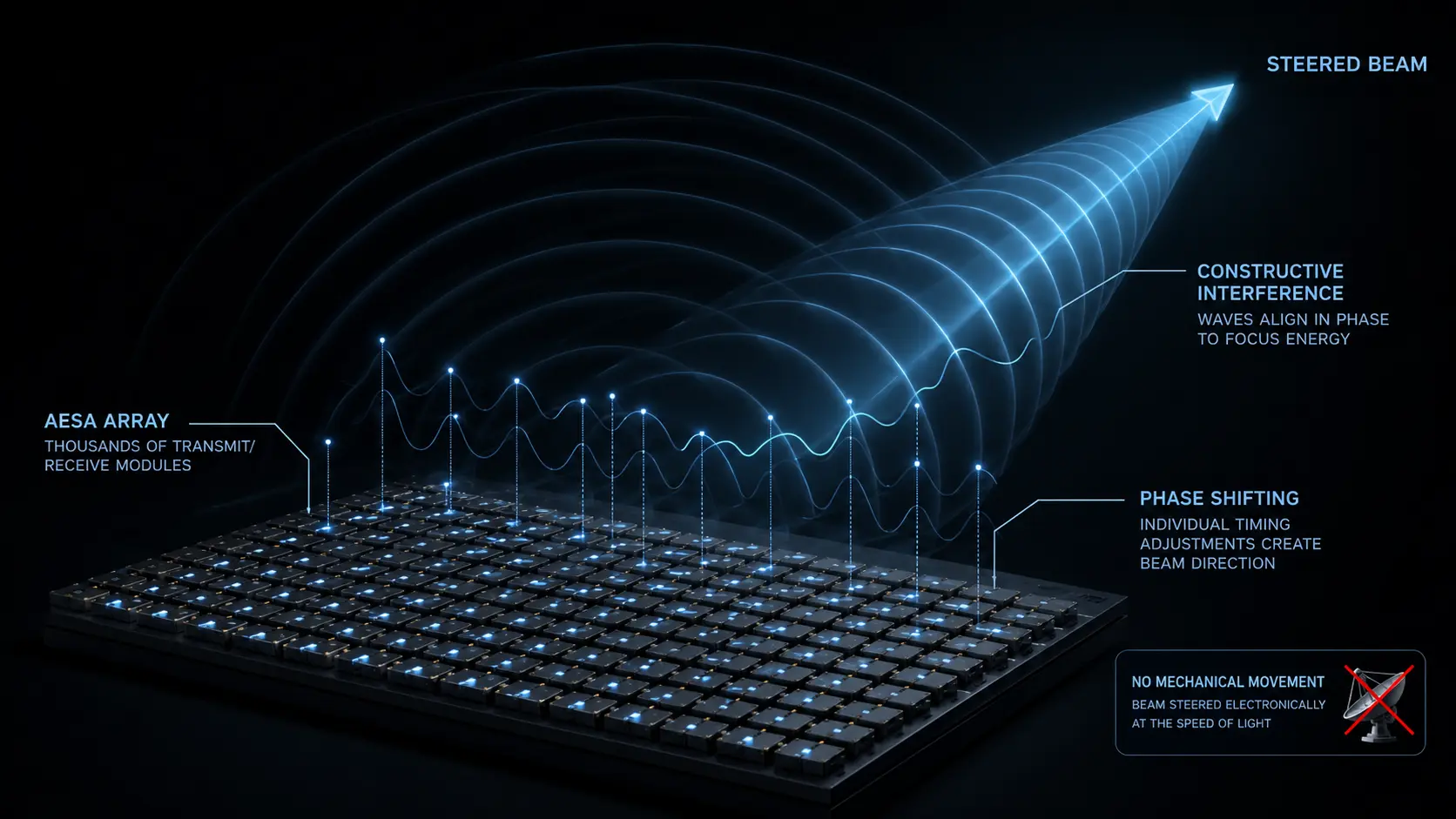
The Active Electronically Scanned Array (AESA) eliminates the motorized swivel entirely. The “dish” is a flat, stationary plate embedded in the nose of a fighter jet or the hull of a warship. The surface of this plate is covered by thousands of individual, microscopic antennas known as Transmit/Receive Modules (TRMs). Every single TRM generates its own RF energy and possesses its own dedicated receiver.
An AESA steers its radar beam using the physics of constructive and destructive interference. By delaying the exact microsecond that each individual TRM fires its pulse—a process called phase shifting—the intersecting radio waves push and pull against each other. This interference physically bends the combined wavefront, instantly steering the focused beam of energy in any direction without moving a single mechanical part.
The absolute range and sensitivity of an AESA radar are dictated strictly by the power density of its TRMs. Historically, these modules were built using Gallium Arsenide (GaAs) semiconductors. Today, defense contractors like Raytheon and Northrop Grumman are retrofitting entire fleets with Gallium Nitride (GaN). GaN is a wide-bandgap semiconductor. It can safely conduct vastly higher voltages and operate at extreme temperatures without thermal breakdown. By swapping GaAs for GaN, engineers physically force up to five times more electrical power through the exact same microscopic antenna footprint, exponentially increasing the radar’s detection range.
WHY IT MATTERS NOW
In modern beyond-visual-range (BVR) aerial combat, fighter jets almost never see each other with the naked eye. Air superiority is a strict mathematical contest of electromagnetic detection. The jet that sees the adversary first fires first.
The integration of Gallium Nitride AESA radars fundamentally alters this detection math. An F-35 equipped with a high-power AESA can detect a legacy adversary aircraft hundreds of miles away. Because the AESA beam is steered electronically at the speed of light, it can instantly jump between targets, tracking a swarm of incoming cruise missiles while simultaneously guiding a dozen interceptor missiles to their targets. Mechanical radars physically cannot spin fast enough to process this volume of simultaneous threats.
This specific semiconductor upgrade dictates global military logistics. The limiting factor of a GaN AESA radar is no longer the antenna itself; it is the thermal management of the host vehicle. Blasting megawatts of RF energy generates massive waste heat. The true engineering bottleneck for modern fighter jets and naval destroyers is their ability to physically pump enough liquid coolant to the radar face to prevent the GaN modules from melting the surrounding airframe.
Furthermore, because an AESA consists of thousands of independent modules, it possesses absolute frequency agility. It can fire hundreds of different frequencies in a single millisecond. This makes the radar highly resistant to enemy jamming. An adversary attempting to drown out the radar signal cannot predict which exact frequency the AESA will use next, rendering traditional “dumb” electronic warfare systems entirely obsolete.
WHAT MOST PEOPLE MISS
Military analysts frequently debate the aerodynamic maneuverability of different fighter jets, arguing over turn radii and thrust-to-weight ratios. They completely miss the reality that aerodynamic dogfighting has been dead for twenty years. A modern fighter jet is simply a flying battery and a liquid cooling pump explicitly designed to keep a GaN AESA radar airborne.
Because the TRMs can be grouped and programmed via software to act independently, an AESA radar is not just a sensor; it is a directed-energy weapon. A pilot can partition the array, using 800 modules to track a target while simultaneously focusing the remaining 400 modules to blast a highly concentrated, localized burst of microwave energy directly into the adversary’s flight computer, physically frying their electronics without firing a kinetic missile.
THE TRAJECTORY
Next 12–36 Months: Militaries will complete the deployment of GaN-based AESA radars onto legacy 4th-generation fighter jets (like the F-16 and F/A-18). This relatively cheap software and hardware upgrade will instantly provide thirty-year-old airframes with 5th-generation targeting and electronic attack capabilities.
Next Five Years: AESA technology will detach from the nose cone and become conformal. Engineers will print flexible, ultra-thin GaN TRMs directly into the carbon-fiber skin of the aircraft’s wings and fuselage. This will provide the pilot with true 360-degree, continuous electromagnetic spherical awareness, entirely eliminating the blind spot behind the aircraft.
Next Ten Years: Cognitive Electronic Warfare will automate AESA operation. Machine learning algorithms will sit directly on the radar’s processing back-end, analyzing enemy jamming signals in real-time and autonomously rewriting the AESA’s phase-shifting logic in milliseconds to counter novel, unrecognized electronic threats without human pilot intervention.
What Could Go Wrong: GaN TRMs operate at extreme voltages. If a localized cyber intrusion successfully hacks the radar’s thermal management software, it could intentionally throttle the liquid cooling pumps during a high-power scan. The GaN modules would instantly overheat, physically burning out the entire multi-million-dollar array and leaving the aircraft permanently blind.
Most Likely Outcome: The Gallium Nitride AESA will become the mandatory minimum baseline for any military platform attempting to survive in contested airspace. The geopolitics of air superiority will shift entirely away from the aerospace engineers designing jet engines toward the material scientists optimizing the thermal dynamics of semiconductor physics.
KEY TERMS
- Active Electronically Scanned Array (AESA): A phased array radar system containing thousands of individual, solid-state transmitting and receiving modules that steer radar beams electronically.
- Transmit/Receive Module (TRM): The self-contained microscopic circuit board within an AESA that generates, amplifies, and receives a specific radio frequency pulse.
- Gallium Nitride (GaN): A wide-bandgap semiconductor material that handles significantly higher voltages and temperatures than legacy silicon, maximizing radar power output.
- Phase Shifting: The mathematical delaying of a radio wave by fractions of a microsecond to create constructive interference, allowing the radar to steer a beam without mechanical movement.
- Electronic Warfare (EW): Any military action involving the use of electromagnetic or directed energy to control the electromagnetic spectrum or to attack the enemy.
SOURCES
- Department of Defense (DoD) — Advanced Radar Systems and Active Electronically Scanned Array Capabilities
- IEEE Microwave Magazine — Gallium Nitride Transmit/Receive Modules for Next-Generation Phased Arrays
- Northrop Grumman — Scalable Agile Beam Radar (SABR) and AESA Architecture
- Raytheon Technologies — GaN Semiconductors and the Future of Electronic Warfare