Advertisement
)

A billion-dollar spy satellite in standard orbit can easily read a license plate, but it costs hundreds of millions of dollars to launch and is a highly visible, predictable target. If you lower that satellite’s orbit by just 200 miles, the camera resolution naturally quadruples, radar costs plummet, and latency vanishes. But there is a lethal catch: at that altitude, the Earth’s atmosphere is still thick enough to create massive aerodynamic drag. Within weeks, the friction will tear a multi-million-dollar satellite out of the sky and incinerate it.
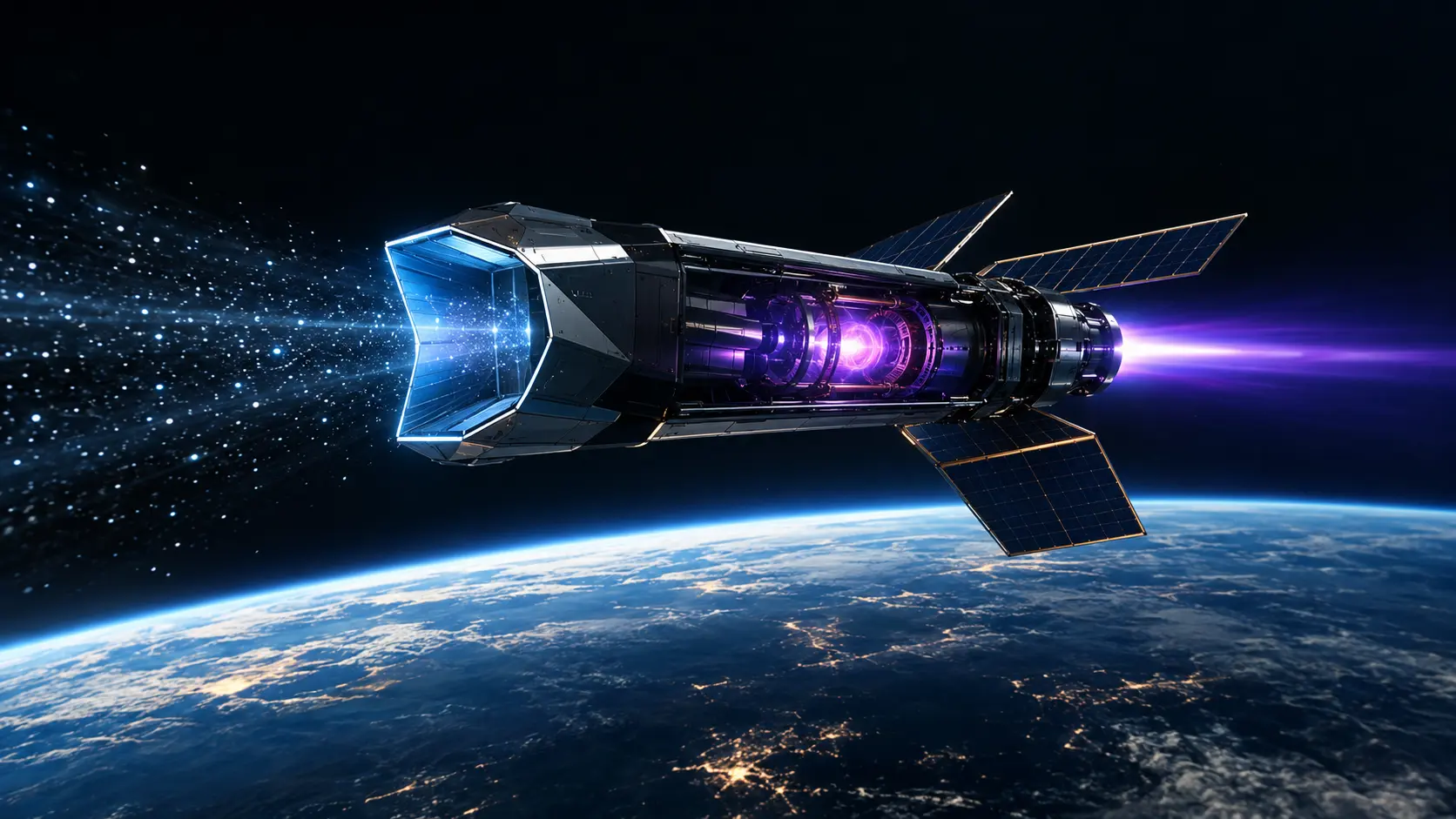
Why should you care right now? Because the aerospace industry has figured out how to weaponize that exact aerodynamic drag. In 2026, vanguard space companies are launching the first satellites equipped with Air-Breathing Electric Propulsion (ABEP). Instead of fighting the thin atmosphere, these engines swallow it, supercharge it into plasma, and shoot it out the back as thrust. By literally using the sky as unlimited rocket fuel, these satellites can linger indefinitely just above the stratosphere, fundamentally changing the economics of global surveillance, telecommunications, and defense.
What is Air-Breathing Electric Propulsion (ABEP)?
Air-Breathing Electric Propulsion (ABEP) is a spacecraft engine technology that collects residual atmospheric gases in Very Low Earth Orbit (VLEO) and ionizes them to generate thrust. By using the surrounding atmosphere as a continuous propellant source, ABEP allows satellites to maintain orbit indefinitely without carrying traditional onboard rocket fuel.
At a Glance
- Concept: A satellite engine that works like a jet engine in space, sucking in thin air instead of carrying heavy tanks of gas.
- Why it matters: It unlocks Very Low Earth Orbit (VLEO). Satellites can fly closer to Earth for sharper images and faster internet, without crashing and burning up after a few weeks.
- Who uses it: Defense contractors building persistent surveillance meshes, telecommunications firms seeking ultra-low latency, and aerospace startups like Kreios Space.
- Biggest takeaway: Standard thrusters melt when exposed to the corrosive oxygen at the edge of the atmosphere. ABEP uses magnetic fields and radio waves to create thrust without ever letting the corrosive gas touch the engine’s metal parts.
In Simple Words
Imagine trying to drive a car across a vast, empty desert.
Normally, you have to fill your trunk with as many heavy gas cans as possible. The farther you want to go, the more gas you have to carry. Eventually, there is no room left in the car for passengers or cargo, and when you inevitably run out of gas, the car stops forever. This is how traditional satellites work in low orbits.
An Air-Breathing Electric Propulsion satellite is like a car with a special scoop on the front. As it drives, it scoops up the microscopic dust floating in the desert air, feeds it into a high-tech nuclear reactor, and uses that dust as fuel. Because the desert is full of dust, the car never runs out of fuel. It can drive forever, and because it doesn’t need to carry any gas cans, the entire trunk is freed up to carry massive, heavy cameras and sensors.
Why This Matters
For Aerospace Engineers, Space Investors, and Defense Strategists, ABEP solves the Mass Fraction Penalty.
In orbital mechanics, the “mass fraction” dictates how much of a satellite’s total weight is dedicated to fuel versus actual payload (the cameras, antennas, and computers). To survive in Very Low Earth Orbit (VLEO) using standard electric thrusters, a satellite must dedicate over 50% of its total mass to heavy Xenon or Krypton propellant just to fight the continuous drag.
ABEP drops the propellant mass requirement to zero. By harvesting the atmosphere, the satellite generates its own propellant on the fly. This inversion of the mass fraction allows defense contractors to build much smaller, cheaper satellites that carry vastly superior optical sensors. It transforms VLEO from a temporary, expendable “drop zone” into a permanent, highly lucrative operational domain.
The Evacuation to Very Low Earth Orbit (VLEO)
We are witnessing the Evacuation to VLEO.
Standard Low Earth Orbit (LEO)—where the ISS and Starlink operate—is becoming catastrophically crowded. The risk of Kessler Syndrome (a runaway chain reaction of satellite collisions) is rising exponentially as companies launch thousands of mega-constellations.
VLEO acts as a natural safe haven. Because the drag is so high between 150 km and 250 km, space debris cannot exist there. If a satellite breaks into pieces, the atmosphere naturally drags the debris down and burns it up within days. ABEP is the technological key that unlocks this self-cleaning, debris-free super-highway, allowing hyperscale operators to build massive constellations without the regulatory nightmare of orbital clutter.
How Air-Breathing Electric Propulsion Works
Catching air at 17,000 miles per hour and turning it into thrust without melting the spacecraft requires bending the rules of fluid dynamics and electromagnetism. Here is the first-principles breakdown of the architecture.
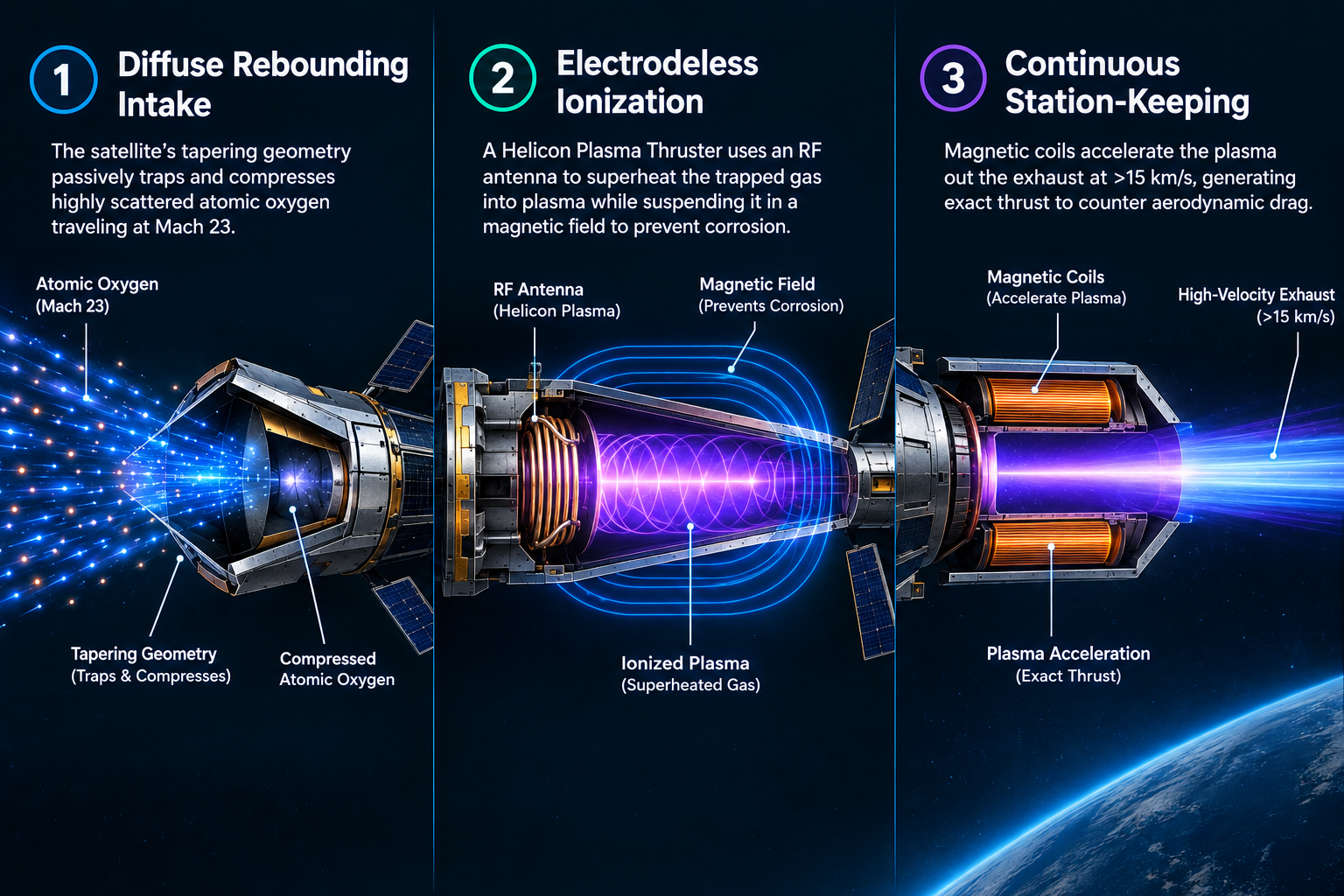
1. The Fundamental Problem: Diffuse Rebounding
At 200 kilometers above the Earth, the atmosphere is effectively a vacuum, consisting of widely scattered atomic oxygen and nitrogen. The satellite is traveling at 7.8 km/s (Mach 23). When these gas particles hit the satellite’s intake, they don’t flow like wind. They hit the metal and instantly bounce back out into space like billiard balls. This is called “diffuse rebounding.”
2. The Core Mechanism: The Aerodynamic Trap
To solve this, engineers design highly specialized, long, tapering intake geometries. The intake acts like a lobster trap. When a particle enters and bounces, the internal angles of the walls force it to bounce deeper into the chamber rather than back out. This passive compression artificially creates a dense pocket of gas at the back of the engine.
3. Technical Depth: The Corrosive Oxygen Threat
Normally, electric thrusters use metal electrodes to shock gas into plasma. However, the gas gathered in VLEO is primarily atomic oxygen (O)—a highly reactive, violently corrosive element. If atomic oxygen touches a charged metal electrode, the electrode rusts, erodes, and fails within hours.
Micro-Insight: You cannot use standard ion engines in VLEO because the atmosphere will literally eat the engine from the inside out.
4. Technical Depth: The Helicon Plasma Thruster (HPT)
Because metal electrodes will melt, ABEP uses an electrodeless engine called a Helicon Plasma Thruster. It wraps the gas chamber in a Radio Frequency (RF) “birdcage” antenna, similar to the technology used inside an MRI machine.
The antenna blasts the trapped gas with intense electromagnetic waves. This excites the electrons, heating the gas until it violently strips apart into a glowing, ionized plasma. The entire process happens suspended in a magnetic field, meaning the corrosive plasma never physically touches the walls of the engine.
5. Real-World Consequences: Continuous Station-Keeping
Finally, magnetic coils at the rear of the engine act as an invisible nozzle. They magnetically accelerate the plasma out the back of the satellite at exhaust velocities exceeding 15 km/s. As long as the thrust generated by this plasma exhaust is precisely equal to or greater than the aerodynamic drag of the intake, the satellite achieves indefinite orbit.
Defense and Commercial Applications of ABEP
ABEP is transitioning from laboratory vacuum chambers into tactical orbital hardware.
Persistent High-Resolution SIGINT: Signals Intelligence (SIGINT) satellites listen for faint terrestrial radio and cellular emissions. The closer they are to Earth, the better they can pinpoint the location of an enemy transmitter. Traditional SIGINT satellites in LEO struggle to hear weak signals. An ABEP-equipped SIGINT satellite can drop down to 180 km, drastically increasing its signal-to-noise ratio, and loiter above a conflict zone indefinitely, providing defense agencies with an unblinking, high-fidelity ear on the ground.
Ultra-Low Latency Trading Networks: High-frequency financial trading algorithms rely on millisecond advantages. Sending data up to standard LEO (500 km) and back takes time. By deploying a mesh of ABEP satellites at 160 km equipped with optical laser cross-links, financial institutions can theoretically build an orbital network with latencies lower than terrestrial trans-oceanic fiber optic cables, securing a massive arbitrage advantage.
The Kreios Space AERIS Mission: In collaboration with the satellite bus manufacturer NanoAvionics, European startup Kreios Space is preparing to launch the AERIS technology demonstration mission. Slated for the 2025/2026 timeframe, this mission will physically test a scaled-down Helicon Plasma Thruster in orbit, attempting to prove that the thrust-to-drag ratio can be consistently inverted under real-world solar weather conditions.
Economic & Strategic Impact
The core strategic consequence of ABEP is the Democratization of Earth Observation.
Currently, achieving sub-meter optical resolution (where you can clearly see individual cars or shipping containers) requires massive, school-bus-sized satellites equipped with exquisite, multi-million-dollar telescope lenses. Launching these behemoths into 500 km orbits requires heavy-lift rockets.
By lowering the orbit to 200 km, the laws of optics change. You can achieve the exact same sub-meter resolution using a camera lens a fraction of the size and cost. ABEP allows startups to buy cheap, off-the-shelf commercial camera sensors, pack them into a cheap, washing-machine-sized satellite, and achieve military-grade imagery. This aggressively undercuts legacy Earth Observation giants, flooding the commercial market with cheap, high-resolution geospatial intelligence.
Advantages
- Infinite Propellant: Eliminates the heaviest component of satellite design, freeing up weight and volume for superior payloads (cameras, radar, computers).
- Debris-Free Environment: VLEO is self-cleaning. The natural drag ensures that failed satellites and space junk de-orbit rapidly, eliminating collision risks.
- Superior Physics for Payloads: Lower altitude exponentially improves optical resolution, radar signal return, and telecommunications latency.
- Launch Economics: Smaller satellites without heavy propellant tanks can be launched in massive swarms on cheaper rideshare rockets.
Limitations
- Solar Weather Volatility: The density of the atmosphere at 200 km is entirely dictated by the sun. During a Solar Maximum, the atmosphere expands, increasing density (good for collecting fuel, bad for sudden drag spikes). During a Solar Minimum, the atmosphere shrinks. If the air gets too thin, the ABEP intake cannot compress enough gas to feed the thruster, and the satellite falls.
- Power Hunger: Turning gas into plasma using RF waves requires massive amounts of electrical power. The satellite must carry enormous solar panels, but large solar panels create more aerodynamic drag, forcing the engine to work even harder in a vicious cycle.
- Material Degradation: Even with electrodeless engines, the exterior of the satellite is constantly battered by highly reactive atomic oxygen, rapidly eroding standard aerospace plastics and thermal blankets.
Takeaway: ABEP is an incredibly delicate balancing act. You have to build solar panels big enough to power the engine, but small enough so they don’t act like giant parachutes that pull the satellite out of the sky.
Common Misconceptions
Misconception: ABEP engines use jet fuel like an airplane.
Reality: ABEP engines use zero combustible fuel. They use electricity (from solar panels) to electrocute the air until it becomes plasma, using magnetic fields to shoot it out the back.
Misconception: The atmosphere at 200 km is like the air we breathe.
Reality: The air at that altitude is near-vacuum and mostly composed of atomic oxygen (single oxygen atoms), rather than the breathable molecular oxygen (O₂) found on Earth. It is highly corrosive and completely unbreathable.
Misconception: ABEP allows satellites to fly in the clouds.
Reality: VLEO (150 km) is still technically space. If a satellite drops below 120 km, the atmosphere becomes too thick; the drag overwhelms any electric thruster, and the satellite burns up like a meteor.
What Most People Miss
The disruptive capability of Aerodynamic Attitude Control.
When analysts look at ABEP satellites, they focus on the main engine pushing the spacecraft forward. What they miss is that operating in VLEO brings a new force into play: aerodynamics.
Standard satellites use heavy spinning gyroscopes (reaction wheels) to point their cameras. In VLEO, the atmosphere is thick enough that satellites can be equipped with small, motorized fins or deployable drag-skirts. By slightly tilting these fins, the satellite can use the atmospheric “wind” to steer itself, point its cameras, and stabilize its orbit. This “aerodynamic attitude control” allows engineers to remove heavy, failure-prone gyroscopes entirely, further slashing the weight and cost of the spacecraft.
Comparison Table
| Feature | Standard LEO Orbit | Standard VLEO Orbit (Chemical) | VLEO Orbit with ABEP |
| Altitude | 500 km – 1,200 km | 150 km – 300 km | 150 km – 300 km |
| Propellant Required | Moderate (Xenon/Krypton) | Massive (Continuous burns) | Zero (Atmospheric harvest) |
| Optical Resolution | Moderate | Excellent | Excellent |
| Orbital Lifespan | 5 to 10 years | Weeks to Months | Theoretically Infinite |
| Space Debris Risk | High (Kessler Syndrome risk) | Zero (Self-cleaning) | Zero (Self-cleaning) |
Case Study
Situation: European Earth observation startups wanted to deploy constellations of synthetic aperture radar (SAR) satellites to track global maritime shipping. However, SAR radar requires massive amounts of power and large antennas. Placing them in standard LEO required massive, heavy satellites to generate enough radar energy to bounce a signal off the Earth and back.
Challenge: Lower the orbit to VLEO to reduce the required radar power and shrink the satellite’s cost, without the satellite burning up in the atmosphere after 60 days due to aerodynamic drag.
Solution (The Kreios Space AERIS Mission): Kreios Space developed an electrodeless Helicon Plasma Thruster specifically optimized for atomic oxygen. By partnering with satellite bus manufacturer NanoAvionics, they engineered a highly aerodynamic satellite chassis (the AERIS mission). The satellite features a specialized diffuse-rebounding intake that scoops the trace VLEO atmosphere, routing it directly into the RF plasma chamber.
Outcome: Designed for launch in the 2026 window, the AERIS mission represents the critical transition from vacuum-chamber theory to orbital reality. The systems modeling proves that by matching the thrust output to the atmospheric drag, the satellite can achieve a sustained, propellant-less orbit at 200 km. This effectively validates the business model for the SAR startups: they can now buy cheaper, lighter radar payloads, deploy them in VLEO, and rely on the ABEP engine to keep the constellation aloft indefinitely.
Lessons Learned: The AERIS architecture proves that fighting the atmosphere is a losing battle. The only mathematically viable way to conquer VLEO is to assimilate the environment, turning the primary hazard (drag) into the primary asset (propellant).
Future Outlook
Next 12–24 Months
The era of Orbital Demonstrations and Intake Validation. Through 2026, the focus will be entirely on technology demonstration missions like Kreios Space’s AERIS. The primary success metric will not be the thruster itself, but the intake. Aerospace engineers will anxiously monitor telemetry to verify if the passive compression geometry can successfully trap enough particles at Mach 23 to feed the thruster without creating so much drag that the satellite immediately de-orbits.
Next 3–5 Years
The scaling of Persistent Defense Architectures. As the core technology is validated, military agencies (like the US Space Force and DARPA) will become the primary early adopters. By 2030, we will see the deployment of highly classified, maneuverable ABEP surveillance meshes. Because they require no propellant, these satellites will be able to aggressively change their orbits to track moving targets or evade anti-satellite weapons, completely breaking the standard rules of orbital predictability.
Next 10 Years
The Planetary Atmospheric Skimmer. By the mid-2030s, ABEP technology will transition from Earth orbit to deep space exploration. NASA and the ESA will deploy ABEP-equipped probes to orbit Mars, Venus, and Titan. Because these planets have atmospheres, a deep-space probe equipped with a Helicon Plasma Thruster could dip into the Martian upper atmosphere, refuel itself using the ambient carbon dioxide, and execute massive orbital plane changes without carrying a single drop of fuel from Earth, fundamentally rewriting the mechanics of interplanetary exploration.
Most Likely Scenario
Air-Breathing Electric Propulsion is the definitive key to the Very Low Earth Orbit economy. While the engineering tolerances required to balance solar power collection against aerodynamic drag are brutally tight, the financial incentives are absolute. By completely eliminating the propellant mass fraction and providing continuous, low-latency proximity to the Earth’s surface, ABEP will permanently transform VLEO from an atmospheric graveyard into the most coveted real estate in the modern space economy.
Key Takeaways
- Very Low Earth Orbit (VLEO) gives satellites incredibly sharp cameras and fast internet speeds, but the atmosphere there causes huge drag that rips satellites out of the sky.
- Air-Breathing Electric Propulsion (ABEP) solves this by scooping up that thin atmosphere and using it as rocket fuel, allowing the satellite to stay in orbit forever.
- Normal rocket engines would rust and melt because the air in VLEO is full of highly corrosive atomic oxygen.
- ABEP avoids melting by using an “electrodeless” engine. It uses radio waves and magnetic fields to turn the air into plasma thrust without the corrosive gas ever touching the metal walls.
- By eliminating the need to carry heavy tanks of fuel, companies can build much smaller, cheaper satellites, democratizing access to high-resolution Earth observation.
Glossary
Air-Breathing Electric Propulsion (ABEP): A thruster technology that uses atmospheric gases gathered from the surrounding environment as propellant, ionizing them to create thrust.
Atomic Oxygen (O): Highly reactive, single oxygen atoms found in the upper atmosphere. It is fiercely corrosive and quickly degrades standard spacecraft materials.
Diffuse Rebounding: A physics phenomenon where gas particles hit a surface at high speeds and randomly bounce back out, making it extremely difficult to “scoop” air in space.
Helicon Plasma Thruster (HPT): A specific type of space engine that uses Radio Frequency (RF) waves and magnetic fields to heat gas into plasma without requiring internal metal electrodes.
Kessler Syndrome: A theoretical scenario where the density of space junk in Low Earth Orbit becomes so high that collisions cause a runaway chain reaction, making spaceflight impossible. VLEO avoids this because drag pulls the junk down.
Mass Fraction: The ratio of a spacecraft’s fuel weight compared to its total weight. ABEP attempts to reduce the propellant mass fraction to absolute zero.
Very Low Earth Orbit (VLEO): The region of space between 150 km and 300 km above the Earth’s surface, characterized by high aerodynamic drag and excellent observation capabilities.
Sources
European Space Agency (ESA): Air-breathing electric thruster development
Kreios Space: AERIS Mission and ABEP Technological Roadmap
Journal of Electric Propulsion: Atmospheric-breathing electric propulsion systems: A review
DARPA: Very Low Earth Orbit (VLEO) and Advanced Propulsion Programs
Acta Astronautica: Intake design for atmosphere-breathing electric propulsion