Advertisement
)
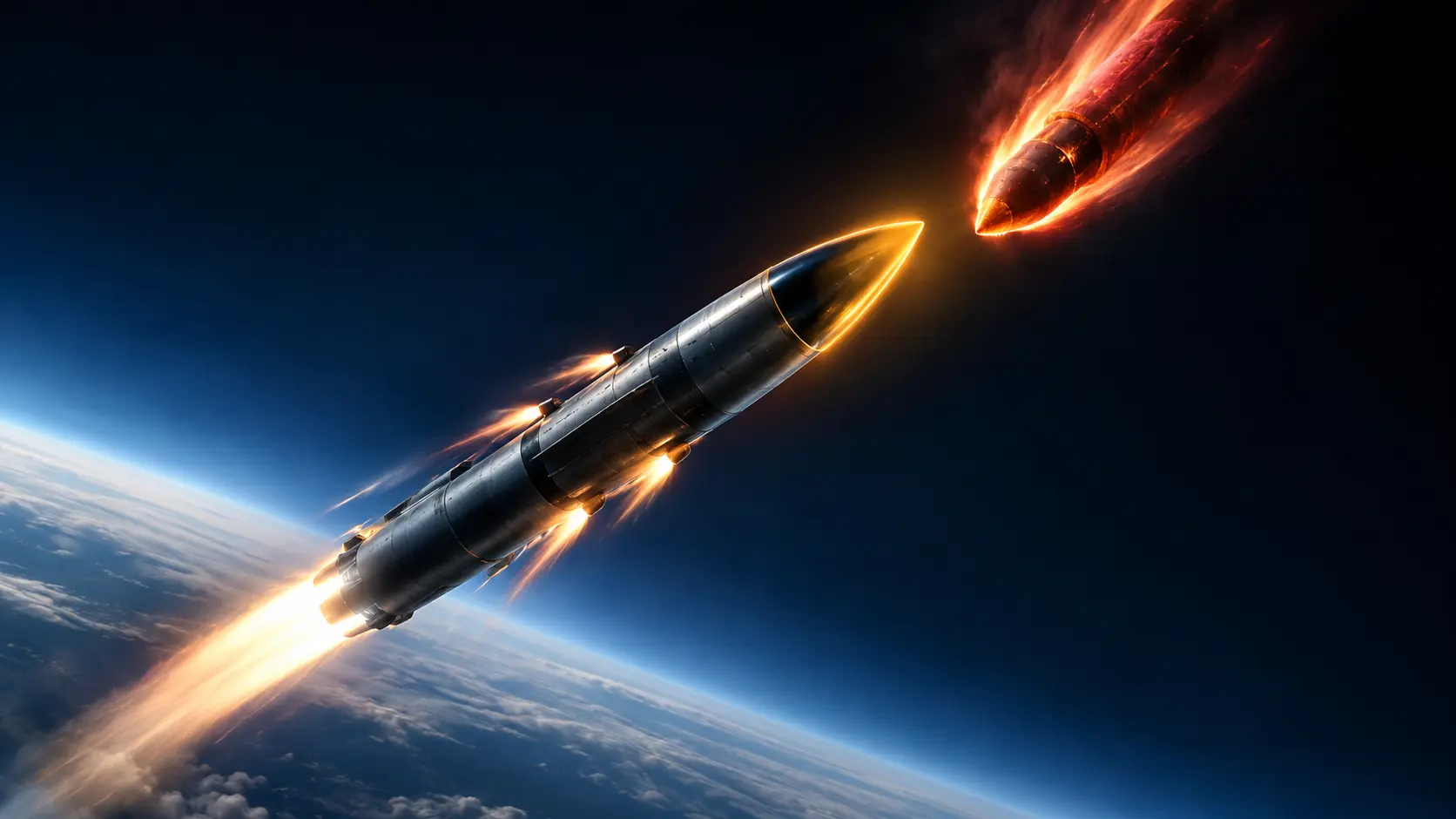

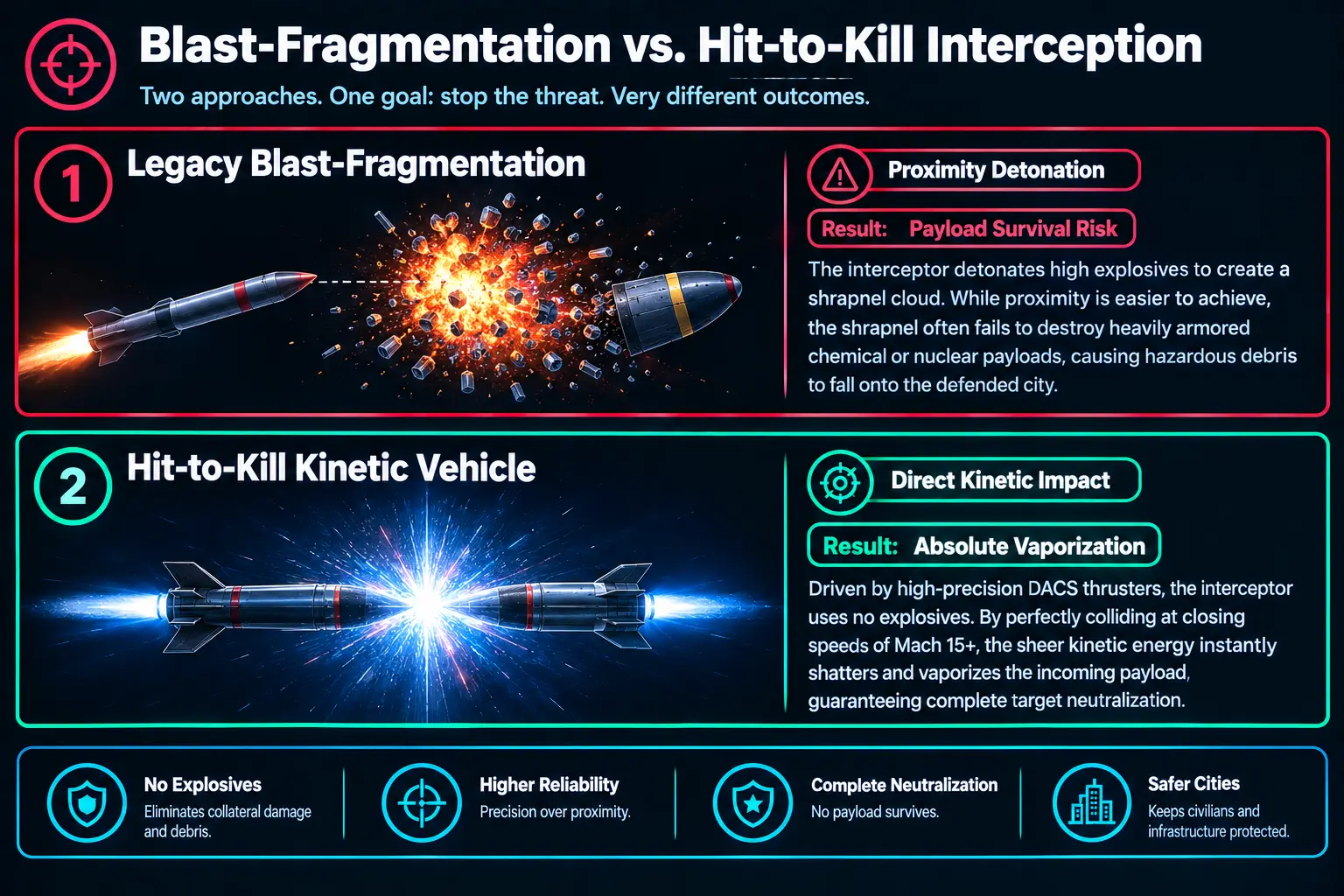
If an adversary launches a tactical ballistic missile at a population center, you have approximately five minutes to prevent mass casualties. Historically, militaries attempted to shoot down incoming missiles by detonating a large explosive warhead nearby, hoping the resulting cloud of shrapnel would shred the threat. This approach is dangerously flawed; wrapping a chemical or nuclear payload in shrapnel often fails to destroy the core, instead raining hazardous debris over the very city you are trying to protect.
Why should you care right now? Because modern defense architectures have abandoned explosives entirely, shifting to an engineering concept bordering on science fiction: hitting a bullet with a bullet. By relying purely on kinetic energy, endo-atmospheric interceptors smash directly into incoming warheads at closing speeds exceeding 15,000 miles per hour, physically vaporizing the threat on impact. This requires staggering technological choreography, maneuvering a hyper-velocity projectile through the Earth’s atmosphere using miniature rocket thrusters to achieve millimeter-perfect accuracy. Understanding this hit-to-kill capability is no longer an aerospace niche; it is the fundamental baseline of modern geopolitical deterrence and global security.
What are Endo-Atmospheric Kinetic Kill Vehicles?
Endo-Atmospheric Kinetic Kill Vehicles are highly maneuverable, non-explosive missile interceptors designed to operate within the Earth’s atmosphere. They obliterate incoming ballistic and hypersonic threats purely through the extreme kinetic energy of a direct collision, utilizing advanced lateral thrusters and onboard infrared sensors to achieve millimeter-level targeting accuracy.
At a Glance
- Concept: Shooting down an incoming missile by colliding with it head-on at 15,000 miles per hour, rather than trying to blow it up with explosives.
- Why it matters: It guarantees the absolute destruction of chemical, biological, or nuclear payloads high in the atmosphere, preventing lethal fallout from reaching the ground.
- Who uses it: Vanguard air defense systems, primarily the Patriot PAC-3 MSE, the Terminal High Altitude Area Defense (THAAD) system, and Israel’s David’s Sling.
- Biggest takeaway: At hypersonic speeds, aerodynamic fins are too slow to steer. The interceptor must use a ring of miniature rocket engines to violently “shove” itself sideways into the path of the incoming weapon.
In Simple Words
Imagine two cars driving at each other on a highway at 7,500 miles per hour.
The old way of stopping the enemy car was to throw a hand grenade out the window as you drove past, hoping the explosion would blow out their tires or crack their engine block. Sometimes it worked; sometimes the enemy car kept rolling and crashed into its target anyway.
A Kinetic Kill Vehicle does not use a grenade. Instead, it uses a hyper-advanced steering system to ensure it crashes directly, head-on, into the grill of the enemy car. Because both cars are moving at absurd speeds, the sheer force of the physical crash instantly vaporizes both vehicles into dust. There is no explosive bomb inside the interceptor; it destroys the target using nothing but pure speed and perfect math.
Why This Matters
For Defense Strategists, Military Contractors, and Aerospace VCs, Kinetic Kill Vehicles solve the Explosive Intercept Failure.
During the Gulf War, early Patriot missiles relied on blast-fragmentation warheads to intercept Scud missiles. The Patriot would successfully detect the Scud and explode next to it. However, the shrapnel often only hit the empty fuel tanks at the back of the Scud, leaving the heavy, armored warhead at the front perfectly intact to fall on the military base below.
A blast-fragmentation warhead guarantees proximity, but it cannot guarantee lethality. A hit-to-kill vehicle forces absolute lethality. By converting the interceptor into a dense block of kinetic energy, it ensures that if an intercept is calculated, the enemy payload ceases to exist structurally. This shift is the reason defense budgets globally have pivoted billions of dollars away from legacy explosive interceptors toward pure kinetic architectures.
The Physics of Newtonian Interception
We are witnessing the absolute limit of Newtonian Interception Physics.
To execute a hit-to-kill intercept in the terminal phase (the final seconds before a missile hits the ground), the interceptor must process radar data, track a thermal signature, and execute a physical maneuver in a fraction of a second. This leaves zero margin for error. A miss by a single meter is a total failure.
We have effectively maximized how fast a physical object can maneuver inside the atmosphere without tearing itself apart. The defense industry is no longer fighting aerodynamics; it is fighting the speed of silicon processing and the thermal limits of advanced ceramics.
How Kinetic Kill Vehicles (KKVs) Work
Smashing two supersonic objects together in the upper atmosphere requires bypassing standard aerodynamic flight controls. Here is the first-principles breakdown of the architecture.
1. The Fundamental Problem: Aerodynamic Latency
If you want an airplane to turn left, you move a flap, the air pushes against the flap, and the plane slowly banks left. In missile defense, the target is moving so fast that waiting for air pressure to turn the interceptor takes too long. In the thin air of the upper atmosphere, aerodynamic fins are almost entirely useless.
2. The Core Mechanism: Kinetic Energy Impact
The physics of destruction rely on the equation Ek = 1/2 mv². Because velocity is squared, an interceptor does not need to be heavy if it is incredibly fast. When a 300-pound interceptor hits a warhead at a closing speed of Mach 15, the kinetic energy transferred is equivalent to a massive detonation of TNT, instantly shattering the crystalline structure of the enemy warhead’s metals.
3. Technical Depth: Divert and Attitude Control System (DACS)
To steer without relying on air pressure, the interceptor uses a DACS. This is a ring of tiny, ultra-powerful rocket thrusters positioned around the missile’s center of gravity. When the onboard computer realizes the enemy missile has shifted right, the DACS fires a violent burst of thrust to the left. This physically “slides” the interceptor sideways in mid-air (divert) without changing the angle its nose is pointing (attitude), ensuring it perfectly blocks the incoming path.
Micro-Insight: DACS thrusters burn hypergolic fuels—chemicals that instantly explode the millisecond they touch each other. This eliminates the need for an ignition sequence, allowing the thrusters to pulse in precise, microsecond bursts.
4. Technical Depth: Aero-Optic Seeker Heating
To hit the target, the interceptor must see it. It uses an infrared (IR) camera in its nose. However, pushing through the atmosphere at Mach 8 creates immense friction, heating the air in front of the missile into a 3,000°F plasma sheath. To prevent the camera from being blinded by its own heat, the sensor window is machined from artificial sapphire, and highly complex cooling gases are actively pumped across the lens to maintain thermal clarity (aero-optic mitigation).
5. Real-World Consequences: The Sub-Meter Margin
Because the interceptor relies purely on a direct physical strike, its guidance loop updates thousands of times a second during the final moments of flight. If the enemy missile attempts a last-second evasive maneuver, the DACS fires its final lateral pulses to match the maneuver, executing a flawless, vaporizing impact high above the clouds.
DACS Kinetic Intercept Simulator
Endo-Atmospheric Hit-to-Kill Missile Defense & Lateral Thrust Dynamics
Target Maneuverability
Low-G
Interceptor Control Authority
Closing Velocity
Mach 15.0
Cross-Range Error (Miss Distance)
0.0 m
Intercept Status
STANDBY
Terminal Phase Closing Geometry
AWAITING TARGET
Tracking Error Tolerance vs. Time
Real-World KKV Missile Defense Systems
Kinetic hit-to-kill technology is the defining feature of the world's premier integrated air and missile defense systems.
Terminal High Altitude Area Defense (THAAD): Developed by Lockheed Martin, THAAD is designed to intercept short, medium, and intermediate-range ballistic missiles in their terminal phase. It is unique because it operates in both the upper endo-atmosphere and the lower exo-atmosphere. Its kill vehicle relies entirely on kinetic energy and a highly advanced liquid DACS to destroy targets before they can reenter the thicker parts of the atmosphere.
Patriot PAC-3 MSE: Unlike the older Patriot variants (PAC-2) that used blast-fragmentation warheads, the PAC-3 Missile Segment Enhancement (MSE) is a dedicated hit-to-kill interceptor. It is much smaller and lighter because it carries no explosive payload, allowing a standard Patriot launcher to carry up to 16 PAC-3 missiles compared to just 4 of the older PAC-2s. It utilizes 180 solid-propellant attitude control motors located in its forward section to aggressively snap the missile onto the target at the last second.
David's Sling (Stunner Interceptor): Co-developed by Israel's Rafael and the U.S.'s Raytheon, the Stunner interceptor is a masterpiece of endo-atmospheric design. It features a radical "dolphin nose" shape that houses a dual-seeker system (radar and optical). The asymmetrical nose ensures the optical sensor is rarely obscured by the aerodynamic heat generated at the tip of the missile, allowing it to maintain a flawless hit-to-kill lock on maneuvering tactical missiles and heavy rockets.
Economic & Strategic Impact
The core strategic consequence of hit-to-kill technology is the Asymmetric Cost Dilemma.
Engineering a vehicle capable of executing millimeter-perfect maneuvers at Mach 10 is brutally expensive. A single PAC-3 MSE or THAAD interceptor can cost between $4 million and $12 million. Conversely, an adversary can mass-produce crude, unguided ballistic missiles for less than $500,000 each.
Because kinetic kill is the only reliable way to ensure a nuclear or chemical warhead doesn't detonate over a city, defenders are forced to spend massive amounts of capital to intercept cheap threats. This economic asymmetry dictates modern geopolitical strategy: adversaries build overwhelming volume (swarms) to bankrupt the defender's expensive interceptor magazines.
Advantages
- Absolute Payload Neutralization: Kinetic impacts physically shatter chemical or biological payloads, ensuring hazardous materials are incinerated by the friction and impact heat rather than dispersed over the ground.
- Magazine Density: By removing heavy high-explosive warheads, the interceptor shrinks significantly in size and weight, allowing air defense batteries to pack vastly more missiles onto a single launch truck.
- High Altitude Efficacy: DACS thrusters work flawlessly in the thin air of the upper atmosphere, whereas traditional interceptors relying on tail fins lose their ability to steer as they climb higher.
Limitations
- Zero Margin for Error: A blast-fragmentation warhead can miss by 10 meters and still destroy the target with shrapnel. A hit-to-kill vehicle that misses by 1 meter is a complete operational failure.
- Susceptibility to Decoys: Because the interceptor must physically strike a specific point in space, adversaries often surround their true warhead with lightweight, heated mylar balloons. The onboard sensors must rapidly process thermal signatures to identify the real, heavy warhead before impact.
- Extreme Material Costs: Developing high-temperature ceramic matrix composites (CMCs) and pure sapphire optical windows to survive hypersonic plasma environments drives the unit cost of each interceptor into the millions.
Takeaway: Hit-to-kill is binary. It either achieves a spectacular, vaporizing success or it completely misses. There are no partial victories in kinetic missile defense.
Common Misconceptions
Misconception: Hit-to-kill interceptors chase the target from behind like a dogfight.
Reality: Intercepts are almost exclusively head-on or steep-angle cross-range collisions. Chasing a ballistic missile is mathematically impossible because the interceptor would run out of fuel trying to catch up; they must meet at a precisely calculated intersection point.
Misconception: There is a small explosive backup inside the kill vehicle.
Reality: True kinetic kill vehicles contain zero explosives. The destruction is derived 100% from the physics of the crash. (Note: Some specific atmospheric interceptors contain minor "lethality enhancers"—small metal rings designed to expand the impact area—but they fundamentally rely on kinetic mass, not blast waves).
Misconception: Radar is the only thing guiding the interceptor.
Reality: Ground-based radar guides the interceptor to the general vicinity. However, in the final seconds (the terminal phase), ground radar is not precise enough. The kill vehicle must open its "eyes" (the onboard infrared seeker) to visually lock onto the hot glow of the enemy warhead and steer itself into the crash.
What Most People Miss
The disruptive capability of The Plasma Sheath Blackout.
When analysts discuss missile defense, they focus on the speed of the rockets. What they miss is the severe electromagnetic consequence of that speed.
As an interceptor pushes through the dense lower atmosphere at Mach 8+, the air friction is so violent it strips electrons from the air molecules, creating an envelope of ionized plasma around the nose of the missile. Plasma absorbs and reflects radio waves. This creates a "blackout" period where the interceptor is entirely deaf to instructions from the ground radar. During the most critical seconds of the intercept, the kill vehicle is completely alone, relying exclusively on its onboard AI and thermal sensors to make the final, lethal adjustments.
Comparison Table
| Metric | Blast-Fragmentation | Exo-Atmospheric KKV (e.g., GMD/EKV) | Endo-Atmospheric KKV (e.g., THAAD/PAC-3) |
| Kill Mechanism | Shrapnel Cloud | Direct Kinetic Impact | Direct Kinetic Impact |
| Operating Environment | Lower Atmosphere | Deep Space (Vacuum) | Upper/Lower Atmosphere |
| Steering Mechanism | Aerodynamic Fins | Liquid DACS Only | Solid/Liquid DACS + Aero Fins |
| Payload Neutralization | Unreliable (Partial) | Absolute Vaporization | Absolute Vaporization |
| Thermal Shielding | Minimal | None (Vacuum operation) | Extreme (Sapphire windows, active cooling) |
Future Outlook
Next 12–24 Months
The era of Advanced Decoy Discrimination. Through 2026, the primary focus of prime contractors (like Raytheon and Lockheed Martin) will be integrating advanced neural networks directly into the seeker heads of the kill vehicles. As adversaries deploy complex countermeasure clouds (flares and thermal balloons) alongside their warheads, the interceptor's onboard computer must utilize AI to distinguish the microscopic heat signature differences of the true, dense warhead in real-time.
Next 3–5 Years
The scaling of Ceramic Matrix Composites (CMCs). To increase the agility of the DACS, the thrusters must burn hotter and at higher pressures.The defense industry is transitioning away from heavy, internationally mined metal components toward domestically sourced CMCs. These woven composite preforms can withstand the 3000°F hypergolic exhaust of the lateral thrusters while slashing the overall weight of the kill vehicle, directly translating into faster divert times and higher hit probabilities.
Next 10 Years
The Directed Energy Tiering Model. By the mid-2030s, the economic asymmetry of spending $8 million to shoot down a $500,000 missile will force a massive architectural shift. Militaries will deploy 300-kilowatt solid-state lasers (Directed Energy) to handle cheap drones, cruise missiles, and low-tier artillery. This will allow the military to reserve its expensive kinetic kill vehicles strictly for the threats that lasers cannot stop: heavy intercontinental ballistic missiles (ICBMs) and maneuvering Hypersonic Glide Vehicles (HGVs).
Most Likely Scenario
Endo-Atmospheric Kinetic Kill Vehicles are the apex of applied aerospace physics. Smashed between the uncompromising laws of hypersonic aerodynamics and the binary requirement for total payload destruction, KKVs have proven that hitting a bullet with a bullet is not only possible but operationally reliable. While the sheer cost of engineering these systems ensures they remain a premium strategic asset, kinetic interception will stand as the ultimate final barrier defending the civilized world from ballistic devastation for decades to come.
Key Takeaways
- Shooting an explosive near a ballistic missile is unreliable and can cause hazardous warhead debris to fall on the defended city.
- Kinetic Kill Vehicles (KKVs) solve this by colliding directly with the incoming missile at 15,000 mph, using pure kinetic energy to vaporize the threat completely.
- Because air pressure is too thin to steer quickly at high altitudes, interceptors use a Divert and Attitude Control System (DACS)—firing tiny, violent rocket bursts sideways to slide into the exact path of the target.
- Operating at hypersonic speeds inside the atmosphere generates intense plasma heat, requiring the interceptor's target-tracking cameras to be protected behind custom-machined sapphire windows.
- Hit-to-kill requires absolute precision. A miss by a single meter is a total failure, meaning the onboard sensors and thrusters must update and react thousands of times a second during the final moments of flight.
Glossary
Blast-Fragmentation: A traditional warhead that detonates near a target to destroy it with a cloud of high-speed metal shrapnel.
Closing Velocity: The combined speed at which two objects are moving toward each other. A Mach 8 interceptor hitting a Mach 10 warhead head-on has a massive Mach 18 closing velocity.
Divert and Attitude Control System (DACS): A network of small, powerful rocket thrusters used to rapidly shift the interceptor's path sideways without changing the direction it is pointing.
Endo-Atmospheric: Operating within the Earth's atmosphere, where vehicles must fight severe aerodynamic drag and intense friction heating.
Hit-to-Kill: A defense philosophy that relies purely on direct, physical impact to destroy a target, containing zero explosives.
Hypergolic Fuel: Rocket propellants that spontaneously ignite the instant they come into contact with each other, allowing for microsecond-precise thruster pulses.
Terminal Phase: The final, seconds-long segment of a ballistic missile's flight as it dives toward its target.
Sources
Missile Defense Agency (MDA): The Ground-Based Midcourse Defense System and Terminal Interception
IEEE Aerospace and Electronic Systems: Divert and Attitude Control Systems for Kinetic Kill Vehicles
Lockheed Martin Space Systems: THAAD Interceptor and Hit-to-Kill Lethality
Raytheon Missiles & Defense: Stunner Interceptor and PAC-3 MSE Architecture
Journal of Spacecraft and Rockets: Aero-Optic Mitigation and Sapphire Window Thermal Shock Modeling