Advertisement
)
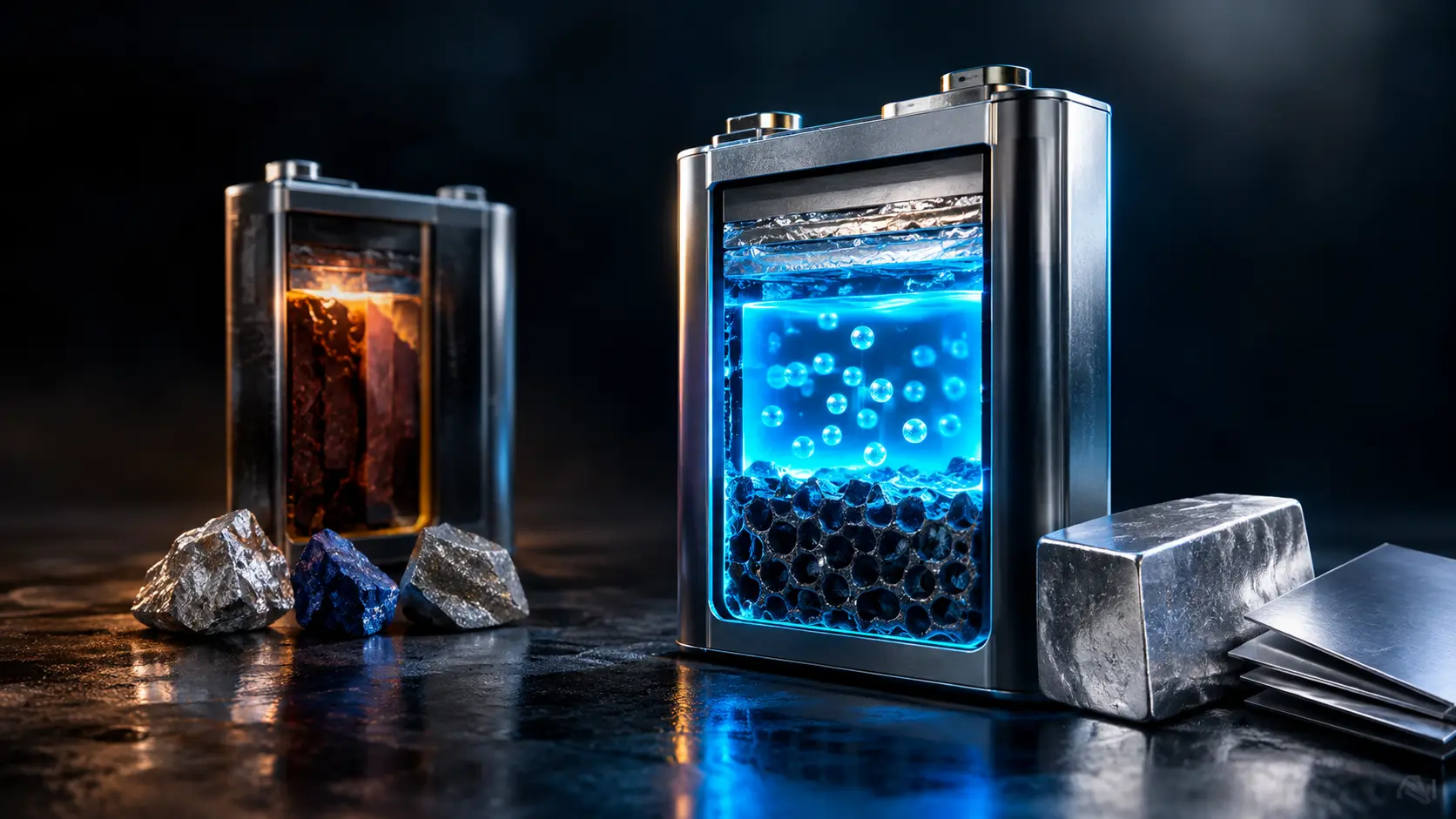

Electric vehicle supply chains are sitting on a geopolitical and thermodynamic powder keg. Traditional lithium-ion batteries rely on fragile, highly volatile metals like lithium, cobalt, and nickel. If a microscopic separator inside a lithium battery fails, the cell erupts into a self-sustaining chemical fire that standard water hoses cannot easily extinguish. To feed the relentless, trillion-dollar demand for grid storage and electric mobility, the energy industry has realized it cannot indefinitely rely on expensive rare-earth minerals that randomly explode.
Why should you care right now? Because vanguard battery engineers are executing a mass industrial pivot to the most abundant metal in the Earth’s crust: Aluminum. By combining trivalent aluminum ions with specialized, non-flammable liquid electrolytes, defense and cleantech companies are building batteries that physically cannot catch fire, charge in a fraction of the time, and target a disruptive £50/kWh manufacturing cost. This lithium-free architecture is not merely a safety upgrade; it is the ultimate geopolitical decoupling of the global energy storage market.
What are Aluminum-Ion Batteries (AIBs)?
Aluminum-Ion Batteries (AIBs) are a class of rechargeable energy storage devices that use aluminum metal as the negative electrode (anode). They function by moving trivalent aluminum ions back and forth through a non-flammable ionic liquid electrolyte to a carbon-based cathode, offering extreme safety, rapid charging, and an ultra-low-cost, lithium-free supply chain.
At a Glance
- Concept: Swapping out rare, explosive lithium for common, stable aluminum to store electricity.
- Why it matters: Lithium batteries cost roughly $100 to $130 per kWh and rely on constrained supply chains in South America and China. Aluminum is everywhere, pushing targeted manufacturing costs down to £50/kWh.
- Who uses it: Vanguard battery startups like Eqonic (UK), Graphene Manufacturing Group (GMG), and advanced industrial grid operators.
- Biggest takeaway: An aluminum ion carries three times the electrical charge of a lithium ion. While the battery is physically heavier, it can theoretically pack massive amounts of energy into a very small space (volumetric energy density).
In Simple Words
Think of a battery like a delivery service moving packages (electrons) between two warehouses (the anode and the cathode).
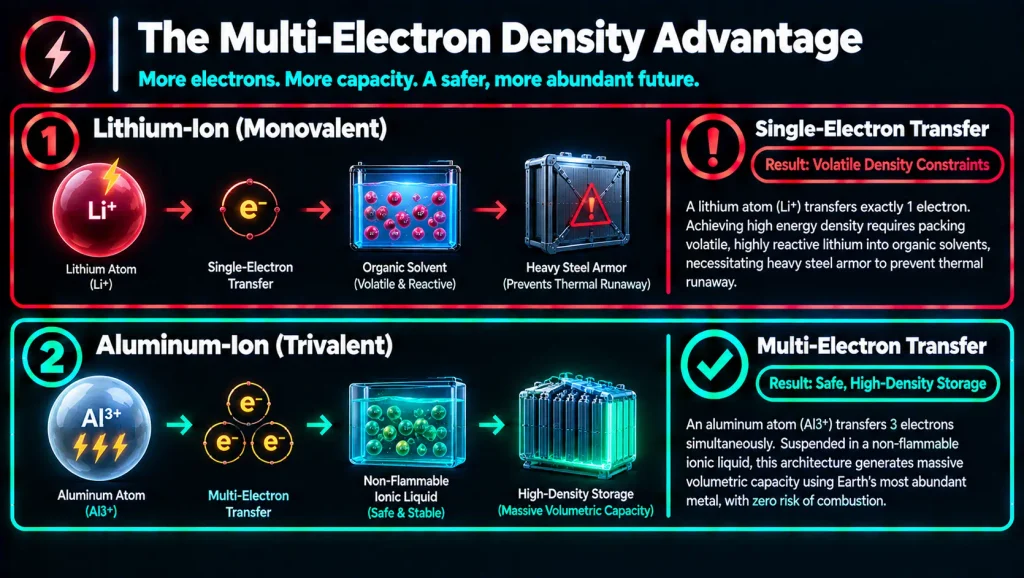
In a Lithium-Ion Battery, the delivery trucks (lithium ions) can only carry one package at a time. The highway they drive on (the organic electrolyte) is covered in gasoline. If a truck crashes, the entire highway catches on fire and burns down the warehouses.
In an Aluminum-Ion Battery, the delivery trucks (aluminum ions) are much bigger and can carry three packages at a time. More importantly, the highway they drive on is made of non-flammable liquid. You can literally shoot a bullet through an aluminum-ion battery, and it will not catch fire. Because the trucks carry more packages and the highway never burns, you can push electricity back and forth incredibly fast, allowing the battery to charge in minutes instead of hours.
Why This Matters
For Cleantech VCs, EV Supply Chain Execs, and Battery Engineers, AIBs solve the Thermal Runaway Liability.
The greatest engineering constraint in the electric vehicle industry is thermal management. Automakers must spend billions of dollars and devote massive physical space inside a car to liquid cooling systems, heavy armored shielding, and fire-suppression logic just to keep the lithium-ion battery from overheating.
Because aluminum-ion batteries use a chloroaluminate ionic liquid electrolyte, they have practically zero vapor pressure and are inherently non-flammable. You do not need to armor them or actively cool them. By eliminating the heavy thermal management systems, automakers can offset the slightly heavier weight of the aluminum battery itself. This fundamentally alters the unit economics of EV manufacturing, slashing assembly complexity and completely eliminating the legal and consumer liability of battery fires.
Micro-Insight: The value of an aluminum-ion battery is not just what it adds to a system, but what it allows engineers to subtract: fireproofing, cooling pumps, and geopolitical risk.
The Industrialization of Multi-Electron Transfer Electrochemistry
We are witnessing the industrialization of Post-Lithium Electrochemistry.
For thirty years, the world forced lithium into every possible form factor simply because it was the lightest metal on the periodic table. As we transition from mobile phones (where weight is everything) to massive stationary grid storage and heavy-duty transit (where cost and safety are everything), the chemical priority is shifting. The next decade of battery technology relies on matching specific elemental physics—like aluminum’s three-electron transfer—to specific infrastructural demands, permanently ending the “one-size-fits-all” lithium monopoly.
How Chloroaluminate Ionic Liquids Enable Aluminum-Ion Batteries
Extracting rechargeable power from aluminum without destroying the battery requires navigating complex, multi-ion chemistry. Here is the first-principles breakdown of the architecture.
1. The Fundamental Problem: The Oxide Layer
Aluminum naturally forms a tough, microscopic layer of aluminum oxide the second it is exposed to air. This oxide layer is the reason soda cans don’t rust, but in a battery, it acts as a brick wall, blocking the flow of electricity. Early attempts to build aluminum batteries failed because the oxide layer instantly killed the electrochemical reaction.
2. The Core Mechanism: Chloroaluminate Ionic Liquids
To dissolve the oxide wall, engineers abandoned traditional watery or organic electrolytes. Instead, AIBs use a room-temperature “ionic liquid” (essentially a liquid salt) made by mixing aluminum chloride and an imidazolium-based salt. This highly acidic, non-flammable liquid strips away the oxide layer and creates a highly conductive, fireproof highway for the ions to travel across.
3. Technical Depth: Trivalent Multi-Electron Transfer
When the battery discharges, the aluminum metal anode releases ions into the liquid. Because aluminum is trivalent, it strips off three electrons per atom (Al3+). This is a massive theoretical advantage. For every single atomic reaction, an AIB generates three times the electrical current of a lithium reaction.
4. Technical Depth: Graphite Intercalation
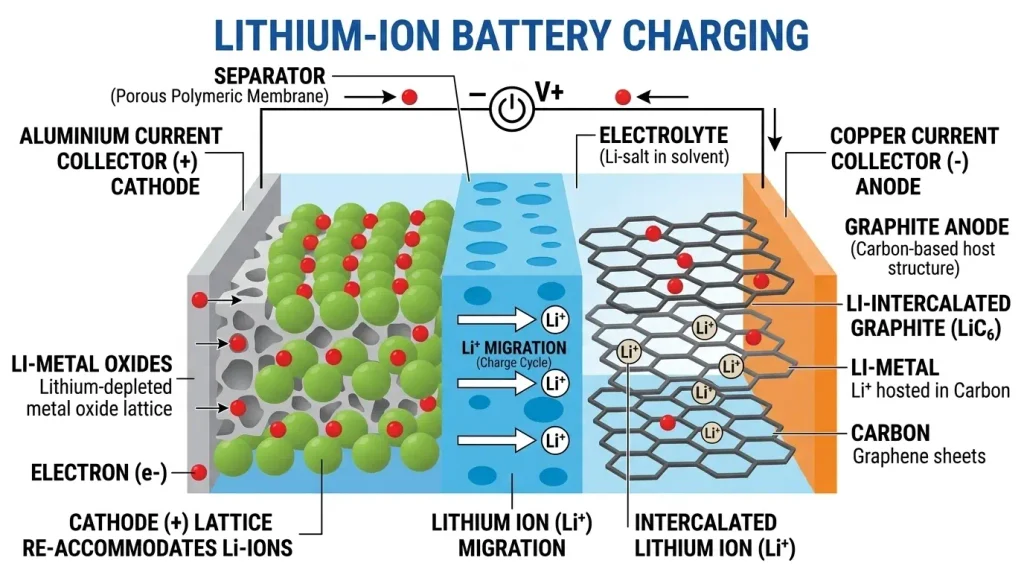
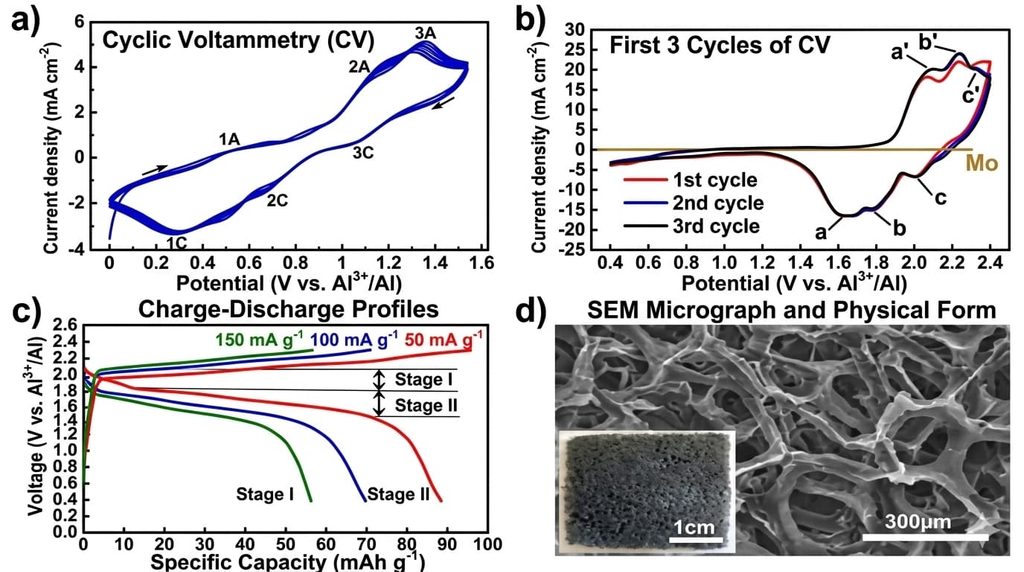
Where do the ions go? The cathode is usually made of specialized, porous carbon or graphene. The aluminum ions travel through the liquid and wedge themselves into the microscopic gaps between the layers of graphene (a process called intercalation). When you plug the battery into the wall to recharge, the electrical current violently yanks the ions back out of the graphene and deposits them back onto the aluminum anode.
Battery Chemistry Comparison: Lithium-Ion vs. Aluminum-Ion
Simulating Trivalent Charge Kinetics, Thermal Runaway Hazards, and Cathode Intercalation
Charge Rate (C-Rate)
10 C
Cell Architecture
Lithium-Ion (NMC)
Aluminum-Ion (AIB)
Core Temperature
25.0°C
State of Charge (SoC)
0.0%
Safety / Flammability
Nominal
Electrochemical Cell Cross-Section & Ionic Transport
STANDBY
Core Temperature (°C) & State of Charge (%) vs. Time
5. Real-World Consequences: The Anion Swelling Trap
There is a catch. When the Al3+ ion travels through the specific liquid electrolyte, it bonds with chloride to form a massive, complex molecule called [AlCl4]-. This molecule is physically huge. When it forces its way into the layers of the graphite cathode, it causes the carbon structure to stretch and swell. Over thousands of charging cycles, this physical stretching acts like a crowbar, slowly cracking and degrading the cathode, which historically ruined the battery’s lifespan.
Commercial Deployment and EQONIC Battery Architecture
Aluminum-ion chemistry is rapidly exiting the laboratory and entering early commercial validation.
Eqonic’s £50/kWh Industrial Platform: In late 2026, the UK-based battery company Eqonic advanced its proprietary aluminum-based cell architecture toward industrial validation. Eqonic specifically engineered its composite chemistry to contain zero lithium, sodium, or rare-earth materials. By optimizing the mature, global aluminum supply chain, the company established a target manufacturing scale-up cost of £50/kWh. This price point effectively undercuts the cheapest lithium iron phosphate (LFP) cells out of China, targeting both electric mobility and massive stationary energy storage.
Graphene Manufacturing Group (GMG) Ultra-Fast Charging: Australian materials company GMG, in partnership with the University of Queensland, is commercializing a graphene aluminum-ion battery. By utilizing highly pristine graphene for the cathode, the battery can absorb the massive aluminum ions with almost zero resistance. The result is a battery that charges up to 70 times faster than a standard lithium-ion cell, allowing heavy industrial equipment or commercial drones to recharge in less than two minutes without overheating.
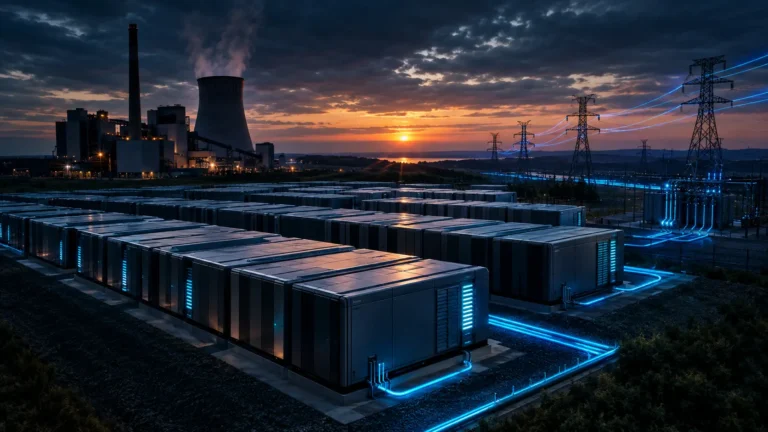
Utility-Scale Grid Storage: Renewable energy grids need to store massive amounts of solar power for nighttime use. Weight does not matter for a battery sitting in a shipping container on a concrete pad. Because AIBs are cheap, non-flammable, and possess excellent volumetric energy density (they pack a lot of energy into a small space, even if that space is heavy), utility companies are adopting them to build massive, multi-megawatt storage farms that are physically immune to the catastrophic fires that plague lithium-ion grid installations.
Achieving Supply Chain Sovereignty via Aluminum Storage
The core strategic consequence of Aluminum-Ion Batteries is Total Geopolitical Independence.
The modern lithium-ion supply chain is an absolute strategic choke point. The mining of lithium and cobalt is concentrated in South America and the Democratic Republic of Congo, while the chemical refinement process is almost entirely monopolized by China. Western automakers and governments are terrified of being cut off from these critical minerals via trade wars or export restrictions.
Aluminum is fundamentally different. It is the most abundant metal in the Earth’s crust. It is mined, refined, and recycled heavily on every single continent. By transitioning battery architectures to aluminum and carbon (graphite/graphene), a nation instantly secures a 100% sovereign, domestic supply chain for its energy storage, immunizing its economy against foreign resource extortion.
Advantages
- Inherent Fire Safety: The chloroaluminate ionic liquid electrolyte simply cannot catch fire. AIBs can be punctured, crushed, or overheated without triggering thermal runaway.
- Ultra-Fast Charging Kinetics: The chemical reaction between the aluminum and the graphene cathode is incredibly rapid, allowing the battery to fully charge and discharge in minutes.
- Abundant, Cheap Materials: Replaces expensive lithium and conflict-mineral cobalt with highly abundant, easily recyclable aluminum and carbon, driving down CapEx.
- Volumetric Energy Density: While heavy, the three-electron transfer allows AIBs to store significant amounts of energy in a compact physical volume.
Limitations
- Low Gravimetric Energy Density (Heavy): Aluminum is physically heavy, and the chloroaluminate ions moving through the electrolyte are massive. AIBs currently hold about half the energy per kilogram compared to top-tier lithium-ion batteries, limiting their use in long-range passenger EVs or aircraft.
- Corrosive Electrolytes: The ionic liquid used to dissolve the oxide layer is highly acidic and corrosive. The internal components of the battery (like the casing and current collectors) must be made from expensive, specialized materials to prevent the battery from slowly eating itself from the inside out.
- Cathode Degradation: Squeezing the massive [AlCl4]- molecules into the cathode causes physical swelling. The industry is currently engaged in a brutal materials science sprint to design graphene structures that can survive 10,000 charge cycles without cracking.
Takeaway: Aluminum-ion batteries are heavy, robust industrial workhorses. They will not go into your ultra-thin smartphone, but they will absolutely power the delivery truck outside your window and the solar grid powering your city.
Common Misconceptions
Misconception: Aluminum-ion is the same as Aluminum-Air.
Reality: They are completely different technologies. An Aluminum-Air battery generates power by permanently rusting (consuming) the aluminum anode—it is not truly rechargeable; you have to physically swap out the metal. An Aluminum-Ion battery is a closed, fully rechargeable system just like a standard smartphone battery.
Misconception: We can just drop aluminum into existing battery factories.
Reality: The chemistry requires completely different handling. Because the ionic liquid electrolyte is highly sensitive to moisture, AIBs must be assembled in ultra-dry, specialized cleanrooms, requiring significant CapEx retooling for legacy lithium-ion gigafactories.
Misconception: Trivalent ions mean three times the power of lithium.
Reality: While aluminum carries three electrons (Al3+), the overall voltage of an aluminum-ion cell is lower than a lithium cell (roughly 2.0V vs. 3.7V). The total energy output is a combination of both charge and voltage, meaning AIBs still trail lithium in raw energy per kilogram.
What Most People Miss
The disruptive capability of The Cold Weather Advantage.
When analysts compare batteries, they usually look at performance at room temperature. What they miss is operational reality.
Standard lithium-ion batteries suffer a massive performance collapse in freezing temperatures; the organic liquid inside them becomes sluggish, killing the EV’s range and disabling fast-charging. The specific ionic liquid electrolytes used in Aluminum-Ion batteries have an incredibly wide thermal operating window. They remain highly conductive at sub-zero temperatures. An AIB can be fast-charged in the middle of a blizzard without requiring internal battery heaters to be running, preserving precious energy for actual vehicle propulsion.
Comparison Table
| Metric | Lithium-Ion (NMC/LFP) | Aluminum-Ion (AIB) |
| Charge Carrier | Single Electron (Li⁺) | Three Electrons (Al³⁺) |
| Fire Risk (Thermal Runaway) | High (Volatile organic electrolyte) | Zero (Non-flammable ionic liquid) |
| Raw Material Abundance | Low / Geopolitically Constrained | Extremely High (Earth’s most abundant metal) |
| Target Manufacturing Cost | ~$100 – $130 / kWh | ~£50 / kWh ($65 / kWh) |
| Charging Speed | Moderate (30 – 60 mins) | Ultra-Fast (2 – 10 mins) |
Future Outlook
Next 12–24 Months
The era of Industrial Validation and Scale-Up. Through 2027, companies like Eqonic and GMG will transition from laboratory coin-cells to large-format, commercial pouch cells. The primary focus is proving the industrial manufacturability of the corrosive ionic liquid electrolytes and securing independent third-party safety certifications to definitively prove the non-flammable claims to wary insurance underwriters.
Next 3–5 Years
The scaling of Stationary Grid and Commercial Fleet Deployment. By 2030, AIBs will capture significant market share in sectors where weight is a secondary concern to safety and cost. Utility companies will deploy massive aluminum-ion battery farms alongside solar installations. Similarly, commercial delivery fleets and city buses—which return to a depot frequently and require ultra-fast, 5-minute top-up charges—will rapidly pivot to aluminum, bypassing the fire codes required for massive indoor lithium charging depots.
Next 10 Years
The Cathode Breakthrough and Passenger EV Integration. By the mid-2030s, advancements in nanotechnology and 3D-printed graphene will permanently solve the cathode swelling problem, massively increasing the cycle life and gravimetric energy density of AIBs. As the technology matures, aluminum-ion will break out of the commercial fleet sector and be integrated into the chassis of standard passenger EVs, acting as a structural, fireproof energy sink that completely isolates Western automakers from Asian rare-earth supply chains.
Most Likely Scenario
Aluminum-Ion Batteries represent the necessary, inevitable diversification of the global energy storage market. While lithium will retain its crown in aerospace and high-end electronics where extreme lightness is mandatory, the sheer economic and safety advantages of aluminum are mathematically undeniable for heavy industry and grid storage. By leveraging the most abundant metal on Earth, AIBs will commoditize battery storage, driving prices to the £50/kWh threshold required to fully finalize the global transition away from fossil fuels.
Key Takeaways
- Traditional lithium-ion batteries are expensive, prone to catching fire, and rely on fragile, geopolitically hoarded supply chains.
- Aluminum-ion batteries solve this by using the Earth’s most abundant metal and a non-flammable liquid electrolyte, making them cheap and impossible to ignite.
- Because aluminum is trivalent (carrying three electrons per ion), the battery can transfer massive amounts of charge rapidly, enabling ultra-fast charging in minutes.
- The primary engineering challenge is cathode degradation. The massive chloroaluminate ions used in the process cause standard cathodes to swell and crack over time.
- Vanguard startups are targeting a disruptive £50/kWh manufacturing cost, aiming to deploy AIBs primarily for grid storage, commercial delivery fleets, and cold-weather operations.
Glossary
[AlCl4]- (Tetrachloroaluminate): The massive, complex anion formed when an aluminum ion binds with chloride in the electrolyte. This large molecule must physically squeeze into the cathode to store energy.
Al3+ (Trivalent Aluminum): An aluminum atom that has lost three electrons. Because it carries a +3 charge, it can move three times the electrical current of a +1 lithium ion (Li⁺).
Cathode Degradation: The physical breakdown of a battery’s positive electrode. In AIBs, this is usually caused by the massive [AlCl4]- molecules stretching and cracking the carbon structure over time.
Chloroaluminate Ionic Liquid: A specialized, room-temperature liquid salt used as the electrolyte in AIBs. It dissolves aluminum’s tough oxide layer and is completely non-flammable.
Gravimetric Energy Density: How much energy a battery can hold per unit of weight (Wh/kg). Lithium is light and has high gravimetric density; aluminum is heavier and has lower gravimetric density.
Intercalation: The chemical process of wedging a molecule or ion into the microscopic gaps between the layers of a crystal lattice (like sliding a book onto a tightly packed shelf).
Thermal Runaway: A catastrophic chain reaction where a battery overheats, catches fire, and generates its own oxygen, making it nearly impossible to extinguish.
Sources
Nature Energy: Rechargeable Aluminum-Ion Batteries with Ultra-Fast Charging Kinetics
Graphene Manufacturing Group (GMG) & University of Queensland: Commercializing Graphene Aluminum-Ion Energy Storage
Eqonic Group: Advancing Aluminum Battery Technology Toward £50/kWh Industrial Validation
Advanced Materials: Mitigating Cathode Degradation in Chloroaluminate Ionic Liquid Electrolytes
Journal of The Electrochemical Society: Multi-Electron Transfer Thermodynamics in Trivalent Battery Architectures