Advertisement
)

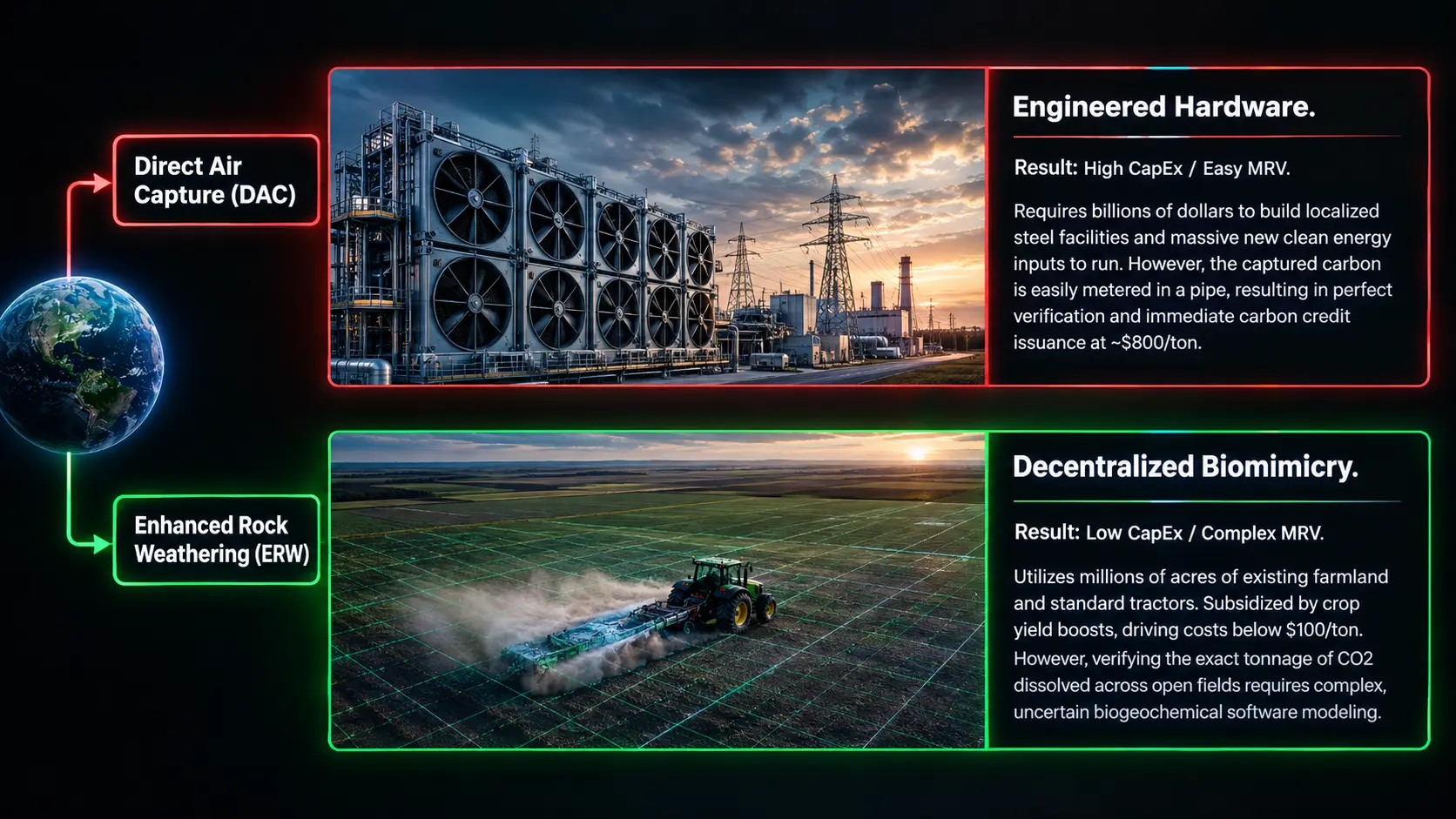
To prevent catastrophic climate change, humanity must remove billions of tons of carbon dioxide from the atmosphere every year. The prevailing engineering solution is Direct Air Capture (DAC)—building massive, multi-billion-dollar facilities filled with giant fans and chemical filters. While effective, DAC is brutally expensive, consumes massive amounts of electricity, and requires building an entirely new global infrastructure from scratch. We are attempting to out-engineer a problem that the Earth already knows how to solve.
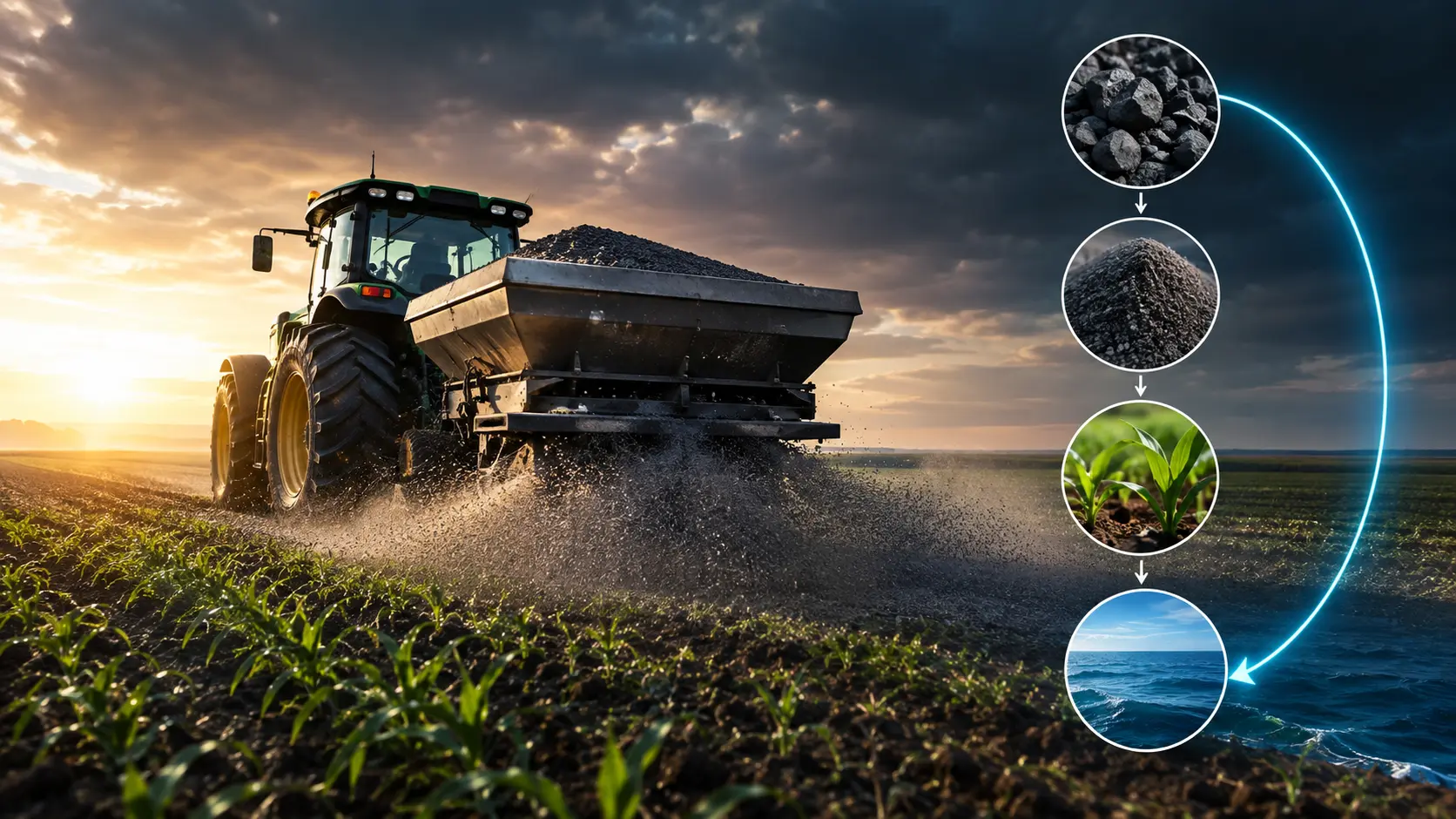
Why should you care right now? Because a coalition of geologists, agronomists, and cleantech VCs has realized that we do not need to build new machines; we just need to use the tractors we already have to hack the Earth’s natural carbon cycle. This approach is called Enhanced Rock Weathering (ERW). By grinding up volcanic basalt rock and paying farmers to sprinkle it over their fields, we can accelerate a 100-million-year geological process into a single farming season. It permanently deletes CO₂ from the sky, deposits it safely into the ocean as dissolved salt, and simultaneously fertilizes the soil—all at a target price below $100 per ton. ERW is shifting carbon removal from an expensive, centralized tech problem into a profitable, decentralized agricultural commodity.
What is Enhanced Rock Weathering (ERW)?
Enhanced Rock Weathering (ERW) is a nature-based carbon removal technology that involves crushing silicate rocks, primarily basalt, into a fine dust and spreading it across agricultural land. As rain falls on the dust, a chemical reaction converts atmospheric carbon dioxide into dissolved bicarbonate, safely locking the carbon in the ocean for millennia.
At a Glance
- Concept: Grinding up volcanic rock and spreading it on farmland to naturally suck CO₂ out of the rain.
- Why it matters: Engineered carbon capture machines cost up to $1,000 per ton. ERW targets sub-$100 per ton by piggybacking on existing mining and farming infrastructure.
- Who uses it: Vanguard carbon removal startups (like Lithos Carbon, UNDO, and Eion), progressive agricultural co-ops, and corporate buyers like Stripe and Microsoft purchasing the carbon credits.
- Biggest takeaway: ERW is a dual-threat solution. Not only does it remove carbon, but the dissolving rock acts as a natural fertilizer, fixing acidic soils and boosting crop yields, meaning farmers actively want to participate.
In Simple Words
The Earth has a built-in thermostat called the silicate weathering cycle. When rain falls through the sky, it grabs a little bit of CO₂ and turns into very weak acid rain. When this acidic rain hits rocks on mountains, it slowly dissolves the rock, turning the CO₂ into liquid baking soda (bicarbonate). This liquid washes into rivers and eventually the ocean, where the carbon is trapped for 100,000 years.
The problem is that this natural process takes millions of years because solid rocks don’t have much surface area.
Enhanced Rock Weathering (ERW) puts this process on fast-forward. Instead of waiting for rain to slowly melt a solid mountain, we take a mountain, crush it into millions of tons of fine dust, and spread it flat across millions of acres of farmland. By turning the rock into dust, we expose massive amounts of surface area to the rain. The CO₂ reacts with the rock dust almost immediately. We are using tractors to speed up geology.
Why This Matters
For Cleantech VCs, ESG Policy Makers, and Agronomists, ERW solves the Carbon Removal Scaling Bottleneck.
The ultimate metric for carbon dioxide removal (CDR) is scale. To matter, a technology must be capable of removing gigatons (billions of tons) of CO₂. Direct Air Capture (DAC) is highly precise, but building enough steel machines to capture a gigaton of carbon requires trillions of dollars of capital expenditure (CapEx) and massive new power plants just to run the fans.
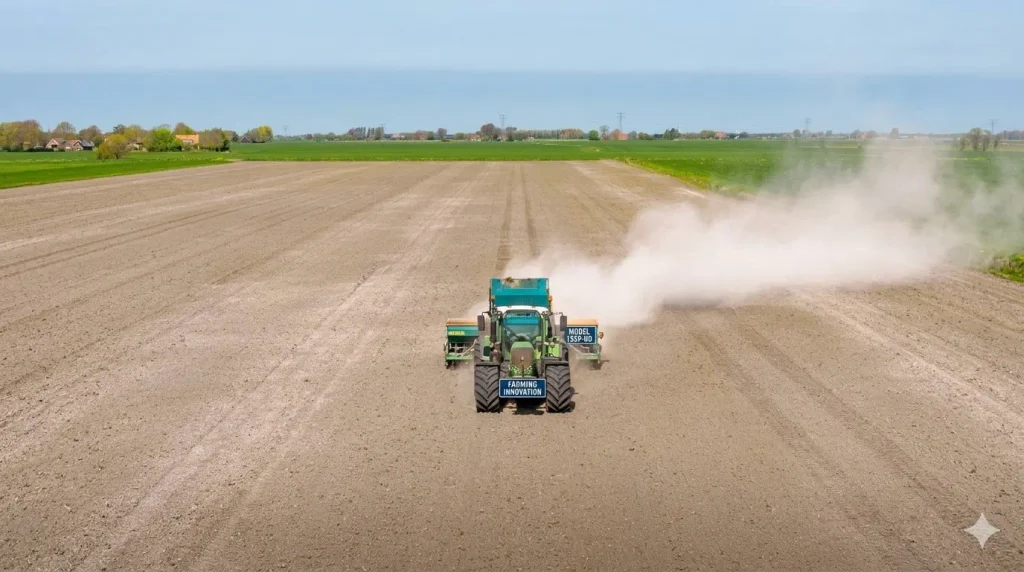
ERW has virtually zero CapEx. The rock (basalt) is already being mined globally as a cheap byproduct of the aggregate and construction industry. The delivery mechanism (tractors and spreaders) already exists on every farm on Earth. The land required is already cleared for agriculture. ERW is an operational expenditure (OPEX) play. By leveraging the existing agricultural supply chain, ERW can scale to gigaton-levels of carbon removal faster and cheaper than any engineered hardware solution on the market.
Micro-Insight: The genius of ERW is that it does not compete with agriculture for land; it actively integrates into the soil, turning the world’s farmers into a decentralized army of carbon removers.
The Shift to Permanent Carbon Removal (CDR)
We are witnessing the Commodification of Biogeochemical Interventions.
Historically, carbon offsets were based on “avoidance” (paying someone not to cut down a forest). The market is now demanding strict “removal” (permanently deleting carbon from the system). ERW bridges the gap between fragile nature-based solutions (like planting trees, which can burn down and release the carbon back) and rigid engineered solutions (like DAC). ERW uses nature’s chemistry but achieves permanent, geological storage. It is the ultimate hybrid carbon asset.
How Enhanced Rock Weathering Works
Turning a rock into a carbon vacuum requires specific mineralogy and a deep understanding of soil chemistry. Here is the first-principles breakdown of the architecture.
1. The Fundamental Problem: Slow Geological Carbon Sequestration
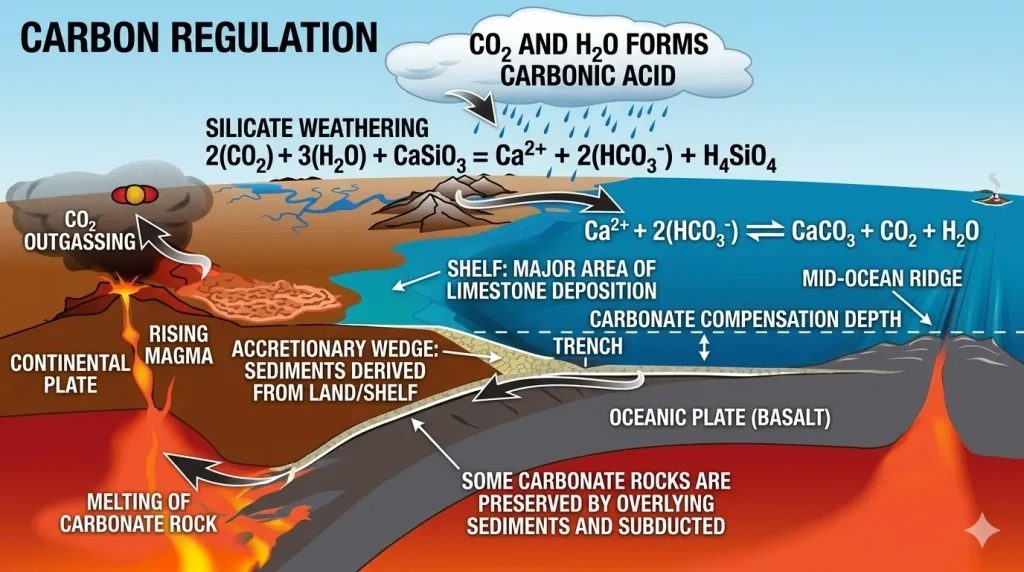
Atmospheric CO₂ naturally dissolves into rainwater, forming a weak carbonic acid (CO₂). When this rain hits standard soil or organic matter, very little permanent carbon storage occurs. For permanent storage, the carbonic acid must react with a specific type of mineral (silicates) to form a stable, dissolved salt (bicarbonate).
2. The Core Mechanism: Crushed Basalt
Basalt is a dark, volcanic rock rich in silicate minerals containing calcium and magnesium. It weathers quickly. By crushing basalt into a fine powder (usually less than 100 micrometers), the surface area increases exponentially. This crushed dust is spread onto agricultural soils.
3. Technical Depth: The Bicarbonate Pathway
When the slightly acidic rain hits the massive surface area of the basalt dust in the soil, a rapid chemical reaction occurs. The carbonic acid dissolves the calcium and magnesium silicates in the rock. The CO₂ is chemically transformed into dissolved bicarbonate (HCO₃⁻).
Plain-English Takeaway: The rock acts like a chemical sponge. It absorbs the carbon out of the rainwater and permanently locks it into a harmless liquid salt.
4. Technical Depth: Oceanic Storage
This dissolved bicarbonate does not stay in the soil. It slowly percolates down into the groundwater, flows into streams, and eventually washes into the global ocean. Once in the ocean, the bicarbonate is incredibly stable. It remains dissolved in the seawater for roughly 100,000 years, eventually being used by marine life (like corals and oysters) to build their shells, which eventually fall to the ocean floor to become limestone.
5. Real-World Consequences: Agronomic Co-Benefits
Farmers do not spread basalt just to be nice to the climate; they do it because it makes them money. Heavy agricultural use makes soil acidic, which stunts crop growth. Farmers usually buy and spread agricultural lime (crushed limestone) to fix this. Basalt dust does the exact same thing—it acts as a powerful pH buffer, neutralizing acidic soil. Furthermore, as the basalt dissolves, it releases essential micronutrients (potassium, phosphorus, zinc, and silica) directly into the roots, improving crop yields and pest resistance.
DAC vs. ERW Climate Simulator
Comparing Engineered Carbon Capture vs. Decentralized Biogeochemical Weathering
Carbon Removal Target
10,000 Tons
Removal Architecture
Direct Air Capture (DAC)
Enhanced Rock Weathering (ERW)
Unit Cost ($ / Ton CO₂)
$750.00
Energy Demand (MWh)
25,000
Soil Agronomic Value (pH)
0.0 (None)
System Architecture & Chemical Pathways
SYSTEM STANDBY
Economic Efficiency vs. Agronomic Co-Benefits
Real-World Applications
ERW has exited the academic modeling phase and is currently being deployed across millions of acres of active farmland.
Lithos Carbon and the US Corn Belt: Lithos Carbon, a prominent ERW startup, has deployed thousands of tons of basalt across the American Midwest. They utilize advanced software to match specific basalt chemistry to local soil deficiencies, ensuring maximum crop yield for the farmer. By selling the resulting carbon credits to corporate buyers like Stripe and Shopify, Lithos subsidizes the cost of the rock, allowing them to give the basalt to the farmers entirely for free.
UNDO in the UK and Global Tropics: The UK-based company UNDO has aggressively scaled its ERW operations by partnering directly with local quarries. Rock quarries naturally produce massive amounts of basalt dust as a waste byproduct of crushing gravel for roads. UNDO takes this waste dust and spreads it on local farms. Furthermore, they are expanding into tropical regions, because the hot, wet climates of the tropics cause the basalt to dissolve and sequester carbon much faster than in temperate zones.
Ocean Alkalinity Enhancement (OAE): A direct offshoot of ERW is OAE. Instead of spreading the rock on farmland, companies are investigating dumping specific alkaline rocks directly into the ocean. Because the ocean has absorbed roughly 30% of human CO₂ emissions, it is becoming highly acidic. Adding rock dust directly to the ocean buffers this acidification (saving coral reefs) while simultaneously allowing the ocean to pull even more CO₂ out of the sky.
Economic & Strategic Impact
The core strategic consequence of ERW is the Creation of High-Quality, Permanent Carbon Credits.
The voluntary carbon market has suffered severe reputational damage. Billions of dollars were spent on forestry credits that proved to be phantom emissions (trees that were never actually going to be cut down) or impermanent (forests that subsequently burned in wildfires).
Corporate ESG buyers are now demanding absolute permanence. Because ERW converts CO₂ into dissolved bicarbonate that remains stable for 100,000 years, it satisfies the strictest definition of geological permanence. As the verification models improve, ERW carbon credits will command a massive premium on the open market, funneling billions of tech-sector dollars directly into rural agricultural economies.
Agronomic and Climate Benefits of ERW
- Geological Permanence: The carbon is locked in the ocean for >10,000 years, eliminating the reversal risk associated with planting trees.
- Zero New Infrastructure: Utilizes existing quarry mining waste, standard transport trucks, and standard agricultural spreaders.
- Agronomic Subsidies: Replaces expensive agricultural lime, corrects soil pH, and adds vital nutrients, directly increasing crop yields for farmers.
- Massive Scalability: With billions of acres of global farmland available, ERW has a theoretical ceiling of capturing 2 to 4 gigatons of CO₂ annually.
Challenges of Scaling Basalt Carbon Removal
- The MRV Bottleneck: Measurement, Reporting, and Verification is incredibly difficult. You cannot put a physical meter on a farm field to watch the rock dissolve. Proving exactly how much CO₂ was captured requires complex biogeochemical soil modeling and expensive water sampling.
- Heavy Metal Contamination: Some basalt deposits contain trace amounts of heavy metals like nickel or chromium. If the wrong rock is used, it can slowly poison the agricultural soil over decades.
- Energy of Grinding: If a company has to actively mine and grind massive boulders specifically for ERW, the energy used by the crushers can negate up to 10% to 20% of the total carbon removed. (This is why early ERW companies only use existing quarry waste dust).
Takeaway: The physical execution of ERW is incredibly simple; you just drive a tractor. The financial execution of ERW is incredibly complex; you have to prove to a skeptical auditor exactly how many molecules of carbon dissolved in the dirt over a five-year period.
Common Misconceptions
Misconception: The rock turns into a solid lump of carbon in the soil.
Reality: The rock does not trap the carbon as a solid. The reaction creates a dissolved liquid (bicarbonate) that washes away in the groundwater and flows to the ocean.
Misconception: We will run out of basalt.
Reality: Basalt is an extrusive igneous rock; it is the most common rock type in the Earth’s crust. Most ocean floors and massive continental areas are made entirely of basalt. Supply is functionally infinite.
Misconception: ERW competes with Direct Air Capture (DAC).
Reality: They are complementary. DAC is fast, easily measurable, and requires a tiny physical footprint, making it ideal for urban areas or industrial sites. ERW is slow, hard to measure, and requires millions of acres, making it ideal for rural deployment. We need both to hit gigaton scales.
What Most People Miss
The disruptive capability of The Silicon Yield Boost.
When farmers think of fertilizer, they think of NPK (Nitrogen, Phosphorus, Potassium). They rarely think of Silicon.
Basalt is incredibly rich in plant-available silicon. When spread via ERW, the dissolving silicon is absorbed by crops like corn, wheat, and sugarcane. The silicon reinforces the cellular walls of the plants. This makes the crop physically stronger—they stand up straighter (preventing “lodging” in heavy winds), develop massive resistance to fungal infections, and become highly resilient against drought. ERW companies are realizing that they don’t even need to sell the carbon angle to farmers; the silicon yield boost alone is enough to drive agricultural adoption.
Comparison Table
| Metric | Direct Air Capture (DAC) | Afforestation (Tree Planting) | Enhanced Rock Weathering (ERW) |
| Storage Permanence | >10,000 Years (Injected deep underground) | Low (10-100 Years, fire risk) | >10,000 Years (Ocean bicarbonate) |
| Current Cost per Ton | $600 – $1,000 | $10 – $30 | $80 – $200 (Targeting <$100) |
| CapEx Required | Massive (Billion-dollar facilities) | Low | Near Zero (Leverages existing ag equipment) |
| Measurement (MRV) | Exact (Metered pipeline) | Moderate (Satellite/LiDAR) | Highly Complex (Biogeochemical modeling) |
| Ancillary Benefits | None | Biodiversity / Habitat | Soil pH buffering & crop yield increases |
Future Outlook
Next 12–24 Months
The era of MRV Standardization. Through 2027, the entire ERW industry will focus on validating their Measurement, Reporting, and Verification methodologies. Independent carbon registries (like Puro.earth and Verra) will finalize strict guidelines on how ERW startups must measure soil pH, water alkalinity, and trace heavy metals. This standardization is mandatory to transition ERW credits from bespoke, high-risk pilot purchases into commoditized, tradable financial assets.
Next 3–5 Years
The scaling of Global Quarry Integration. By 2030, ERW will move beyond utilizing waste dust. Major global mining and aggregate conglomerates (like Holcim or Vulcan Materials) will vertically integrate. They will purposefully grind basalt to the optimal ERW micrometer spec, selling it as a premium agricultural carbon product. The logistics networks will be optimized, with dedicated rail lines moving millions of tons of basalt from central quarries directly into the heart of the American Midwest and the Brazilian Cerrado.
Next 10 Years
The Oceanic Alkalinity Transition. By the mid-2030s, the limits of agricultural ERW transport logistics will be reached. To push past 5 gigatons of removal, the industry will aggressively scale Ocean Alkalinity Enhancement (OAE). Specially designed cargo ships will release millions of tons of dissolved silicates and hydroxides directly into the shipping wakes in the open ocean. This will bypass the complex soil microbiology and land transport bottlenecks entirely, utilizing the vast surface area of the ocean to actively reverse both atmospheric carbon levels and ocean acidification simultaneously.
Most Likely Scenario
Enhanced Rock Weathering represents the most economically pragmatic approach to permanent carbon removal. By aligning the geopolitical mandate of carbon sequestration with the immediate financial self-interest of the global farmer, ERW secures a virtually limitless deployment vector. While the complex biogeochemical measurement hurdles will cause early friction in the carbon markets, the sheer efficiency of utilizing existing agricultural infrastructure guarantees that crushed basalt will be one of the foundational pillars of the gigaton-scale carbon removal economy.
Key Takeaways
- Enhanced Rock Weathering (ERW) crushes common basalt rock into dust and spreads it on farmland, accelerating a natural geological process that turns CO₂ into harmless, dissolved ocean salt.
- Unlike engineered Direct Air Capture (DAC) machines, ERW requires zero new infrastructure. It uses the massive global fleet of existing farm tractors and mining equipment to achieve scale immediately.
- ERW permanently removes carbon for 10,000 years, making it a high-quality, premium carbon credit compared to planting trees that can easily burn down.
- Farmers actively want ERW on their land because the dissolving rock neutralizes acidic soil, releases vital nutrients (like silicon), and boosts overall crop yields.
- The primary bottleneck to scaling the industry is MRV (Measurement, Reporting, and Verification)—proving to an auditor exactly how much invisible carbon dissolved into the soil over a multi-year timeframe.
Glossary
Agronomy: The science of soil management and crop production. ERW relies heavily on agronomy to ensure the rock dust improves, rather than harms, crop yields.
Basalt: A dark, fine-grained, igneous rock formed from the rapid cooling of lava. It is rich in calcium and magnesium silicates, making it the ideal rock for rapid weathering.
Bicarbonate (HCO₃⁻): The stable, dissolved compound created when carbonic acid (rain + CO₂) reacts with silicate rocks. It washes into the ocean, permanently locking the carbon away.
Direct Air Capture (DAC): An engineered technology that uses massive fans and chemical sorbents to pull CO₂ directly out of the ambient air. It is precise but highly expensive.
MRV (Measurement, Reporting, and Verification): The rigorous scientific and auditing process required to prove that a specific amount of CO₂ was permanently removed from the atmosphere to validate a carbon credit.
Operational Expenditure (OPEX): The ongoing costs for running a product, business, or system. ERW is an OPEX-heavy model (paying for trucking and spreading), unlike DAC which is CapEx-heavy (building the facility).
Sources
Nature: Potential for large-scale CO2 removal via enhanced rock weathering with croplands
IPCC (Intergovernmental Panel on Climate Change): Carbon Dioxide Removal (CDR) and Ocean Alkalinity
Lithos Carbon: Agronomic Benefits and MRV of Enhanced Rock Weathering
UNDO: Scaling Enhanced Rock Weathering through Global Quarry Partnerships
Frontiers in Climate: The Geochemistry and Economics of Basalt Amendment in Agriculture