Advertisement
)

AT A GLANCE
- Concept: Phase Change: The physical law where turning a liquid into a gas absorbs massive amounts of heat.
- Concept: Anhydrous Ammonia: An industrial chemical refrigerant holding zero global warming potential but extreme human toxicity.
- Concept: Multi-Stage Compression: Squeezing ammonia vapor sequentially to achieve the ultra-low temperatures required for flash-freezing.
- Concept: Valve Topologies: Automated mechanical gates that actively restrict flow to manage localized pressure and temperature drops.
HOW AMMONIA REFRIGERATION WORKS
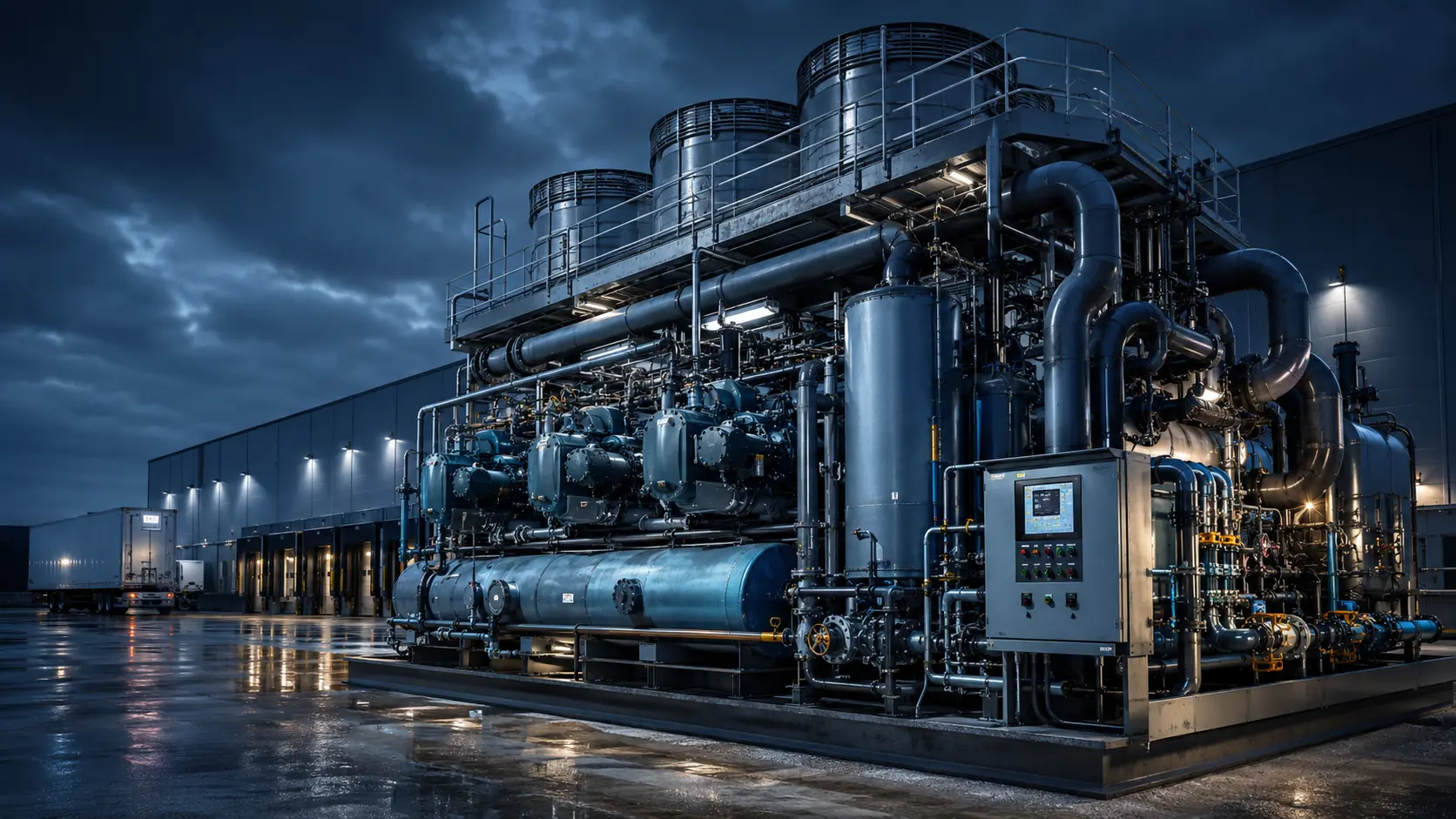
The modern world depends entirely on an invisible network of artificial winter. But most people do not realize that a cold chain logistics hub does not actually pump cold air into a room; it physically pumps heat out. This extraction relies on a continuous thermodynamic loop known as the vapor compression cycle.
Engineers utilize anhydrous ammonia NH3 as the primary thermal sponge because its specific heat capacity exceeds nearly every other industrial chemical. The extraction cycle begins in the evaporator coils suspended above the warehouse floor. Liquid ammonia enters these metal coils at extremely low pressure, causing it to boil instantly at temperatures well below freezing.
As the liquid flashes into a vapor, it violently absorbs the ambient heat from the surrounding warehouse air, dropping the facility’s internal temperature to strict cryogenic bounds. The system must then eject this stolen heat outside the building. Massive mechanical compressors ingest the warm ammonia gas and physically crush it, forcing the molecules together to exponentially increase both the pressure and the temperature of the vapor.
This superheated gas flows to condenser units on the warehouse roof, where external fans or water towers strip the heat away, forcing the ammonia to condense back into a high-pressure liquid. To restart the cycle, the liquid ammonia hits an expansion valve. This automated mechanical gate acts as a strict bottleneck, drastically dropping the fluid’s pressure, crashing its temperature, and sending it back to the evaporator coils to absorb another load of thermal energy.
WHY IT MATTERS NOW
Urban mega-cities simply cannot exist without massive, automated cold-storage facilities processing millions of tons of agricultural products and vaccines daily. The thermodynamic efficiency of these hubs dictates the ultimate shelf-life and safety of the global biological supply line. If this temperature control fails, the inventory spoils immediately, triggering localized supply shortages and massive financial write-offs.
Simultaneously, global regulators are actively outlawing legacy synthetic refrigerants. Hydrofluorocarbons (HFCs), the chemicals historically used in standard commercial freezers, trap atmospheric heat thousands of times more effectively than carbon dioxide. The Kigali Amendment to the Montreal Protocol forces international logistics conglomerates to abandon these chemicals entirely, triggering a massive industrial pivot back to natural ammonia.
Ammonia traps absolutely zero atmospheric heat and destroys zero ozone. This chemical reality makes multi-stage ammonia compression the only legally and economically viable architecture for the next century of global supply chain infrastructure.
This mandatory transition shifts billions of dollars in capital expenditure. Real estate investment trusts dominating the cold-storage sector must retrofit aging warehouses with industrial-grade ammonia cascades. Because ammonia rapidly corrodes standard copper plumbing, these retrofits require entirely new carbon-steel or stainless-steel piping topologies, generating massive capital contracts for specialized industrial metallurgy and HVAC engineering firms.
WHAT MOST PEOPLE MISS
Logistics analysts frequently evaluate cold chains by tracking battery-powered temperature sensors attached to individual shipping pallets. They completely overlook the extreme mechanical danger inherent in the central refrigeration plant itself. Anhydrous ammonia is a highly toxic, caustic gas; a microscopic pipe fracture can instantly flood a million-square-foot warehouse with a lethal chemical cloud, killing workers and contaminating the entire biological inventory.
To mitigate this absolute risk, modern hubs do not simply pump ammonia blindly through pipes. They rely on complex, automated valve topologies and active pressure-relief venting architectures. These computerized safety matrices isolate and physically lock down compromised pipe sectors in milliseconds, purposefully routing toxic blow-off gas into specialized rooftop water scrubbers to instantly neutralize the chemical threat before it reaches the surrounding civilian population.
THE TRAJECTORY
Next 12–36 Months: Hyperscale cold-storage operators will implement artificial intelligence-driven thermal load prediction. By linking the ammonia compressor matrix directly to inbound trucking software, the facility will automatically pre-cool specific warehouse zones hours before a massive shipment of frozen pharmaceuticals arrives on the loading dock, drastically flattening electricity consumption spikes.
Next Five Years: The mass adoption of low-charge ammonia and carbon dioxide NH3/CO2 cascade systems. To minimize toxic risk, facilities will restrict ammonia strictly to a small, isolated machine room on the roof. The ammonia will exclusively cool a secondary, harmless liquid carbon dioxide loop that circulates through the actual warehouse floor, reducing the total lethal chemical volume on-site by up to eighty percent.
Next Ten Years: The integration of fully automated cryogenic retrieval systems. Humans will be entirely removed from the deep-freeze zones. Robotic shuttles utilizing specialized solid-state battery chemistries will autonomously load and unload pallets in completely oxygen-depleted, ammonia-cooled micro-environments, maximizing storage density and eliminating thermal leakage from human entry points.
What Could Go Wrong: Severe regional power grid failures. Multi-stage ammonia compressors require massive, uninterrupted electrical current to overcome internal gas pressure upon a cold startup. If rolling blackouts plague an industrial zone, the compressors cannot restart, causing the warehouse temperature to quickly breach strict thermal bounds and forcing the complete chemical destruction of the inventory.
Most Likely Outcome: The ammonia vapor compression cycle will cement itself as the irreplaceable thermodynamic engine of global logistics. The unbeatable chemical efficiency of the molecule, combined with tightening environmental regulations, ensures that ammonia will actively govern the physical expansion of international food and medicine distribution.
KEY TERMS
- Vapor Compression Cycle: A continuous thermodynamic process that physically relocates heat by alternating a chemical refrigerant between a liquid and a gaseous state.
- Anhydrous Ammonia (NH3): A highly efficient, naturally occurring chemical refrigerant that lacks water, used extensively in heavy industry despite its extreme human toxicity.
- Evaporator: The heat-exchanging physical coil where low-pressure liquid refrigerant boils into a gas, absorbing thermal energy from the surrounding environment.
- Compressor: A heavy mechanical pump that physically crushes gaseous refrigerant, increasing its temperature and pressure to force it through the system.
- Expansion Valve: An automated mechanical gateway that rapidly drops the pressure of a liquid refrigerant, instantly cooling it before it enters the evaporator.
SOURCES
- International Institute of Refrigeration (IIR) — Ammonia as a Refrigerant and Thermodynamic Efficiency
- American Society of Heating, Refrigerating and Air-Conditioning Engineers (ASHRAE) — Industrial Refrigeration and Vapor Compression Mechanics
- Global Cold Chain Alliance (GCCA) — Low-Charge Ammonia Systems and Automated Warehouse Topologies
- Environmental Protection Agency (EPA) — The Phasedown of Hydrofluorocarbons and the Transition to Natural Refrigerants