Advertisement
)

AT A GLANCE
- Concept: Line Commutation: Relying on the natural voltage cycle of the alternating current grid to turn switches off.
- Concept: Thyristor Valve: A heavy-duty semiconductor that acts as a one-way electrical gate triggered by a light pulse.
- Concept: Series Stacking: Connecting hundreds of individual thyristors in a single tower to withstand extreme voltage.
- Concept: Commutation Failure: A catastrophic event where the switch fails to close, short-circuiting the entire transmission line.
HOW A THYRISTOR VALVE STACK WORKS
Moving electricity across continental distances using alternating current (AC) is physically inefficient. The alternating electrons vibrate back and forth, losing massive amounts of thermal energy to the surrounding air. High-Voltage Direct Current (HVDC) solves this by pushing electrons in a single, continuous direction.
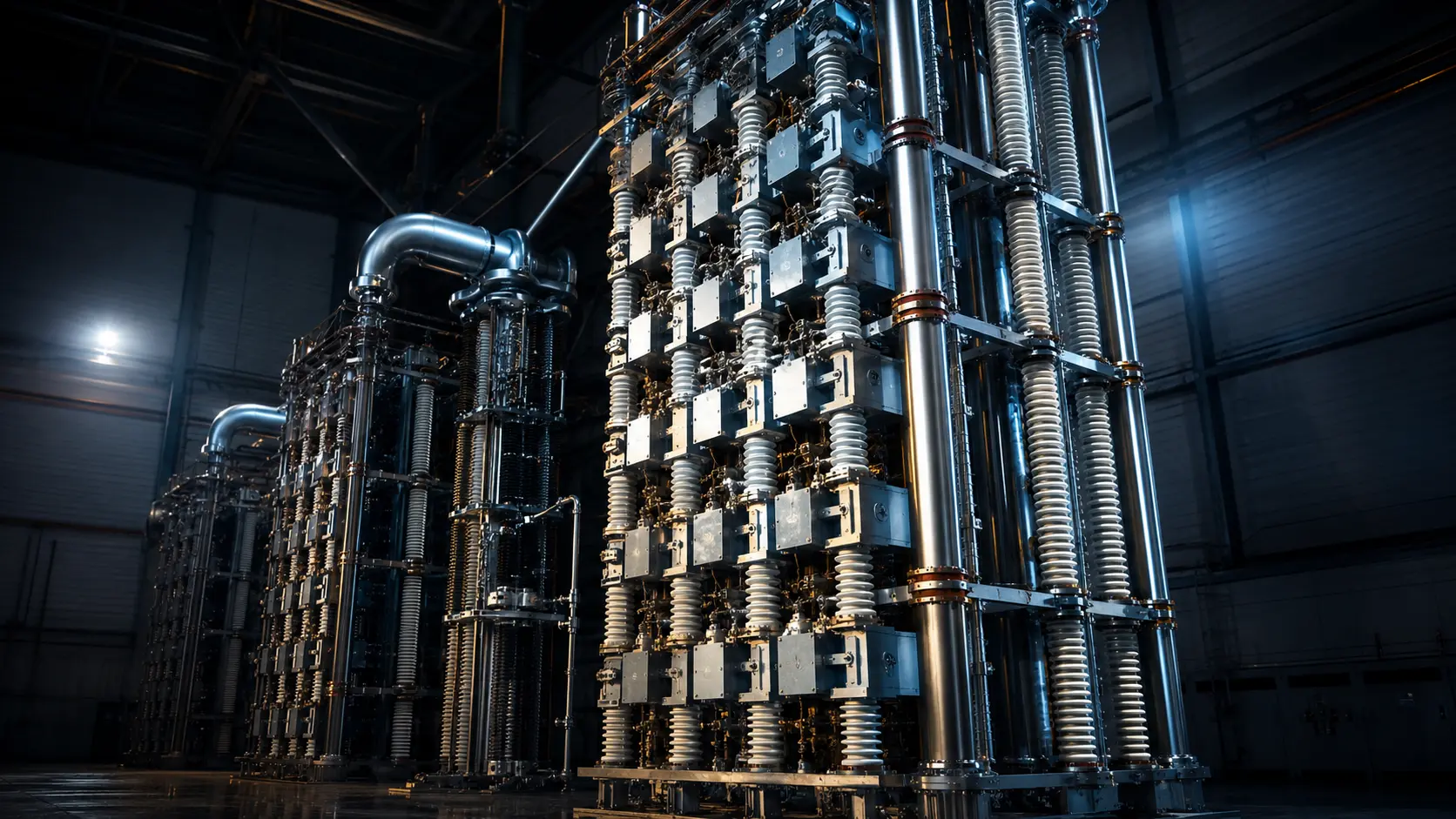
To connect an HVDC line to a standard AC grid, engineers build massive converter stations anchored by Line-Commutated Converters (LCCs). The mechanical heart of an LCC is the thyristor valve stack. A thyristor is a solid-state semiconductor switch that physically blocks or allows electrical flow without using any moving mechanical parts.
A single thyristor can only handle a few thousand volts before its internal silicon structure melts. To process an 800-kilovolt transmission line, engineers stack hundreds of thyristors in series to form a single vertical valve. These stacked semiconductors divide the immense voltage load equally among themselves.
The converter station operates this stack using extreme microsecond precision. Fiber-optic cables deliver synchronized light pulses to the gate of every thyristor simultaneously, commanding them to open and close in exact rhythm with the AC grid’s sine wave.
Because snapping gigawatts of power on and off generates massive transient overvoltages, each thyristor connects to a specialized snubber circuit and a surge arrester. These parallel components absorb and dissipate the chaotic voltage spikes, preventing a microscopic arc from physically bridging the gap and destroying the silicon stack.
WHY IT MATTERS NOW
Global industrial decarbonization mathematically requires relocating power generation. Solar irradiance peaks in deserts, and wind speeds peak offshore, but the heavy industrial centers consuming that power sit thousands of miles away. LCC HVDC transmission acts as the only viable pipeline capable of moving massive baseload power across these geographic voids.
China currently operates the world’s largest ultra-high-voltage direct current (UHVDC) networks, pushing up to 12 gigawatts of power per line from the Gobi Desert to the eastern seaboard. These mega-projects rely exclusively on LCC thyristor technology because it offers the highest absolute power capacity at the lowest physical energy loss.
Western grids face severe interconnection queues, stalling hundreds of renewable energy projects. Upgrading legacy AC corridors is politically and geographically impossible due to right-of-way disputes. Wrapping existing rights-of-way with high-capacity LCC HVDC lines triples the power throughput without expanding the physical footprint.
European grid operators are currently linking isolated national grids through massive subsea HVDC interconnectors. These specialized LCC stations synchronize the energy markets of distinct sovereign nations, allowing surplus offshore wind from the North Sea to instantly balance industrial demand spikes in central Europe.
The ability to manufacture these flawless, high-diameter silicon thyristor wafers is heavily concentrated among a few elite global electrical engineering conglomerates. Securing the supply chain for these specific semiconductors directly dictates a nation’s ability to modernize its heavy industrial grid.
WHAT MOST PEOPLE MISS
Energy analysts view HVDC lines as invincible electricity highways, entirely ignoring the extreme fragility of line commutation. A thyristor cannot turn itself off; it strictly relies on the receiving AC grid’s voltage to naturally cross zero to break the circuit.
If a minor short circuit occurs on the receiving AC grid, the local voltage temporarily drops. Without that necessary voltage push, the thyristor stays locked open. The incoming gigawatt DC current instantly short-circuits straight to the ground, triggering a cascading commutation failure that can collapse entire regional power grids in milliseconds.
Grid operators must rely on advanced algorithmic recovery matrices to prevent this exact collapse. When the sensors detect a commutation failure, the phase-firing controls instantly shift the gate pulses to artificially choke the DC current, absorbing the transient shock and rapidly resetting the valve sequence before the receiving grid physically destabilizes.
THE TRAJECTORY
Next 12–36 Months: Grid operators will heavily deploy advanced predictive control algorithms inside LCC stations. These algorithms will continuously monitor the AC grid’s health, slightly delaying the thyristor gate-firing pulses to guarantee successful shutoff during minor voltage dips.
Next Five Years: The integration of ultra-high-voltage 1100kV systems. Manufacturers will push the physical limits of silicon thyristor doping, creating single wafers capable of handling significantly more heat and current to reduce the total number of stacked components required per valve.
Next Ten Years: The systemic shift toward Voltage Source Converters (VSC). While LCCs dominate bulk transmission today, the maturation of Insulated-Gate Bipolar Transistors (IGBTs) will eventually allow VSC stations to push similar megawatt loads without relying on the receiving AC grid for commutation.
What Could Go Wrong: Synchronized cyber-physical attacks. The entire thyristor stack relies on absolute microsecond timing dictated by GPS-synchronized clocks. A targeted electronic spoofing attack on this timing signal would cause the valves to misfire, instantly triggering catastrophic thermal runaway and destroying the converter station.
Most Likely Outcome: LCC thyristor stacks will remain the mandatory workhorse for bulk, point-to-point continental transmission. The unbeatable raw power efficiency of a highly resilient thyristor mathematically guarantees its survival in civilization-scale energy networks.
KEY TERMS
- Line-Commutated Converter (LCC): A power electronics system that relies on the external alternating current grid’s natural voltage cycle to turn its semiconductor switches off.
- Thyristor: A highly resilient, solid-state semiconductor device that allows electrical current to flow in only one direction after receiving a trigger pulse.
- Gate-Firing Control: The precise, microsecond-level electronic command system that triggers individual thyristors to open simultaneously across a high-voltage stack.
- Commutation Failure: A severe electrical fault where a thyristor fails to close, causing the direct current line to short-circuit into the converter station.
- Transient Overvoltage: A sudden, chaotic spike in electrical pressure caused by switching massive currents on and off in microseconds.
SOURCES
- Institute of Electrical and Electronics Engineers (IEEE) — Transient Overvoltage Protection in UHVDC Thyristor Valves
- International Council on Large Electric Systems (CIGRE) — Commutation Failure Mitigation in Line Commutated Converters
- Department of Energy (DOE) — The Role of High-Voltage Direct Current in National Grid Resilience
- National Renewable Energy Laboratory (NREL) — High-Power Electronics and the Economics of HVDC Transmission