Advertisement
)

At a Glance
- Concept: Combining the precision of targeted immunotherapy with the extreme lethality of traditional chemotherapy.
- Why it matters: Standard chemotherapy is a “carpet bomb” that poisons the entire body. ADCs act as a “sniper rifle,” fundamentally changing how we treat solid tumors and offering hope to patients with previously untreatable advanced cancers.
- Who uses it: Major pharmaceutical companies (AstraZeneca, Daiichi Sankyo, Pfizer, Gilead), oncologists, and patients battling breast, lung, and bladder cancers.
- Biggest takeaway: The secret to a successful ADC is not just the targeting or the toxin—it is the “linker.” If the chemical chain connecting the toxin to the antibody breaks too early in the bloodstream, the drug becomes a deadly poison. If it is too strong, the drug fails to kill the tumor.
In Simple Words
Treating cancer is incredibly difficult because cancer cells are not foreign invaders like bacteria; they are your own body’s cells that have mutated and started dividing out of control.
Because they are your own cells, a drug that kills cancer usually kills healthy cells, too. Traditional chemotherapy is a biological carpet bomb. It kills any cell in the body that divides quickly. It kills the tumor, but it also kills your hair follicles (causing hair loss) and the lining of your stomach (causing severe nausea). The goal of chemotherapy is essentially to poison the cancer just slightly faster than you poison the patient.
Antibody-Drug Conjugates (ADCs) solve this by acting as a molecular sniper rifle.
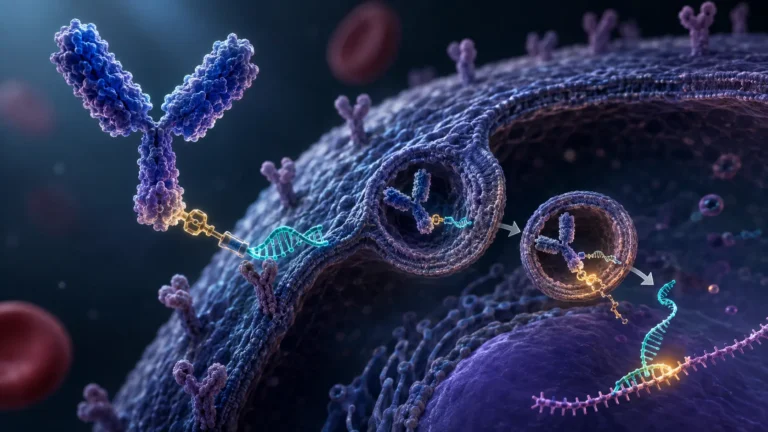
Scientists take an incredibly toxic poison—often 100 to 1,000 times more lethal than standard chemotherapy—and tie it to a targeted antibody. This antibody is programmed to ignore healthy cells and look for a specific protein “flag” that only exists on the surface of cancer cells. The ADC floats harmlessly through the bloodstream until it finds a cell waving that specific flag. It binds to the cancer cell, gets swallowed inside, and releases the poison, destroying the tumor from the inside out without harming the healthy tissue nearby.
Why This Matters
The commercial and medical impact of ADCs is the defining biotech story of the 2020s.
For decades, the failure rate for ADCs was astronomically high. The chemical links holding the poison to the antibody kept breaking in the bloodstream, causing severe toxicities and halting clinical trials. But recent breakthroughs in chemical engineering have solved this stability problem, triggering a massive paradigm shift in oncology.
Financially, this triggered one of the largest M&A (Mergers and Acquisitions) waves in pharmaceutical history. In late 2023, Pfizer acquired Seagen (a pioneer in ADC technology) for a staggering USD 43 billion. Following this, companies like AbbVie, Merck, and Johnson & Johnson deployed tens of billions of dollars to acquire ADC startups and licensing rights. By 2026, the global ADC market size has comfortably surpassed USD 20 billion and is rapidly expanding. For biotech investors, understanding the mechanics of how an ADC is constructed is the baseline requirement for evaluating any modern oncology pipeline.
The Big Picture
The true breakthrough of the ADC is how it combines two completely different eras of medicine into a single molecule.
The first era was Chemotherapy (1940s–1990s): highly lethal, but completely untargeted.
The second era was Monoclonal Antibodies (1990s–2010s): highly targeted, but often not lethal enough to kill aggressive solid tumors on their own.
An ADC is a bioconjugate—a synthetic marriage of biology and chemistry. It proves that we do not need to invent entirely new poisons to cure cancer. We just needed a vastly superior delivery mechanism for the poisons we already had.
How It Works
An ADC is composed of three distinct, highly engineered components. If any of the three fail, the drug fails.
1. The Antibody (The GPS)
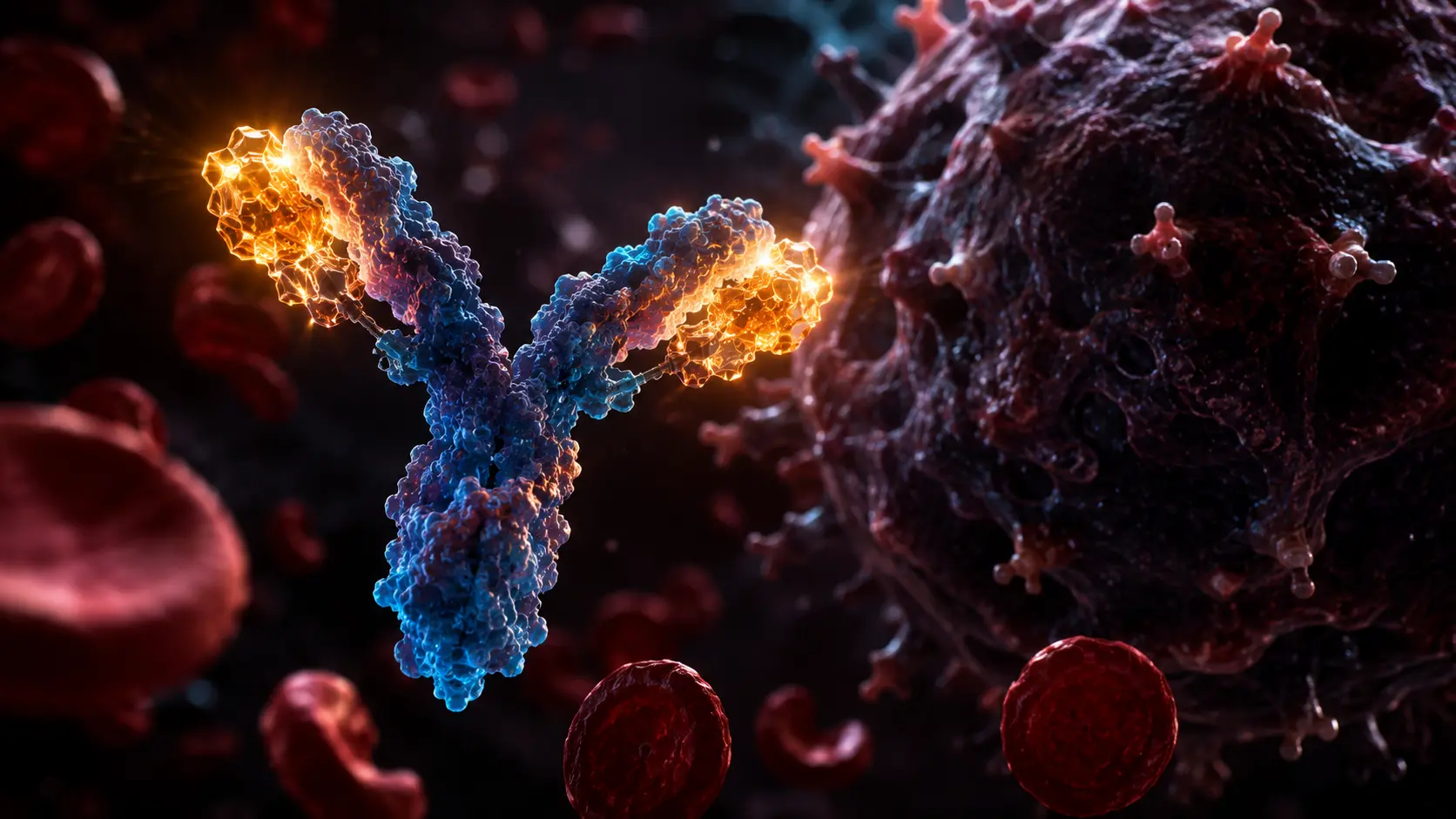
The foundation of the drug is a Monoclonal Antibody (mAb). This is a large, Y-shaped immune protein engineered in a laboratory. The tip of the “Y” is designed to act like a lock-and-key for a specific antigen (a protein flag) overexpressed on the surface of a cancer cell. A famous example is the HER2 protein, heavily present in certain breast cancers. The antibody guarantees the drug only docks with cells waving the HER2 flag.
2. The Payload (The Warhead)
Attached to the antibody is the cytotoxic payload. Because only a tiny fraction of the drug actually makes it inside the tumor, the payload must be devastatingly potent. Traditional ADCs use two main types of poisons:
- Microtubule Inhibitors (e.g., MMAE): These poisons freeze the cell’s internal skeleton, physically preventing the cancer cell from dividing.
- Topoisomerase Inhibitors (e.g., Deruxtecan): These poisons shatter the cancer cell’s DNA while it is trying to replicate, triggering immediate cell death (apoptosis).
3. The Linker (The Release Mechanism)
The linker is the chemical chain that ties the payload to the antibody. This is the hardest part of the engineering process.
- Cleavable Linkers: Designed to break apart when exposed to specific conditions inside a cancer cell (like high acidity or specific enzymes). Once inside, the linker snaps, releasing the poison.
- Non-Cleavable Linkers: These never break. Instead, the entire antibody must be digested and destroyed by the cancer cell’s internal stomach (the lysosome) before the payload is freed. This offers higher stability in the bloodstream but requires the cancer cell to fully digest the drug.
4. Internalization (The Detonation)
When the ADC finds the cancer cell, it binds to the surface flag. The cancer cell, thinking it has captured a normal nutrient, swallows the ADC—a process called receptor-mediated endocytosis. The ADC is pulled into a highly acidic internal “stomach” bubble (the lysosome). Here, the linker breaks, the extreme poison floods the inside of the cell, and the cancer cell dies.
5. Technical Depth: The Bystander Effect
Solid tumors are notoriously messy. Not every cell in a tumor waves the target flag; some are “flag-negative.” If an ADC only kills flag-positive cells, the tumor will shrink but eventually regrow.
Modern ADCs utilize highly engineered, membrane-permeable payloads to trigger the Bystander Effect. When the primary cancer cell dies and bursts open, the toxic payload spills out. Because the payload is membrane-permeable, it seeps into the neighboring, flag-negative cancer cells and kills them too. This creates a localized, microscopic “blast radius” deep inside the tumor, destroying the cancer tissue regardless of whether every individual cell had the target flag.
Real-World Applications
ADCs are rapidly replacing traditional chemotherapy as the standard of care for complex solid tumors.
HER2-Low Breast Cancer (Enhertu): For decades, breast cancer patients were classified as either HER2-positive (treatable with targeted therapies) or HER2-negative (untreatable with targeted therapies). AstraZeneca and Daiichi Sankyo developed an ADC called Enhertu. Enhertu’s payload is so potent and its bystander effect so strong that it proved highly effective even on patients with very low levels of HER2 flags. This legally and medically created an entirely new category of breast cancer (“HER2-low”), rewriting global treatment guidelines and offering a lifeline to thousands of women.
Urothelial (Bladder) Cancer (Padcev): Advanced bladder cancer historically had grim survival rates and grueling chemotherapy regimens. Padcev, an ADC targeting the Nectin-4 protein, delivers a microtubule inhibitor directly into the urothelial tumor. When combined with immunotherapy (Keytruda), the clinical trial results were so overwhelmingly positive that independent monitors halted the trial early because it was deemed unethical to continue giving the control group standard chemotherapy.
Economic & Strategic Impact
The financial mechanics of the ADC market represent a gold rush in the contract manufacturing space.
Because ADCs involve handling highly toxic compounds alongside delicate biological proteins, they are notoriously difficult to manufacture. You cannot make the antibody and attach the poison in a standard pharmaceutical facility; it requires highly specialized, airtight isolation suites to protect the manufacturing workers from the microscopic warheads.
As major pharma giants acquire ADC pipelines, they realize they lack the specialized factories to mass-produce them. This has led to a massive surge in strategic value for Contract Development and Manufacturing Organizations (CDMOs) like Lonza and WuXi Biologics. Biotech investors are heavily scrutinizing the supply chain, recognizing that owning the intellectual property for a breakthrough ADC is useless if the company cannot secure the highly constrained manufacturing capacity required to bring it to market.
Advantages
- Extreme Precision: By targeting cancer-specific antigens, ADCs drastically widen the “therapeutic window”—the dosage gap between killing the cancer and killing the patient.
- The Bystander Effect: Advanced linkers and payloads allow the drug to kill heterogeneous (mixed) tumors by creating a localized blast radius that wipes out neighboring cancer cells that lack the target antigen.
- Reviving Failed Drugs: Highly toxic compounds that failed FDA trials in the 1990s because they were too deadly to human patients are now being pulled off the shelf and successfully repurposed as payloads for ADCs, saving decades of chemical R&D.
Limitations
- Premature Cleavage (Toxicity): If the chemical linker is unstable, the highly toxic payload will snap off while floating in the bloodstream. This causes devastating off-target toxicity, damaging the liver, kidneys, or bone marrow.
- Antigen Shedding: Some cancer cells evolve to “shed” their protein flags into the bloodstream. The ADC binds to the floating flag in the blood rather than the cancer cell, neutralizing the drug before it ever reaches the tumor.
- Astronomical Costs: The R&D, complex biological manufacturing, and proprietary linker technology make ADCs some of the most expensive drugs on Earth, often costing upwards of USD 10,000 to USD 15,000 per month, creating severe global healthcare access disparities.
Common Misconceptions
Misconception: ADCs have zero side effects because they only target cancer cells.
Reality: ADCs are not perfectly safe. Some healthy cells inevitably wave the same protein flags as cancer cells, resulting in collateral damage. Furthermore, slight leakage of the payload in the bloodstream can cause severe side effects, including neutropenia (low white blood cells) and interstitial lung disease (lung scarring).
Misconception: A stronger poison always makes a better ADC.
Reality: The Drug-to-Antibody Ratio (DAR) is a delicate balancing act. If you attach too many poison molecules to a single antibody (e.g., a DAR of 8 instead of 4), the antibody becomes too heavy, clumps together, and gets filtered out by the liver before it ever reaches the tumor.
Misconception: ADCs cure cancer permanently.
Reality: While they offer unprecedented progression-free survival rates for advanced stages, cancer is highly adaptive. Tumors eventually mutate, stop displaying the target antigen, or develop internal pumps that literally spit the poison back out of the cell, leading to eventual drug resistance.
What Most People Miss
The true intellectual property (IP) moat of an ADC company is almost never the antibody or the payload—it is the Linker Chemistry.
Anyone can engineer an antibody. Anyone can find a toxic chemical. But designing a microscopic chemical chain that is 100% stable in the neutral pH of human blood, yet instantly shatters in the acidic environment of a tumor cell, requires elite biochemical engineering. When a pharmaceutical giant pays billions of dollars to acquire an ADC startup, they are primarily buying the proprietary, patented linker technology that they can subsequently use to build dozens of different drugs.
Comparison Table
| Feature | Traditional Chemotherapy | Monoclonal Antibodies (mAbs) | Antibody-Drug Conjugates (ADCs) |
| Mechanism | Systemic poisoning of fast-dividing cells. | Binds to cell surface to block signals or flag for immune system. | Delivers a toxic payload directly inside the targeted cell. |
| Targeting | Blind (Carpet Bomb). | Highly Specific (GPS). | Highly Specific (GPS + Warhead). |
| Toxicity to Healthy Tissue | Very High. | Low to Moderate. | Moderate (Relies on linker stability). |
| Primary Use Case | Broad, frontline cancer treatment. | Immunotherapy, blocking tumor growth. | Complex solid tumors, late-stage relapses. |
| Bystander Effect | Systemic, undirected. | None. | Highly localized to the tumor microenvironment. |
Case Study
Situation: HER2-positive breast cancer has long been treated with targeted antibodies like Herceptin (trastuzumab). However, a significant portion of patients eventually relapsed as their tumors mutated and grew resistant to the antibody, leaving them with few options other than brutal, systemic chemotherapy.
Challenge: Daiichi Sankyo and AstraZeneca sought to create a drug that could utilize the proven targeting of trastuzumab but deliver a lethal payload that the cancer cells could not resist, while maintaining stability in the bloodstream to prevent fatal side effects.
Solution (The Drug): They engineered Enhertu (trastuzumab deruxtecan). They took the trastuzumab antibody and attached a highly potent topoisomerase I inhibitor (deruxtecan). Crucially, they developed a proprietary, highly stable tetrapeptide-based cleavable linker and optimized the Drug-to-Antibody Ratio (DAR) to a very high 8:1 without destabilizing the molecule.
Outcome: The clinical results redefined modern oncology. In trials for patients with metastatic breast cancer who had exhausted all other treatments, Enhertu doubled progression-free survival compared to the standard of care. Furthermore, its potent bystander effect proved so effective that the FDA rapidly expanded its approval to include patients with “HER2-low” tumors, a massive demographic previously deemed ineligible for targeted therapies.
Lessons Learned: Enhertu proved that an optimized linker and a payload with a strong bystander effect can completely override a tumor’s natural resistance mechanisms, turning a previously fatal, untreatable diagnosis into a highly manageable, chronic condition.
Future Outlook
Next 12–24 Months
The industry is moving aggressively into combination therapies. Rather than using ADCs as a last resort, clinical trials are combining ADCs with PD-1 inhibitors (like Keytruda) as frontline treatments. By using the ADC to blow the tumor cells apart, it exposes the tumor’s hidden antigens, allowing the immunotherapy drug to signal the patient’s own T-cells to swarm and eradicate the remaining cancer. This one-two punch will become the new gold standard for solid tumors.
Next 3–5 Years
We will witness the rise of novel payloads beyond traditional chemotherapy. Biotech firms are developing Immune-Stimulating Antibody Conjugates (ISACs) and Radionuclide Drug Conjugates (RDCs). Instead of delivering a chemical poison, the antibody will deliver a microscopic payload of radioactive isotopes (like Actinium-225) directly to the tumor, delivering localized radiation therapy from the inside out without burning the surrounding healthy organs.
Next 10 Years
The focus will shift to overcoming ADC resistance. As tumors learn to downregulate the target antigens, companies will deploy bispecific ADCs—antibodies designed to look for two different protein flags simultaneously. If the tumor mutates and hides Flag A, the ADC will still latch onto Flag B, preventing the cancer from escaping targeted destruction.
Most Likely Scenario
The commercial dominance of ADCs is permanent. They bridge the gap between the blunt force of the 20th century and the precision immunotherapy of the 21st century. As linker chemistry approaches near-perfect stability in the bloodstream, the severe toxicities associated with cancer treatment will plummet, transforming oncology from a discipline of managing brutal side effects into a practice of precise, targeted molecular eradication.
Key Takeaways
- Antibody-Drug Conjugates (ADCs) combine a targeting immune protein with a highly lethal chemotherapy payload, acting as a biological sniper rifle against cancer.
- The drug targets specific antigens (protein flags) on the surface of cancer cells, ensuring the poison is only released after the cell swallows the ADC.
- The “Linker” is the most critical and complex piece of engineering. It must remain perfectly stable in the blood but shatter instantly in the acidic environment of a tumor cell.
- Modern ADCs utilize the “Bystander Effect”—when the target cancer cell bursts, the membrane-permeable payload leaks out and kills neighboring cancer cells that lacked the target flag.
- ADCs like Enhertu have revolutionized the treatment of solid tumors, leading to a massive, multi-billion dollar M&A wave as big pharma scrambles to acquire advanced linker technology.
- While far safer than traditional chemotherapy, ADCs still carry risks of severe side effects if the linker breaks prematurely in the bloodstream.
Glossary
Antigen: A molecular structure, often a protein on the outside of a cell, that an antibody recognizes and binds to. In ADCs, these are specific flags overexpressed by cancer cells (e.g., HER2, Trop-2).
Bystander Effect: A mechanism where the toxic payload, after destroying the primary targeted cancer cell, leaks out and kills neighboring cancer cells, creating a localized blast radius deep inside the tumor.
Cleavable Linker: A chemical chain connecting the antibody to the payload that is specifically designed to break apart when exposed to the low pH or specific enzymes found inside a cancer cell’s lysosome.
Drug-to-Antibody Ratio (DAR): The average number of toxic payload molecules attached to a single antibody. Finding the optimal DAR (usually between 4 and 8) is critical to balancing lethality with bloodstream stability.
Monoclonal Antibody (mAb): A laboratory-produced immune protein engineered to bind to only one specific substance or antigen on a cell surface.
Topoisomerase Inhibitor: A class of highly toxic payloads used in ADCs that kill cells by interfering with the enzymes that unwind DNA during cell division, physically shattering the cancer’s genetic code.
Frequently Asked Questions
Why don’t we just give the patient the toxic payload directly?
The payloads used in ADCs are often 100 to 1,000 times more toxic than standard chemotherapy. If you injected these chemicals directly into the bloodstream without the antibody guiding them, they would instantly kill the patient by destroying the liver, kidneys, and bone marrow.
Do ADCs cause hair loss and nausea like normal chemo?
They can, but generally at much lower rates. Because the payload is mostly released inside the tumor, systemic (body-wide) toxicity is vastly reduced. However, because a small percentage of the linkers inevitably break in the bloodstream, patients still experience some classic chemotherapy side effects, though often less severe.
Are ADCs used for blood cancers like leukemia?
Yes, though they are currently most famous for revolutionizing the treatment of solid tumors (breast, lung, bladder). ADCs targeting specific blood cell antigens have been approved and are highly effective for various leukemias and lymphomas.
Why is manufacturing ADCs so difficult?
It requires handling two completely opposed environments. The antibody is a delicate biological protein that must be grown in sterile vats and treated gently. The payload is a deadly, synthetic chemical poison that requires extreme hazardous material containment to protect the factory workers. Safely combining them into a single drug requires incredibly complex, isolated facilities.
Is an ADC the same thing as CAR-T cell therapy?
No. CAR-T involves extracting a patient’s own living T-cells, genetically reprogramming them to hunt cancer, and putting them back in the body. An ADC is a synthetic, non-living drug manufactured in a factory and administered intravenously off the shelf.
Sources
- National Cancer Institute (NCI): Antibody-Drug Conjugates in Cancer Therapy
- Nature Reviews Drug Discovery: The evolution of antibody–drug conjugates (2024/2025)
- AstraZeneca / Daiichi Sankyo: Enhertu (trastuzumab deruxtecan) Clinical Data and Approvals
- BioCentury: The ADC Dealmaking Boom and Contract Manufacturing Capacity Constraints (2026)