Advertisement
)

AT A GLANCE
- Concept: Terminal Operating System (TOS): The central software brain that schedules every single robotic movement across the entire port.
- Concept: Ship-to-Shore (STS) Crane: Colossal, semi-autonomous metal structures that pluck shipping containers from the deck of massive cargo vessels.
- Concept: Automated Guided Vehicle (AGV): Driverless, low-profile trucks that catch containers from the cranes and transport them across the dock.
- Concept: Stacking Matrix: A highly organized grid of containers constantly reshuffled by robotic gantry cranes to minimize loading delays.
IN SIMPLE WORDS
Every phone, car part, and pair of shoes you buy crossed an ocean in a standard steel shipping container. A modern cargo ship carries over 20,000 of these boxes at once.
Unloading a ship that large using human truck drivers and manual cranes takes weeks. The port becomes a massive traffic jam.
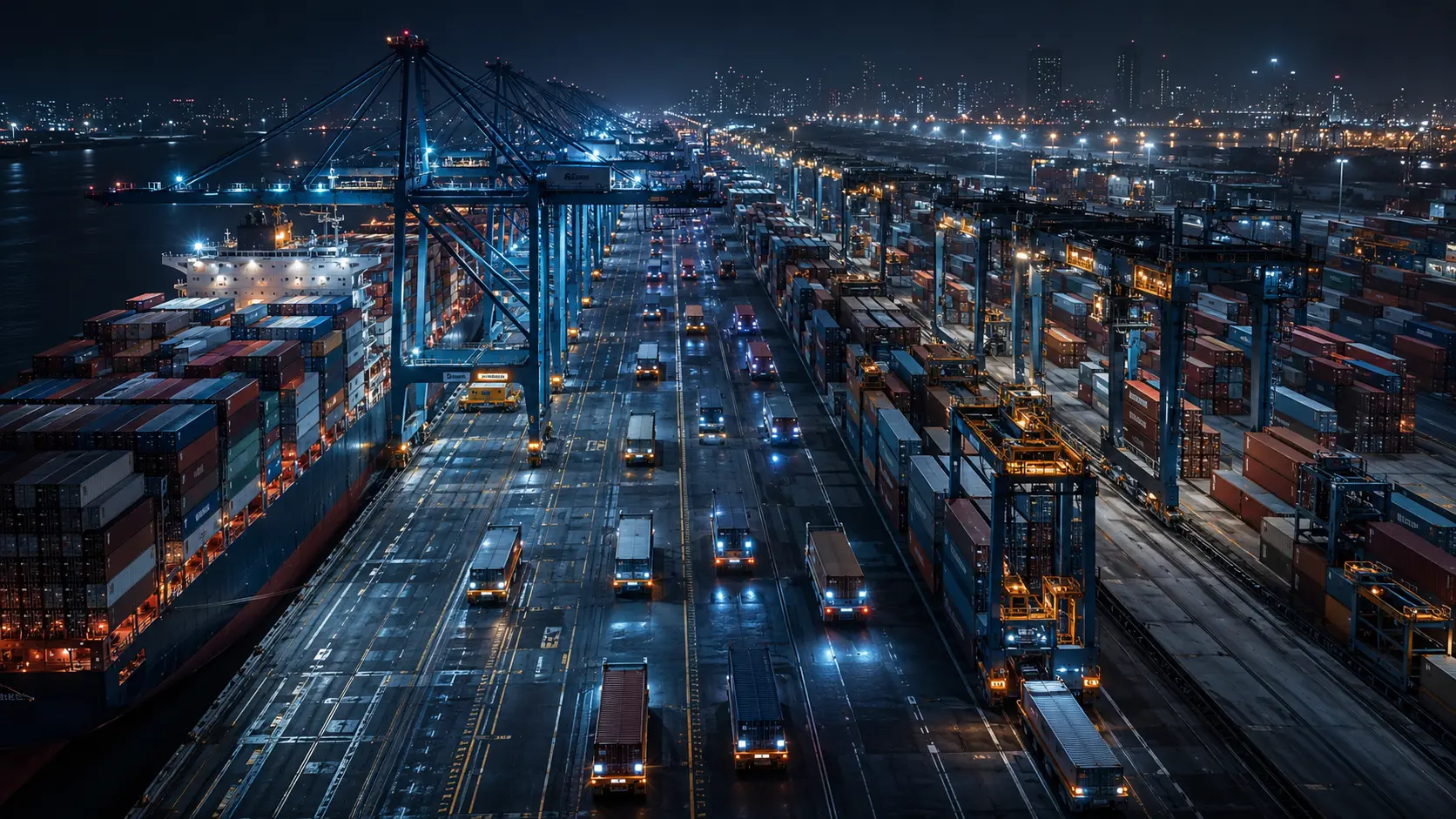
To fix this, modern megaports have removed humans from the physical dock entirely. When a ship arrives, the entire port operates like a massive, highly synchronized video game. Giant robotic cranes grab the boxes. Driverless flatbed robots carry them away. Automated stacking machines perfectly organize them into massive steel walls.
The entire process is controlled by a central supercomputer. This computer calculates millions of possible paths every second, ensuring no robot crashes and no container is lost, turning global trade into a perfectly orchestrated machine that runs silently, 24 hours a day, in the dark.
HOW IT WORKS
The physical efficiency of global trade relies strictly on the mathematical optimization of terminal logistics. The heart of a modern automated port is the Terminal Operating System (TOS).
The TOS acts as the central intelligence engine. Weeks before a vessel even arrives, the TOS receives an electronic manifest detailing the exact weight, destination, and hazardous material classification of every container on board. The software calculates a comprehensive berth allocation schedule and a highly complex unloading sequence.
When the massive ultra-large container vessel (ULCV) docks, the port’s Ship-to-Shore (STS) cranes take over. These cranes are largely autonomous, using laser scanning arrays and computer vision to model the physical geometry of the ship’s deck. A remote human operator, sitting miles away in a control room, only intervenes for the final few inches of the pick to ensure safety.
Once the STS crane hoists a 40-ton container from the ship, it does not drop it onto a human-driven truck. It lowers the box onto an Automated Guided Vehicle (AGV). AGVs are battery-powered, driverless platforms that navigate the tarmac using an invisible grid of transponders embedded in the concrete.
The TOS manages a fleet of hundreds of AGVs simultaneously, calculating optimal pathfinding networks to prevent gridlock. The AGV transports the box to the container yard, where an Automated Stacking Crane (ASC) picks it up.
The ASC organizes the containers into dense, multi-story blocks. Crucially, the TOS anticipates which containers will be loaded onto trains or semi-trucks first. During quiet night shifts, the TOS commands the ASCs to autonomously perform “housekeeping”—reshuffling the massive stacks so the containers scheduled for morning departure sit perfectly at the top of the pile.
REAL WORLD EXAMPLE
The Yangshan Deep-Water Port in Shanghai is the largest fully automated container terminal on Earth. Phase IV of the port operates across 114 robotic stacking cranes and 130 AGVs, all driven by an indigenous Chinese operating system called ITOS.
If a massive storm delays a ship by two days, the entire global supply chain backing up behind it threatens to freeze. At Yangshan, the ITOS software instantly recalculates the entire port’s schedule in milliseconds. It reroutes the AGVs, changes the stacking logic, and optimizes the berth assignments for the incoming fleet without a single human meeting. The port moves over 6 million twenty-foot equivalent units (TEUs) annually with a fraction of the workforce required by traditional Western ports.
WHY IT MATTERS NOW
Global supply chains demand absolute predictability. The traditional model of human-operated ports creates extreme vulnerability to labor strikes, fatigue, and fatal industrial accidents.
During the pandemic-induced supply chain crisis, human-operated ports in Los Angeles and Long Beach experienced structural failure. Ships waited offshore for weeks because the manual unloading processes could not physically scale to meet the surge in demand. Automated ports in Europe and Asia absorbed the exact same cargo surges seamlessly simply by running their robotics 24/7.
Consequently, automation dictates global economic competitiveness. A fully automated terminal reduces physical ship turnaround time by up to 30%. For a shipping conglomerate like Maersk or MSC, shaving a day off a port call saves millions of dollars in bunker fuel and capital costs. Ships now actively prioritize routes that include automated megaports, financially starving older, legacy terminals of high-volume traffic.
COMMON MISCONCEPTIONS
- “Automated ports move cranes faster than humans.” Human operators actually move individual cranes slightly faster in short bursts. The advantage of automation is relentless consistency. Robots do not take lunch breaks, experience fatigue, or stop during shift changes.
- “The entire port is completely empty of humans.” While the main tarmac is a strict “no-go” zone for safety, automated ports still employ hundreds of highly paid software engineers, mechanics, and remote crane operators sitting in off-site control towers.
- “Every port will automate soon.” Full automation requires a massive, perfectly flat concrete footprint. Many legacy ports located within dense city centers physically lack the space to redesign their layouts for AGV grids and automated stacking blocks.
WHAT MOST PEOPLE MISS
Labor disputes dominate the headlines, but the actual technical barrier to port automation is the landside handover.
Unloading a ship onto an automated AGV is an entirely closed, predictable system. The chaos occurs when the automated port must hand the container off to an unpredictable human truck driver arriving from the highway.
Integrating a robotic stacking crane with an independent human driver who arrives early, parks slightly crooked, or possesses the wrong manifest creates immense software friction. The true genius of a modern Terminal Operating System is its ability to mathematically buffer the highly ordered, sterile robotic zone against the chaotic, human-driven regional highway system.
THE ECONOMIC AND STRATEGIC IMPACT
The equipment manufacturing market is fiercely monopolized. Chinese state-owned enterprise ZPMC builds roughly 70% of all ship-to-shore cranes globally. This industrial dominance allows China to dictate the hardware standards for global port automation.
This creates severe national security friction. In the United States, military analysts have flagged foreign-built automated cranes as potential espionage threats. Because these cranes rely on massive streams of telemetry data and remote software updates, intelligence agencies fear a hostile state could theoretically freeze an entire American port by executing a malicious remote update during a geopolitical crisis.
Economically, automation brutally accelerates port consolidation. Only the largest mega-ports possess the billions of dollars of upfront capital required to purchase AGV fleets and TOS software. Small, regional ports cannot afford the robotics, losing their shipping contracts to the megaports and accelerating the death of secondary coastal logistics hubs.
THE TRAJECTORY
Next 12–36 Months: The rapid adoption of 5G telemetry networks. Current AGVs rely on buried magnetic transponders or localized Wi-Fi, which can suffer from interference in areas with massive steel containers. Private 5G networks will provide the ultra-low latency required for the TOS to command thousands of moving robots with millimeter precision.
Next Five Years: The full automation of the “last mile” gate handover. Ports will mandate that all incoming highway trucks utilize autonomous driving software while inside the terminal. The TOS will take direct control of the civilian truck’s steering and brakes the moment it passes the security gate, ensuring perfectly predictable parking for the robotic cranes.
Next Ten Years: The deployment of continuous-flow subterranean logistics. Instead of relying on vulnerable surface trucks, advanced megaports will integrate directly with automated underground maglev or vacuum tube networks. Containers will drop straight from the ship into automated subterranean tunnels, bypassing urban traffic entirely to reach regional distribution centers.
What Could Go Wrong: A catastrophic ransomware encryption. An automated port is a massive, highly interconnected internet-of-things (IoT) device. If a state-sponsored hacker successfully encrypts the Terminal Operating System database, the port cannot track which container is which. The entire physical supply chain instantly paralyzes until the software is decrypted.
Most Likely Outcome: The physical handling of global maritime freight will become entirely uncrewed. The stark mathematical superiority of robotic scheduling over manual labor guarantees that automated megaports will completely dominate international trade corridors.
KEY TERMS
- Terminal Operating System (TOS): The complex central software that manages, schedules, and tracks every physical movement and asset within a port.
- Automated Guided Vehicle (AGV): A driverless, flatbed robotic vehicle used to transport shipping containers across the port tarmac.
- Ship-to-Shore (STS) Crane: A massive, specialized gantry crane used to lift containers off a cargo ship and lower them onto the dock.
- Automated Stacking Crane (ASC): A robotic rail-mounted crane that organizes and stacks containers in the storage yard without a human driver.
- TEU: Twenty-Foot Equivalent Unit; the standard measurement for global shipping containers used to calculate a port’s total capacity.
- Berth Allocation: The logistical process of assigning arriving ships to a specific physical parking spot along the port dock at a specific time.
BEGINNER FAQ
What is an automated port? It is a shipping port that uses robots, driverless trucks, and artificial intelligence to unload cargo ships and organize containers without humans working on the actual dock.
Why do ports need to be automated? Modern cargo ships are massive. Unloading them manually takes too long and causes severe traffic jams. Robots can work perfectly in the dark, 24 hours a day, without getting tired.
How do the robotic trucks know where to go? A central supercomputer tells them exactly where to drive. The trucks follow invisible paths using sensors in the concrete, GPS, and advanced radar to avoid hitting each other.
Are there any humans working there? Yes. Humans sit safely in off-site control rooms miles away. They monitor the computers and use joysticks to step in and help if a robot gets confused or a container gets stuck.
How do the cranes know which box to pick up? Before the ship even arrives, the port’s computer receives a digital map of the ship. It calculates a perfect math equation to determine exactly which box to grab first to keep the ship balanced.
Do robots load the containers onto regular trucks? Yes, but this is the hardest part. The robots must hand the box over to a human truck driver. The computer carefully schedules this to make sure the human driver is parked in exactly the right spot.
What happens if the computer crashes? If the central Terminal Operating System crashes or is hacked, the port physically stops moving. Every robot freezes in place until the computer is fixed, which is why cybersecurity is a massive priority.
Will every port look like this soon? No. Buying the robots and software costs billions of dollars. Only the biggest, wealthiest ports in the world can afford to build these systems.
SOURCES
- United Nations Conference on Trade and Development (UNCTAD) — Review of Maritime Transport and Port Automation Trends
- International Transport Forum (ITF) — The Impact of Mega-Ships on Port Infrastructure and Automation
- Institute of Electrical and Electronics Engineers (IEEE) — Scheduling Algorithms and AGV Pathfinding in Automated Container Terminals
- Center for Strategic and International Studies (CSIS) — Cybersecurity and Geopolitical Risks in Maritime Infrastructure