Advertisement
)

At a Glance
- Concept: Removing the human cabin from traditional port straddle carriers and replacing it with autonomous navigation systems orchestrated by a central AI terminal operating system.
- Why it matters: Global supply chains choke when ports shut down for shift changes, human error, or labor strikes. By automating the movement of freight from the ship to the truck, ports can operate in the dark, 24/7/365, guaranteeing baseline economic throughput.
- Who uses it: Mega-ports globally, including the Port of Rotterdam, Patrick Terminals in Australia, and APM Terminals in Los Angeles, utilizing hardware from OEMs like Kalmar and Konecranes.
- Biggest takeaway: The true advantage of an automated straddle carrier is not just driving—it is lifting. Unlike a flatbed robot that must wait for a crane to load it, a straddle carrier picks up and drops off containers independently, mathematically “decoupling” the ship-to-shore crane from the yard stack.
In Simple Words
When a massive cargo ship arrives at a port carrying 20,000 containers, giant cranes lift the boxes off the ship. But those boxes cannot just sit on the dock; they must be moved instantly to a storage yard to wait for a truck or a train.
Historically, human drivers in trucks or tall, spider-like vehicles (straddle carriers) waited under the crane. If the driver was on a coffee break, the multi-million-dollar crane stopped moving.
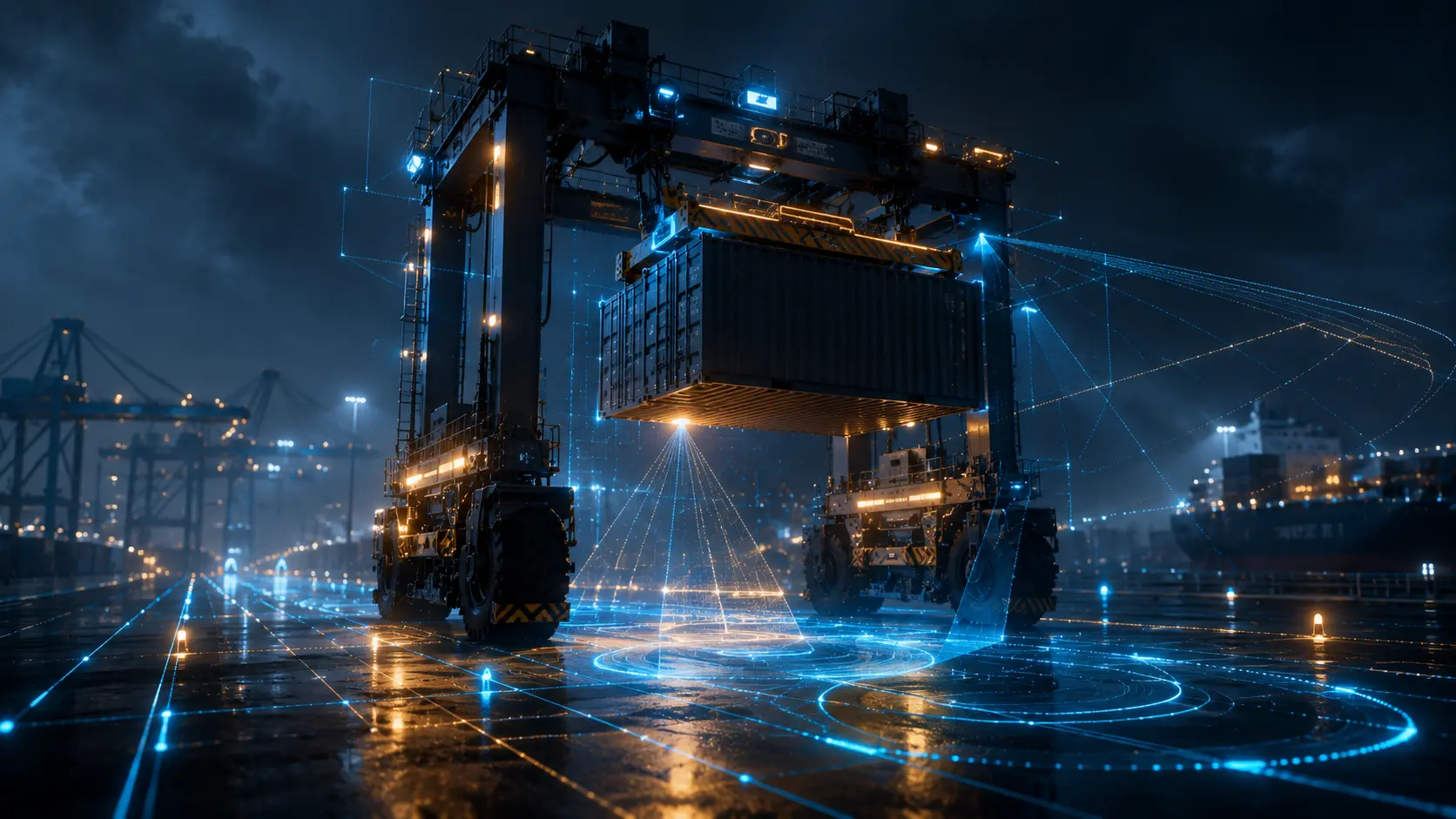
Automated Straddle Carriers (AutoStrads) delete the human driver. They look like massive, steel, four-legged tables on wheels. They are programmed by a central computer to drive themselves across the port, position themselves perfectly over a shipping container, pick it up like an eagle grabbing a fish, and scurry away to stack it in the yard. Because they do not need sleep, shift changes, or lights to see, a fleet of these robots can swarm a port, quietly and relentlessly sorting global freight in the dark.
Why This Matters
The vulnerability of the global supply chain is physically located at the maritime port terminal.
During the logistical shocks of the early 2020s, dozens of cargo ships sat anchored off the coast of California, not because there was a shortage of ships, but because the ports lacked the synchronized ground transport to move containers away from the docks. Human-driven equipment suffers from inherent friction: shift changes waste up to two hours of operational time a day, accident risks require slow speeds, and labor disputes can freeze billions of dollars of GDP overnight.
Automated Straddle Carriers transition port logistics from an unpredictable, labor-intensive operation into a highly predictable, mathematically perfect software operation. For global logistics executives and infrastructure investors, automating the terminal is the only viable strategy to handle the sheer volume of modern ultra-large container vessels (ULCVs) while simultaneously collapsing long-term operating expenditures (OpEx).
The Big Picture
To understand terminal automation, you must understand the difference between Coupled and Decoupled systems.
In many automated ports, operators use Automated Guided Vehicles (AGVs)—which are essentially giant, flat robotic skateboards. AGVs are highly efficient, but they are coupled. The giant Ship-to-Shore (STS) crane must precisely lower the container onto the AGV. The AGV then drives to the yard, where an Automated Stacking Crane (ASC) must pick it up off the AGV. If the AGV arrives late, the STS crane waits. If the ASC is busy, the AGV waits.
A Straddle Carrier decouples this process. An STS crane drops a container directly onto the ground. The crane goes back for the next box immediately. Five minutes later, an Automated Straddle Carrier drives over the box, picks it up off the ground, and moves it to the yard. By breaking the direct handoff, neither the massive crane nor the robot ever has to wait for the other.
HOW AUTOMATED STRADDLE CARRIERS WORK
Turning a 60-ton piece of heavy machinery into a graceful, autonomous robot requires military-grade telemetry and software orchestration.
1. The Fundamental Problem: Ship-to-Shore Synchronization
When a ship carrying 20,000 TEUs (Twenty-foot Equivalent Units) arrives, the terminal has roughly 72 hours to unload it. Moving thousands of steel boxes requires a synchronized dance between the cranes unloading the ship and the vehicles moving the boxes into the yard. If human drivers fall out of sync due to fatigue or miscommunication, the dock becomes congested, and the entire port gridlocks.
2. The Insufficiency of Human Operators
Manned straddle carriers place a human in a glass cabin 40 feet in the air, looking down between their legs to align a spreader bar over a container. It is dangerous, ergonomically punishing work. Human drivers require breaks, are limited by visibility in rain or fog, and naturally deviate from optimal, fuel-efficient driving paths, increasing tire wear and diesel consumption.
3. The Core Mechanism: The Autonomous Straddle Carrier
Manufacturers like Kalmar strip the human cabin entirely. The vehicle is equipped with a hybrid-electric or fully electric battery powertrain. To navigate, it relies heavily on Differential Global Positioning Systems (DGPS). Standard GPS is accurate to within a few meters; DGPS uses fixed ground-based reference stations at the port to correct satellite signals, granting the robot millimeter-level positional accuracy.
4. Technical Depth: Pathfinding and Sensor Fusion
The robot does not “think” on its own—it is a drone. The intelligence lives in the Terminal Operating System (TOS), software programs like Navis N4. The TOS calculates the most efficient route for 50 robots simultaneously, preventing traffic jams. As the AutoStrad executes the assigned route, it uses onboard sensor fusion—LIDAR, radar, and ultrasonic sensors—to detect unexpected obstacles (like a dropped wrench or a stray seagull). If the LIDAR detects an anomaly, the carrier executes an emergency stop in milliseconds.
5. Real-World Consequences: 24/7 Dark Ports
Because the AutoStrads rely on DGPS and radar rather than human eyesight, they do not require floodlights to operate. This creates the phenomenon of the “Dark Port.” A fully automated terminal can operate at 3:00 AM in pitch-black conditions, in heavy fog, or during torrential rain. The equipment executes smooth, mathematically optimized acceleration and braking curves, drastically extending the lifespan of the machinery and dropping energy consumption by up to 30%.
Real-World Applications
Automated Straddle Carriers are actively reshaping major maritime hubs.
Patrick Terminals (Brisbane & Sydney): Patrick Terminals in Australia pioneered this technology, deploying Kalmar AutoStrads over a decade ago. By fully automating their container handling from the crane to the truck-exchange grid, they achieved unprecedented safety records (zero human-machine collisions) and drastically reduced their labor overhead, setting the operational benchmark for mid-sized automated terminals globally.
APM Terminals (Los Angeles – Pier 400): One of the most technologically advanced and highly contested deployments in North America. APM Terminals invested hundreds of millions to retrofit Pier 400 with hybrid AutoStrads. The deployment proved that legacy, brownfield terminals could be upgraded to autonomous operations without shutting down the port, though it triggered massive, ongoing political battles with local longshoreman unions.
Intermodal Rail Handoffs: AutoStrads are increasingly being used to bridge the gap between ocean freight and rail freight. The robots autonomously pick up containers from the yard stack and carry them directly beneath the massive gantry cranes straddling the outgoing railway lines, seamlessly connecting maritime shipping to continental rail networks without a single human touching the cargo.
Economic & Strategic Impact
The economics of port automation represent a massive shift from Operating Expenditure (OpEx) to Capital Expenditure (CapEx).
A standard manned straddle carrier costs roughly USD 1 million. An automated version costs significantly more, and outfitting a terminal with the required 5G network, DGPS transponders, security fencing, and TOS software requires hundreds of millions of dollars in upfront capital.
However, the long-term ROI is overwhelmingly positive for the terminal operator. Labor accounts for over 50% of the operational costs in a traditional port. By eliminating the drivers, operators drastically slash their payroll, eliminate overtime pay, erase worker’s compensation claims from ergonomic injuries, and cut equipment maintenance costs (because robots do not grind gears or slam brakes).
Strategically, this automation triggers fierce geopolitical and domestic labor friction. The International Longshore and Warehouse Union (ILWU) in the U.S. views AutoStrads as an existential threat to high-paying, middle-class jobs. The tension between terminal operators demanding automation to remain globally competitive and unions protecting human labor is the defining political battle of modern maritime infrastructure.
Advantages
- Decoupled Logistics: AutoStrads can independently lift and stack containers, preventing the gridlock caused by traditional flatbed AGVs waiting for cranes.
- Predictable Throughput: Robots do not fatigue. They guarantee a mathematically consistent rate of container movements per hour, allowing precise supply chain forecasting.
- Operational Safety: Removing humans from the active container yard virtually eliminates the risk of fatal crushing accidents and vehicle collisions.
- Environmental Efficiency: Software-optimized driving prevents idling and harsh acceleration, maximizing the efficiency of hybrid or pure-electric battery powertrains.
Limitations
- Massive Infrastructure Costs: Retrofitting a terminal requires ripping up pavement to install transponders, building massive security fences to separate humans from robots, and implementing flawless 5G or localized Wi-Fi networks.
- Software Integration Hell: The physical robots are reliable; the software is fragile. Integrating a new fleet of AutoStrads into a legacy Terminal Operating System (TOS) is notoriously difficult, often causing months of delays and operational bugs before the system runs smoothly.
- Stacking Density Limits: Straddle carriers can typically only stack containers 1-over-2 or 1-over-3 high. For ports with extremely limited land (like Singapore or Hong Kong), operators must use Automated Stacking Cranes (ASCs) which can stack much higher and denser.
Common Misconceptions
Misconception: The straddle carriers are remote-controlled by humans in an office.
Reality: They are completely autonomous. The TOS software assigns a destination, and the onboard computer calculates the path, steers, accelerates, and operates the lifting spreader without any human joystick input.
Misconception: Automated ports are faster than human-driven ports.
Reality: A highly skilled, caffeinated human driver operating at peak adrenaline can actually move a single container faster than an AutoStrad. However, the human burns out after a few hours. The robot moves at a slightly slower, safer, consistent pace 24 hours a day. Over a 72-hour period, the robot fleet easily moves more total volume than the human fleet.
Misconception: AutoStrads are just self-driving trucks.
Reality: A truck requires another machine to load it. A straddle carrier is a mobile crane. It drives over the container, straddling it, lifts it internally, and drives away.
What Most People Miss
The strict segregation of the Interchange Zone.
An automated port is a hyper-controlled environment. Because a 60-ton autonomous robot cannot safely predict the erratic behavior of a human driving an external semi-truck, humans and AutoStrads are strictly forbidden from occupying the same space.
Terminals solve this using “Interchange Zones.” The AutoStrad brings the container to a fenced-off grid at the edge of the terminal and places it on the ground. The AutoStrad drives away. Only after the robot has cleared the area does the gate open, allowing the human-driven semi-truck to back into the grid to receive the container. This absolute physical separation is the architectural foundation of automated port safety.
Comparison Table
| Feature | Manned Truck / Chassis | Automated Guided Vehicle (AGV) | Automated Straddle Carrier |
| Human Driver | Yes | No | No |
| Independent Lifting | No (Requires crane) | No (Requires crane) | Yes (Lifts from ground) |
| Workflow State | Coupled | Coupled | Decoupled |
| Stacking Ability | Cannot stack | Cannot stack | Can stack 1-over-2 or 1-over-3 |
| Primary Advantage | Cheap upfront cost | Extremely high density handling | High flexibility and independent routing |
Case Study
Situation: Patrick Terminals in Brisbane, Australia, was facing increasing labor costs, unpredictable terminal throughput, and a mandate to increase safety in an inherently dangerous maritime environment.
Challenge: Upgrading a fully operational, brownfield port to an automated system without crippling the existing daily freight throughput, while proving that robotics could handle the harsh, corrosive, high-wind environment of an active seaport.
Solution (The Automation Leap): Patrick Terminals partnered with Kalmar to deploy a fleet of AutoStrads, becoming the first terminal in the world to commercialize the technology on a large scale. They integrated the Kalmar equipment with Navis N4 Terminal Operating System, physically fenced off the yard, and transitioned entirely to unmanned horizontal transport.
Outcome: The deployment was a watershed moment for the industry. Patrick Terminals achieved a dramatic reduction in operational costs and virtually eliminated lost-time injuries within the automated zone. By decoupling the ship-to-shore cranes from the yard stacking, they created a highly elastic terminal that could scale container movements up and down instantly based on software commands, without needing to call in extra labor shifts.
Lessons Learned: The Brisbane deployment proved that the hurdle to port automation is no longer mechanical engineering; it is change management. Success required completely rewriting operational protocols, enforcing strict human-robot segregation, and trusting the TOS algorithms over legacy human intuition.
Future Outlook
Next 12–24 Months
The focus is heavily on pure electrification. Early automated straddle carriers used diesel-electric hybrid engines. Driven by global “Green Port” mandates and zero-emission targets, OEMs are rolling out FastCharge pure-battery AutoStrads. These robots will autonomously route themselves to charging stations during micro-lulls in terminal activity, charging their batteries in minutes without human intervention, effectively dropping Scope 1 terminal emissions to zero.
Next 3–5 Years
Software orchestration will leap forward via Artificial Intelligence and Digital Twins. Terminal operators will run real-time, cloud-based digital twins of the port. The AI will ingest data from incoming cargo ships days in advance, preemptively instructing the AutoStrads to “groom” the yard—reshuffling containers during the night so that when the ship arrives, the exact boxes needed are already perfectly positioned for instant loading, maximizing operational velocity.
Next 10 Years
We will see the standardization of global port APIs (Application Programming Interfaces). Currently, an AutoStrad from one manufacturer struggles to talk to software from another. Within a decade, open-source port architectures will allow terminal operators to mix and match hardware. A port in Europe will seamlessly coordinate ZPMC cranes, Kalmar straddle carriers, and autonomous external semi-trucks (from companies like TuSimple or Waymo) through a single, unified, AI-governed data mesh, achieving true, end-to-end global supply chain automation.
Most Likely Scenario
Despite aggressive pushback from labor unions, the mathematics of automated straddle carriers are undeniable. The world’s top 50 mega-ports will transition to heavily automated or semi-automated status by 2035. Ports that rely entirely on manned vehicles will simply become too expensive and too slow to secure contracts from the massive container shipping alliances (like 2M and Ocean Alliance), forcing a global technological upgrade or economic obsolescence.
Key Takeaways
- Automated Straddle Carriers (AutoStrads) are autonomous robots that lift, move, and stack shipping containers in maritime ports without human drivers.
- Unlike flatbed AGVs, AutoStrads can lift containers directly off the ground. This “decouples” the workflow, meaning the massive ship cranes never have to wait for a vehicle to arrive.
- The robots navigate using Differential GPS (DGPS) and LIDAR, orchestrated by a central Terminal Operating System (TOS) that acts as an air traffic controller.
- Automation transitions ports to a high-CapEx, low-OpEx model, drastically reducing labor costs and eliminating the downtime caused by shift changes and human fatigue.
- Because the robots use radar and sensors instead of human vision, they enable “Dark Ports”—terminals that operate flawlessly at night or in heavy fog without floodlights.
- The primary barriers to deployment are extreme upfront infrastructure costs, software integration complexity, and intense political resistance from longshoreman unions.
Glossary
Automated Guided Vehicle (AGV): A flat, robotic platform used in ports to move containers. Unlike a straddle carrier, an AGV cannot lift a container off the ground; it must wait for a crane to load and unload it.
Automated Stacking Crane (ASC): Massive, rail-mounted robotic cranes that stack containers incredibly high and dense in the storage yard, often working in tandem with AGVs or straddle carriers.
Brownfield Terminal: An existing, operational port that is being retrofitted with new automation technology (as opposed to a “Greenfield” terminal, which is built from scratch).
Differential GPS (DGPS): An enhancement to standard GPS that uses a network of fixed, ground-based reference stations to correct satellite signals, providing robots with millimeter-level positional accuracy.
Straddle Carrier: A tall, specialized freight vehicle designed to drive over a shipping container, lifting it internally using a spreader mechanism.
Terminal Operating System (TOS): The central software brain of a port (e.g., Navis N4) that tracks inventory, manages gate operations, and autonomously routes robotic equipment.
Twenty-foot Equivalent Unit (TEU): The standard unit of measurement in shipping, representing the volume of a standard 20-foot-long intermodal container.
Frequently Asked Questions
Are these robots electric or diesel?
Both exist. The industry started with diesel-electric hybrids, where a small diesel generator powered electric wheel motors. Today, the industry is aggressively shifting to pure, FastCharge lithium-ion battery powertrains to meet strict zero-emission port regulations.
How do they avoid hitting people?
They don’t have to, because people are strictly banned from entering the automated operating zone. The port is fenced off. If a human unexpectedly breaches the fence, the robot’s onboard LIDAR and safety sensors will instantly trigger a hard emergency stop.
Do automated ports move containers faster than manual ports?
On a per-minute basis, a highly skilled human is often faster. However, humans take breaks, change shifts, and slow down in bad weather. Over a 24-hour cycle, the relentless, non-stop consistency of automated carriers results in higher total throughput and better operational reliability.
Can a straddle carrier unload a ship directly?
No. The Ship-to-Shore (STS) gantry crane—the massive crane hanging over the water—is still required to lift the container off the vessel and place it on the dock. The straddle carrier then picks it up from the dock and moves it to the yard.
Why don’t all ports use them?
The capital cost is immense, often requiring hundreds of millions of dollars to upgrade paving, fences, and software. Furthermore, in places like the United States, powerful labor unions (ILWU, ILA) heavily negotiate against automation contracts to protect human jobs, slowing adoption compared to ports in Europe and China.
Sources
- Kalmar Global: AutoStrad Solutions and Port Automation Case Studies
- Navis: Terminal Operating Systems (TOS) and Automated Equipment Integration
- McKinsey & Company: The Future of Automated Ports (2025/2026 Industry Report)
- Journal of Commerce (JOC): ILWU and ILA Labor Negotiations and Automation Clauses