Advertisement
)

At a Glance
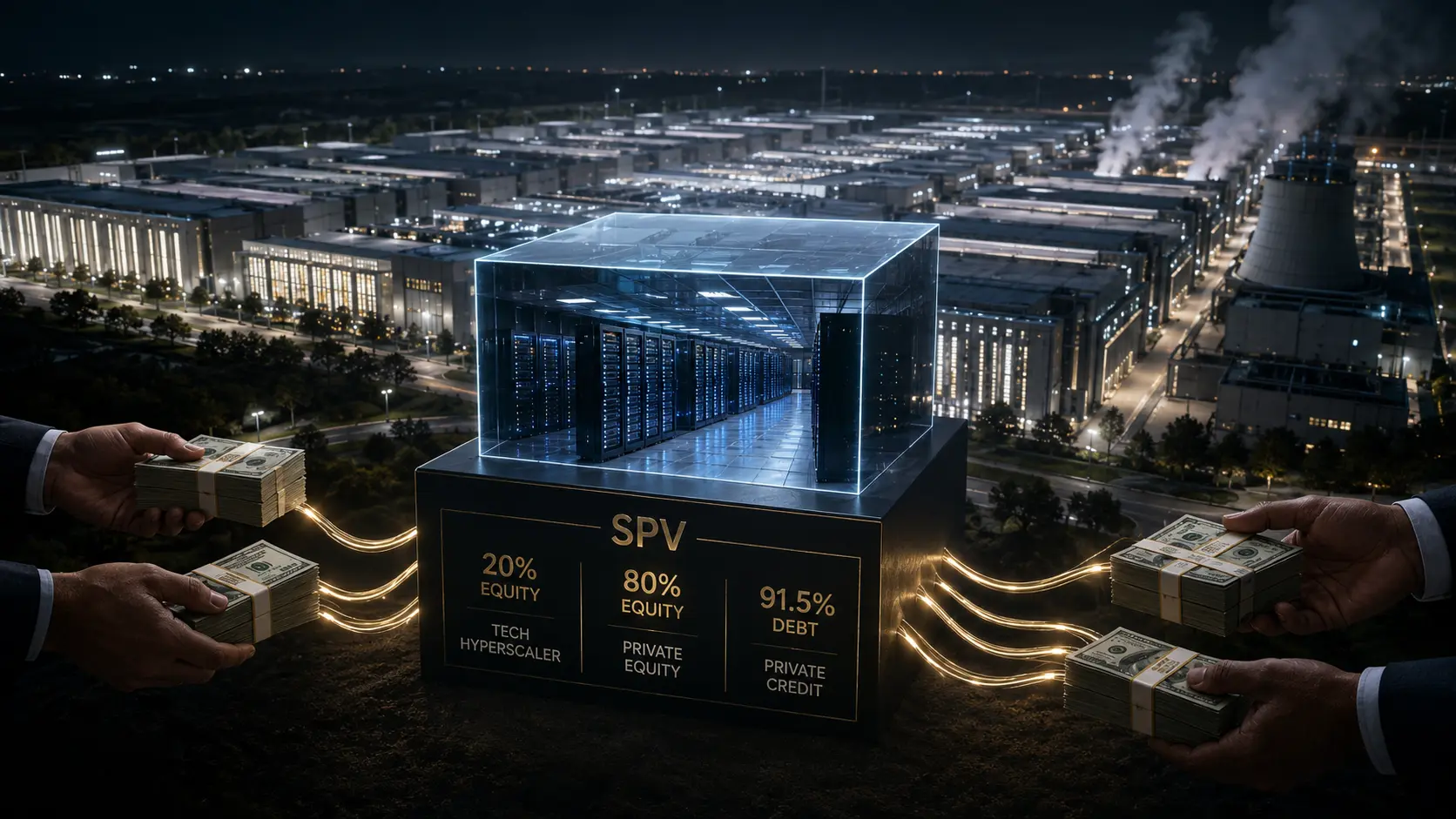
- Concept: Utilizing off-balance-sheet financing where an isolated shell company (the SPV) raises debt to fund infrastructure, while the tech giant signs a long-term lease to guarantee revenue.
- Why it matters: The top five U.S. tech giants have accumulated an estimated $1.65 trillion in off-balance-sheet debt for AI data centers and GPU equipment. This hidden debt now completely eclipses their officially reported balance sheet debt of approximately $1.35 trillion.
- Who uses it: Hyperscalers like Meta, Alphabet, Amazon, Microsoft, and Oracle, alongside private equity sponsors like Blue Owl Capital, and private credit lenders such as PIMCO and BlackRock.
- Biggest takeaway: These SPV structures are highly leveraged, operating with upwards of 91.5% debt and minimal equity cushions. If the return on investment for artificial intelligence fails to materialize, the resulting asset-liability mismatch could trigger a cascade of defaults among institutional lenders, drawing parallels to the 1990s dark fiber crash or the 2008 subprime mortgage crisis.
In Simple Words
Imagine you want to buy a massive, multi-million dollar mansion, but you do not want the mortgage to show up on your personal credit report. If the bank sees that much debt, they will never let you borrow money for anything else.
To solve this, you partner with a wealthy friend. Together, you create a brand new, separate mini-company. Your friend puts in most of the cash and owns 80% of the mini-company, while you own 20%. This new mini-company goes to the bank, takes out the massive mortgage, and buys the mansion.
Then, you sign a 24-year lease agreeing to pay the mini-company rent every month to live in the mansion. The mini-company uses your rent money to pay off the bank loan.
You get to live in and control the mansion. The bank gets paid. Your wealthy friend gets a steady return. And most importantly, because the mini-company took out the loan, your personal credit report still looks completely flawless. In the corporate world, that mini-company is called a Special Purpose Vehicle (SPV), and it is exactly how Wall Street is paying for the AI revolution.
Why This Matters
The global technology sector is fundamentally mispriced if investors only look at official public filings.
To win the artificial intelligence race, hyperscalers must spend unprecedented amounts of capital. Global spending on AI reached $800 billion in 2025 alone, and the race to build necessary AI infrastructure will require an estimated $3 trillion by 2030.
However, public leverage ratios materially understate the real AI-infrastructure exposure of these companies. Tech companies have shifted immense capital requirements off their books through SPVs funded by private investors. Meta alone is responsible for an estimated $420 billion of this hidden debt pile. For macroeconomic analysts, this means the systemic risk of the AI bubble bursting will not land on the tech companies’ balance sheets; it will land directly on the private equity firms, insurance companies, and pension funds underwriting the SPV debt.
The Big Picture
The surge in off-balance-sheet financing represents a historic convergence of two powerful financial forces: Big Tech’s need for infrastructure scaling, and Private Credit’s hunt for long-duration yield.
Historically, tech companies funded expansions using cash reserves. However, the sheer scale of gigawatt-class data centers has forced them to turn to debt markets. Private credit—non-bank lending operating outside of public markets—has emerged as the primary source of this capital. Private credit enables “financial engineering” that keeps debt hidden from the mainstream balance sheet of the borrower, while offering tailored, flexible terms and faster execution than traditional public bond issuance. Morgan Stanley estimates that between 2025 and 2028, private credit capital will finance $800 billion of AI data centers, renewable power, and fiber networks.
How Big Tech AI Debt Works in SPVs
Executing an SPV for hyperscale infrastructure is a masterpiece of legal isolation and structural leverage. Here is the first-principles breakdown.
1. The Fundamental Problem: The Capital Crunch
Technology companies require massive capital to expand their AI capabilities through land, power infrastructure, and advanced computing hardware. However, adding tens of billions in direct debt to a corporate balance sheet destroys credit ratings, limits future borrowing flexibility, and alarms equity shareholders.
2. The Insufficiency of Traditional Corporate Debt
Issuing traditional corporate bonds adds the entire liability directly to the parent company’s books. While hyperscalers have strong cash flows, the sheer $3 trillion estimated infrastructure cost by 2030 cannot be absorbed on-balance-sheet without heavily penalizing their public valuations and leverage ratios.
3. The Core Mechanism: The Special Purpose Vehicle (SPV)
To bypass this limitation, the tech company collaborates with private equity to create an SPV. The hyperscaler retains a minority equity stake (e.g., 20%) while the private equity firm takes the majority (e.g., 80%). The SPV then raises the vast majority of the project’s cost through senior debt provided by private credit markets. The hyperscaler does not owe the debt; instead, it signs a long-term lease agreement with the SPV, committing to multi-year usage of the facilities.
4. Technical Depth: Securitization and Extreme Leverage
Because the SPV is anchored by a lease from an investment-grade tech giant, lenders view the risk as exceptionally low. This allows the SPV to operate with extreme leverage. In massive deals, debt can account for over 91% of the total financing, leaving an incredibly thin equity cushion of around 8.5%. The debt is often issued as 144A format private placement bonds, fully amortizing over decades, and priced at a spread above Treasury bonds.
5. Real-World Consequences: Off-Balance Sheet Risk Transfer
This “control without consolidation” accounting technique legally keeps the massive debt off the tech company’s balance sheet. The tech giant maintains operational control and its pristine credit rating. However, the opaque risk is shifted to the insurance companies and institutional investors holding the SPV debt. If the hyperscaler’s AI revenues disappoint and they default on the lease, the SPV structure possesses almost no equity cushion to absorb the loss, threatening a cascade of defaults.
Real-World Applications
The theoretical boundaries of SPV financing were permanently redrawn in late 2025.
The Meta Hyperion Campus: In October 2025, Meta Platforms and Blue Owl Capital executed a $27 billion financing deal for the Hyperion data center campus in Louisiana. Spanning 4 million square feet, the completed campus will consume 5 gigawatts of electricity—equivalent to the power consumption of 4 million American households.
The financial structure is the defining prototype for modern AI securitization. The total financing required was $29.5 billion. Through an SPV arranged by Morgan Stanley, the project issued $27 billion in debt alongside just $2.5 billion in equity. PIMCO anchored the debt with $18 billion, supported by BlackRock with $3 billion. Meta retained only 20% ownership ($0.5 billion equity) but maintained full operational control, successfully keeping $27 billion in debt completely off its balance sheet.
Hyperscale Leases and GPUs: Beyond real estate, this mechanism is applied to the compute layer itself. Tech giants frequently secure long-term agreements to lease expensive graphics processing units (GPUs) and servers that are not yet operational. Because these projects are still under development, the associated obligations are not immediately recorded on the balance sheet, further inflating the invisible leverage inside the tech ecosystem.
Economic & Strategic Impact
The proliferation of AI infrastructure SPVs has effectively created an entirely new asset class: AI infrastructure-backed securities.
What originated as corporate lending has rapidly evolved into digital infrastructure securitization. Yield-seeking investors—specifically insurance companies and pension funds—are financing hyperscale campuses and power interconnects through long-duration debt anchored by blue-chip tech tenants.
However, this macroeconomic shift creates profound systemic vulnerabilities. If major hyperscalers decide to slow down their capital expenditures due to insufficient returns on AI investments, it would rapidly cool demand in related credit markets. Furthermore, if these data centers remain underutilized, the companies could face substantial losses once the obligations transition, potentially mimicking the dot-com era where 80 million miles of fiber optic cables were laid, leaving 85% to 95% unused as “dark fiber” after the bubble burst.
Advantages
- Balance Sheet Preservation: The SPV structure isolates the liability, allowing the parent tech company to maintain its high credit rating and superior financial indicators.
- Operational Control: Despite holding minority equity, hyperscalers structure the agreements to retain total operational dominion over the data centers and the underlying technology.
- Infinite Scalability: By tapping into private credit and institutional yield-seekers, tech companies unlock pools of capital vastly deeper than their own internal cash reserves or public equity offerings.
Limitations
- Thin Equity Cushions: Deals structured with over 90% debt and less than 10% equity offer virtually no margin for error. If construction costs overrun or lease revenues falter, the SPV instantly faces insolvency.
- Asset-Liability Mismatch: Insurance companies investing heavily in private credit face severe duration risks and may be forced to liquidate investments at severe discounts during broad economic downturns.
- Systemic Opacity: The lack of public disclosure regarding the specific terms of these SPVs, and exactly which lenders sit on the other side of the paper, obscures the true fragility of the global financial system.
Common Misconceptions
Misconception: The tech giants are paying for the AI buildout with their massive cash reserves.
Reality: While they are generating strong operating income, the sheer scale of the required capital has forced a shift. Tech companies are increasingly turning to debt markets, specifically private credit SPVs, to finance the infrastructure rather than relying solely on internal cash.
Misconception: The SPV debt is entirely risk-free because it is backed by a giant like Microsoft or Meta.
Reality: The risk is heavily dependent on the Residual Value Guarantee (RVG) and the specific terms of the lease. If AI demand drops and the hyperscaler breaks the lease or renegotiates, the institutional investors holding the SPV debt will suffer massive write-downs.
Misconception: Off-balance-sheet financing is an illegal accounting fraud.
Reality: Off-balance-sheet financing via SPVs is entirely legal and a standard, sensible mechanism for capital-intensive infrastructure projects. The concern is not criminal fraud, but rather the sheer volume of hidden leverage masking the true macroeconomic exposure.
What Most People Miss
The structural parallels to Collateralized Debt Obligations (CDOs).
During the 2008 financial crisis, the market collapsed because speculative assets (mortgages) were sliced into tranches within SPVs, sold to institutional investors, and assumed to be flawless because demand seemed infinite.
The modern AI data center boom mirrors this architecture. An SPV is formed, raises debt, and sells it to institutional asset managers based on the assumption that AI compute demand is an “infinite money glitch”. Just as the 2008 crisis was triggered when the underlying mortgages faced reality and defaulted, the AI SPV market is vulnerable to a reality check. If AI workloads or profit margins stumble, the underlying revenue streams supporting the SPV debt will collapse, potentially triggering a localized “Subprime Data Center Crisis”.
Comparison Table
| Feature | Traditional Corporate Debt | SPV Off-Balance-Sheet Financing |
| Debt Location | Parent company balance sheet | Isolated shell company (SPV) |
| Credit Rating Impact | Negative (Increases leverage ratio) | Neutral (Debt is legally separate) |
| Equity Requirement | 100% funded by parent | Parent contributes minority (e.g., 20%) |
| Primary Lenders | Public bond markets / Tier-1 Banks | Private credit / Private Equity / Insurance |
| Operational Control | Full Control | Full Control (via lease agreements) |
| Transparency | High (Publicly filed 10-K) | Low (Opaque private contracts) |
Future Outlook
Next 12–24 Months
Expect intense scrutiny during corporate earnings calls. As awareness of the $1.65 trillion hidden debt pile grows, analysts will increasingly demand line-by-line breakdowns of off-balance-sheet vehicles from hyperscaler executives. Simultaneously, the 144A private placement market will see record issuance volumes as more tech firms attempt to replicate the Meta/Blue Owl blueprint before interest rate environments shift.
Next 3–5 Years
The operational reality check. The massive campuses funded in 2025 and 2026 will come online. If the revenue generated by Large Language Models (LLMs) fails to match the staggering capital expenditures, hyperscalers will quietly halt future SPV lease commitments. This will strand the newly built infrastructure, creating a localized “dark fiber” scenario where massive, gigawatt-capable data centers sit idle while the underlying SPV debt remains outstanding.
Next 10 Years
The maturation of AI Infrastructure-Backed Securities. Assuming the AI boom stabilizes into a predictable utility model, these SPVs will permanently alter how national infrastructure is funded. We will witness the total convergence of digital infrastructure and fixed-income markets, where retail and institutional investors routinely buy standardized, highly regulated tranches of AI data center debt, treating hyperscale compute campuses exactly like heavily regulated utility power plants.
Most Likely Scenario
The SPV model is the only mathematically viable way to fund the $3 trillion AI infrastructure requirement by 2030. While a painful market correction is highly probable if AI revenues temporarily stagnate, the fundamental financial engineering of the SPV will endure. It permanently transfers the risk of technological obsolescence away from Silicon Valley and directly into the portfolios of global private credit and insurance markets.
Key Takeaways
- To fund the massive AI infrastructure boom, tech giants are utilizing Special Purpose Vehicles (SPVs) to secure financing without adding debt to their corporate balance sheets.
- Five major U.S. tech companies currently hold an estimated $1.65 trillion in off-balance-sheet debt, exceeding their reported balance sheet debt.
- Meta’s Hyperion data center represents the largest private credit deal in history, financing a $29.5 billion campus with 91.5% debt while keeping the liability entirely off Meta’s books.
- Private credit, including insurance companies and pension funds, is eagerly supplying this capital in pursuit of high, long-duration yields anchored by blue-chip tech tenants.
- These SPV structures operate with incredibly thin equity cushions (often under 10%), creating severe asset-liability mismatch risks.
- If AI revenue fails to justify the extreme capital expenditure, the market faces a potential crisis mirroring the 1990s telecom dark fiber crash or the 2008 subprime mortgage collapse.
Glossary
144A Private Placement: A mechanism in the U.S. financial markets allowing debt to be sold directly to large institutional investors without rigorous SEC public registration, frequently used for rapid SPV debt issuance.
Asset-Liability Mismatch: A financial risk that occurs when the cash flows generated by an asset (like lease payments from an AI data center) fail to align with the repayment schedule of a liability (the debt used to build it).
Dark Fiber: A historical reference to the massive overbuilding of fiber optic cables in the 1990s that went unused after the dot-com bubble burst, serving as a cautionary tale for overbuilding AI infrastructure.
Off-Balance-Sheet Financing: A legal accounting practice where a company does not include a liability on its main balance sheet, preserving its leverage ratios and credit rating.
Private Credit: Non-bank lending provided by institutional investors, private equity firms, and insurance companies, operating outside of the heavily regulated public bond markets.
Special Purpose Vehicle (SPV): A subsidiary or legally distinct entity created for a specific, narrow objective—in this context, to isolate financial risk and raise debt to build a data center without encumbering the parent company.