Advertisement
)

AT A GLANCE
- Concept: Cap and Trade: Governments set a strict limit on total emissions and force companies to buy permits.
- Concept: Voluntary Offset: Companies willingly pay to plant trees or capture carbon to claim they are carbon neutral.
- Concept: Carbon Allowance: A government-issued permit that gives a factory the legal right to pollute.
- Concept: Greenwashing: Buying cheap, low-quality carbon credits to appear environmentally friendly without reducing actual emissions.
IN SIMPLE WORDS
Imagine a city where the government says, “Only 100 bags of trash can be thrown away today.” They print 100 tickets, and you need one ticket for every bag you throw out.
If you are a messy factory that produces 10 bags of trash but only has 5 tickets, you have a massive problem. You must either spend money to clean up your factory and make less trash, or you must buy 5 extra tickets from a cleaner factory that didn’t use theirs.
This is exactly how carbon credit markets work. Instead of bags of trash, they trade tickets to emit carbon dioxide. By slowly reducing the total number of tickets printed each year, the government forces the price of the tickets to rise. Eventually, it becomes so expensive to buy tickets that corporations decide it is cheaper to stop polluting and switch to clean energy instead.
HOW IT WORKS
Carbon markets exist in two entirely different parallel systems: the mandatory compliance market and the voluntary offset market. Understanding the difference between these two systems is critical to understanding climate finance.
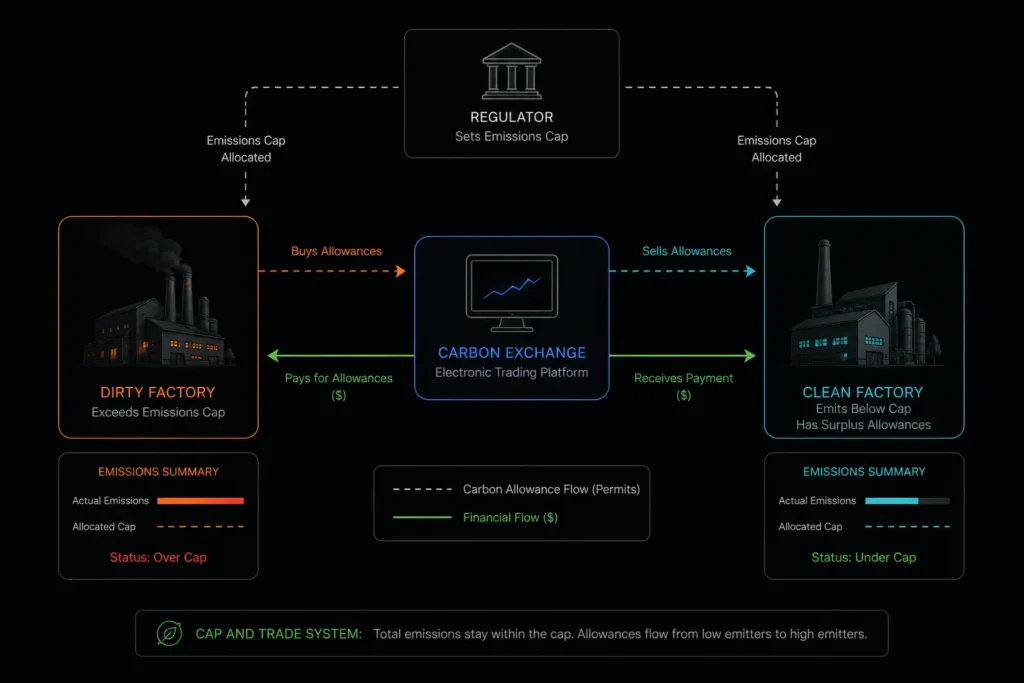
The compliance market, often called Cap and Trade, is created and strictly enforced by governments. The most famous example is the European Union Emissions Trading System (EU ETS). The government sets a hard ceiling—a cap—on the total amount of greenhouse gases that heavy industries, power plants, and airlines can legally emit each year.
The government then issues a limited number of digital permits, known as Carbon Allowances, which equal that cap. One allowance equals one metric ton of carbon dioxide. Companies must hold enough allowances at the end of the year to cover their total emissions. If a power plant cuts its emissions by installing solar panels, it has leftover allowances. It can sell these excess allowances on an open financial exchange to a steel factory that failed to reduce its emissions.
This creates a highly liquid commodities market. The supply of allowances is intentionally reduced by the government every year, mathematically forcing the price of pollution to rise. This forces industrial corporations to run complex financial calculations, weighing the cost of buying carbon allowances against the capital expenditure required to upgrade their factories to zero-carbon technology.
The second system is the Voluntary Carbon Market (VCM). Unlike the strict government allowance market, this is a highly unregulated ecosystem of private corporations trying to meet public relations goals. When a technology company claims it is “Carbon Neutral,” it is usually buying voluntary carbon offsets. These offsets are generated by private projects—like planting a forest in the Amazon or building a wind farm in India. The project developer mathematically calculates how much carbon the forest will absorb, gets a private registry to verify it, and sells that verified offset as a credit to the technology company.
REAL WORLD EXAMPLE
Tesla is famous for selling electric vehicles, but for years, a massive portion of its actual corporate profit came directly from the carbon compliance markets.
Because Tesla only manufactures zero-emission vehicles, it generates a massive surplus of regulatory carbon credits under government emission standards. Legacy automakers like Chrysler and Ford, who could not produce enough electric vehicles to meet government mandates, were forced to buy these excess credits directly from Tesla to avoid billions in fines. In a single year, Tesla generated over 1.5 billion dollars in pure profit simply by selling its unused regulatory carbon allowances to its heavily polluting competitors.
WHY IT MATTERS NOW
The global transition away from fossil fuels cannot happen based on goodwill alone; it requires a brutal financial incentive. Carbon markets are the primary economic weapon used to force massive multinational corporations to decarbonize. By artificially placing a financial cost on pollution, carbon markets integrate environmental damage directly into a company’s balance sheet.
Currently, the price of carbon varies wildly around the world. In the European Union, a ton of carbon can cost over 80 euros, severely penalizing heavy polluters. In other parts of the world, there is no price on carbon at all. This creates a massive geopolitical issue known as “carbon leakage,” where a steel manufacturer simply moves its factory out of Europe and into a country with no carbon taxes, completely defeating the purpose of the policy.
To combat this, massive trade blocs are implementing the Carbon Border Adjustment Mechanism (CBAM). This is essentially a carbon tariff. If a foreign company wants to sell cheap, dirty steel into Europe, they must pay a massive tax at the border equal to the carbon price they would have paid if they manufactured the steel inside Europe. This forces the entire global supply chain to start accounting for their emissions.
Meanwhile, the voluntary carbon market is facing a severe crisis of trust. Investigative journalists and satellite data analysts have proven that millions of voluntary offsets sold by major registries are completely worthless. Companies were selling credits for “protecting a forest” that was never actually in danger of being cut down, allowing massive airlines and oil companies to claim they were carbon neutral while changing absolutely nothing about their actual emissions.
COMMON MISCONCEPTIONS
- “Carbon offsets physically remove the pollution a company creates.” Buying a carbon credit does not suck the pollution out of the air above a factory. It simply pays someone else in a different part of the world to emit slightly less, theoretically balancing the global math.
- “A carbon credit and a carbon allowance are the same thing.” An allowance is a government permission slip to pollute (compliance market). A credit is a certificate proving you reduced pollution somewhere else (voluntary market).
- “Planting trees is a permanent carbon fix.” Trees can burn down. If a company buys a forest offset to cancel out its jet fuel emissions, and that forest burns in a wildfire ten years later, all that stored carbon goes right back into the atmosphere, rendering the offset mathematically useless.
WHAT MOST PEOPLE MISS
Financial traders are treating government carbon allowances exactly like traditional commodities such as oil or gold.
Hedge funds and commodity trading desks now aggressively trade EU ETS carbon allowances simply to speculate on the price. If a hedge fund believes the European Union will pass stricter climate laws next year, they will buy millions of allowances today, hoard them to artificially restrict supply, and sell them back to desperate energy companies at a massive profit when the new laws take effect. The market designed to save the planet is now a highly lucrative Wall Street trading desk.
THE ECONOMIC AND STRATEGIC IMPACT
The primary financial beneficiaries of the compliance markets are clean energy infrastructure companies. As the price of carbon allowances rises, the mathematical return on investment for building massive solar, wind, and nuclear plants becomes incredibly lucrative compared to operating a heavily taxed natural gas plant.
The losers are legacy heavy industries like cement manufacturing, steel forging, and commercial aviation. Because there are currently no cheap, zero-carbon alternatives for flying a passenger jet or forging structural steel, these companies must simply absorb the massive cost of buying carbon allowances, driving up the price of construction and travel globally.
Strategically, the implementation of carbon border tariffs is rewriting global trade routes. Developing nations that rely heavily on exporting cheap, high-carbon manufactured goods will be locked out of premium Western markets unless they rapidly decarbonize their domestic power grids, forcing a global acceleration of clean energy adoption.
THE TRAJECTORY
Next 12–36 Months: The aggressive enforcement of the European Carbon Border Adjustment Mechanism (CBAM). Global manufacturers in Asia and the Americas will be forced to drastically audit their supply chain emissions to avoid massive tariffs when exporting goods into the European Union.
Next Five Years:
The purge of the voluntary carbon market. Loose, unverified tree-planting offsets will collapse in value. They will be entirely replaced by high-quality, scientifically verified Direct Air Capture (DAC) credits, where companies pay thousands of dollars per ton to literally vacuum carbon dioxide out of the atmosphere and bury it permanently underground.
Next Ten Years: The linkage of sovereign cap and trade systems. Isolated carbon markets in North America, Europe, and Asia will begin to merge their financial infrastructure. This will create a single, unified global price for a ton of carbon, making it impossible for multinational corporations to hide their emissions in unregulated countries.
What Could Go Wrong: A populist political backlash against carbon pricing. As the government cap on carbon tightens, the cost of electricity and gasoline naturally rises for average citizens. If inflation spikes during a cold winter, voters may demand governments scrap the cap and trade system entirely to lower energy bills, instantly crashing the multi-billion dollar carbon market and stalling global decarbonization.
Most Likely Outcome: The cost of emitting carbon will become as fundamental to corporate accounting as the cost of labor or raw materials. While the voluntary market will remain highly volatile and heavily scrutinized, government-enforced compliance markets will systematically squeeze heavy industry until burning fossil fuels is mathematically unprofitable.
KEY TERMS
- Cap and Trade: A government regulatory system that sets a maximum limit on emissions and allows companies to buy and sell their allotted pollution permits.
- Carbon Allowance: A government-issued permit that gives a company the legal right to emit one metric ton of carbon dioxide.
- Carbon Offset: A certificate representing the reduction or removal of one ton of carbon dioxide, usually sold by private environmental projects.
- Carbon Leakage: When strict environmental laws in one country force a company to move its factories to a country with no environmental laws.
- Carbon Border Adjustment Mechanism (CBAM): A tariff applied to imported goods based on the amount of carbon pollution created during their manufacturing.
- Greenwashing: The practice of a company buying cheap, unverified carbon credits to falsely market themselves as environmentally friendly without changing their actual behavior.
BEGINNER FAQ
What exactly is a carbon credit? It is a digital certificate that represents one ton of carbon dioxide. In some markets, it is a ticket allowing you to pollute. In other markets, it is proof that you cleaned up pollution.
Why do we need a market for this? Because making it expensive to pollute is the fastest way to force corporations to change. If dumping trash in the street was free, everyone would do it. If it costs hundreds of dollars per bag, people find a cleaner way to live.
Who forces companies to buy these? In a compliance market, the government legally forces them to. In the voluntary market, companies buy them on their own to look good for their customers and investors.
What happens if a factory ignores the government cap? They are hit with massive, crushing financial fines that cost significantly more than simply buying the carbon allowances would have cost.
Can regular people buy carbon credits? Yes, but they usually don’t need to. Sometimes when you buy an airline ticket, the airline asks if you want to pay an extra fee to “offset” your flight. That money buys a fraction of a voluntary carbon credit.
Are companies really just paying to plant trees? Sometimes, yes. But scientists are finding that many of these “tree-planting” projects are scams. The trees were never in danger, or they burn down a few years later, meaning the pollution was never actually canceled out.
How does a carbon market help build solar panels? If a company builds a solar farm instead of a coal plant, they don’t need to buy carbon allowances. They save millions of dollars, making the solar farm highly profitable and encouraging more people to build clean energy.
Is the price of carbon the same everywhere? No, and that is a massive problem. A ton of carbon costs over 80 euros in Europe, but might cost 3 dollars in another country. Governments are currently fighting to create one global price to stop companies from cheating the system.
SOURCES
- World Bank — State and Trends of Carbon Pricing Global Report
- European Commission — The EU Emissions Trading System (EU ETS) and Carbon Border Adjustment Mechanism
- Intergovernmental Panel on Climate Change (IPCC) — Mitigation of Climate Change and Carbon Pricing Mechanisms
- Taskforce on Scaling Voluntary Carbon Markets (TSVCM) — Blueprint for a High-Integrity Voluntary Carbon Market