Advertisement
)


AT A GLANCE
- Concept: Insurance-Linked Security (ILS): A financial product whose value is driven by insurance loss events rather than corporate earnings or interest rates.
- Concept: Special Purpose Vehicle (SPV): A distinct, legally isolated shell company created specifically to hold the investors’ cash and issue the bonds.
- Concept: Parametric Trigger: A mathematical payout threshold based strictly on scientific data, such as a hurricane’s wind speed or an earthquake’s magnitude.
- Concept: Principal Forgiveness: The unique mechanism where the bond issuer is legally allowed to keep the investors’ original money to pay for disaster reconstruction.
IN SIMPLE WORDS
Imagine you live in a city terrified of a massive hurricane. You want insurance, but no single insurance company has enough cash to rebuild the entire city if it is destroyed.
To solve this, the insurance company goes to Wall Street. They ask hedge funds to put a billion dollars into a locked vault. In exchange for locking up their money, the hedge funds receive an incredibly high interest rate.
Here is the catch: The contract states that if a Category 5 hurricane hits the city before the year ends, the vault unlocks, and the city takes the entire billion dollars to rebuild. The hedge funds lose everything. But, if the year passes and no hurricane strikes, the hedge funds get their original billion dollars back, plus all the massive interest they collected. This is a catastrophe bond—a high-stakes bet where Wall Street acts as the ultimate financial shock absorber for acts of God.
HOW A CATASTROPHE BOND WORKS
Catastrophe bonds (often called cat bonds) are the primary instrument within the Insurance-Linked Securities (ILS) market. They exist to transfer extreme, localized risk from the balance sheets of insurance companies (the “sponsors”) directly to global capital markets.
The mechanics rely on strict legal isolation. An insurance company does not issue a cat bond directly. Instead, they create a Special Purpose Vehicle (SPV)—an offshore shell company, typically in Bermuda.
Investors purchase the bonds from the SPV, depositing their principal cash into a collateral trust. The SPV invests this cash in ultra-safe, highly liquid assets like US Treasury bills to generate a baseline return. Simultaneously, the sponsor pays regular insurance premiums into the SPV. The investors receive the yield from the Treasuries plus the insurance premiums, generating a highly attractive, double-digit coupon rate.
The bond’s payout is dictated by a specifically defined trigger mechanism. While traditional indemnity triggers pay out based on actual physical damage (which takes months to calculate via claims adjusters), modern cat bonds increasingly rely on parametric triggers.
A parametric trigger relies exclusively on an independent scientific oracle. The contract might state a total loss of principal if the National Hurricane Center records sustained wind speeds exceeding 150 mph passing through a predefined GPS box surrounding Miami.
If the oracle confirms the parameter is breached, the SPV instantly liquidates the Treasury collateral and wires the cash to the sponsor. The investors’ principal is completely wiped out. If the bond reaches maturity without a trigger event, the SPV unwinds, returning the original principal to the investors.
REAL WORLD EXAMPLE
In 2017, the World Bank issued a massive catastrophe bond to protect the government of Mexico against earthquakes. The bond utilized a strict parametric trigger based on data from the US Geological Survey (USGS).
On September 7, 2017, a devastating magnitude 8.1 earthquake struck off the coast of Chiapas. Because the earthquake exceeded the contractually defined parametric magnitude limit and occurred within the designated geographic coordinates, the trigger activated instantly. The SPV bypassed the lengthy, corruptible process of assessing physical property damage and immediately released $150 million directly to the Mexican government to fund emergency rescue operations. The investors who bought that specific tranche of the bond lost 100% of their principal.
WHY IT MATTERS NOW
The traditional insurance architecture is structurally failing under the weight of climate change. Reinsurance companies—the companies that insure the insurance companies—are rapidly withdrawing capital from states like California and Florida. They can no longer accurately price the escalating frequency of mega-fires and super-storms using historical data.
When traditional insurers abandon a region, state governments are forced to step in as the insurer of last resort. However, a state government cannot print its own money. If a Category 5 hurricane destroys Miami, the State of Florida mathematically lacks the tax revenue to rebuild the city.
The global capital markets are the only financial entities large enough to absorb this scale of climate destruction. The global bond market manages over $130 trillion in assets. A $100 billion hurricane is a fatal blow to an insurance company, but it represents less than a fraction of a percent of global bond liquidity. Catastrophe bonds act as a vital release valve, transferring the massive financial liability of a warming planet away from local taxpayers and directly onto the balance sheets of global institutional investors.
COMMON MISCONCEPTIONS
- “Investors want disasters to happen to make money.” Exactly the opposite. Investors only make a profit if the disaster never occurs. If a disaster triggers the bond, the investors lose their entire investment.
- “Cat bonds cause insurance rates to go up.” Cat bonds actually help stabilize local insurance markets. By providing insurance companies with guaranteed backup cash, those companies can continue writing policies for homeowners in high-risk areas instead of abandoning the state entirely.
- “They only cover hurricanes.” While Florida windstorm bonds dominate the market, cat bonds have been issued to cover Japanese earthquakes, European windstorms, extreme mortality events (like the COVID-19 pandemic), and even cyber-attacks.
WHAT MOST PEOPLE MISS
Financial analysts focus heavily on the high interest rates these bonds pay, but they miss the true reason hedge funds aggressively buy them: zero correlation.
In a traditional investment portfolio, if the stock market crashes or interest rates spike, both stocks and corporate bonds lose value simultaneously. A catastrophe bond is entirely uncorrelated to the macroeconomic cycle. A hurricane does not care what the Federal Reserve does with interest rates. An earthquake does not care if the S&P 500 is in a bear market. Adding cat bonds to a portfolio provides absolute diversification, guaranteeing a high yield that cannot be affected by financial panics or recessions.
THE ECONOMIC AND STRATEGIC IMPACT
The primary beneficiaries of the cat bond market are advanced risk-modeling agencies like AIR Worldwide and RMS. Because parametric bonds rely entirely on mathematical probabilities, the proprietary computer models that simulate 10,000 years of synthetic hurricane tracks dictate the pricing of the entire multi-billion-dollar market.
For sovereign nations in the developing world, cat bonds offer a strategic lifeline. Nations in the Caribbean and the Pacific ring of fire frequently suffer GDP-destroying natural disasters. Traditional foreign aid takes months to arrive. Sovereign parametric cat bonds provide these governments with instant, unquestioned liquidity within days of a disaster, preventing total economic collapse.
Conversely, the market creates severe “basis risk” for the sponsors. If a massive hurricane completely destroys a city, but the wind speeds recorded by the scientific oracle are 1 mph slower than the parametric trigger requirement, the bond will not pay out. The sponsor suffers catastrophic physical losses but receives absolutely zero financial relief from the bond.
THE TRAJECTORY
Next 12–36 Months: The rapid expansion of cyber catastrophe bonds. As the physical climate market matures, insurers are utilizing the exact same SPV architecture to hedge against systemic digital risk. These bonds will trigger if a massive, global cloud-service outage or a coordinated ransomware attack causes billions of dollars in simultaneous corporate losses.
Next Five Years: The rise of localized resilience bonds. Municipalities will issue specific cat bonds where the interest rates are directly tied to infrastructure improvements. If a city builds a massive sea wall to reduce flooding risk, the mathematical probability of a bond triggering drops, which automatically lowers the interest rate the city must pay to the investors.
Next Ten Years:
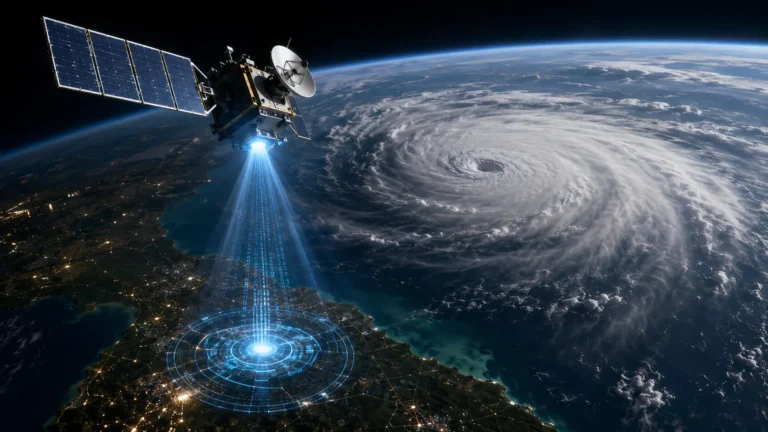
The integration of satellite-based parametric triggers. Instead of relying on ground-based weather stations, bonds will trigger automatically based on real-time synthetic aperture radar (SAR) and optical imagery from low-Earth orbit satellites, objectively measuring flood depth and wildfire burn scars instantly.
What Could Go Wrong: A catastrophic failure of risk models. If climate change accelerates faster than the probabilistic models predict, resulting in multiple mega-disasters in a single year, investors will suffer consecutive, total losses of principal. Institutional capital would immediately flee the ILS market, collapsing the primary mechanism the world uses to fund climate recovery.
Most Likely Outcome: Catastrophe bonds will transition from a niche hedge fund instrument into a mandatory pillar of global infrastructure finance. As climate volatility renders traditional property insurance mathematically impossible in coastal regions, parametric capital markets will become the sole mechanism securing the value of high-risk real estate.
KEY TERMS
- Catastrophe Bond (Cat Bond): A high-yield debt instrument that raises money for an insurance company in case of a natural disaster, placing the investor’s principal at risk.
- Insurance-Linked Security (ILS): A broad category of financial instruments whose value is driven by insurance events, not traditional economic factors.
- Special Purpose Vehicle (SPV): A legally isolated “shell” company created specifically to hold the investors’ money and execute the catastrophe bond contract.
- Parametric Trigger: A payout mechanism based strictly on objective, measurable scientific data (like wind speed or earthquake magnitude) rather than actual property damage.
- Indemnity Trigger: A payout mechanism based on the actual, verified financial losses suffered by the sponsor, requiring lengthy claims adjustments.
- Basis Risk: The dangerous scenario where an entity suffers massive real-world losses, but the specific mathematical conditions of the parametric trigger are not met, resulting in zero payout.
- Uncorrelated Asset: An investment whose price movements are entirely independent of the broader stock market or global economy.
BEGINNER FAQ
What is a catastrophe bond? It is a financial bet between Wall Street and an insurance company. Investors put up money and earn high interest. If a specific natural disaster happens, the insurance company takes the money. If it doesn’t, the investors keep their money and the interest.
Why do insurance companies use them? Major disasters like a Category 5 hurricane can cause more damage than an insurance company has cash to cover. Cat bonds give them access to the massive pools of money controlled by Wall Street hedge funds.
What happens to the investors if the disaster strikes? They lose their money. The original cash they invested is legally transferred to the insurance company to pay for the disaster recovery.
Why would anyone invest in something so risky? They pay incredibly high interest rates, often over 10% or 15%. Also, the risk is completely disconnected from the stock market. A stock market crash does not cause a hurricane.
What is a parametric trigger? It is a strict rule based on science, not money. For example, a bond might only pay out if a hurricane’s wind speed hits exactly 150 mph. It doesn’t matter how many houses are destroyed; it only matters what the wind speed gauge says.
Why use parametric triggers instead of just paying for the damage? Speed. Figuring out exactly how much damage a hurricane caused across an entire state takes months or years of paperwork. A parametric trigger uses data from a weather station and pays out instantly within days.
Who holds the money while waiting for a disaster? The money is held in an independent, secure trust account, usually managed by an offshore shell company called a Special Purpose Vehicle (SPV), so neither the investors nor the insurance company can touch it until the contract dictates.
Do these bonds cover anything besides weather? Yes. While hurricanes and earthquakes are the most common, there are cat bonds designed to trigger during extreme pandemics or massive cyber-attacks that take down global computer networks.
SOURCES
- The World Bank — Insurance-Linked Securities and Sovereign Catastrophe Bonds
- National Association of Insurance Commissioners (NAIC) — Catastrophe Bonds and the Reinsurance Market
- Artemis.bm — The Deal Directory and Analytics of the Insurance-Linked Securities Market
- Swiss Re Institute — The Evolution of Parametric Triggers in Climate Risk Finance