Advertisement
)

AT A GLANCE
- Concept: Subtractive Manufacturing: The process of creating an object by systematically cutting away material from a larger solid block.
- Concept: G-Code: The fundamental programming language that translates digital 3D models into physical coordinate movements for the machine.
- Concept: Multi-Axis Kinematics: The simultaneous mathematical rotation and translation of the cutting tool across up to five spatial dimensions.
- Concept: Closed-Loop Servo Matrix: The sensor system that continuously verifies the physical position of the cutting tool thousands of times per second.
IN SIMPLE WORDS
Imagine trying to carve a perfect sphere out of a solid block of titanium using a hand chisel. No matter how skilled you are, human hands shake, and metal physically resists. CNC machining replaces human hands with an automated robotic carving system guided by pure mathematics.
You start with a solid block of raw metal. A computer reads a digital 3D design and translates it into thousands of exact physical coordinates. It then commands a spinning, diamond-tipped cutting tool to move along those invisible coordinates, shaving away the excess metal layer by layer.
Instead of building up material like a 3D printer, a CNC machine sculpts entirely by subtraction. It carves critical industrial components—from jet engine turbine blades to the aluminum frames of smartphones—with an accuracy thinner than a single human hair, operating continuously without making a mathematical error.
HOW CNC MACHINING WORKS
A CNC machine is fundamentally a physical execution engine for applied geometry. The process begins in a Computer-Aided Manufacturing (CAM) software environment, which ingests a 3D digital model and outputs a standardized script known as G-code. This code acts as the master operational ledger, instructing the machine exactly where to move, how fast to spin the tool, and how deep to cut.
Modern high-precision manufacturing relies heavily on 5-axis machining centers. While a standard machine moves the cutting tool along the X, Y, and Z linear axes, a 5-axis machine adds two rotational axes (A and B). This multi-axis kinematic architecture allows the cutting tool to approach the raw material from virtually any angle.
To execute these complex angles without colliding with the workpiece, the machine’s controller relies on advanced interpolations. The computer calculates the exact micro-movements required between two programmed coordinates, ensuring the toolpath remains perfectly smooth as it transitions across curved metal surfaces.
To maintain sub-micron geometric tolerances—where an error of one-thousandth of a millimeter ruins the part—the machine utilizes a closed-loop servo encoder matrix. As the physical motors drive the heavy steel axes, optical glass scales measure the exact physical displacement of the tool. The encoders instantly feed this position data back to the central processor.
If the physical tool deviates from the mathematical G-code by even a fraction of a micron due to mechanical friction or tool deflection, the controller detects the error in milliseconds. It instantly sends a corrective electrical current to the servo motors, forcing the tool back onto its exact programmed path.
REAL WORLD EXAMPLE
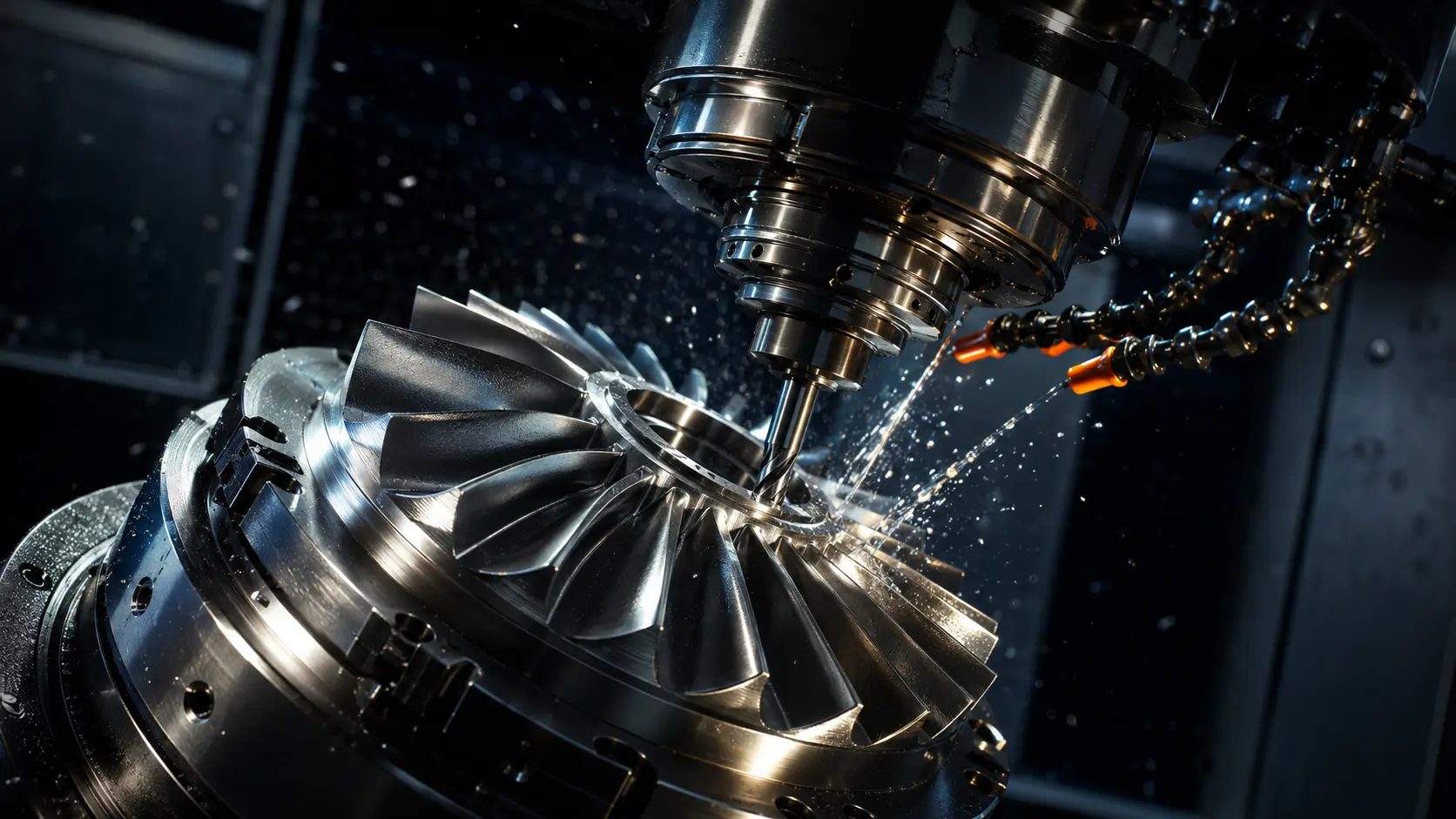
The aerospace industry relies entirely on multi-axis CNC machining to manufacture jet engine blisks (bladed disks). A blisk is a single, continuous piece of titanium engineered to replace the traditional assembly of a central rotor disk and dozens of individual, removable blades.
Manufacturing a blisk requires a 5-axis CNC mill to plunge its cutting tool deep between the tightly spaced aerodynamic blades. The machine must simultaneously rotate the titanium block and angle the spinning cutter to carve the complex, sweeping curves of the airfoil. Because the final part spins at thousands of revolutions per minute inside a jet engine, a machining error of five microns will cause microscopic vibrations, tearing the engine apart mid-flight. The CNC machine guarantees absolute aerodynamic symmetry.
WHY IT MATTERS NOW
The global economy is currently executing a massive reshoring of critical industrial supply chains. Western nations are aggressively rebuilding their domestic manufacturing bases to avoid reliance on adversarial nations during geopolitical crises.
Establishing a sovereign industrial base is impossible without a vast, modernized fleet of CNC machines. A nation cannot manufacture fifth-generation stealth fighters, nuclear submarine propellers, or advanced medical devices using manual labor or outdated milling machines.
Furthermore, the rise of the electric vehicle (EV) market is drastically altering CNC capacity demands. EV drivetrains require highly complex, perfectly machined aluminum battery enclosures and stator housings. These massive, single-piece metal castings require specialized, large-format CNC machines to face and thread the metal with extreme precision.
While 3D printing captures significant public attention, additive manufacturing remains too slow and structurally imprecise for heavy, high-stress load-bearing components. CNC machining remains the undisputed, mathematically proven method for producing high-strength metallic parts at commercial scale.
COMMON MISCONCEPTIONS
- “CNC machines are just 3D printers operating in reverse.” While both use digital models, CNC machines endure massive physical forces. A 3D printer lightly deposits melted plastic; a CNC machine physically violently rips steel apart, requiring extreme mechanical rigidity to survive the operation.
- “The machine does all the work automatically.” Generating the physical part requires highly skilled human machinists. A human must calculate the exact feed rates, select the correct carbide tools, and design the physical clamps holding the raw metal to prevent catastrophic crashes.
- “Faster spindle speeds mean faster production.” Simply spinning the tool faster generates immense heat that can melt the tool or warp the metal. Production speed is a delicate balance of chip load, material hardness, and physical coolant flow.
WHAT MOST PEOPLE MISS
Industrial engineers obsess over the quality of the cutting tools, but they frequently underestimate the invisible threat of thermal displacement.
A high-performance CNC machine generates intense heat through motor friction and metal cutting. If the internal temperature of the massive cast-iron machine frame rises by just two degrees Celsius, the entire steel chassis physically expands. This microscopic expansion physically pushes the cutting tool out of alignment, instantly destroying sub-micron tolerances. Advanced facilities must invest in active thermal compensation systems, pumping refrigerated fluids directly through the machine’s internal skeleton to freeze its physical dimensions in place.
THE ECONOMIC AND STRATEGIC IMPACT
The primary financial beneficiaries are the specialized corporations that design the complex logic controllers and servo motors, such as Fanuc, Siemens, and Heidenhain. Because the entire machine tool industry relies on these proprietary digital brains to translate G-code into physical movement, these software and electronics companies capture the highest profit margins in the sector.
Geopolitically, high-axis CNC machines are classified as critical dual-use technologies. The physical capability to machine complex, curved metal directly translates into the ability to manufacture advanced uranium centrifuges for nuclear weapons programs.
Because of this, the United States and its allies place severe export controls on 5-axis machines. Selling a high-precision CNC mill to unauthorized states or shell corporations violates international arms control treaties. Governments embed GPS trackers and gyroscopes deep inside the machines; if an unauthorized buyer attempts to physically move the machine to a hidden military facility, the internal software permanently bricks the controller.
THE TRAJECTORY
Next 12–36 Months: The integration of artificial intelligence into toolpath generation. CAM software will utilize machine learning to automatically calculate the most mathematically efficient cutting routes. This will reduce machining time by up to thirty percent while predicting exactly when a cutting tool will physically break before it happens.
Next Five Years: The widespread adoption of hybrid subtractive-additive machines. Factories will deploy single machines capable of both depositing metal via laser powder-bed fusion and immediately milling that deposited metal to a perfect finish, allowing engineers to manufacture impossible internal geometries.
Next Ten Years: The era of digital twin hyper-machining. Before a physical block of metal is ever touched, the entire machining process will run inside a perfect, physics-based digital simulation. The simulation will calculate exact thermodynamic warping, vibration resonance, and mechanical deflection, guaranteeing a flawless physical part on the very first attempt.
What Could Go Wrong: A severe collapse in the skilled labor pool. While the machines are automated, programming and maintaining them requires deep metallurgical and mathematical expertise. The current generation of master machinists is rapidly retiring. If nations fail to train young engineers in advanced kinematics, factories will possess million-dollar machines with no humans capable of operating them safely.
Most Likely Outcome: CNC machining will remain the inescapable physical foundation of human industrial civilization. As digital technology advances, the physical tolerances required to house those electronics will become exponentially tighter, permanently securing the value of sub-micron subtractive engineering.
KEY TERMS
- Subtractive Manufacturing: The process of creating a physical object by systematically cutting material away from a larger solid block.
- Multi-Axis Kinematics: The simultaneous movement of a machine tool across multiple linear and rotational axes to achieve complex cutting angles.
- G-Code: The standardized programming language that provides exact coordinate and speed instructions to the CNC controller.
- Closed-Loop Servo System: A motor and sensor network that constantly measures its own physical position and instantly corrects any microscopic errors.
- Thermal Displacement: The physical expansion or warping of a machine’s metal chassis caused by the heat generated during operation.
- Tolerances: The strict, allowable limits of physical variation in a manufactured part, often measured in fractions of a millimeter.
BEGINNER FAQ
What does CNC stand for? It stands for Computer Numerical Control. It means a computer translates numbers and coordinates into physical mechanical movements.
How is a CNC machine different from a 3D printer? A 3D printer builds an object by adding material layer by layer. A CNC machine creates an object by taking a solid block of metal and carving away the excess material.
What is a 5-axis machine? A basic machine moves left-right, forward-back, and up-down (3 axes). A 5-axis machine can also tilt and rotate the cutting tool, allowing it to carve complex, curved shapes from almost any angle without stopping.
How does the machine know what to cut? An engineer designs the part in a 3D computer program. Software translates that 3D design into thousands of specific mathematical coordinates, called G-code, which the machine physically follows.
What materials can a CNC machine cut? They can cut almost anything solid, including soft plastics, wood, aluminum, extremely hard titanium, and high-temperature steel alloys used in rockets.
Are these machines fully automatic? Once the program starts, the machine cuts automatically. However, setting up the metal, choosing the right cutting tools, and writing the safe computer program requires a highly trained human machinist.
Why is thermal expansion a problem? When metal gets hot, it physically grows. If a machine gets too warm while cutting, its steel frame expands slightly, causing the cutting tool to miss its microscopic target coordinates.
Why do governments track these machines? Because the same machine used to carve a harmless medical device can be used to carve parts for nuclear weapons or missile engines. Governments strictly control who is allowed to buy the most advanced versions.
SOURCES
- National Institute of Standards and Technology (NIST) — Advanced Manufacturing and Multi-Axis Machine Tool Metrology
- Society of Manufacturing Engineers (SME) — Kinematics and Closed-Loop Control in High-Precision Machining
- Massachusetts Institute of Technology (MIT) — Thermal Error Compensation Models for Precision CNC Machine Tools
- Defense Advanced Research Projects Agency (DARPA) — Supply Chain Resilience and Sovereign Subtractive Manufacturing Capabilities