Advertisement
)


Private equity firms are sitting on trillions of dollars of unsold companies, and traditional bank lending has run completely dry. With interest rates squeezing returns and distributions to investors grinding to a near halt, Wall Street billionaires needed a massive new source of cash. They found it sitting quietly inside the heavily regulated vaults of the global life insurance industry.
Because life insurance companies are legally penalized for aggressively gambling retirees’ money on risky, illiquid private equity funds, Wall Street engineered a staggering financial cheat code. They are taking their private investment funds, running them through a legal shredder, and repackaging them as highly rated, “safe” corporate bonds.
Why should you care right now? Because this maneuver is completely rewiring global finance. By converting private equity stakes into complex debt instruments, alternative asset managers are silently extracting hundreds of billions of dollars from insurance balance sheets. Understanding the architecture of these financial vehicles reveals exactly how the risk of opaque private markets is being seamlessly transferred into the retirement and life insurance accounts of everyday citizens.
What are Collateralized Fund Obligations (CFOs)?
Collateralized Fund Obligations (CFOs) are complex securitization vehicles that pool together limited partner (LP) investments from private equity, private credit, or infrastructure funds. This illiquid pool is then transferred to a separate entity and sliced into various tranches of rated debt and equity, allowing investors to buy bonds backed by private market assets.
At a Glance
- Concept: Taking high-risk, high-return private equity investments and transforming them into fixed-income bonds through financial engineering and tranching.
- Why it matters: It solves a massive regulatory bottleneck. Insurance companies have trillions to invest but can’t buy private equity due to strict capital rules. CFOs turn that equity into a bond, allowing insurance money to flow freely into Wall Street mega-funds.
- Who uses it: Elite alternative asset managers (Apollo, Blackstone, KKR), sovereign wealth funds looking to liquidate secondary stakes, and global life insurance conglomerates.
- Biggest takeaway: CFOs are a form of regulatory capital arbitrage. The underlying asset (a private company) doesn’t change, but by changing the legal wrapper around it, Wall Street legally manipulates how much cash an insurance company is required to hold in reserve.
In Simple Words
Imagine you own a basket of highly valuable, but completely illiquid, fine art. You need cash today, but selling the art will take years.
You go to a bank, but the bank says, “We only lend money against safe, predictable bonds that pay monthly interest. We don’t lend against unpredictable art.”
To solve this, you create a new shell company. You put all your art into this company. Then, you have the company print its own “bonds” and sell them to the bank. You tell the bank: “Whenever one of the paintings eventually sells, the money will go directly into the shell company, and the shell company will use that cash to pay the interest on your bond.”
A Collateralized Fund Obligation (CFO) does the exact same thing, but instead of fine art, the basket is filled with stakes in private equity funds. Wall Street puts the funds in a box, issues bonds backed by the future payouts of those funds, and sells those bonds to life insurance companies who are desperate for safe, interest-paying debt.
Why This Matters
For decades, the lifeblood of private equity was institutional capital—pension funds and university endowments. Today, those LPs are “over-allocated.” They have too much private equity and cannot legally buy more.
To continue growing their Assets Under Management (AUM), firms like Apollo, KKR, and Ares realized they had to pivot to the insurance industry, which holds over $30 trillion globally. However, insurance companies are governed by the National Association of Insurance Commissioners (NAIC) in the US, which heavily penalizes them for holding equity.
For institutional investors and credit analysts, CFOs and their cousins (Rated Note Feeders) are the ultimate skeleton key. They magically convert the exact same private equity exposure into NAIC-friendly fixed income. The explosion of the CFO market represents the financialization of private equity itself—shifting the industry’s reliance from the stock market to the global shadow banking credit apparatus.
The Evolution of Collateralized Fund Obligations
The structural DNA of a CFO is directly inherited from the infamous Collateralized Debt Obligations (CDOs) of the 2008 financial crisis, but with a critical mutation.
Instead of pooling subprime mortgages (like a CDO) or corporate loans (like a CLO), a CFO pools Limited Partner (LP) interests in private funds. This makes CFOs incredibly complex to model. Mortgages pay a predictable monthly mortgage payment. Private equity funds only pay out when a company is eventually sold—a highly irregular and unpredictable cash flow known as “lumpy distributions.”
To achieve a high credit rating from agencies like Fitch or Kroll, a CFO must hold a massive “liquidity facility” (a giant cash buffer) to ensure the bondholders get their interest payments every month, even if the underlying private equity funds go years without selling a single company.
How Collateralized Fund Obligations (CFOs) Work
Transforming illiquid equity into liquid debt requires mastering the mathematics of structural subordination and cash flow waterfalls. Here is the first-principles breakdown.
1. The Fundamental Problem: The NAIC Capital Charge
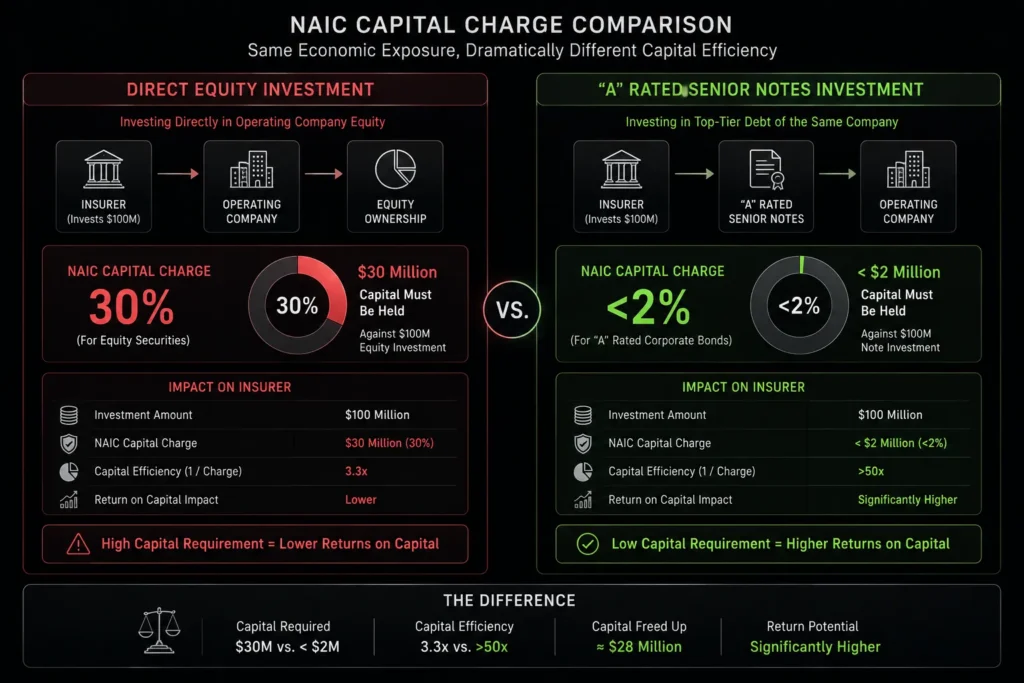
If an insurance company buys $100 million of a standard private equity fund, the NAIC views this as high risk. They may force the insurer to hold $30 million in cash reserves just in case the investment goes bad. This 30% “Risk-Based Capital (RBC) charge” destroys the insurer’s profitability. They want to invest, but the capital penalty is too high.
2. The Insufficiency of Secondary Markets
If a current LP (like a pension fund) wants to sell their private equity stake, they traditionally sell it on the “Secondary Market” at a massive discount to another buyer. But again, insurance companies cannot easily buy these secondary stakes because they are still classified as equity.
3. The Core Mechanism: The SPV and Tranching
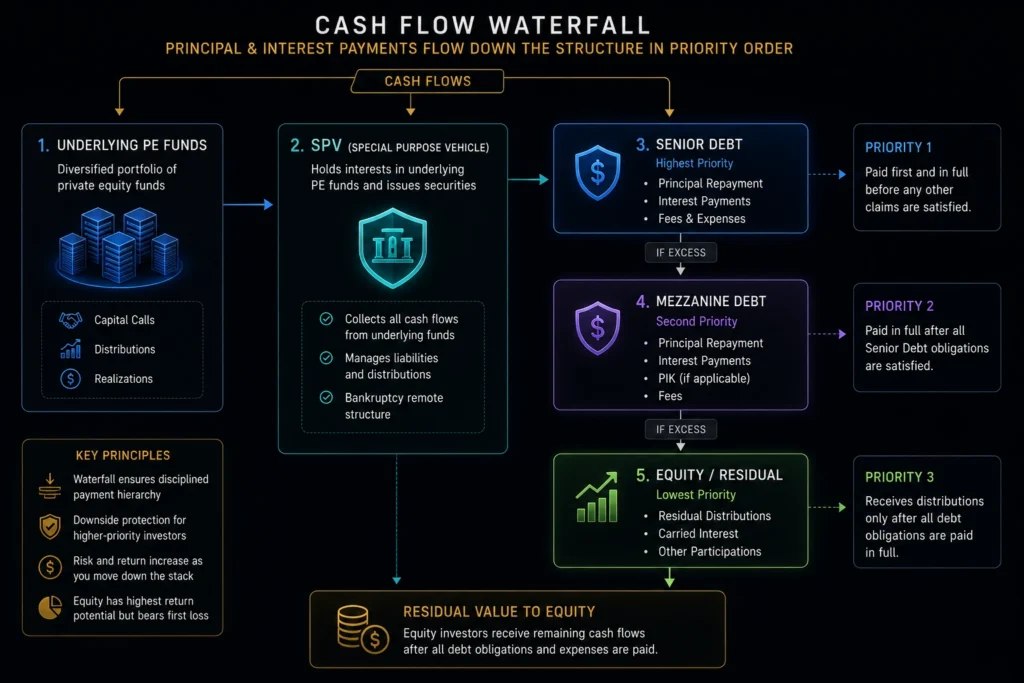
The sponsor establishes a Special Purpose Vehicle (SPV) and transfers a diversified pool of private equity LP stakes into it. The SPV then issues liabilities divided into tranches (slices).
- Senior Debt (e.g., Rated ‘A’): Gets paid first, takes the lowest risk, earns ~6% yield.
- Mezzanine Debt (e.g., Rated ‘BBB’): Gets paid second, takes moderate risk, earns ~9% yield.
- Equity Tranche: Gets paid last, takes the first loss, but earns the massive upside if the funds overperform.
4. Technical Depth: Capital Arbitrage via Rated Notes
When the insurance company buys the Senior Debt tranche of the CFO, the rating agencies grade it an ‘A’. Under NAIC rules, an ‘A’ rated bond might only carry a 1.5% capital charge. The insurer gets access to private market yields but only has to hold a fraction of the cash in reserve compared to buying the fund directly. The underlying economic risk is identical, but the legal classification creates massive capital efficiency.
5. Real-World Consequences: The Cash Flow Waterfall
When the underlying private equity funds successfully sell a company, the cash distribution flows up into the SPV. The SPV’s legal code strictly dictates the “waterfall.” The cash must be used to pay the coupon to the Senior Debt holders first. If there is cash left over, it flows down to the Mezzanine. Only if all debt obligations are met does the Equity tranche receive a payout. If a severe recession hits and the funds stop distributing cash, the Equity tranche gets wiped out completely to protect the Senior bondholders.
Real-World Applications: Rated Note Feeders & CFOs
The CFO architecture is actively being utilized across multiple vectors of the private markets.
Rated Note Feeders (The Capital Call Hack): A major private equity firm launches a new $10 billion fund. An insurance company wants to commit $1 billion. Instead of committing $1 billion in standard equity, the PE firm builds a “Rated Note Feeder” just for them. The insurer commits $200 million as equity and $800 million as a rated loan (debt) to the feeder. When the PE firm issues a capital call, the insurer funds 80% of it by essentially “lending” the money to their own investment, dramatically slashing their regulatory capital requirements from day one.
GP-Led Liquidity Solutions: A General Partner (the PE firm itself) holds a massive balance sheet of their own older funds. To free up cash to launch new products or pay out partners, the GP packages their own GP commitments across ten different vintage funds into a CFO, sells the debt tranches to institutional investors, and retains the equity tranche. This generates immediate, non-dilutive cash without forcing the GP to sell their assets in a distressed secondary market.
Sovereign Wealth De-Risking: Massive sovereign wealth funds in the Middle East and Asia hold hundreds of billions in illiquid private equity. To rebalance their portfolios without triggering a fire sale, they construct massive CFOs. They sell the senior, low-risk debt tranches to global insurers, instantly extracting billions in liquid cash, while retaining the high-yield equity tranche to capture the long-term upside of the portfolio.
Economic & Strategic Impact
The pivot to insurance capital is driving the ultimate consolidation of Wall Street: the Asset Manager-Insurer Nexus.
The demand for highly rated CFOs and private credit has become so insatiable that the largest private equity firms are simply buying the insurance companies.
Apollo Global Management led the charge by aggressively integrating with Athene (a massive life insurance and retirement services company). By owning the insurer, Apollo essentially guarantees a captive buyer for its own structured debt products. The private equity firm originates the complex private credit or CFO, and their affiliated insurance company buys the senior debt tranche. This vertically integrated loop captures fees at every step of the transaction, completely cutting traditional commercial banks out of the global credit supply chain.
Advantages
- Regulatory Arbitrage: Radically reduces Risk-Based Capital (RBC) charges for insurance companies, allowing them to participate in high-yield private markets while maintaining strict compliance.
- Liquidity Extraction: Allows LPs and GPs to extract cash from highly illiquid, 10-year private equity lockups without suffering the punitive discounts found on the secondary market.
- Structural Downside Protection: The tranched waterfall structure ensures that Senior bondholders are shielded from massive market downturns by the thick, loss-absorbing Equity and Mezzanine layers below them.
Limitations
- Lumpy Cash Flows (Duration Risk): Unlike mortgages that pay monthly, private equity only pays when a company is sold. If an economic recession freezes M&A activity, the CFO receives zero cash. The CFO must rely heavily on expensive, pre-funded “liquidity facilities” (revolving credit lines) just to pay the monthly interest to bondholders.
- Valuation Opacity: Rating a CFO requires trusting the Net Asset Value (NAV) of the underlying private equity funds. PE funds use “Mark-to-Model” accounting, which is highly subjective. If the underlying companies are overvalued, the entire debt structure of the CFO is built on a mathematical illusion.
- Regulatory Backlash: The NAIC is acutely aware that Wall Street is using Rated Note Feeders to bypass capital rules. Regulatory bodies are actively proposing new guidelines to aggressively increase the capital charges on CFOs, threatening to close the arbitrage loophole entirely.
Common Misconceptions
Misconception: CFOs are the same thing as CLOs (Collateralized Loan Obligations).
Reality: CLOs pool hundreds of individual corporate loans that pay regular, contractual monthly interest. CFOs pool Limited Partner stakes in entire funds. CFOs are vastly more complex because their cash flows rely on the unpredictable sale of private companies, not contractual loan repayments.
Misconception: The insurance company is buying private equity.
Reality: Economically yes, legally no. The insurance company is buying a fixed-income corporate bond issued by a shell company. They do not get the massive 20% equity returns of the PE fund; they only get the fixed 6% or 7% coupon promised by the bond.
Misconception: If the private equity market crashes, the insurance company goes bankrupt.
Reality: The insurance company only holds the Senior Debt tranche. For the Senior tranche to lose a single dollar, the underlying private equity portfolio would typically have to lose 40% to 50% of its total value to wipe out the Equity and Mezzanine tranches first.
What Most People Miss
The hidden danger of Cross-Collateralized Contagion.
When evaluating the risk of a CFO, rating agencies assume that the 50 different private equity funds inside the pool are diversified (e.g., distinct software, healthcare, and industrial companies).
What most analysts miss is that in the modern private equity ecosystem, these funds often lend to each other, buy companies from each other, and use the exact same subscription lines of credit from the exact same shadow banks. If a systemic liquidity freeze hits the private markets, the “diversified” funds inside the CFO may crash simultaneously because they share the same underlying, hidden leverage. The mathematical diversification that secured the ‘A’ rating is often a mirage masking deep, cross-collateralized systemic risk.
Comparison Table
| Feature | Direct Private Equity Investment | Collateralized Loan Obligation (CLO) | Collateralized Fund Obligation (CFO) |
| Underlying Asset | Direct stake in a PE fund | Pool of syndicated corporate loans | Pool of LP stakes across multiple PE/VC funds |
| Cash Flow Profile | Highly unpredictable (Lumpy) | Highly predictable (Monthly interest) | Highly unpredictable (Requires liquidity facility) |
| NAIC Capital Charge | Punitive (~30% equity charge) | Low (Fixed-income charge) | Low (Fixed-income charge on senior notes) |
| Primary Investor | Pensions, Endowments | Banks, Insurance, Asset Managers | Life Insurance Companies, Sovereign Wealth |
| Return Profile | Infinite upside, total loss risk | Capped yield, tranched protection | Capped yield, tranched protection |
Case Study
Situation: A major global life insurance provider needed to increase the yield of its $50 billion general account to meet long-term payout obligations to policyholders. Traditional government and corporate bonds were yielding too little, but allocating heavily into direct private equity would trigger massive NAIC capital penalties, destroying their balance sheet.
Challenge: How to gain exposure to the superior returns of top-quartile private equity buyout funds without taking on the regulatory burden of holding pure equity.
Solution (The Rated Note Feeder): Instead of committing $500 million directly to the latest mega-cap buyout fund, the insurer and the Private Equity sponsor structured a custom Rated Note Feeder. The feeder was capitalized with $100 million of equity and $400 million of notes rated ‘A-‘ by a recognized rating agency. The insurer purchased the entire structure.
Outcome: When the PE sponsor called capital, the insurer funded it 80% through the debt notes. Under NAIC guidelines, the insurer was permitted to hold vastly lower capital reserves against the $400 million debt portion.
Lessons Learned: The insurer successfully achieved indirect exposure to elite private market assets while preserving regulatory capital. However, the case highlighted that the structure relies entirely on the rating agency’s assessment. If the NAIC alters its guidelines—as they aggressively debated throughout 2024 and 2025—the capital arbitrage driving the entire transaction could be instantly neutralized.
Future Outlook
Next 12–24 Months
The era of NAIC Regulatory Crackdowns. The explosive growth of Rated Note Feeders has alarmed insurance regulators. Over the next two years, the NAIC will finalize stringent rules specifically targeting the securitization of LP interests. Regulators will implement “look-through” provisions, forcing insurers to hold higher capital charges if the underlying collateral is deemed too heavily skewed toward pure equity rather than debt. This will force Wall Street to significantly re-engineer CFO structures, likely increasing the required size of the equity tranches to protect the senior notes.
Next 3–5 Years
The rise of Continuation Fund CFOs. As the IPO market remains unpredictable, private equity firms are increasingly rolling their best assets into “Continuation Funds” to hold them longer. To finance these massive, multi-billion-dollar single-asset or concentrated portfolios, sponsors will construct highly specialized CFOs. Rather than pooling 50 different funds, they will securitize the cash flows of a few elite, mature companies, selling the debt tranches directly to private credit funds and insurers to generate synthetic liquidity without an official exit.
Next 10 Years
The Tokenization of Tranched Alternatives. By the mid-2030s, the manual, bespoke legal structuring of CFOs will be replaced by blockchain tokenization. The underlying LP stakes will be represented by smart contracts on a distributed ledger. The cash flow waterfall will execute automatically and atomically. This will allow the high-yield mezzanine tranches of CFOs to be sold not just to global insurers, but fractionalized and distributed to high-net-worth retail investors via digital wealth management platforms, democratizing access to institutional-grade structured finance.
Most Likely Scenario
Despite aggressive regulatory pushback, the fundamental economic marriage between Private Equity and Life Insurance is permanent. Wall Street will continuously adapt the legal architecture of CFOs to stay one step ahead of NAIC capital rules. As traditional commercial banks permanently retreat from corporate lending, the securitization of private funds will cement alternative asset managers as the undisputed titans of the global credit system.
Key Takeaways
- Collateralized Fund Obligations (CFOs) are financial vehicles that package illiquid private equity fund investments into a pool and issue highly rated, fixed-income bonds against them.
- The primary buyers are life insurance companies, who hold trillions of dollars but are heavily penalized by regulators (NAIC) for holding risky equity.
- By changing the legal wrapper from “equity” to a rated “bond,” Wall Street allows insurers to access private market yields while drastically reducing their mandatory cash reserves (Capital Arbitrage).
- CFOs use a “waterfall” structure: Senior debt gets paid first and is protected by the Mezzanine and Equity tranches, which absorb the first losses if the PE funds fail.
- Because private equity payouts are highly unpredictable, CFOs require massive cash “liquidity facilities” to ensure bondholders receive their monthly interest payments during an M&A drought.
- To secure a captive buyer for these complex products, mega-PE firms (like Apollo and KKR) have directly acquired massive life insurance companies, vertically integrating the shadow banking system.
Glossary
Capital Call: A legal right of a private equity fund to demand that its investors (LPs) provide the capital they committed, usually executed when the fund finds a company to buy.
Collateralized Loan Obligation (CLO): A sibling to the CFO, a CLO pools regular, interest-paying corporate loans and slices them into tranches. It is vastly more predictable than a CFO.
General Partner (GP) / Limited Partner (LP): The GP is the private equity firm that manages the money and buys the companies. The LP is the investor (pension fund, insurance company) who provides the capital.
National Association of Insurance Commissioners (NAIC): The U.S. standard-setting and regulatory support organization that dictates how much cash insurance companies must hold in reserve against their investments.
Rated Note Feeder: A specific type of investment vehicle designed for an individual LP that issues both equity and rated debt to fund capital calls, optimizing the LP’s regulatory capital requirements.
Risk-Based Capital (RBC): A method used to measure the minimum amount of capital appropriate for an insurance company to support its overall business operations in consideration of its size and risk profile.
Structural Subordination: The financial engineering concept where lower tranches of a securitization (Equity) are legally required to absorb losses before the higher tranches (Senior Debt) are affected.
Frequently Asked Questions
Are CFOs the same as the CDOs that caused the 2008 crash?
They use the exact same mathematical structure (tranching and securitization), but the underlying assets are entirely different. CDOs held subprime residential mortgages issued to individual consumers. CFOs hold institutional private equity stakes managed by elite Wall Street firms.
If an insurance company buys a CFO, do they own the underlying companies?
No. The insurance company owns a bond issued by a shell company (the SPV). They have no voting rights, control, or direct ownership of the companies the private equity fund buys.
How do CFOs pay monthly interest if private equity funds only pay out every few years?
This is the hardest engineering challenge of a CFO. They require a “Liquidity Facility”—a massive revolving line of credit from a major bank. If the PE funds don’t distribute cash that month, the CFO draws on the bank line of credit to pay the bondholders their interest, and pays the bank back when a company is eventually sold.
Why are regulators trying to stop this?
Regulators fear “capital arbitrage.” They believe Wall Street is using complex math to disguise high-risk equity as low-risk debt. If a massive recession hits and the PE funds collapse, regulators fear the insurance companies will not have enough cash in reserve to pay out life insurance policies.
Why would a Private Equity firm sell their own funds into a CFO?
To generate liquidity. If a PE firm holds $1 billion of their own money in their own older funds, it is trapped. By packaging it into a CFO and selling the senior debt to insurers, the PE firm instantly gets $700 million in cash today, while still keeping the remaining $300 million equity upside.
Sources
[1] Fitch Ratings: Collateralized Fund Obligations (CFO) Rating Criteria and Methodology (2025/2026 Updates)
[2] National Association of Insurance Commissioners (NAIC): Securitization of LP Interests and RBC Capital Charge Revisions
[3] PitchBook: The Rise of Rated Note Feeders and Private Equity’s Insurance Pivot (Q1 2026 Analysis)
[4] KBRA (Kroll Bond Rating Agency): Private Equity CFOs: Cash Flow Modeling and Liquidity Facility Constraints
[5] Financial Times: Apollo, Athene, and the Asset Manager-Insurer Nexus Rewiring Wall Street