Advertisement
)


Imagine walking into a pawn shop to borrow $50 billion for exactly 12 hours. You hand over a stack of U.S. Treasury bonds as collateral, take the cash, and promise to buy the bonds back the next morning for $50 billion plus a tiny bit of interest. This isn’t a hypothetical scenario—it happens every single afternoon on Wall Street. It is the Repurchase Agreement (Repo) market, a multi-trillion-dollar daily engine that prevents the global banking system from freezing overnight.
But there is a massive logistical nightmare at the heart of this market: how do you physically verify, price, and transfer billions of dollars of complex bonds in milliseconds before the cash moves? You don’t. You hire a specialized, omnipotent middleman. By routing trades through a “tri-party” clearing bank, financial institutions bypass the manual chaos of trading directly with one another. Why should you care right now? Because the interest rate charged in this invisible, overnight pawn shop dictates the Secured Overnight Financing Rate (SOFR)—the foundational number that determines the cost of your corporate debt, your mortgage, and the entire global supply of credit.
What is a Tri-Party Repo?
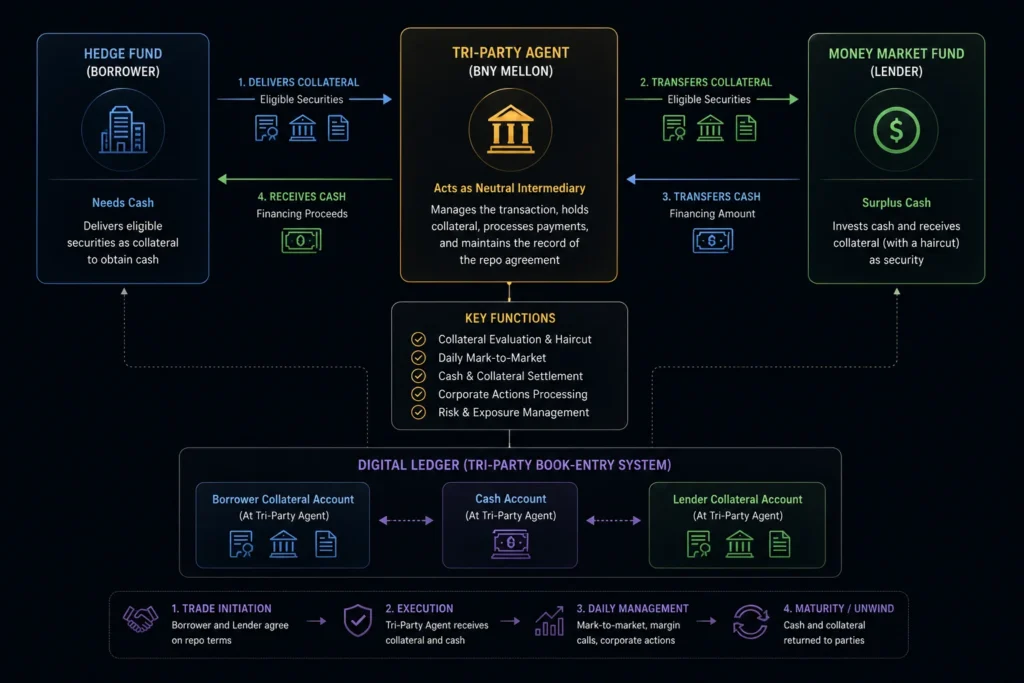
A tri-party repo is a short-term collateralized lending transaction where a third-party clearing bank (the tri-party agent) acts as an intermediary between a cash borrower (e.g., a hedge fund) and a cash lender (e.g., a money market fund). The agent automates the settlement, valuation, and optimization of the collateral.
At a Glance
- Concept: Outsourcing the administrative nightmare of moving billions of dollars of bonds. The clearing bank holds both parties’ accounts and simply updates its internal ledgers to execute the trade.
- Why it matters: It provides the primary safe haven for the world’s cash. Money Market Funds (MMFs) have trillions of dollars that they cannot leave sitting uncollateralized in a bank account. They lend it out overnight via tri-party repos to earn risk-free yield.
- Who uses it:Cash borrowers (Broker-Dealers, Hedge Funds), Cash Lenders (Money Market Funds, Corporate Treasurers, Central Banks), and Tri-Party Agents (BNY Mellon, Euroclear, Clearstream).
- Biggest takeaway: The tri-party agent is an operational middleman, not a risk-taker. If the borrower defaults and goes bankrupt overnight, the clearing bank does not cover the loss; the lender simply seizes the collateral held by the agent.
In Simple Words
If you want to borrow money from a friend to buy a car, you might offer your expensive watch as collateral. If you don’t pay them back, they keep the watch.
But what if you want to borrow money from 50 different friends every single day, and you want to use a constantly changing mix of watches, rings, and necklaces as collateral? Managing who holds what, proving the jewelry is real, and figuring out what happens if the price of gold drops overnight would be a logistical disaster.
This is the Bilateral Repo problem.
To solve it, both you and your 50 friends hire a highly trusted vault manager (the Tri-Party Agent).
You put all your jewelry in the vault. Your friends put all their cash in the vault. You all agree on the rules (e.g., “I will lend $1,000 for every gold watch”). At 4:00 PM, the vault manager’s computer algorithms instantly match the jewelry to the cash, lock the vault, and update everyone’s balances. The next morning, the manager unlocks the vault, returns the jewelry, and gives the cash back to your friends plus interest. No one had to manually inspect a single watch.
Why This Matters
The tri-party repo market is the ultimate transmission mechanism for central bank monetary policy.
When the Federal Reserve wants to raise or lower interest rates, they do not just push a button. They actively participate in the repo market. If the Fed wants to pull cash out of the economy, it executes a “Reverse Repo,” borrowing cash from Money Market Funds and giving them Treasuries as collateral. By draining cash from the system, the remaining cash becomes more scarce, which drives up the overnight interest rate.
For Macro Economists and Corporate Treasurers, monitoring the daily volume and rates of the tri-party repo market is the most accurate real-time indicator of systemic liquidity. If tri-party repo rates suddenly spike, it means lenders are terrified and hoarding cash. It is the definitive early-warning siren of a global financial crisis.
The BNY Mellon Tri-Party Repo Monopoly
The infrastructure of the tri-party market is highly concentrated, functioning effectively as an oligopoly.
In the United States, BNY Mellon is the undisputed titan. For decades, the US market was split between BNY Mellon and JPMorgan Chase. However, recognizing the intense regulatory scrutiny and low margins of the business, JPMorgan exited the US broker-dealer clearing space, leaving BNY Mellon to clear the vast majority of the trillions of dollars in daily US tri-party repo volume.
In Europe, the market is primarily dominated by two International Central Securities Depositories (ICSDs): Euroclear and Clearstream. The European market handles a much wider, fragmented array of collateral (German Bunds, French OATs, Italian BTPs) compared to the US market, which is overwhelmingly dominated by US Treasury securities. This fragmentation forces European tri-party agents to run vastly more complex optimization algorithms to satisfy cross-border regulatory haircuts.
How a Tri-Party Repo Transaction Works
Replacing manual trading with a centralized algorithmic ledger requires strict mathematical rules to protect the lender. Here is the first-principles breakdown.
1. The Fundamental Problem: Bilateral Settlement Risk
In a standard bilateral repo, the borrower must literally transfer the bonds to the lender’s account across the public financial plumbing (like the Fedwire system). If the borrower sends the bonds, but the lender’s system goes offline before sending the cash, the borrower is exposed to massive settlement risk. Furthermore, the lender must manually calculate the value of the bonds every day to ensure they aren’t losing money.
2. The Insufficiency of Central Clearing (Historically)
While central clearinghouses exist, they were historically restricted to major banks. Hedge funds and money market funds could not easily access them. The market needed a flexible middleman that could accommodate thousands of different legal entities with bespoke risk appetites without requiring them to become full members of a clearinghouse.
3. The Core Mechanism: The Single Ledger
The Tri-Party Agent solves this by requiring both the borrower and the lender to open accounts at their bank (e.g., BNY Mellon). When the trade is agreed upon, no assets physically move across the public internet. The agent simply changes the internal digital ledger on its own servers: Debit Borrower’s collateral account -> Credit Lender’s collateral account. Debit Lender’s cash account -> Credit Borrower’s cash account. This internal transfer eliminates settlement failure.
4. Technical Depth: Haircuts and Margining
Because the value of collateral fluctuates, lenders demand a “haircut.” If a hedge fund posts $102 million worth of corporate bonds, the lender might apply a 2% haircut, meaning they will only lend $100 million in cash against it. The tri-party agent’s software calculates these prices continuously. If the value of the corporate bonds drops to $98 million during the day, the tri-party agent automatically issues a “Margin Call,” forcing the hedge fund to instantly deposit $4 million more into the vault to protect the lender.
5. Real-World Consequences: Intraday Substitutions
The most critical feature of a tri-party repo is the ability to substitute collateral. A broker-dealer might use a specific US Treasury bond as collateral on Monday night. On Tuesday at 11:00 AM, a client wants to buy that exact bond. The broker-dealer tells the tri-party agent: “Take that Treasury out of the vault and give it to me, and replace it with an equal value of mortgage-backed securities.” The agent’s algorithm instantly verifies the math, ensures it meets the lender’s risk criteria, and swaps the collateral mid-trade without the lender ever needing to approve it manually.
Who Uses the Tri-Party Repo Market?
The plumbing of the tri-party market facilitates the daily operations of entirely different sectors of the economy.
Money Market Funds (MMFs): An MMF might hold $100 billion of retail investor cash. By law, they cannot take excessive risks, but they must generate a daily yield. MMFs lend billions every afternoon into the tri-party repo market, accepting only Level 1 High-Quality Liquid Assets (HQLA) like US Treasuries as collateral. The tri-party agent ensures the MMF earns its overnight interest with zero operational friction.
Hedge Fund Leverage: A hedge fund wants to buy $500 million worth of bonds, but only has $50 million in cash. They buy $50 million worth of bonds, immediately post them into a tri-party repo vault, borrow $48 million in cash against them, and use that cash to buy more bonds. They repeat this cycle to achieve massive leverage. The tri-party agent manages the labyrinth of haircuts required to keep this highly leveraged house of cards mathematically sound.
Central Bank Operations: The Federal Reserve’s primary tool for controlling the Federal Funds Rate is the Standing Repo Facility (SRF) and the Overnight Reverse Repo Facility (ON RRP). These transactions are settled via tri-party infrastructure, allowing the central bank to inject or drain hundreds of billions of dollars of liquidity into the banking sector seamlessly by 3:00 PM every day.
Economic & Strategic Impact
The transition away from LIBOR (London Interbank Offered Rate) crowned the tri-party repo market as the absolute center of the financial universe.
LIBOR was based on a daily survey of what bankers thought they would charge each other for a loan, which ultimately led to massive fraud and manipulation. To replace it, global regulators adopted the Secured Overnight Financing Rate (SOFR).
SOFR is not a guess; it is a hard, mathematical volume-weighted median of actual, executed tri-party repo transactions backed by US Treasuries. Because SOFR is derived directly from the tri-party clearing data provided by BNY Mellon to the Federal Reserve, the algorithms running inside the tri-party agent’s servers literally dictate the interest rate of trillions of dollars in corporate loans, student loans, and derivatives worldwide.
Advantages
- Operational Efficiency: Eliminates the need for counterparties to build their own massive back-office settlement teams to manually calculate bond prices, process margin calls, and settle cash wires.
- Collateral Optimization: The agent’s software automatically sorts the borrower’s inventory and posts the “cheapest-to-deliver” assets that meet the lender’s criteria, saving the borrower fractions of a basis point that translate to millions of dollars annually.
- Systemic Transparency: Because the vast majority of trades flow through a single clearing bank, central banks have near-perfect, real-time visibility into the health and liquidity of the shadow banking system.
Limitations
- Single Point of Failure: If BNY Mellon’s primary and backup servers suffer a catastrophic failure, the US tri-party repo market halts. Trillions of dollars would freeze, broker-dealers would default, and the global financial system would enter a profound liquidity crisis within hours.
- Fire Sale Risk: The tri-party agent does not take the credit risk. If a massive hedge fund defaults, the lender is left holding the collateral. If multiple lenders panic and try to sell their seized collateral on the open market simultaneously, it can trigger a “fire sale,” crashing bond prices systemically.
- Intraday Credit Reliance: To allow borrowers to substitute collateral during the day, the tri-party agent historically provided massive amounts of “intraday credit”—effectively acting as a temporary, uncollateralized lender for a few hours. Regulators have heavily pressured clearing banks to reduce this practice to lower systemic risk.
Common Misconceptions
Misconception: The tri-party agent guarantees the loan if the borrower goes bankrupt.
Reality: The tri-party agent is a referee, not a guarantor. They provide the vault and do the math. If the borrower defaults, the agent simply unlocks the vault and hands the collateral over to the lender. The lender bears 100% of the default risk.
Misconception: Repo is a shady, unregulated “shadow banking” tool.
Reality: While it exists outside traditional commercial deposit banking, tri-party repo is one of the most heavily scrutinized, regulated, and collateralized markets on Earth. It is the primary tool used by the Federal Reserve itself to manage the US economy.
Misconception: You can use anything as collateral in a tri-party repo.
Reality: While bilateral repos sometimes accept obscure assets, tri-party lenders almost exclusively accept High-Quality Liquid Assets (HQLA) like Sovereign Debt (US Treasuries, German Bunds) or highly rated Agency Mortgage-Backed Securities (MBS) because they must be instantly sellable in the event of a default.
What Most People Miss
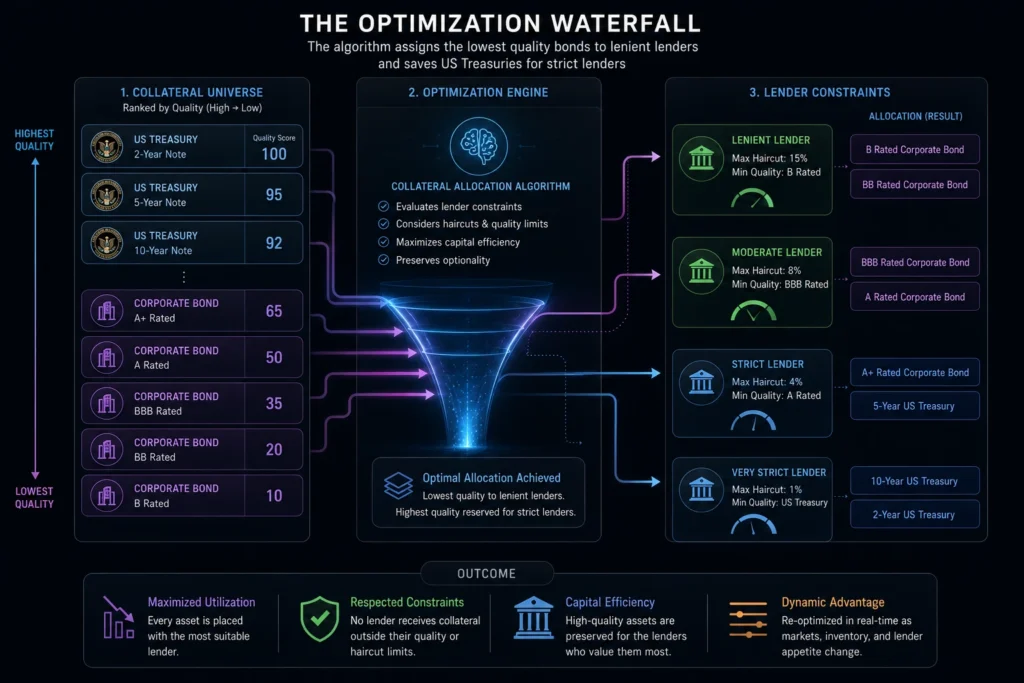
The algorithmic magic of The Optimization Waterfall.
A major global bank holds billions of dollars in US Treasuries, Japanese Government Bonds (JGBs), and Corporate Debt. They need to borrow cash from multiple different lenders. Lender A will accept anything. Lender B will only accept US Treasuries.
What most people miss is how the tri-party agent makes the bank money. The agent’s algorithm executes an “Optimization Waterfall.” It looks at the bank’s entire inventory and automatically assigns the lowest-quality, hardest-to-finance corporate bonds to Lender A, while saving the premium, highly liquid US Treasuries specifically for Lender B. By mathematically prioritizing the cheapest-to-deliver collateral across thousands of trades simultaneously, the algorithm maximizes the bank’s total borrowing capacity without requiring a single human trader to manually sort the bonds.
Comparison Table
| Feature | Bilateral Repo | Tri-Party Repo | FICC Sponsored Repo (Cleared) |
| Middleman | None (Direct peer-to-peer) | Tri-Party Clearing Bank (e.g., BNY Mellon) | Central Counterparty Clearinghouse (CCP) |
| Settlement Admin | Manual by both parties | Automated by Tri-Party Agent | Automated by the CCP |
| Default Risk Bearer | The Lender | The Lender | The Clearinghouse (CCP) |
| Collateral Flexibility | High (Any agreed asset) | Moderate (Agent must be able to price it) | Low (Strictly standardized assets) |
| Primary Advantage | Bespoke, customizable terms | Operational efficiency and optimization | Balance sheet netting (Regulatory capital relief) |
Case Study
Situation: In September 2019, a perfect storm struck the US financial system. Corporate tax payments were due, and a massive settlement of US Treasury debt occurred on the same day. These two events simultaneously drained billions of dollars of cash out of the banking system.
Challenge: Hedge funds and broker-dealers desperately needed cash to fund their daily operations, but Money Market Funds and banks had abruptly stopped lending, fearing they didn’t have enough cash reserves to meet their own regulatory requirements.
Solution (The Repo Spike and Fed Intervention): The shortage of cash relative to the abundance of collateral caused borrowing rates in the tri-party repo market to explode. The overnight rate, which normally hovered around 2%, spiked to nearly 10% intraday. Recognizing that the vital plumbing of Wall Street was seizing up, the Federal Reserve intervened directly into the tri-party market, acting as the “lender of last resort.” The Fed injected hundreds of billions of dollars in cash overnight, accepting Treasuries as collateral via the tri-party infrastructure.
Outcome: The Fed’s intervention successfully stabilized the rate and prevented a broader market crash.
Lessons Learned: The 2019 crisis proved two things. First, the mechanical plumbing of the tri-party agent (BNY Mellon) worked flawlessly; the system didn’t break, the math just priced the scarcity correctly. Second, it proved that the entire global financial system is acutely vulnerable to cash-drain events, cementing the Federal Reserve’s role as a permanent, active participant in the tri-party repo market to guarantee daily liquidity.
Future Outlook
Next 12–24 Months
The era of FICC Sponsored Repo Expansion. Regulators want to move risk off individual balance sheets. We are witnessing a massive migration from standard tri-party repo into “Cleared” or “Sponsored” repo via the Fixed Income Clearing Corporation (FICC). In this model, the FICC steps in to legally guarantee the trade. However, because the FICC still relies on the clearing banks (like BNY Mellon) to actually move the collateral, the tri-party agents will remain the underlying operating system, simply serving a new master.
Next 3–5 Years
The transition to Intraday Repo. Currently, repos are overwhelmingly “overnight” (a 24-hour cycle). But as global markets move toward T+1 (and eventually T+0) instant settlement, institutions will need cash for just a few hours. Tri-party agents will launch algorithmic “Intraday Repo” facilities, allowing a hedge fund to borrow $1 billion at 10:00 AM and repay it at 2:00 PM, utilizing atomic time-stamping to charge interest by the minute rather than by the day.
Next 10 Years
The DLT and Tokenization Pivot. The ultimate evolution of collateral plumbing is Distributed Ledger Technology (DLT). Companies like Broadridge and JPMorgan (via their Onyx platform) are pioneering blockchain-based repo platforms. By tokenizing a US Treasury bond into a digital smart contract, the collateral and the cash can swap simultaneously on a blockchain ledger (Atomic Settlement). By the mid-2030s, this technology will bypass the legacy mainframe servers of traditional tri-party agents entirely, decentralizing the optimization waterfall and eliminating the single-point-of-failure risk that currently haunts Wall Street.
Most Likely Scenario
The tri-party repo market will become even more automated and heavily regulated. While blockchain tokenization represents a massive long-term threat to traditional clearing banks, the sheer multi-trillion-dollar scale and deeply entrenched regulatory trust of institutions like BNY Mellon and Euroclear ensure they will retain their monopoly for the foreseeable decade, acting as the undisputed architects of global liquidity.
Key Takeaways
- A Tri-Party Repo utilizes a clearing bank to sit between a cash borrower and a cash lender to automate the administrative nightmare of transferring collateral.
- The clearing bank (Tri-Party Agent) values the bonds, calculates the “haircut,” manages margin calls, and optimizes the borrower’s inventory, but does not take on the default risk.
- BNY Mellon holds a near-monopoly on US tri-party repo clearing, making its servers one of the most critical single points of failure in global finance.
- Money Market Funds are the primary cash lenders, using tri-party repos to safely park trillions of dollars overnight backed by US Treasuries.
- The tri-party market is the engine of global interest rates; the data generated by these overnight trades dictates the Secured Overnight Financing Rate (SOFR).
- Future innovation in the sector is focused on “Sponsored Repo” clearing and utilizing blockchain (DLT) to achieve instant, intraday “atomic settlement.”
Glossary
Bilateral Repo: A repurchase agreement executed directly between two parties without a clearing bank, requiring manual settlement and collateral valuation.
Cheapest-to-Deliver (CTD): An optimization strategy where an algorithm selects the lowest-quality acceptable asset in a portfolio to use as collateral, saving higher-quality assets for stricter lenders.
Haircut: The difference between the market value of an asset used as loan collateral and the actual amount of the loan. A 2% haircut on $100M of bonds means the lender will only provide $98M in cash.
High-Quality Liquid Assets (HQLA): Premium assets, primarily government sovereign debt (e.g., US Treasuries), that can be sold immediately with minimal loss of value during a financial crisis.
Secured Overnight Financing Rate (SOFR): A broad measure of the cost of borrowing cash overnight collateralized by Treasury securities in the repo market, serving as the benchmark interest rate for global finance.
Standing Repo Facility (SRF): A tool used by the Federal Reserve to lend cash to banks overnight in exchange for Treasuries, ensuring the tri-party market never runs out of liquidity.
Frequently Asked Questions
Does the clearing bank lose money if a hedge fund defaults?
No. The Tri-Party Agent only provides the infrastructure. If the borrower defaults, the agent locks the account and transfers the legal ownership of the collateral to the lender. The lender must then sell the collateral in the open market to recover their cash.
Why don’t lenders just take the collateral directly?
Because moving a billion dollars of complex bonds across the Fedwire system is expensive, prone to manual errors, and administratively exhausting. If the borrower wants to swap a bond halfway through the day, it requires hours of paperwork. The tri-party agent automates all of this instantly on their own internal ledger.
What happens if BNY Mellon’s computers crash?
This is a heavily modeled “black swan” scenario. If the agent goes offline, the daily rollover of trillions of dollars of debt halts. Broker-dealers would suddenly be unable to fund their operations, potentially causing immediate, systemic defaults across Wall Street until the Federal Reserve intervened.
How does this affect normal people?
The interest rates negotiated in the tri-party repo market directly dictate SOFR. SOFR determines the interest rate on everything from corporate loans that fund job creation to adjustable-rate mortgages and auto loans. If the repo market panics, your cost of borrowing rises.
Why did JPMorgan stop clearing tri-party repos?
JPMorgan exited the U.S. broker-dealer tri-party clearing business primarily because of intense regulatory pressure following the 2008 financial crisis, demanding they hold massive amounts of capital against the “intraday credit” they had to extend to facilitate the trades. The low profit margins did not justify the regulatory capital cost.
Sources
[1] Federal Reserve Bank of New York: Tri-Party/GCF Repo Statistics and Market Dynamics (2025/2026 Analysis)
[2] U.S. Securities and Exchange Commission (SEC): BNY Mellon Tri-Party Repo Agent Market Share and Risk Disclosures
[3] International Capital Market Association (ICMA): European Repo Market Survey and Outstanding Value Estimates
[4] Securities Industry and Financial Markets Association (SIFMA): US Repo Statistics and Collateral Types
[5] Securities Finance Times: The European Cleared Triparty Repo Market and Digital Transformation